

Researching a boat’s ownership history starts with one number: the Hull Identification Number, or HIN. This 12-character alphanumeric code, required on all manufactured recreational boats since 1972, is your entry point into every state and federal database that tracks vessel ownership. From there, you pull records from the US Coast Guard’s National Vessel Documentation Center (NVDC) or your state’s registration agency, check for outstanding liens, and verify that every document in the chain tells the same story.
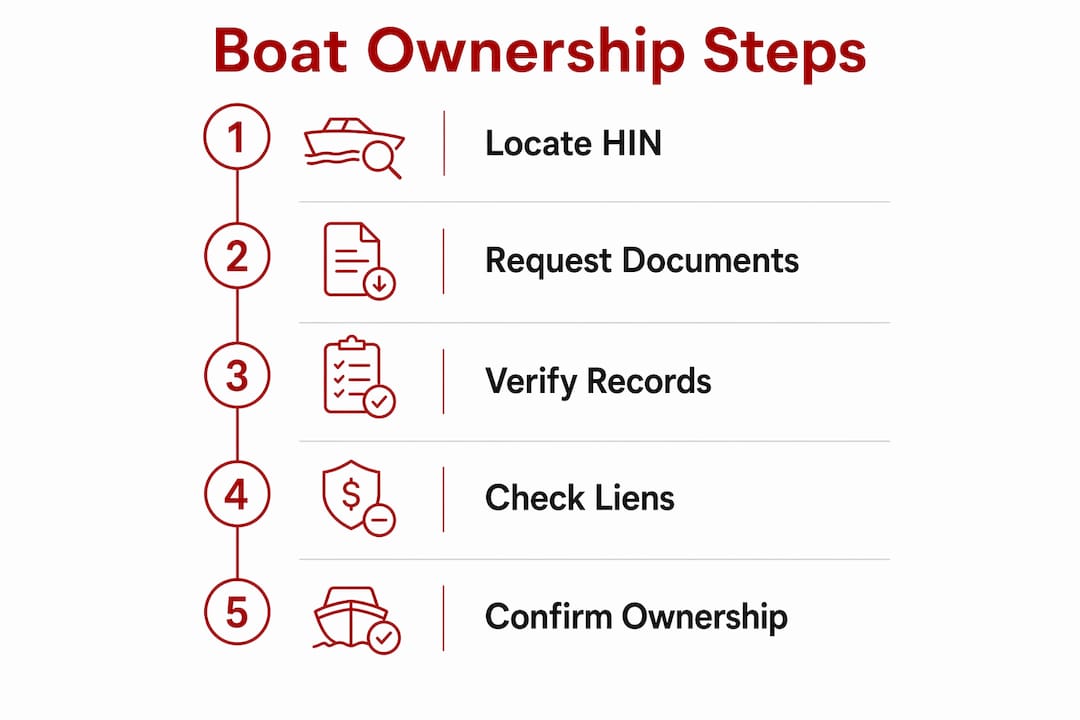
Here is what a thorough ownership history check covers:
- Locate and verify the HIN on the physical hull
- Search state registration databases or the USCG’s CGMIX system
- Request an Abstract of Title or Certificate of Documentation from the NVDC
- Confirm the seller’s name matches the last recorded owner
- Check for liens, mortgages, and legal encumbrances
- Review bills of sale for consistency across all documents
- Flag any gaps in the ownership chain as potential title clouds
How to obtain official boat ownership records
The process splits into two tracks depending on how the vessel is registered. Every motorized boat in the US falls under either state registration or federal documentation. It cannot be in both systems simultaneously.
For state-registered boats, start with the agency that handles vessel records in the state where the boat is primarily operated. That is often the department of motor vehicles, a fish and wildlife agency, or a natural resources department. Some states let you search online; others require a written public records request or a specific form. State record fees typically run $7–$15, though certified copies can cost more. The information returned usually includes the registered owner’s name and address, and sometimes lienholder details.
For federally documented vessels, the USCG’s NVDC maintains all ownership records. The public search tool is the CGMIX Port State Information Exchange, which lets you look up vessels by name, HIN, official number, or call sign. The catch: CGMIX strips personally identifiable information before anything goes public. To get actual owner names, you need to request one of two documents directly from the NVDC:
- Abstract of Title ($25): Shows the complete chain of ownership, all recorded liens and mortgages, and any title encumbrances
- Certified Copy of the Certificate of Documentation ($4): Shows the current managing owner’s name and address
Once you have the documents, cross-check every name, HIN, make, and model across all records. Any inconsistency, even a minor spelling difference, warrants a closer look before you proceed.
Dica de profissional: Before you request any paperwork, physically locate the HIN on the hull. On most boats, it appears on the starboard side of the transom. Verify that number matches what is printed on the title and any bills of sale. If they differ, stop there.
Key documents and identification numbers you need to understand
1. The Hull Identification Number (HIN)
The HIN is a 12-character code stamped directly into the hull. The Coast Guard has required it on all manufactured recreational boats since 1972, which is why pre-1972 vessels can be tricky to trace. Boats built before that date may carry a state-assigned number, a manufacturer’s serial number, or nothing at all. For those older vessels, contact the state registration agency where the boat is located; many states will assign a HIN when an older boat enters their system.

2. Abstract of Title
The Abstract of Title is the most thorough ownership record available for federally documented vessels. Issued by the NVDC, it traces every recorded owner, mortgage, and lien claim back to the vessel’s first registration. What you want to see is a clean chain: Owner A sold to Owner B, Owner B sold to Owner C. A gap in that sequence creates what attorneys call a “cloud” on the title, which can prevent you from documenting the vessel in your name.
3. State titles and registrations
A title proves ownership of the boat itself. A registration authorizes operation on public waters. They are related but legally separate. Some states require both; others rely primarily on registration. Titling requirements vary widely, and the Uniform Certificate of Title Act for Vessels (UCOTA-V) was developed to standardize what appears on a vessel title across states, including lienholder names and damage history. As of 2026, only a handful of states have adopted it, which means buyers cannot rely on a clean title as proof of a clean history.
4. Bills of sale
A bill of sale records the transaction itself: seller and buyer names, HIN, sale price, and date. The seller’s name on the bill of sale must exactly match the last recorded owner on the title or abstract. Missing bills of sale are the most common gap in an ownership chain. If a recent gap exists, the prior owner can often execute a new bill of sale and file it with the NVDC or state agency. If that person is unreachable or deceased, a court order may be required to establish ownership.

5. Certificate of Documentation
For federally documented vessels, the Certificate of Documentation serves as the federal ownership record rather than a state title. It establishes the vessel’s nationality and the managing owner’s identity. Lenders often require federal documentation for preferred mortgage financing on larger boats. You can request a certified copy from the NVDC for $4.
6. Boat history reports
Third-party history reports pull data from insurance records, theft databases, and salvage reports. The National Insurance Crime Bureau offers a free lookup tool called VINCheck, which cross-references a vessel identification number against theft and salvage claims from participating insurers. It has limits: it only covers participating companies, and it will not reveal liens or mechanical damage repaired without an insurance claim. For documented vessels, the Abstract of Title remains the definitive lien source.
7. Common document terms
A few terms appear repeatedly in ownership records and are worth knowing:
- Preferred ship mortgage: A federally recorded lien on a documented vessel, similar to a home mortgage
- Encumbrance: Any financial claim against the vessel, including unpaid repair bills or maritime liens
- Title brand: A notation on a title indicating the vessel was salvaged, damaged, or declared a total loss
- In rem action: A lawsuit filed against the vessel itself rather than a person, used to extinguish disputed liens through a judicial sale
Common legal pitfalls when reviewing a boat’s ownership history
8. Liens follow the boat, not the owner
This is the rule that catches buyers off guard most often. An undisclosed lien means you can inherit financial liability for someone else’s unpaid debt the moment you take possession. For documented vessels, the Abstract of Title is the definitive source for recorded preferred ship mortgages and liens. For state-registered boats, check with the state agency and consider a UCC lien search as well.
9. HIN mismatches signal fraud
A mismatch between the HIN stamped on the hull and the number on the title paperwork is the clearest indicator of fraud or a stolen vessel. Walk away immediately if the numbers do not match exactly. There is no paperwork fix that makes a mismatched HIN acceptable.
10. Seller name discrepancies
The seller’s name must match the last recorded owner on the abstract or title. If it does not, you are dealing with either an unrecorded intermediate sale or something worse. Do not close the deal until the discrepancy is resolved in writing and properly filed with the USCG or state agency.
11. Title washing
Because most states have not adopted UCOTA-V, a boat that suffered major hull damage in one state can be retitled in another state with no damage notation on the new title. A clean title does not mean the boat was never wrecked. If a deal seems too good, request the Abstract of Title for documented vessels, or ask the seller for documentation from every state where the boat has been registered.
12. Gaps in the ownership chain
Every transfer in the ownership history should appear in the record. A gap means someone failed to properly record a sale. That creates a clouded title, which can block you from registering or financing the vessel. Legal remedies for serious encumbrances include in rem actions, where a court orders a judicial sale that extinguishes all prior liens. The process requires US Marshal seizure of the vessel and public notice, so it is expensive and slow, but it produces a completely clean title.
13. Missing bills of sale
A missing bill of sale in the ownership chain is the most common title defect. If the gap is recent and the prior owner is reachable, a new bill of sale can often be executed and filed. For older gaps, a maritime attorney can issue subpoenas and file Freedom of Information requests to reconstruct the chain. Spending money on proper due diligence upfront is almost always cheaper than untangling a title mess after you have already paid.
Dica de profissional: For complex ownership chains or boats that have moved through multiple states, hire a maritime attorney rather than relying solely on a title search service. Attorneys can interpret lien records and identify problems that a standard history report will miss.
Once your ownership research is complete and you are ready to register the vessel, Vesselflag provides international boat registration services across multiple flag jurisdictions, including MMSI setup, insurance coordination, and full compliance support for yacht owners and commercial operators worldwide.
Principais conclusões
A clean boat ownership history requires verifying the HIN on the hull, confirming a complete chain of title through official USCG or state records, and checking for liens before any money changes hands.
| Ponto | Detalhes |
|---|---|
| HIN is your starting point | The 12-character Hull Identification Number, required since 1972, unlocks both state and federal ownership databases. |
| Two record systems exist | State-registered boats use state agencies; federally documented vessels use the NVDC, where an Abstract of Title costs $25. |
| Liens follow the vessel | An undisclosed lien transfers with the boat, making a lien check mandatory before purchase. |
| Document consistency is required | The seller’s name, HIN, make, and model must match across the title, bill of sale, and abstract. |
| Title washing is a real risk | A clean title does not guarantee a clean history; request records from every state where the boat has been registered. |
Perguntas frequentes
How do you look up previous boat owners?
For federally documented vessels, request an Abstract of Title from the USCG’s National Vessel Documentation Center; it shows every recorded owner back to first registration. For state-registered boats, contact the relevant state agency with the HIN or registration number.
Is boat registration a public record?
State registration records are generally public, though the level of detail and access method varies by state. The CGMIX federal database is publicly searchable, but personal ownership details are removed; you must request an Abstract of Title or Certificate of Documentation from the NVDC to get owner names.
What is the best free boat history check?
The National Insurance Crime Bureau’s VINCheck tool is free and cross-references a vessel’s identification number against theft and salvage claims from participating insurers, with up to five searches per day at no cost. It does not cover liens or damage repaired without an insurance claim, so it works best as a first screening step rather than a complete history check.
What should you know about boat ownership before buying?
Confirm the HIN on the hull matches all paperwork, verify there are no outstanding liens through the NVDC or state agency, and check that the seller’s name matches the last recorded owner on the title or abstract. Any gap in the ownership chain or document inconsistency should be resolved before you hand over payment.