

How vessel age impacts registration eligibility and classification in the United States
Vessel age is one of the most consequential factors in the U.S. vessel registration process. The core rule is straightforward: the older a vessel, the more scrutiny it faces, and past certain thresholds, registration can be refused outright. Understanding where those thresholds fall, and what they trigger, is what separates a smooth registration from a costly surprise.
The 20-year mark is the critical inflection point recognized across U.S. and international maritime regulation. Research published in the International Journal of Occupational Safety and Health identified 20 years as the age at which hull failure probability and serious casualties trend sharply upward. Registries respond accordingly, with some refusing vessels beyond that age entirely and others layering on mandatory surveys, elevated fees, and classification requirements.
Here is what vessel age directly determines in the registration context:
- Registration eligibility: Some registries, including the British Virgin Islands, will not accept vessels over 20 years old at all.
- Classification tier: Vessels aged 15–20 years typically require CAP 1 (hull) and CAP 2 (machinery) ratings from a recognized classification society before a registry will accept them.
- Inspection frequency: Age triggers mandatory pre-registration surveys and shortens the interval between renewal inspections.
- Fee structure: Older vessels often face higher registration fees and may incur additional survey costs that younger vessels avoid.
- Special statutory exceptions: Florida Statutes Section 328.72 carves out a specific provision for recreational vessels 30 years or older that retain their original powerplant, allowing registration under special rates.
- Insurance eligibility: Underwriters apply stricter terms and higher premiums as vessels age, which can affect whether a registration-linked insurance requirement can be met.
What U.S. law and international standards say about vessel age thresholds
The clearest domestic example of age-based registration law is Florida Statutes Section 328.72, which explicitly addresses recreational vessels that are at least 30 years old and have retained their original powerplant. Those vessels qualify for special registration provisions, including adjusted classification and fee rates. The statute acknowledges that age alone does not disqualify a vessel, but it does change the rules that apply.

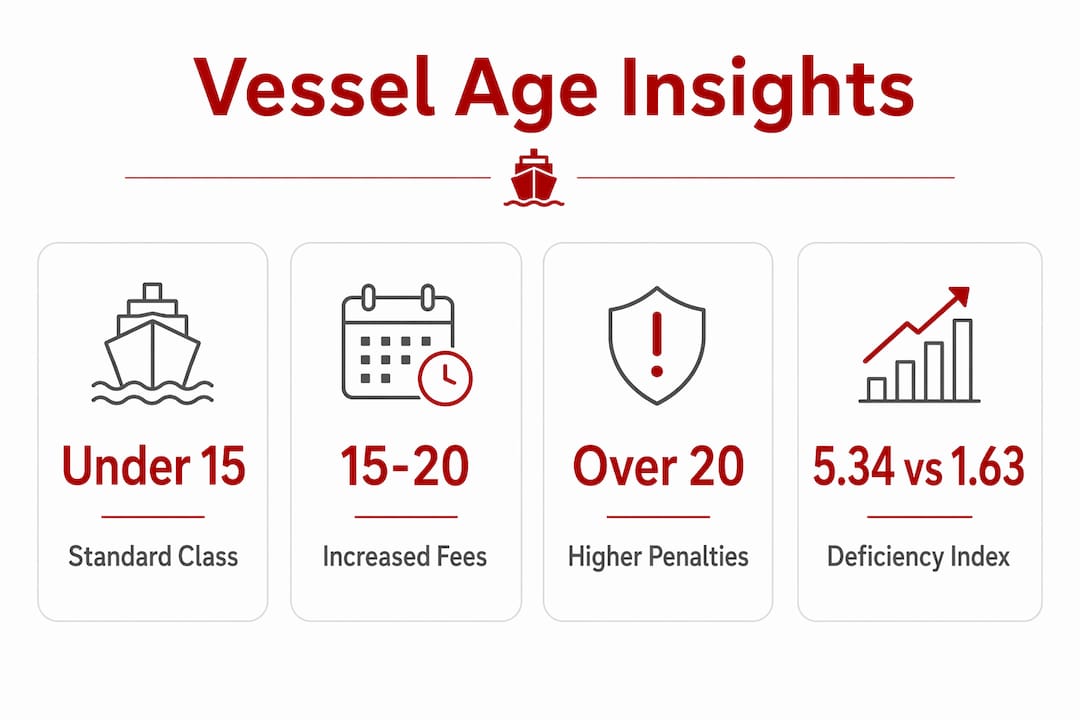
Internationally, the British Virgin Islands registry states plainly that it does not register vessels over 20 years old, alongside vessels it considers unsafe or a pollution risk. That hard cutoff reflects a broader regulatory consensus. India’s DGS Order No. 01 of 2026 sets similar age-based thresholds: vessels under 15 years need standard IACS classification, those aged 15–20 years must hold CAP 1 and CAP 2 ratings, and vessels above 20 years may be disqualified from registry entry entirely.
Age is calculated from the vessel’s Date of Delivery as stated on the Cargo Ship Safety Construction Certificate or equivalent statutory document. That single date drives every compliance cutoff and inspection schedule tied to vessel age.
| Vessel Age | Classification Requirement | Registration Status |
|---|---|---|
| Under 15 years | Standard IACS classification | Routine registration |
| 15–20 years | CAP 1 (hull) + CAP 2 (machinery) ratings required | Conditional registration |
| Over 20 years | Full survey; registry may refuse | High scrutiny or refusal |
| 30+ years (recreational, FL) | Special provisions under Florida Statutes 328.72 | Eligible under special rates |
Key regulatory fact: Vessels over 20 years old show a Deficiency Index of 5.34 compared to 1.63 for younger vessels, and only 12.5% of vessels over 20 years old have zero deficiencies. That data is what drives the hard cutoffs regulators impose.
The distinction between recreational and commercial vessels matters here. Commercial vessels face stricter age-based rules across the board. A recreational vessel aged 30+ years may qualify for a special Florida registration category; a commercial vessel of the same age would face far more demanding survey and classification requirements, and many registries would decline it outright.
How vessel age drives registration fees, penalties, and inspection schedules
Older vessels cost more to keep registered, and the cost curve accelerates past 15 years. Fee structures in most U.S. state registries are not purely age-based, but the mandatory surveys and condition assessments that older vessels must pass add direct costs to the registration process. Fail a survey, and you either pay for remediation or lose registration eligibility.

The inspection picture tightened further when Rightship revised its vessel inspection age trigger from 14 years down to 10 years in a phased approach. That shift means vessels now enter heightened inspection regimes earlier in their operational life, with more frequent checks as they age past that threshold.
Key fee and penalty categories tied to vessel age:
- Survey fees: Pre-registration condition surveys for vessels over 15 years, required by classification societies and some state agencies.
- Renewal inspection costs: Shorter renewal cycles for older vessels mean more frequent survey expenses.
- Late registration penalties: Failure to maintain current registration on an aging vessel can trigger fines; in North Carolina, for example, operating an unregistered vessel carries a fine.
- Remediation costs: If a vessel fails an age-triggered inspection, owners must fund repairs before registration proceeds.
- Classification upgrade fees: Moving from standard classification to CAP 1/CAP 2 status involves additional surveyor fees and documentation costs.
Inspection reality check: Only 12.5% of vessels over 20 years old have zero deficiencies, according to DGS Order 01 of 2026 data, which explains why regulators treat the 20-year threshold as a hard line rather than a soft guideline.
State-level penalties vary. Florida’s registration statute ties penalties to failure to comply with registration requirements, not specifically to vessel age, but an aging vessel that fails a mandatory survey and continues operating unregistered faces compounding liability. The registration requirements for vessels in 2026 reflect this tightening environment.
How classification societies and market forces respond to vessel age
Classification societies are the enforcement layer between a vessel’s physical condition and its legal registration status. Organizations like the American Bureau of Shipping (ABS) apply age-based survey programs that determine whether a vessel can hold a valid class certificate, which many registries require as a condition of registration. The Condition Assessment Program (CAP) is the primary tool for aging vessels, assigning ratings to hull and machinery that directly affect registry acceptance.
CAP ratings work on a tiered scale. A CAP 1 rating signals that hull or machinery condition is close to new-build standard. CAP 2 indicates acceptable condition with some wear. Vessels that cannot achieve at least CAP 2 face registration barriers, and those that drop below the threshold mid-registration period can lose their class certificate, triggering a registration lapse. Understanding yacht classification societies and how they apply these ratings is worth the time for any owner of a vessel approaching the 15-year mark.
The market consequences compound the regulatory ones:
- Depreciation: Market value drops as vessels age past 15–20 years, partly because buyers price in the higher survey and compliance costs.
- Insurance premiums: Underwriters raise premiums as vessels age, reflecting the increased risk profile that classification data confirms.
- Financing difficulty: Lenders often apply their own age limits, making it harder to finance older vessels and reducing the buyer pool.
- Resale value: A vessel with a current CAP rating and clean survey history commands a measurably better price than one with gaps in its classification record.
- Registration continuity: A lapsed class certificate can break registration continuity, requiring a full re-registration process rather than a simple renewal.
Consejo de experto: Thorough maintenance logs are one of the few tools that can shift a registry’s or insurer’s assessment of an aging vessel. Regulators increasingly weigh documented maintenance history alongside fixed age thresholds. A vessel with complete maintenance records can sometimes qualify for registration categories that its age alone would otherwise block.
Maritime regulators are moving toward performance-based assessments rather than pure age cutoffs, but that shift is gradual. For now, the CAP rating and survey record remain the primary levers an owner can pull to offset the registration disadvantages of an older vessel.
How vessel age complicates transfer and resale registration
Buying or selling an older vessel introduces a registration layer that many owners underestimate. When a vessel changes hands, the new owner typically must re-register it, and that process triggers a fresh eligibility assessment based on the vessel’s current age and condition. A vessel that was grandfathered under a previous owner’s registration may not qualify under the same terms for the new owner.
The 20-year threshold is particularly sharp in transfer scenarios. A vessel that was registered just before crossing the 20-year mark may face outright refusal when the new owner applies for registration after the birthday passes. Some registries apply the age test at the time of the transfer application, not at the time of the original registration. That timing gap catches buyers off guard, especially in private sales where the seller’s registration status looks current.
Survey requirements at transfer are also more demanding for older vessels. Most registries require a pre-purchase or pre-registration survey for vessels over a certain age, and the cost and outcome of that survey fall on the buyer. A failed survey does not just delay registration; it can unwind a sale entirely if the buyer’s financing or insurance is contingent on registration approval.
For commercial vessel transfers, the stakes are higher. Commercial registries often require proof of classification society membership and a current class certificate as part of the transfer documentation. If the vessel’s class has lapsed, the buyer must reinstate it before registration proceeds, which can take weeks and cost considerably more than a standard renewal. The commercial vessel registration process in 2026 reflects these added layers for aging tonnage.
Sellers benefit from addressing age-related compliance before listing. A vessel with a current survey, valid class certificate, and clean maintenance history sells faster and at a better price, because the buyer’s registration path is clear from day one.
Federal vs. state registration: how vessel age plays out differently
The U.S. runs two parallel registration systems, and vessel age interacts with each one differently. Federal documentation through the U.S. Coast Guard National Vessel Documentation Center (NVDC) covers vessels of five net tons or more used in coastwise trade, fishing, or recreation on navigable waters. State registration covers most recreational vessels, particularly those under the federal tonnage threshold.
Federal documentation does not impose a hard age cutoff the way some international registries do, but it does require that the vessel be in compliance with applicable safety standards. An older vessel that cannot pass a Coast Guard safety inspection will not maintain valid federal documentation. The NVDC also requires that the vessel be owned by a U.S. citizen, which is a separate eligibility filter that age does not affect.
State registration rules vary considerably. Florida’s system, governed by Chapter 328 of the Florida Statutes, includes the age-specific provision for 30-year-old recreational vessels noted earlier. Other states apply their own fee schedules and inspection requirements, some of which scale with vessel age. California’s DMV handles boat registration and applies fees based on vessel value rather than age directly, but older vessels with lower assessed values may actually see lower fees, a counterintuitive outcome compared to the commercial sector.
The key practical difference: federal documentation tends to be more relevant for commercial operators and larger recreational vessels crossing state lines or operating internationally, while state registration governs day-to-day recreational use. An owner who federally documents a vessel is generally exempt from state registration in their home state, but must still comply with state numbering and display requirements in some jurisdictions.
Age-related inspection requirements also diverge. The Coast Guard’s Commercial Vessel Compliance program applies rigorous age-sensitive inspection standards to commercial vessels, while recreational vessels under state registration face lighter inspection regimes unless they trigger specific safety concerns. That gap means a 25-year-old recreational vessel in Florida may face fewer formal barriers than a 25-year-old commercial tug seeking federal documentation renewal.
Vessel age and registration: getting expert help when it matters
Navigating age-related registration rules across multiple jurisdictions is genuinely complex, especially when a vessel is approaching a threshold or changing hands. Vesselflag specializes in exactly this kind of compliance work, handling matriculación de yates y embarcaciones across international flags including San Marino, Malta, UK Part 1, and others, with full attention to age-based eligibility requirements.

Whether you are registering a vessel for the first time, managing a transfer, or trying to maintain registration continuity on an aging hull, Vesselflag’s team works through the documentation, survey coordination, and flag-state requirements so you do not have to. Visit Vessel Flag to find the right registration path for your vessel’s age and type.
Principales conclusiones
Vessel age is the single most consequential eligibility factor in U.S. and international registration, with the 20-year threshold triggering the sharpest regulatory consequences across fees, surveys, and classification requirements.
| Punto | Detalles |
|---|---|
| The 20-year threshold | Vessels over 20 years show a Deficiency Index of 5.34 vs. 1.63 for younger vessels, and only 12.5% have zero deficiencies; many registries refuse them outright. |
| CAP ratings at 15 years | Vessels aged 15–20 years must hold CAP 1 (hull) and CAP 2 (machinery) ratings to qualify for conditional registration. |
| Florida’s 30-year exception | Florida Statutes Section 328.72 allows recreational vessels 30+ years old with original powerplant to register under special provisions. |
| Transfer triggers fresh review | Buying an older vessel resets the eligibility assessment; a vessel grandfathered under a prior owner may not qualify for the new owner. |
| Maintenance records matter | Documented maintenance history can offset age-based registration barriers, as regulators increasingly weigh condition alongside fixed thresholds. |
Preguntas frecuentes
Does a boat’s age affect whether it can be registered?
Yes, directly. Most registries apply stricter requirements as vessels age, and some, like the British Virgin Islands, refuse vessels over 20 years old entirely. U.S. state registries vary, but older vessels typically face mandatory surveys and higher fees.
Is a vessel number the same as a VIN number?
No. A vessel registration number is issued by a state agency or federal documentation authority and identifies the vessel for regulatory purposes. A VIN (Vehicle Identification Number) is a standardized automotive identifier; vessels use Hull Identification Numbers (HINs) instead, which serve a similar traceability function but follow a different format.
How is vessel age calculated for registration purposes?
Age is calculated from the vessel’s Date of Delivery as recorded on the Cargo Ship Safety Construction Certificate or equivalent statutory document. That date sets every compliance cutoff and inspection deadline tied to vessel age.
Do recreational and commercial vessels face the same age-based registration rules?
No. Commercial vessels face stricter age thresholds and more demanding survey requirements across the board. Florida Statutes Section 328.72, for example, provides a special registration category for recreational vessels 30 years or older, a provision that does not extend to commercial use.
What happens to registration when an older vessel is sold?
The new owner must apply for registration, which triggers a fresh eligibility assessment based on the vessel’s current age and condition. A vessel that was registered under a prior owner may not qualify under the same terms if it has crossed a key age threshold since the original registration was issued.