

En resumen:
- Palau operates an open ship registry allowing foreign-owned vessels to fly its flag without economic ties to the country. Registry services have remained uninterrupted since December 2025, governed by international maritime standards and compliance obligations under UNCLOS Article 94. The registration process is swift, flexible, and accepts corporate ownership, making Palau an attractive option for vessel operators seeking global recognition and broad eligibility.
Palau vessel registration is one of those topics where the basic question, what is Palau registration, quickly leads to a more complex picture than most owners expect. Palau operates as an open ship registry, meaning foreign-owned vessels can fly the Palauan flag without any economic connection to the country. Since December 2025, Palau’s Bureau of Marine Transportation has maintained uninterrupted registry services in full compliance with international standards. Whether you operate a yacht, a commercial vessel, or a charter boat, understanding how this registry works and what it demands from you is the foundation of legal maritime operations.
Índice
- Puntos clave
- Why Palau vessel registration is worth considering
- The Palau registration process step by step
- Palau’s regulatory environment and compliance risks
- How Palau compares to other international registries
- Keeping your registration valid through 2026
- My honest take on Palau registration in 2026
- Ready to register your vessel under the Palau flag?
- Preguntas frecuentes
Puntos clave
| Punto | Detalles |
|---|---|
| Open registry model | Palau allows foreign-owned vessels to register without requiring economic ties to the country. |
| Governance is stable | Registry services have continued without interruption since the December 2025 management transition. |
| Compliance is mandatory | Palau adheres to UNCLOS Article 94, meaning flag state oversight obligations apply regardless of vessel origin. |
| Older vessels face extra steps | Yachts over 20 years old may require a pre-registration inspection before eligibility is confirmed. |
| Verify documents actively | Use QR code and online checks to confirm your registration documents remain valid after governance transitions. |
Why Palau vessel registration is worth considering
Palau’s registry has grown steadily as a recognized option for both pleasure and commercial vessel operators worldwide. As an open registry model, it extends eligibility to virtually any foreign-owned vessel, regardless of the owner’s nationality or physical ties to the Pacific island nation. That flexibility alone sets it apart from closed registries tied to national fleets.
Here is what makes the Palauan flag worth a close look:
- International recognition. Palau’s registry is recognized under international maritime law, giving your vessel legal standing in ports worldwide.
- Broad vessel eligibility. The registry accepts yachts and commercial vessels of unlimited tonnage, though vessels over 20 years old may need a pre-registration inspection.
- Speed and accessibility. The Palau registration process is designed to move quickly once documents are in order, making it attractive for operators who cannot afford long waiting periods.
- Legal framework backed by amendments. Recent amendments to Palau’s Maritime and Admiralty Act have strengthened governance and assured owners of stable, continuous service despite management changes.
- Corporate ownership accepted. Vessels owned by offshore companies can register under the Palau flag, which suits structured yacht ownership arrangements.
Consejo de experto: If you own a yacht through a corporate entity, confirm upfront that your corporate structure meets Palau’s ownership documentation requirements. This saves significant back-and-forth during the application stage.
What is Palau flag registration, in practical terms? It is your vessel’s legal identity under Palauan jurisdiction. That identity governs which port state control authorities inspect your ship, which labor and safety conventions apply, and how disputes are adjudicated at sea.
The Palau registration process step by step
Getting registered under the Palau flag involves more than filling out a form. Here is the structured path from eligibility to certificate in hand.
Confirm vessel eligibility. Check the vessel’s age, tonnage, and type. Commercial vessels of unlimited gross tonnage qualify. Yachts are broadly eligible, though those over 20 years old may face inspection requirements before the application proceeds.
Gather ownership documentation. You will need proof of ownership such as a bill of sale, builder’s certificate, or prior registry deletion certificate. For corporate-owned vessels, corporate documents including articles of incorporation and a certificate of good standing are required.
Prepare vessel technical documents. This includes the vessel’s measurement certificate, safety equipment certificates, and any applicable classification society documents. Ensuring these are current before applying avoids processing delays.
Submit the application to the Bureau of Marine Transportation. Palau’s Bureau of Marine Transportation remains the governing authority. Applications go through the official registry channels, now managed directly by the bureau following the 2025 governance transition.
Pay registration fees. Palau registration fees are calculated based on vessel tonnage and type. Commercial vessels and yachts have separate fee schedules. Confirming the current fee structure directly with the registry or through a professional service avoids surprises.
Receive your certificate of registry. Once documents are verified and fees are paid, your provisional and then permanent certificate of registry is issued. This document is what port authorities will check.
Verify your documents using QR or online tools. After issuance, verify document validity using the registry’s online or QR code check system. This is especially important after governance transitions, as port state authorities and insurers will run these checks themselves.
For a thorough breakdown of what this looks like for commercial operators specifically, the commercial vessel registration guide from Vesselflag walks through every stage with jurisdiction-specific detail.
Consejo de experto: Request a provisional certificate of registry immediately upon approval. This gives your vessel legal authorization to operate while the permanent certificate is processed, avoiding any gap in compliance.
Palau’s regulatory environment and compliance risks
This is the section most guides skip, and it is the one that matters most to experienced operators. Understanding what is Palau yacht registry means also understanding what the flag state is responsible for, and where the risks lie.
Palau operates as an open registry, meaning it extends its flag to vessels with no physical or economic link to the country. That convenience comes with a serious obligation. Under UNCLOS Article 94, every flag state must effectively control the ships flying its flag. Safety, crew standards, and environmental compliance all fall under flag state jurisdiction, regardless of where the owner lives.
Here is the context every prospective registrant should understand:
- Past blacklisting. The Palau flag was blacklisted by the Paris MoU in 2017 due to safety and labor record concerns. This history is a fact, not a deal-breaker, but it demands that you treat compliance seriously.
- Active reform. Palau’s government has pledged to clean up past oversight failures and is actively restructuring the registry’s governance model, including the presidential appointment authority for contracted registry managers. This is a positive sign of institutional commitment.
- Verification is your responsibility too. Open registries can offer flexibility and economic advantages, but they impose regulatory challenges that owners must actively manage to avoid reputational and operational risks.
- Port state control scrutiny. Vessels flagged in registries with a history of safety issues face higher inspection rates at major ports. Plan for this and keep your compliance documentation flawless.
“Professional vessel operators plan for a transitional period around registry governance changes, ensuring that all operational documents remain accepted by charterers, insurers, and port state control by using registry verification mechanisms.”
The governance transition completed in late 2025 brings cleaner oversight, but it also means owners should double-check that any documents issued during the transition period are formally recognized by the current bureau.
How Palau compares to other international registries

Choosing a flag involves trade-offs. Here is how Palau stacks up against three other commonly used open and international registries.
| Característica | Palau | Islas Marshall | Malta | Panamá |
|---|---|---|---|---|
| Registry type | Open | Open | EU-flagged | Open |
| Vessel eligibility | All types, unlimited tonnage | All types, unlimited tonnage | All types, EU compliance | All types, unlimited tonnage |
| Yacht-specific support | Strong | Strong | Moderado | Moderado |
| Regulatory reputation | Improving post-2025 | Strong | Strong (Paris MoU white list) | Variable |
| Processing speed | Rápido | Rápido | Moderado | Rápido |
| EU port access benefits | No | No | Sí | No |
| Fee structure | Competitive | Competitive | Higher | Competitive |
Palau’s main competitive strength is speed combined with an improving governance record. For yacht owners who do not require EU port benefits and want quick, cost-effective registration with broad eligibility, Palau is a strong fit. Malta wins on regulatory reputation and EU access, but comes with higher fees and longer processing timelines. For a broader comparison of your options, the vessel registration process guide at Vesselflag covers key jurisdictions side by side.
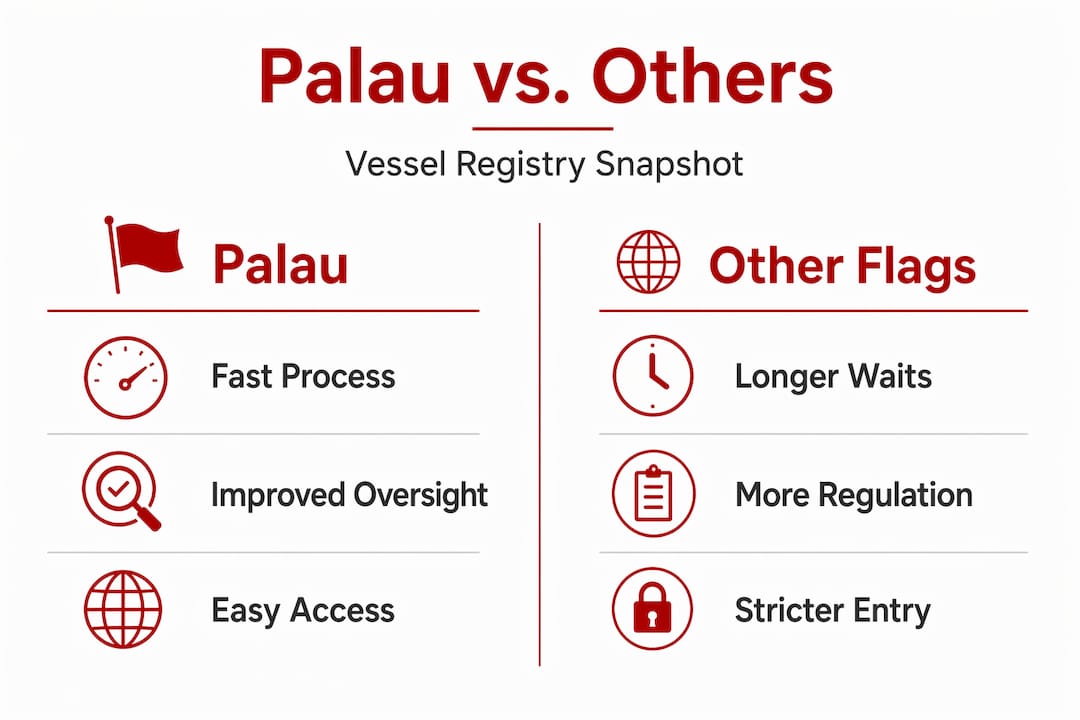
Where Palau is less suitable: if your vessel operates heavily in Paris MoU port state control zones and needs a flag with an unblemished recent history, a white-listed registry may serve you better until Palau’s reform record matures further.
Keeping your registration valid through 2026
Registering is the starting point, not the finish line. Here is how to stay compliant and avoid disruptions during the current governance transition period.
- Set renewal reminders well in advance. Palau registration certificates are time-limited. Missing a renewal deadline can void your documentation mid-voyage, creating real operational and legal problems.
- Monitor official registry communications. Given the 2025 governance transition, stay subscribed to official bureau announcements. Changes in fees, documentation requirements, or contact points can affect your standing.
- Use the QR verification tool after any document issuance. Whether it is a new certificate or an amended one, run the QR or online verification before your next port call. Charterers and insurers will do this regardless.
- Work with a registration professional for renewals. En vessel registration checklist from Vesselflag is a practical tool for yacht owners who want to track what needs renewing and when.
- Keep deletion certificates if changing flags. If you ever move to a different registry, you will need a formal deletion certificate from the Palau bureau. Request this proactively to avoid delays in your next registration.
Consejo de experto: Scan and store all your original registration documents in a cloud-based system accessible to your captain and manager. In the event of an audit at sea, having digital backups means you are never caught without proof of compliance.
My honest take on Palau registration in 2026
I’ve worked with vessel owners across dozens of jurisdictions, and Palau is one of the registries where I see the most confusion. People either dismiss it because of the 2017 Paris MoU blacklisting or embrace it without understanding what the flag state actually requires from them. Both approaches lead to problems.
My experience tells me that the 2025 governance transition is genuinely significant. The bureau’s direct management of the registry, backed by legislative amendments, is a structural improvement, not just a press release. Owners who register now are entering a more accountable system than what existed three years ago.
What I’ve learned from working through governance transition periods in multiple registries is this: documentation verification cannot be reactive. The operators who run into port state control issues are almost always the ones who assumed their documents were fine because they were issued correctly. Run the QR check. Confirm with your insurer. Do not assume continuity without verification.
Palau registration makes real sense for the right vessel and the right owner. It is not the registry for someone who wants the cleanest possible flag reputation with zero scrutiny. But for a yacht owner who needs fast, flexible, internationally recognized registration and is prepared to stay on top of compliance actively, it delivers exactly what it promises.
— VesselFlag
Ready to register your vessel under the Palau flag?
Palau boat registration involves more moving parts than most owners realize, from eligibility checks to governance-aware document verification. Vesselflag specializes in getting it right the first time.
Vesselflag handles the full Palau registration process on your behalf, including document preparation, fee calculation, submission to the Bureau of Marine Transportation, and post-issuance verification. Whether you are registering a yacht or a commercial vessel, the team at Vesselflag has the current knowledge to keep your registration compliant through 2026 and beyond. Start with the Palau boat registration page for a full overview of services, fees, and timelines, or explore all opciones de registro de banderas to compare jurisdictions before committing.
Preguntas frecuentes
What is Palau registration for vessels?
Palau vessel registration is the process of officially flagging a boat or ship under Palauan jurisdiction through the Bureau of Marine Transportation, granting the vessel legal identity and the right to fly the Palau flag internationally.
What documents are required for Palau registration?
Key requirements include proof of ownership (bill of sale or builder’s certificate), a prior registry deletion certificate if applicable, vessel measurement and safety certificates, and corporate documents if the vessel is company-owned.
Is the Palau flag registration safe to use after the 2025 transition?
Yes. Registry services have continued without interruption since the December 2025 governance change, and recent legislative amendments have strengthened oversight, though owners should actively verify all issued documents.
How long does the Palau registration process take?
Palau registration is generally fast compared to many international registries, with provisional certificates issued quickly once complete documentation and fees are submitted.
Can a foreign-owned yacht register under the Palau flag?
Yes. Palau operates as an open registry, meaning foreign nationals and offshore corporate entities can register vessels without any economic connection to Palau, subject to meeting documentation and compliance requirements.