
A complete application for Polish yacht registration should be decided within 30 days, and a certificate of submission lets you operate while the file is processed. In practice, the time you lose is rarely in the registry. It goes on missing documents, translations and a registration document that has to be collected in person. At Vessel Flag we prepare and file Polish applications from €320, one-off, so that the file reaches the authority complete the first time. The registry, not us, issues the documents.
TL;DR
- The legal benchmark is 30 días from a complete application to entry in the Polish register, according to the Polish Yachting Association’s guidance.
- A certificate of submission is issued once the authority has checked the file is complete. Our Polish provisional papers typically take 2 to 5 days.
- Delays come from incomplete files, uncertified translations, powers of attorney and the SIS (Schengen Information System) check on the vessel.
- A Polish MMSI radio licence takes 4 to 6 weeks after registration, so start the radio paperwork as soon as the flag is secured.
- Foreign owners without a Polish PESEL number (the national ID number) or a Polish business must apply through an agent.
Índice
- How long Polish yacht registration really takes
- Who can apply, and why it affects timing
- Documents: the main factor in how long it takes
- The step-by-step process
- What causes delays, and how to avoid them
- The MMSI radio licence: the timing owners forget
- Poland compared with other flags on time
- Poland registration with Vessel Flag
- Our view on timing
- Preguntas frecuentes
- Fuentes
How long Polish yacht registration really takes
There are three clocks running, and owners often confuse them.
- Preparing the file. This is in your hands. It depends on how quickly you can produce proof of ownership, identity or company documents, and any translations.
- Provisional status. Once the authority confirms that the application is complete, it issues a certificate of submission. Under the 2020 ministerial regulation, that certificate may be used until the registration document is issued or a refusal is delivered, and this should happen within 30 days of submitting a complete application. For Polish provisional papers, our own timeframe is 2 to 5 days.
- Entry in the register. After verification in the Schengen Information System, the watercraft is entered in the register. The same PYA page puts this at within 30 days of filing a complete application.
So the honest answer to “how long” is: up to a month from a complete file, with provisional papers available well before that. The word “complete” matters most in that sentence. A file with one missing page does not run on a 30-day clock at all, because the case can be left unprocessed.
A realistic timeline
| Stage | What happens | Typical time |
|---|---|---|
| Document gathering | Ownership proof, ID or company extract, translations | Depends on you; days to weeks |
| Application check | Authority confirms the file is complete | Short, once the file is right |
| Provisional papers | Certificate of submission for use while the case runs | 2 to 5 days with Vessel Flag |
| Registration decision | SIS check, entry in the register | Within 30 days of a complete application |
| Registration document | Collected at the authority | Depends on your collection arrangement |
| Licencia de radio MMSI | Issued after registration | 4 to 6 weeks after registration |
We do not promise a fixed outcome. The authority sets the pace once the file is in, and the figures above describe how the process is designed to run, not a guarantee.
Who can apply, and why it affects timing
Who files, and how, changes how long the process takes.
- Individuals with a PESEL number can file electronically through the REJA24 portal. REJA24 is the Polish electronic register for yachts and other craft up to 24 m.
- Foreigners and foreign entities without a PESEL number or a business in Poland may apply only through an agent. For most of our clients, such as non-Polish owners, brokers and charter operators, this is the normal route.
- Companies must act through authorised persons, so the signing authority has to be clear before filing.
- Co-owned yachts filed on paper need all co-owners present or their powers of attorney.
Registration is mandatory in some cases. The consolidated REJA24 Act requires it for yachts over 7.5 m in length or with mechanical propulsion over 15 kW, and for craft sailing outside Poland without another nationality. Vessels up to 24 m that are not subject to mandatory registration can still be registered on the owner’s application. If you are unsure whether your vessel and your ownership structure qualify, our Poland registry eligibility guide sets out who can register and which vessels qualify.
Documents: the main factor in how long it takes
Most slow Polish registrations are slow because of paperwork. According to the PYA guidance, the application normally needs:
- the owner’s application;
- proof of ownership;
- supporting documents for the owner and vessel details;
- proof of payment of the PLN 80 fee;
- owner consent for the shipowner’s navigation, and a CE declaration if one was issued;
- an identity document for an individual owner, or an extract from the business register for a company owner;
- a power of attorney and stamp-duty receipt if a representative files.
En Gdańsk City Office procedure page confirms the same logic from the authority’s side. A natural-person owner shows an ID card or other photo document. A legal-entity owner needs a current National Court Register (KRS) extract.
What counts as proof of ownership
Article 6 of the REJA24 Act lists the accepted forms: a VAT invoice, a sales, exchange or gift contract, a final court order, or a builder’s statement for self-built units. Electronic applications may attach digital copies of the originals, but the originals must be shown to the authority before the registration document is collected.
This is where brokers lose days. A bill of sale that does not name the right party, a contract that is not in Polish or English, or an invoice that does not match the hull identification details will all stall a file. If the yacht was bought outside Poland, read our guide to a Polish flag for a yacht bought abroad before you assemble the paperwork.
Translations
Foreign-language documents may need certified translations. Ordering them early is the cheapest way to protect your timeline. Commission them once the final document set is settled, because a translation of a draft you later replace is wasted time.
The step-by-step process
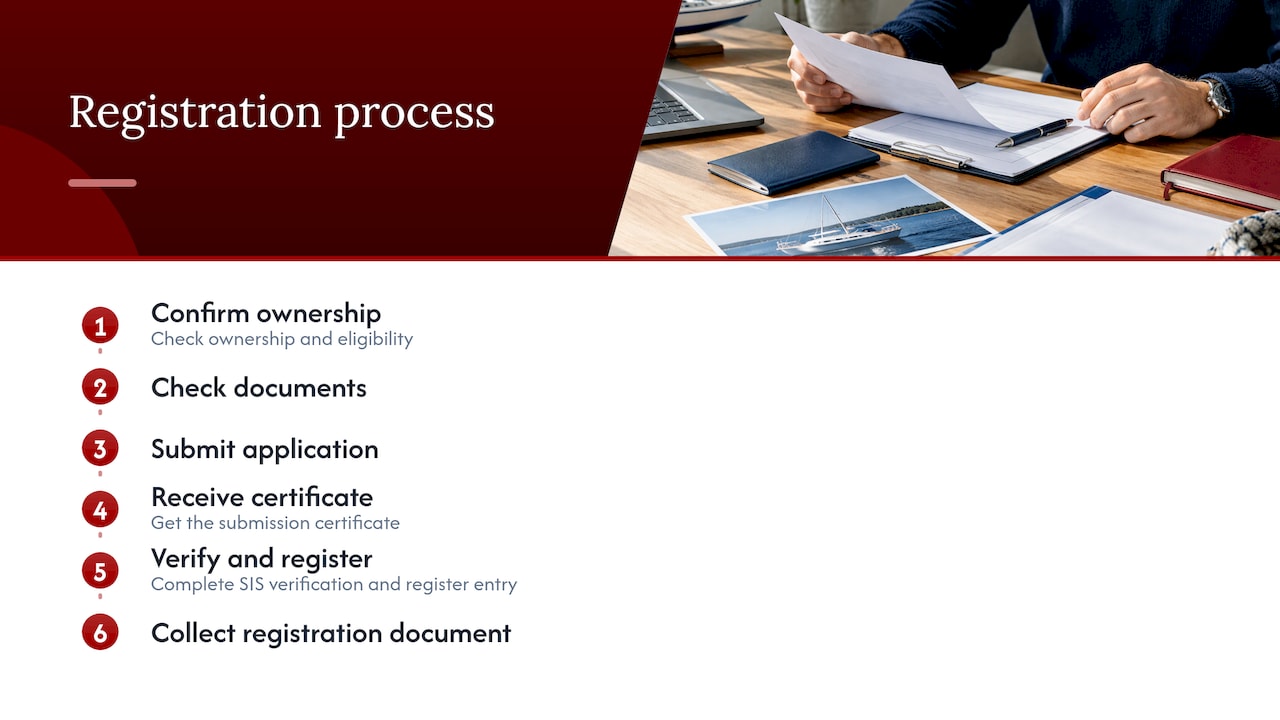
1. Confirm eligibility and ownership structure
Decide who the registered owner will be: an individual, a company or co-owners. This decides which identity or company documents you need and who signs. Changing the owner after filing means restarting.
2. Collect and check the documents
Gather proof of ownership, owner identity or company extract, vessel details and any CE declaration. Check names and hull details match across every document. At this stage we review the file before anything is submitted, so errors surface before the authority sees them rather than after.
3. Presentar la solicitud
A paper application can go to the PYA office, or an electronic one through REJA24. Foreign owners without a PESEL number go through an agent. The fee is PLN 80 for paper filing, payable on the spot by cash or card, and it is not refundable even if the case is left unprocessed or refused. That makes a clean first filing worth more than a quick one.
4. Receive the certificate of submission
When the authority has verified completeness, you receive the certificate of submission. It lets you use the yacht while the case runs, for up to 30 days or until the registration document is issued or a refusal is delivered. Our Polish provisional papers take 2 to 5 days. For how the interim status works, see our page on Polish temporary registration.
5. SIS verification and entry in the register
The authority checks the watercraft in the Schengen Information System, then enters it in the register. This should be within 30 days of a complete application.
6. Collect the registration document
The registration document can be collected only at the registration authority. It cannot be posted to the applicant. Plan for this when scheduling a delivery, a charter start or a sale. The registry issues the document, and Vessel Flag prepares and files the application.
What causes delays, and how to avoid them
| Cause of delay | Why it happens | How to avoid it |
|---|---|---|
| Incomplete file | Missing documents leave the case unprocessed | Check the file against the document list before filing |
| Ownership evidence that does not match | Names or hull details differ between documents | Reconcile every document first |
| Untranslated or uncertified foreign documents | The authority may require certified translations | Order translations once documents are final |
| Power of attorney problems | A representative needs a power of attorney and stamp-duty receipt | Prepare it with the file, not after |
| Co-owner availability | Paper filing needs all co-owners or their powers of attorney | Sort out powers of attorney early |
| Company authority unclear | Legal entities must act through authorised persons | Confirm signatories before filing |
| SIS verification | The vessel is checked before entry in the register | Make sure the hull identification data is accurate |
Fees and previous registrations
The standard first-registration fee is PLN 80. A legal analysis from the ZPP notes that vessels registered under the old rules pay a preferential PLN 60 for re-registration into REJA24. The same analysis explains that the 30-day duty to notify a sale applies only to vessels already in the REJA24 system, and that a seller’s failure to notify does not block the buyer’s application. For brokers handling resales, that last point removes one worry.
Inspections after registration
Registration is not the only compliance step. According to the Ministry of Infrastructure’s 2024 booklet, commercial yachts over 15 m face annual inspections. Recreational yachts of 15 m and above need an intermediate inspection between years 2 and 3 of the 5-year Safety Certificate. Recreational yachts up to 15 m have no obligation of technical or safety inspections. Check this before you set a launch or charter date for a larger vessel.
The MMSI radio licence: the timing owners forget
An MMSI (Maritime Mobile Service Identity) is the nine-digit number your VHF radio and distress equipment transmit. Under the Polish flag, the licence follows registration: a Polish MMSI licence takes 4 to 6 weeks after registration. That is longer than the registration itself, so it is the step most likely to hold up a departure.
Our Polish MMSI licence costs €149, VAT included, with no annual fees. If the vessel also needs a UK or San Marino radio licence, those are €150 and €200 respectively, both VAT included with no annual fees. The UK licence takes 1 day. Details are on our MMSI radio licence page. Ask for it as soon as the flag is secured, so that the 4 to 6 weeks run while you do other preparation.
Poland compared with other flags on time
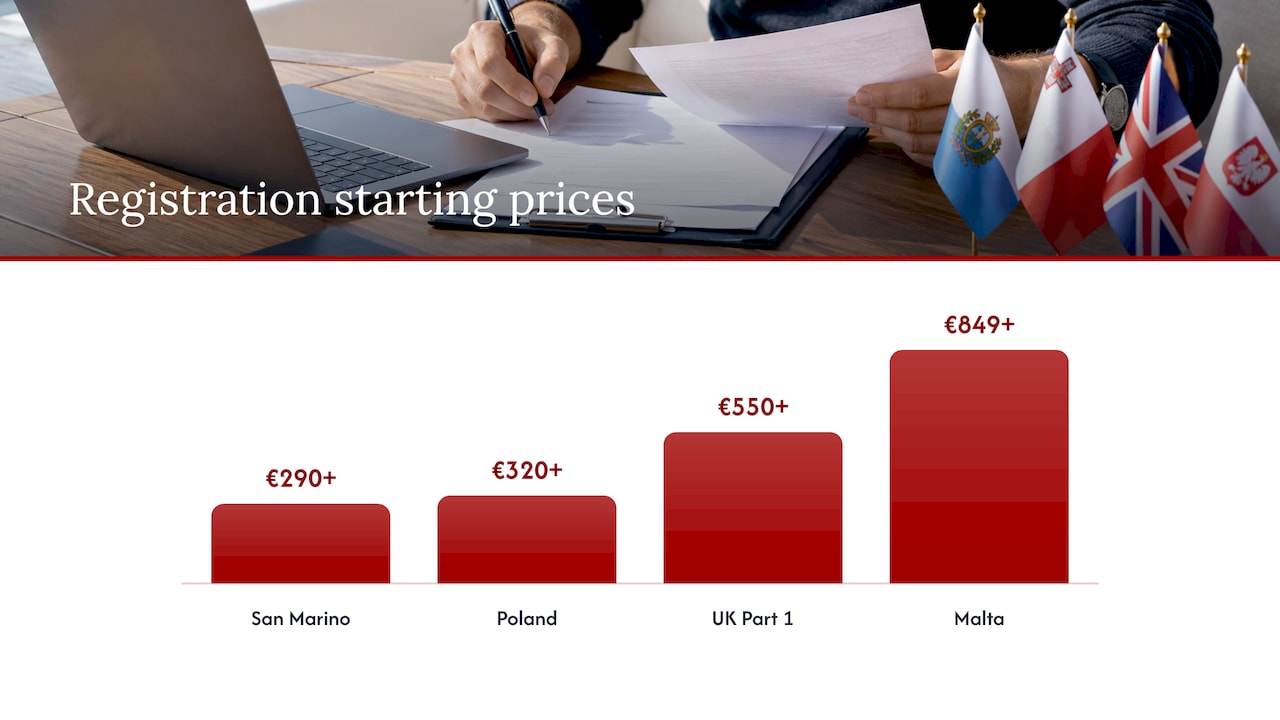
Owners often ask whether another flag is quicker. The honest comparison is by process, not by promise. Our San Marino provisional certificate takes 2 to 6 days, not guaranteed, and starts from €290. UK Part 1 starts from €550 and Malta from €849. Poland starts from €320. Each flag has its own eligibility rules, so the right choice depends on ownership structure, vessel size and where you cruise. If you are weighing them, our San Marino y Reino Unido, 1.ª parte pages set out each process.
For UK Part 1, owners can register personally if eligible, through an existing company (UK or an eligible foreign one, such as a Delaware corporation), or through a new UK LTD. A UK company is not always required.
Poland registration with Vessel Flag
We are a private consultancy: we prepare and file the application, and the Polish authority issues the registration. Polish registration with us starts from €320, one-off, and the whole process runs remotely. We also arrange the Polish MMSI licence (€149) and, where the ownership structure needs it, company formation for yacht ownership.
What you gain is a file checked before it is submitted, so the 30-day period begins on a complete application rather than a partial one.
Comience en el Página de registro de la bandera de Polonia and tell us the vessel, the owner and the planned use.
Our view on timing
Owners ask us how many days Polish registration takes. The more useful question is how many days the file takes to become complete.
The 30-day period is generous when the application is right. It is expensive when it is not, because the fee is not refundable if the case is left unprocessed. That is why we spend our effort before filing: reconciling names and hull details, settling who signs, and making sure translations and powers of attorney are in hand.
Our experience across eight flags has taught us that the registry process is predictable and the preparation is where owners and brokers differ. We also advise starting the MMSI application early, because the 4 to 6 weeks after registration is the part nobody plans for.
VesselFlag
Preguntas frecuentes
¿Cuánto tiempo se tarda en matricular un yate en Polonia?
A complete application should be decided within 30 days. A certificate of submission is issued once the authority has checked the file, and our Polish provisional papers take 2 to 5 days. The clock starts only when the file is complete.
Can I use the yacht while the application is being processed?
Yes, on the certificate of submission. It may be used until the registration document is issued or a refusal is delivered, within the 30-day period. Read our temporary registration page for how this works.
Can a non-Polish owner register a yacht in Poland?
Yes. Foreigners and foreign entities without a PESEL number or a business in Poland apply through an agent. Vessel Flag prepares and files these applications remotely, and our eligibility guide covers the details.
How long does the Polish MMSI licence take?
A Polish MMSI licence takes 4 to 6 weeks after registration and costs €149, VAT included, with no annual fees. A UK licence takes 1 day.
What does Polish registration cost?
Our Polish registration starts from €320, one-off. The official fee for paper filing is PLN 80, and it is not refundable if a case is left unprocessed or refused.
Fuentes
- Regulation of the Minister of Maritime Economy and Inland Navigation, 2020
- Polish Yachting Association: registration of yachts and other vessels, REJA24
- Gdańsk City Office: yacht registration procedure
- REJA24 Act, Article 6: grounds for registration
- REJA24 Act, consolidated text 2024
- Ministry of Infrastructure: information booklet for sailors and shipowners, 2024
- ZPP legal analysis of the REJA24 Act
Ready to register under the Polish flag? See the Página de registro de la bandera de Polonia or book a consultation with Vessel Flag.
Recomendado
- Registro temporal de yates y embarcaciones en Polonia: cómo funciona
- Requisitos para registrarse en el Registro de Yates de Polonia: ¿Quién puede registrarse y qué embarcaciones cumplen los requisitos?
VesselFlag is a private consultancy that prepares and files yacht registration applications for owners. We are not a government body or flag registry; certificates are issued by the relevant registry. This article is general information, not legal advice.