

A statutory declaration in yacht registration is a written statement of fact, signed by the owner in front of an authorised witness, that the registry relies on to establish who owns the vessel and whether that owner is entitled to the flag. Registries use it for ownership, nationality or eligibility, and to cover gaps in the paperwork. The details vary by flag, and a declaration that is wrongly worded, signed or witnessed is a common cause of delay. At Vessel Flag we prepare and file registration applications under eight flags, so the paperwork below is what we work through with owners and brokers every day.
TL;DR
- A statutory declaration is a sworn or affirmed written statement. In registration it usually covers ownership, qualification to own under the flag, and sometimes missing documents.
- Many registries have their own named form, such as a declaration of ownership or of entitlement, rather than a generic “statutory declaration”. The content is what matters.
- The owner makes it personally, in front of a witness the registry accepts. Rules on who qualifies, and on remote signing, depend on the country and registry.
- A false statement can bring criminal liability and, in some jurisdictions, forfeiture or cancellation of the registration.
- Check witness and legalisation requirements before you sign. A correct form signed in front of the wrong person has to be redone.
Índice
- What a statutory declaration does in yacht registration
- What the declaration usually has to contain
- When a declaration replaces a missing document
- Who can make it, and who can witness it
- Signing and submitting: where applications stall
- How registries differ
- What happens if the declaration is wrong or missing
- How Vessel Flag handles the paperwork
- Perspective
- Preguntas frecuentes
- Next step
- Fuentes
What a statutory declaration does in yacht registration
The NSW Department of Communities and Justice describes a statutory declaration as a written statement declared true in front of an authorised witness, with both declarant and witness signing the signature panel. That is the core idea everywhere: a signed statement, a person who checks it was signed properly, and a legal penalty if it is untrue.
A registry cannot inspect your title the way a court would. It needs to be satisfied of three things: who owns the yacht, that this owner is allowed to hold it under that flag, and that the yacht is free to move from its previous registration. The declaration puts those facts on the record, and the supporting documents (bill of sale, builder’s certificate, deletion certificate) back them up.
In practice you meet declarations in three roles:
- Declaration of ownership or entitlement. Part of the standard application. The owner states their identity, their qualification and the share they hold.
- Declaration of nationality or eligibility. The owner states the grounds on which they, or their company, qualify to fly the flag.
- Declaration replacing a missing document. Used when a bill of sale, receipt or builder’s certificate cannot be produced.
Yacht owners and brokers often use “statutory declaration”, “affidavit” and “declaration of ownership” as if they were one thing. Registries do not. Always use the registry’s own wording and form where one exists, and treat the term in this article as shorthand for the sworn statement the registry asks for.
What the declaration usually has to contain
The required content follows the same pattern across the registries whose rules are public. Three examples show it.
Gibraltar. En Pleasure Yachts Regulations 1997 require each owner to sign a declaration of entitlement to ownership. It covers the declarant’s qualification or residency, authority to act for a company, the number of shares or fraction of the yacht in which title will vest, and that the yacht’s description is correct. It also states that the yacht is not registered elsewhere or will be deleted from that registry. For first registration, the same regulations ask for a builder’s certificate and bill of sale, or the bill of sale alone where the building details are declared unknown, plus a declaration that the yacht is free from maritime liens and encumbrances.
United Kingdom. En Merchant Shipping Act 1894 provides in section 9 that nobody is entitled to be registered as owner until they, or for a company an authorised person, have made and signed a declaration. It contains the declarant’s qualification to own a British ship, the time and place of building (or that the vessel is foreign built and the details unknown), the master’s name, the number of shares, and that no unqualified person holds a legal or beneficial interest.
New Zealand. Under section 13 of the Ship Registration Act 1992, a Part A applicant must supply a declaration with their full name, address and nationality, the grounds for that nationality, the extent of their interest, and a statement identifying the owners. The Registrar cannot register the ship without it unless a dispensation is granted.
The common elements are easy to list:
- full legal name, address and nationality or place of incorporation of each owner;
- the basis of the owner’s qualification under the flag;
- the share each owner holds;
- the yacht’s description, matching the other documents exactly;
- a statement about prior registration or encumbrances;
- date and signature, with the witness’s details.
Before signing, compare every name, hull number and date with the bill of sale and any builder’s certificate. Our Lista de comprobación de los documentos de matriculación de un yate shows which documents the declaration has to agree with.
When a declaration replaces a missing document
This is the case brokers meet most often with older or second-hand yachts: the original receipt is gone, or the builder no longer exists.
Registries that accept a declaration in place of a document want specifics, not a general assurance:
- Transport for NSW asks for a declaration stating the purchase price, seller, purchase date, why the bill of sale or receipt is unavailable, and that the vessel was lawfully obtained.
- Maritime New Zealand says the Registrar may accept a Declaration for Absence of Certain Documents (SR27) where building and ownership-change information cannot be furnished.
- Gibraltar, as above, allows first registration on a bill of sale alone where the declarant declares the building time and place unknown or the builder’s certificate cannot be produced.
A declaration of this kind is only as strong as its detail. Say what the missing document was, when you last had it, what you did to find it, and how you acquired the yacht. A vague line such as “documents lost” invites follow-up questions and weeks of correspondence.
Who can make it, and who can witness it
The person making the declaration is the owner. For a company-owned yacht it is the person the company has authorised. Maritime New Zealand states that an attorney cannot make a statutory declaration on an owner’s behalf. If a power of attorney is used elsewhere in the application, it needs a certified true copy and a certificate of non-revocation. Do not assume a registry that accepts a power of attorney for one document accepts it for the declaration.
The witness is where owners most often go wrong. Rules depend on the registry and on where you sign:
- For New Zealand, the same guidance says declarations made in New Zealand may be taken by a justice of the peace or a solicitor. Elsewhere in the Commonwealth, judges, justices of the peace and Commonwealth representatives can take them. In other countries the declaration must be made before a judge, a notary public or a New Zealand High Court solicitor.
- For an Australian Commonwealth declaration, the list of eligible witnesses includes judges, justices of the peace, notaries public and certain licensed professionals.
- Malta’s registry procedure asks for the declaration of ownership to be made in front of the Registrar by the owner or an authorised representative, alongside proof of qualification and a resident agent for non-resident owners.
A notary public is the safest default for an owner outside the flag state’s country, because most registries name notaries. Confirm the registry accepts the specific witness before the appointment, not after.
Signing and submitting: where applications stall
The NSW JP Handbook is explicit that the declarant must sign in front of the witness, never present a pre-signed document. It also describes remote witnessing in that jurisdiction: the witness sees the signature in real time over an audio-visual link, signs the document or an exact copy, and is reasonably satisfied it is the same document. That rule belongs to NSW. Other registries may require wet-ink originals, a notary’s stamp or a specific form of legalisation, so do not assume remote witnessing is accepted.
A workable routine for any flag:
- Get the registry’s current form and instructions. Do not reuse a declaration from a previous yacht or flag.
- Fill it in from the source documents. Names and yacht details must match the bill of sale, builder’s certificate and any deletion certificate letter for letter.
- Leave signature and date blank. The New Zealand form guidance says the ownership and nationality declaration must not be dated before the application for registration, which shows why dating in advance causes trouble.
- Sign in front of the accepted witness and make sure the witness completes their part in full, including name, capacity and any identity confirmation.
- Check whether legalisation is needed. Documents signed abroad often need an apostille or consular legalisation. Our guide to consular legalisation of yacht documents explains when that applies.
- Check translation. A declaration in another language usually needs a translation. See what to translate in our Guía de traducción de documentos para yates.
- Send the original or the form the registry specifies, and keep a complete copy.
The declaration often travels with identity and address evidence. Registries differ on what they accept, which we cover in Comprobante de domicilio para el registro de yates.
How registries differ
The table compares the registries named in the public rules above. It shows the pattern of the declaration, not the full application.
| Registro | What the declaration covers | Witness or submission point |
|---|---|---|
| United Kingdom (Merchant Shipping Act 1894, s9) | Qualification to own a British ship, building details, master, shares, no unqualified interest | Signed by the owner, or the authorised person for a company |
| Malta (Transport Malta) | Declaration of ownership, alongside proof of qualification and a resident agent for non-residents | Made in front of the Registrar by the owner or authorised representative |
| Gibraltar | Entitlement to ownership, shares, majority qualified ownership, not registered elsewhere, free of liens | Signed by each owner in the specified form |
| New Zealand (Part A) | Name, address, nationality, interest, owners, New Zealand-owned status | Before an accepted officer; no attorney |
| Langkawi (Malaysia) | Declaration of ownership: information true, legal owner of the shares, no other person entitled | Signed by all individual owners or a person authorised by the yachting entity |
For Malta, the registry provisionally registers the yacht for six months (extendable by up to six more) while documentation is finalised, so a declaration problem can usually be fixed within that period, though it still holds up the final certificate. Langkawi’s guidelines also state that ownership documents must be notarised in the country where issued, and they list the acceptable documents of title, including an affidavit or a court order.
The lesson for owners moving between flags is that the declaration is not portable. Each registry has its own form, witness list and attached documents. For a broader view of how the flag choice shapes the paperwork, see our overview of registro internacional de pabellones para yates.
What happens if the declaration is wrong or missing
The consequences range from a rejected application to criminal liability.
- No declaration, no registration. In New Zealand the Registrar cannot register the ship without one unless a dispensation is granted.
- Criminal exposure in the UK. Under the 1894 Act, wilfully making a false statement about title or ownership is a misdemeanour. A false declaration of qualification to own a British ship is also a misdemeanour, and the ship or share is liable to forfeiture. The Merchant Shipping Act 1995, section 14 makes it an offence to give the registrar a statement you know to be false, or to make one recklessly, about a ship’s British connection. It also requires owners to tell the registrar as soon as practicable about any change affecting that connection.
- Cancellation. The NSW form warns that false information may lead to cancellation of the vessel registration, in addition to action for making a false declaration.
The practical risks are mundane: a company name spelled differently from the certificate of incorporation, a share percentage that does not match the bill of sale, or a declaration signed before the witness was present. Each of these is easy to avoid with a careful read-through before the appointment.
If you are unsure whether you or your company qualifies for a flag, or what a statement in the form means in law, ask a maritime solicitor before signing. A declaration is a legal statement made under penalty, and the registry cannot advise you on it.
How Vessel Flag handles the paperwork
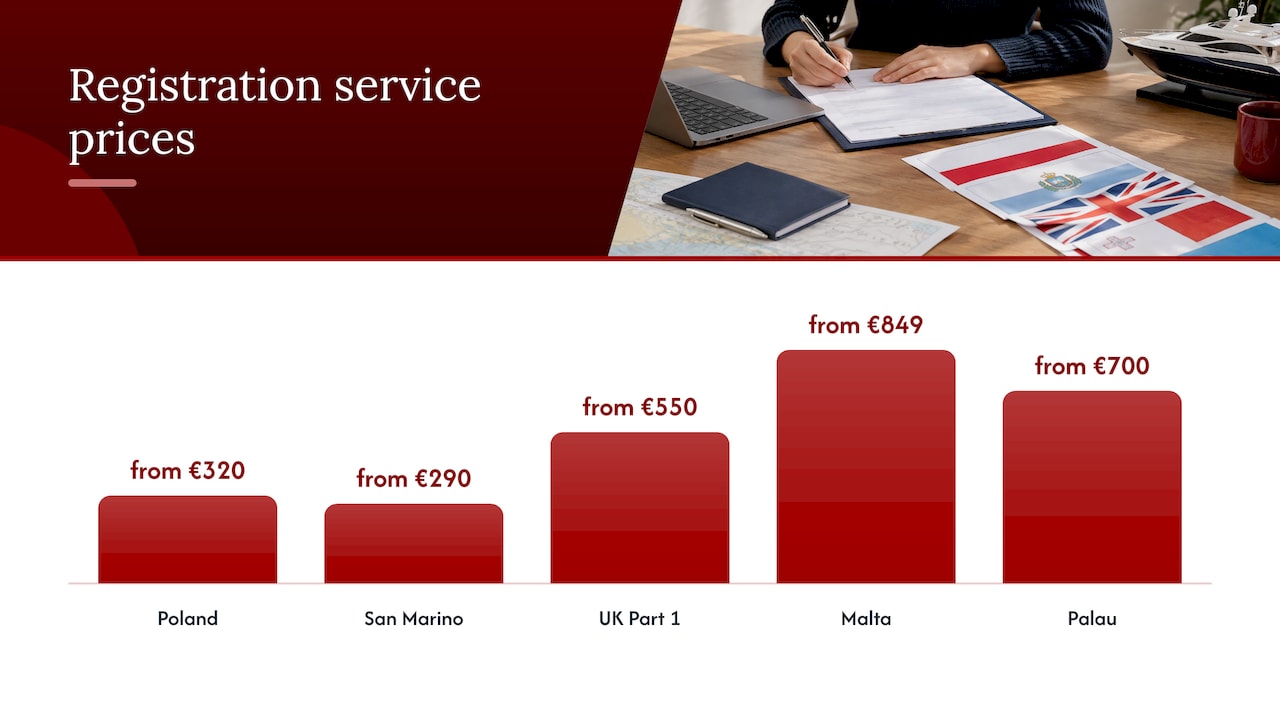
Vessel Flag is a private consultancy, not a registry or government body. We prepare and file yacht and boat registration applications for private owners, companies and brokers under the flags of Poland, San Marino, UK Part 1, Malta, Palau, the Marshall Islands, the Cayman Islands and the Cook Islands. The flag registry issues the certificates. The service is fully remote with published one-off prices, so you know the cost before you start.
The published figures are:
- Poland from €320 one-off, with provisional papers taking 2 to 5 days.
- San Marino from €290 one-off, with the provisional certificate taking 2 to 6 days, not guaranteed.
- UK Part 1 from €550 one-off. Owners can register personally if eligible, through an existing company (UK or an eligible foreign one, such as a Delaware corporation) or through a new UK LTD.
- Malta from €849 one-off.
- Palau from €700 one-off.
- Marshall Islands and Cayman Islands: a service fee of €250 and €450 respectively, plus registry fees.
If the yacht is to be owned through a company, we also arrange formation: company formation for yacht ownership covers UK LTD at €485 and Delaware LLC from €455 (€605 with apostille). Because the declaration has to describe the owner exactly, getting the company in place before the application avoids the common mismatch between the owner named in the form and the owner named on the certificate of incorporation.
We also arrange MMSI numbers and ship radio licences: €149 in Poland, €150 in the UK and €200 in San Marino, each VAT included with no annual fees. Our MMSI radio licence page has the details. For an overview of the documents involved, our yacht documentation guide for compliance and registration sets out the procedure.
Perspective
The declaration looks like the smallest document in the pack, and it causes a disproportionate share of the delays. The reason is that it is the one document that has to agree with all the others. The owner’s name, the share, the yacht’s description and the previous registration all appear in it, and any difference from the bill of sale or the certificate of incorporation raises a query.
Our view is that the right order of work is to settle the ownership structure first, assemble and check the supporting documents second, and only then bring the declaration to the witness. Owners who sign first and fix the rest later tend to sign twice.
We work across eight flags, and the same declaration never fits two of them. That is the argument for having one team prepare the application from start to finish, with the company set-up, the radio licence and any transfer between flags handled in the same process. The owner signs what the registry needs, once, in front of the right witness.
VesselFlag
Preguntas frecuentes
Is a statutory declaration the same as a declaration of ownership?
Not always. A declaration of ownership is the registry’s own form and is often made in the form of a statutory declaration. Some registries use the term statutory declaration for any sworn statement, including one that replaces a missing document. Use the exact form the registry specifies.
Can someone sign the declaration for me?
Generally no. The owner or, for a company, the person it authorises makes the declaration. Maritime New Zealand, for example, states that an attorney cannot make one for an owner. Check the registry’s rules before relying on a power of attorney.
Do I need a notary?
Often yes when you sign outside the flag state’s country, because registries commonly list notaries among accepted witnesses. Whether a notary is enough, and whether legalisation or translation follows, depends on the registry. Confirm before the appointment.
What if I cannot find the bill of sale?
Some registries accept a declaration explaining the gap, giving the purchase details, the seller and the reason the document is missing. Gibraltar, for example, allows a bill of sale alone where the builder’s certificate cannot be produced. The detail you give decides how smoothly it is accepted.
Can I sign the declaration remotely?
Only where the registry and the witness’s own jurisdiction allow it. NSW permits witnessing over an audio-visual link under set conditions, but that is an NSW rule and not a general one. For most flags, plan for in-person signing and ask the registry to confirm in writing.
Next step
If you are preparing a registration and want the declaration, company and supporting documents to line up first time, start with the flag page: UK Part 1 yacht registration, Registro de yates en Malta, Registro de la bandera de Polonia o Registro de yates en San Marino. Then book a consultation and we will go through your yacht, your ownership structure and the declaration your chosen registry requires.
Fuentes
- Merchant Shipping Act 1894, legislation.gov.uk
- Merchant Shipping Act 1995, section 14, legislation.gov.uk
- Registration Procedure, Transport Malta
- Gibraltar Merchant Shipping (Pleasure Yachts) Regulations 1997
- Ship Registration Act 1992, New Zealand Legislation
- Application for Registration of Ship in Part A (SR2), Maritime New Zealand
- JP Handbook, Chapter 2, NSW Department of Communities and Justice
- Application for Vessel Registration, Transport for NSW
- Certifying your identity documents, Civil Aviation Safety Authority
- LIYR registration guidelines, September 2025, Marine Department Malaysia
Recomendado
VesselFlag is a private consultancy that prepares and files yacht registration applications for owners. We are not a government body or flag registry; certificates are issued by the relevant registry. This article is general information, not legal advice.