
TL;DR:
- Private yacht operating limits include passenger caps and charter day maximums that control vessel use. Ignoring these limits can lead to reclassification, insurance voids, and legal penalties, especially in US waters and YET jurisdictions. Owners should maintain detailed records, stay within regulatory thresholds, and ensure compliance with flag and safety standards to avoid costly violations.
Private yacht operating limits define the legal and safety boundaries that govern how you use your vessel, covering passenger caps, charter day maximums, and certification requirements. These limits come from bodies like the U.S. Coast Guard, the Red Ensign Group, and national maritime authorities. Ignoring them triggers vessel reclassification, insurance voids, and serious financial penalties. Whether you operate privately, charter occasionally, or cruise across multiple jurisdictions, understanding these rules is the foundation of responsible ownership.
What are private yacht operating limits?
Private yacht operating limits are the regulatory thresholds that determine how a vessel may be used without crossing into commercial territory. The two most consequential limits are the U.S. Coast Guard’s 12-guest passenger rule and the Yacht Engaged in Trade (YET) regime’s 84-day annual charter cap. Both define the outer boundary of private operation. Cross either threshold without proper authorization and your vessel’s legal classification changes, along with every obligation attached to it.
These limits exist because the risk profile of a vessel changes dramatically with passenger load and commercial frequency. A yacht carrying 13 paying guests faces the same liability exposure as a small passenger ferry. Regulators treat it the same way.
Why does the 12-guest rule matter for private charters?
U.S. Coast Guard regulations cap recreational vessels at 12 paying passengers. Crew members do not count toward this number. The moment a 13th paying guest boards, the vessel legally becomes a passenger vessel under federal law.
That reclassification is not a paperwork formality. Exceeding the 12-guest limit requires costly structural upgrades including enhanced fire protection systems, stability improvements, and commercial-grade life-saving appliances. Most private yachts cannot meet those standards without a full refit. The practical result is that the 12-guest rule functions as a hard ceiling for private charter operations in U.S. waters.
Key facts yacht owners need to know about the 12-guest rule:
- Crew are excluded from the passenger count, but they must be documented separately on crew lists.
- Inspectors verify passenger counts against crew lists during port checks. Misclassification leads to severe penalties and insurance voids.
- Insurance policies written for private recreational use become void the moment the vessel operates as an unlicensed passenger carrier.
- The rule applies in U.S. waters regardless of the vessel’s flag state.
- Bareboat charters where the charterer takes full control of the vessel may be treated differently, but the distinction requires legal confirmation per jurisdiction.
Pro Tip: Keep a signed passenger manifest for every charter trip. If an inspector boards, a clear record showing 12 or fewer paying guests is your first line of defense.
How does the YET regime affect private chartering limits?
The Yacht Engaged in Trade (YET) regime is the most practical tool available to owners of larger private yachts who want to charter commercially without full commercial registration. YET permits qualifying yachts of 24 meters or more to charter up to 84 days per year in select jurisdictions while retaining their private status for the remainder of the year.
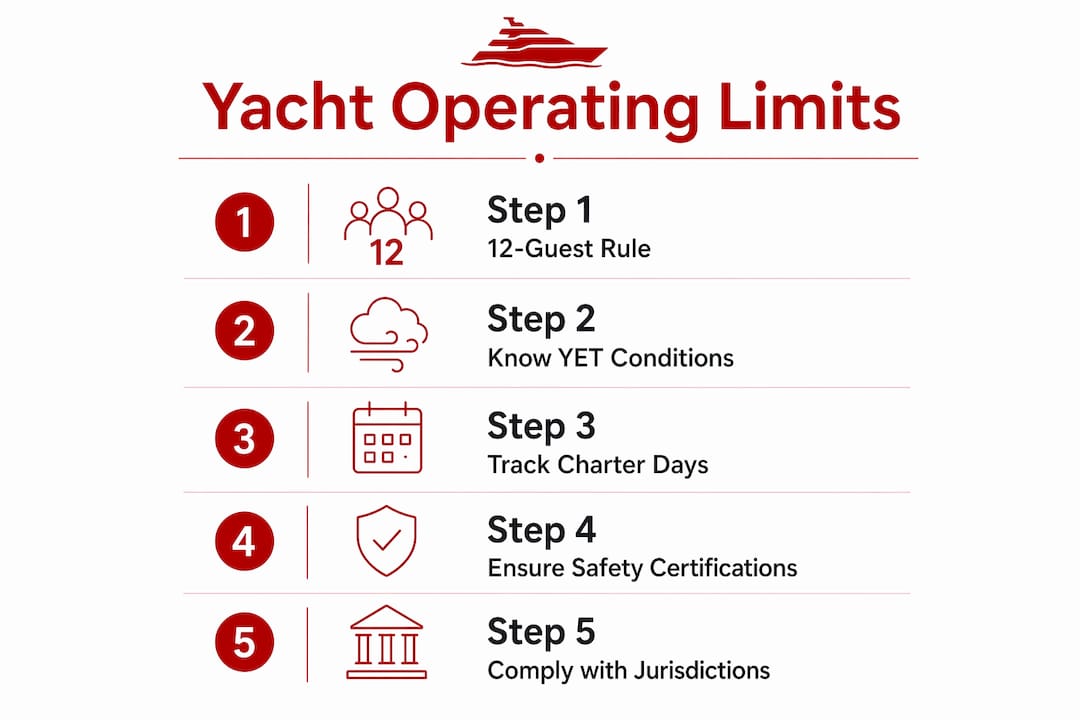
The 84-day cap is firm. It is not a guideline. Exceeding it without converting to full commercial registration exposes the owner to VAT liability, customs penalties, and potential flag state sanctions. The 84-day figure also resets annually, so careful scheduling is not optional.
YET compliance requires meeting these conditions:
- The vessel must be 24 meters or longer.
- The yacht must comply with Red Ensign Group Yacht Code standards for safety and crew certification.
- Private use is prohibited during any designated charter period.
- The owner must register under a participating flag state such as the Cayman Islands.
- Charter operations must occur within jurisdictions that recognize the YET framework.
YET programs exist only in select jurisdictions, notably France and Monaco within the EU, and the Cayman Islands internationally. Owners who charter in non-YET jurisdictions face VAT and customs exposure without proper local advisory.
| YET condition | Requirement |
|---|---|
| Minimum vessel length | 24 meters |
| Maximum charter days | 84 days per year |
| Safety standard | Red Ensign Group Yacht Code |
| Private use during charter | Not permitted |
| Participating jurisdictions | Cayman Islands, France, Monaco |
Pro Tip: Track charter days in a dedicated log from the first day of the season. Owners who rely on memory or informal records routinely underestimate usage and breach the 84-day cap without realizing it.
What safety and certification standards apply to private yachts?
Safety certification for private yachts operates on two tracks: voluntary programs for smaller vessels and mandatory compliance for larger ones. The Maltese Merchant Shipping Directorate introduced voluntary safety guidelines for pleasure yachts under 24 meters, offering a Pleasure Yacht Safety Certificate valid for five years. The certificate requires safety surveys and crew competence checks. It is not legally required, but it carries real weight with insurers and port authorities.
For larger vessels, the ISM Code is mandatory for yachts over 500 GT. It requires a documented Safety Management System (SMS) and a designated person ashore (DPA) who holds accountability for safety oversight. Even for yachts below that threshold, adopting ISM Code principles reduces insurance risk and builds a stronger safety culture on board.
Practical safety standards worth implementing regardless of legal obligation:
- Safety Management System (SMS): Document all safety procedures, emergency contacts, and maintenance schedules in a single accessible file.
- Designated Person Ashore (DPA): Assign a shore-based contact with authority to act on safety issues between the owner and the vessel.
- Crew competence records: Maintain certificates for all crew, updated and accessible for inspection.
- Pleasure Yacht Safety Certificate: Pursue Maltese yacht certification if operating in Mediterranean waters. It signals compliance to port authorities before they ask.
- Regular drills: Run man-overboard, fire, and flooding drills at the start of each season and after any crew change.
The comparison below shows how voluntary and mandatory standards differ in scope:
| Standard | Applies to | Legal status | Key requirement |
|---|---|---|---|
| Maltese Pleasure Yacht Safety Certificate | Yachts under 24m | Voluntary | Safety survey + crew checks |
| ISM Code | Vessels over 500 GT | Mandatory | SMS + DPA appointment |
| Red Ensign Group Yacht Code | YET-registered yachts 24m+ | Mandatory for YET | Full safety and crew compliance |
How do jurisdictional differences affect operating limits?
Flag state choice is one of the most consequential decisions a yacht owner makes. It determines which operating limits apply, what crew certifications are required, and whether dual-use chartering is even possible. U.S. flag yachts require officers to be U.S. citizens and 75% of unlicensed crew to hold U.S. passports. No dual-use charter category exists under the U.S. flag. That single fact eliminates the YET option entirely for U.S.-flagged vessels.
Cayman Islands flagging offers the opposite flexibility. The YET regime is fully available, crew nationality restrictions are minimal, and the flag is widely accepted across Mediterranean and Caribbean ports. Owners who operate across multiple regions need to understand maritime regulations in each jurisdiction before committing to a flag state.
The practical risk of misalignment is significant. An owner who charters in a non-YET jurisdiction under the assumption that their Cayman Islands YET registration provides cover will face local VAT assessments and customs liability. Local fiscal agents, not the flag state registry, determine VAT treatment in each port. Coordinating with those agents before the season starts is not optional for owners who charter internationally.
Pro Tip: Before entering any new jurisdiction for a charter, confirm YET recognition and VAT treatment with a local maritime agent. A one-hour consultation costs far less than a customs penalty.
What practical steps help owners manage operating limits?
Compliance does not happen by accident. Owners who stay within operating limits do so because they build systems around those limits, not because they get lucky. The following practices form the core of effective compliance management:
- Passenger count records: Log every charter with a signed manifest showing the number of paying guests. Store these records for at least three years.
- Charter day tracking: Maintain a running total of YET charter days from the first booking of the season. Review the count monthly.
- SMS documentation: Keep your Safety Management System current. Update it after any incident, crew change, or regulatory update.
- DPA appointment: Confirm your Designated Person Ashore is reachable and briefed before every charter season.
- Crew certification audits: Review all crew certificates at the start of each season. Expired STCW or medical certificates create immediate compliance gaps.
- Fiscal agent coordination: Engage a local agent in each jurisdiction where you charter to confirm VAT and customs obligations before arrival.
- Yacht compliance planning: Treat compliance as a scheduled activity, not a reactive one. Build it into your annual management calendar.
Structured maintenance budgeting and regular safety drills improve operational safety and reduce the risk of incidents that trigger regulatory scrutiny. Owners who run commercial-standard drills on private vessels consistently report fewer insurance claims and smoother port inspections.
Principales conclusiones
Private yacht operating limits are defined by hard regulatory thresholds including the 12-guest passenger cap, the 84-day YET charter limit, and flag-specific crew and safety requirements that vary by jurisdiction.
| Punto | Detalles |
|---|---|
| 12-guest passenger cap | Exceeding 12 paying guests triggers mandatory reclassification as a commercial passenger vessel. |
| YET 84-day charter limit | Yachts 24m+ may charter up to 84 days annually under YET without full commercial registration. |
| Flag state determines flexibility | U.S. flag eliminates dual-use chartering; Cayman Islands flag enables YET with fewer crew restrictions. |
| Voluntary certification pays off | Maltese Pleasure Yacht Safety Certificates and ISM Code adoption reduce insurance risk and ease port inspections. |
| Jurisdiction-specific VAT risk | YET recognition varies by country; local fiscal agents must confirm VAT treatment before each charter. |
The compliance gap most owners don’t see coming
At Vesselflag, we work with yacht owners across dozens of flag states, and the pattern we see most often is not deliberate rule-breaking. It is owners who genuinely believe their flag state registration covers them everywhere. It does not.
The YET regime is a perfect example. An owner registers under the Cayman Islands flag, qualifies for YET, and assumes that status travels with the vessel. Then they charter in a port that does not recognize YET, and suddenly they are facing a VAT bill they never budgeted for. The flag state gave them the right tool. They just used it in the wrong jurisdiction.
The same logic applies to the 12-guest rule. Owners who charter in U.S. waters under a foreign flag still fall under U.S. Coast Guard jurisdiction for passenger limits. The flag on the stern does not change the law of the waters you are sailing in.
What we consistently recommend is treating compliance as a layered system. Your flag state sets the foundation. Local regulations in each port add the next layer. Your insurance policy adds the third. All three need to align before you take a paying guest aboard. Owners who understand commercial yacht status before they need it avoid the expensive lessons that come from learning it after the fact.
Voluntary certifications like the Maltese Pleasure Yacht Safety Certificate are underused precisely because they are not required. That is the wrong reason to skip them. Port authorities notice when a private yacht arrives with documented safety surveys and crew competence records. It changes the tone of every inspection.
— Vesselflag
Vesselflag helps yacht owners stay on the right side of the rules
Navigating registration requirements across multiple jurisdictions is one of the most time-consuming parts of yacht ownership. Vesselflag specializes in exactly that work, helping owners select the right flag state, complete registration efficiently, and maintain documentation that holds up to port authority scrutiny worldwide.
Whether you are registering a new vessel, switching flags to access YET chartering, or confirming that your current registration aligns with your operating plans, Vesselflag’s team provides clear guidance at every step. The complete yacht registration guide covers flag options, timelines, and compliance requirements in plain language. For owners who want to confirm their registration supports their actual operating limits, the yacht registration validity guide is the right starting point.
PREGUNTAS FRECUENTES
What is the 12-guest rule for private yachts?
The U.S. Coast Guard limits recreational vessels to 12 paying passengers. Carrying a 13th paying guest triggers mandatory reclassification as a commercial passenger vessel, requiring costly structural upgrades.
How many days can a private yacht charter under the YET regime?
The YET regime caps commercial charter activity at 84 days per year. Vessels must be at least 24 meters long and comply with Red Ensign Group Yacht Code standards to qualify.
Does a foreign flag protect a yacht from U.S. passenger limits?
No. U.S. Coast Guard jurisdiction applies in U.S. waters regardless of the vessel’s flag state. The 12-guest passenger cap applies to all vessels operating in those waters.
Is the ISM Code mandatory for private yachts?
The ISM Code is mandatory only for vessels over 500 GT. For smaller private yachts, adopting ISM principles including a documented SMS and a DPA is a best practice that reduces insurance and legal risk.
Can I use my yacht privately and for charter in the same year?
Yes, under the YET regime in qualifying jurisdictions such as the Cayman Islands, France, and Monaco. Private use and charter use must be clearly separated, and charter days cannot exceed 84 annually.