
TL;DR:
- Choosing the right flag reduces inspections, insurance costs, and compliance risks.
- Accurate documentation and professional assistance are essential to avoid delays and penalties.
- Ongoing compliance, including renewals and crew documentation, is vital for legal vessel operation.
Registering your yacht under the wrong flag is not just a paperwork inconvenience. It can trigger port state inspections, detentions, and insurance complications that cost far more than the registration fees you tried to save. Yacht registration mistakes can lead to inspections, detentions, and insurance issues that derail your entire season. This guide walks you through every stage of yacht flag registration, from choosing the right jurisdiction to staying compliant year after year, so you can focus on operating your vessel with confidence instead of chasing paperwork.
Índice
- Understanding yacht flag registration and its impact
- Preparation and prerequisites: What you need before registering
- Step-by-step yacht flag registration process
- Troubleshooting, common pitfalls, and ongoing compliance
- Our expert perspective: What most owners overlook in yacht flag registration
- Your next step: Secure your yacht registration with trusted guidance
- Frequently asked questions
Principales conclusiones
| Punto | Detalles |
|---|---|
| Flag state choice | Choosing the right flag directly impacts inspections, fees, and legal compliance. |
| Document preparation | Gather all required documents before beginning registration to avoid delays. |
| Step-by-step process | Following each step methodically ensures smooth registration and rapid certification. |
| Ongoing compliance | Maintain annual renewals and necessary certifications to prevent costly mistakes. |
| Professional support | Hiring experienced agents or attorneys streamlines the process and protects from errors. |
Understanding yacht flag registration and its impact
Yacht flag registration is the legal process of recording your vessel under a specific country’s maritime authority, which then becomes your vessel’s “flag state.” That flag state sets the rules your yacht must follow, governs crew certification requirements, and determines how port state control officers around the world will treat your vessel during inspections.
Your choice of flag has a direct effect on three things: reputation, insurance premiums, and how often you get pulled aside for inspections. Flags listed on the Paris MoU white list face significantly fewer port state control detentions than those on the gray or black lists. A white list flag signals to insurers and port authorities that your vessel meets a high standard of compliance, which translates into lower premiums and smoother port entries.
The most popular flags for yachts include the Cayman Islands, Marshall Islands, and Malta. All three are tax neutral, recognized for prestige, and associated with fewer inspections globally. Each has its own strengths depending on your operational needs.
| Bandera | Cronología | Key advantage | Inspection risk |
|---|---|---|---|
| Islas Marshall | 1 to 3 days provisional | Speed, global recognition | Low (white list) |
| Islas Caimán | 1 to 2 weeks provisional | Prestige, strong legal framework | Low (white list) |
| Malta | 2 to 4 weeks | EU flag access, tax efficiency | Low (white list) |
| Panamá | 1 to 2 weeks | Low cost, large registry | Medium (gray list risk) |
When evaluating flags, consider these factors before committing:
- Operational area: EU waters favor EU flags like Malta for VAT and port access reasons
- Charter plans: Some flags restrict commercial charter activity or require additional permits
- Financing requirements: US lenders often require US documentation or specific flag arrangements
- Crew nationality rules: Certain flags impose crew certification requirements tied to the flag state
Understanding the global yacht registration process before you commit to a flag saves significant time and money down the line.
Pro Tip: Avoid choosing a flag purely based on the lowest registration fee. A flag on the Paris MoU gray or black list will cost you far more in inspection delays and insurance hikes than you saved upfront.
Preparation and prerequisites: What you need before registering
With a clear understanding of why flag registration matters, it’s time to gather the essentials and prepare for a smooth process. Preparation is where most delays originate. Owners who arrive at the registration stage without complete documentation routinely face weeks of back-and-forth that could have been avoided.
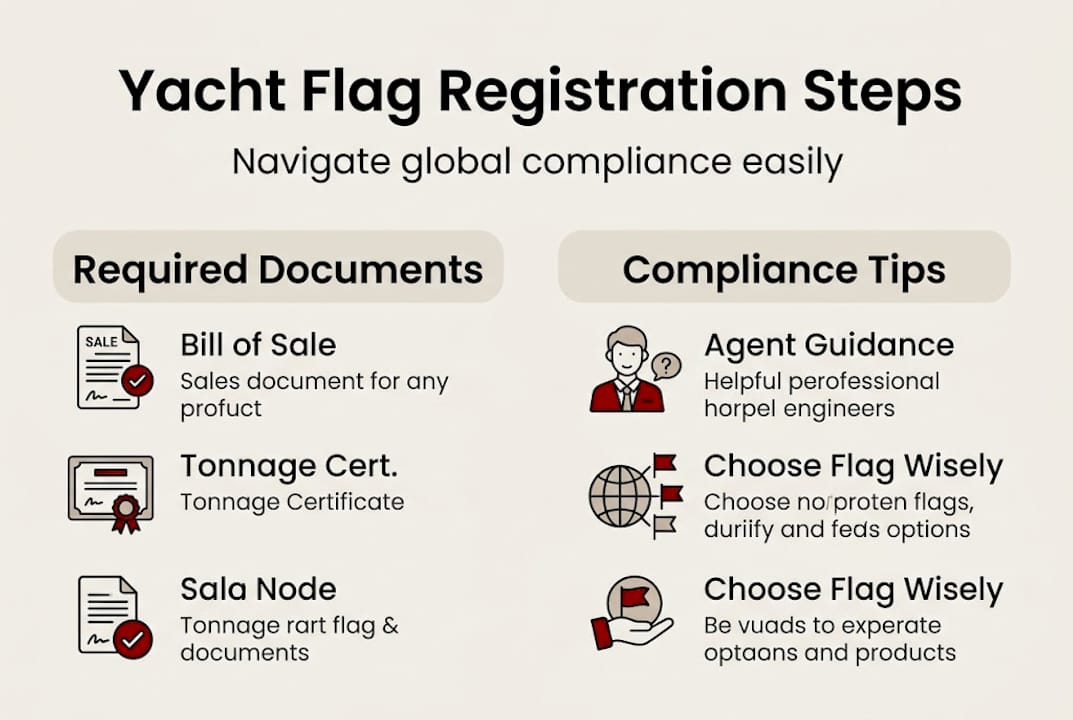
The key documents required for yacht flag registration include the bill of sale, builder’s certificate, tonnage certificate, and owner identification or corporate documents for company-owned vessels. Missing even one of these can pause your entire application.

Here is a practical document checklist to prepare before submitting:
| Document | Purpose | Notes |
|---|---|---|
| Bill of sale | Proves ownership transfer | Must be notarized in most jurisdictions |
| Builder’s certificate | Confirms original construction | Required for new builds |
| Tonnage certificate | Establishes gross tonnage | Needed for fee calculation |
| Owner ID or corporate docs | Identifies legal owner | Passport plus corporate registry for SPVs |
| Deletion certificate | Proves removal from prior flag | Required when transferring flags |
Beyond documents, you need to decide on your ownership structure before applying. Private ownership is simpler but may expose you to personal liability. A Special Purpose Vehicle (SPV) or LLC structure offers liability protection and can simplify future sales or transfers. Many experienced owners use a Delaware flag registration or similar corporate structure to separate personal assets from vessel liability.
Hiring a qualified maritime agent or attorney is not optional if you want an efficient process. Agents know exactly what each flag authority expects, which version of a document is acceptable, and how to handle edge cases. They prevent the kind of small errors that trigger rejection letters. Review registration best practices to understand what a good agent should be doing on your behalf.
Pro Tip: Start preparing your documents at the purchase agreement stage, not after closing. By the time you sign the bill of sale, your document package should already be 80% complete.
Step-by-step yacht flag registration process
Once preparations are complete, you can move through registration following these detailed steps. The sequence below applies to most major flag states, with notes on where timelines and requirements differ.
- Select your flag state strategically. Based on your operational area, charter plans, and compliance needs, confirm your flag choice before any application is submitted.
- Engage a qualified maritime agent or attorney. They will manage submission, liaise with the flag authority, and flag any document issues before they cause delays.
- Submit your application with all supporting documents and fees. Incomplete submissions are the single biggest cause of delays. Your agent should verify completeness before submission.
- Undergo any required surveys or inspections. The Cayman Islands requires surveys before issuing even a provisional certificate. Marshall Islands is more flexible for provisional issuance.
- Receive your provisional certificate. This allows you to operate legally while the full registration is processed.
- Obtain your permanent certificate. This typically follows after all surveys, inspections, and outstanding documents are confirmed.
- Apply for your MMSI, AIS, and radio license. These are separate from the registration itself but are required for legal operation.
Timelines vary significantly by flag. Provisional certificates are available in 1 to 3 days for Marshall Islands and 1 to 2 weeks for Cayman Islands, with overall registration typically completing in 2 to 8 weeks depending on the flag and survey requirements.
For commercial vessels, the commercial vessel registration steps differ from private yacht registration, particularly around safety equipment surveys and crew certification requirements.
Key milestones to track during registration:
- Application submitted and acknowledged by flag authority
- Survey scheduled and completed (if required)
- Provisional certificate issued
- Outstanding conditions cleared
- Permanent certificate issued
- MMSI and radio license obtained
Review efficient international flags if you want a side-by-side look at how different jurisdictions handle each of these steps. The Yatco registration sequence also provides useful context on how brokers typically coordinate this process during a sale.
Pro Tip: Request a provisional certificate immediately upon application approval. It lets you move the vessel, complete sea trials, and begin operations without waiting for the full permanent certificate.
Troubleshooting, common pitfalls, and ongoing compliance
After registration, staying compliant and avoiding enforcement actions means knowing ongoing requirements and common traps. Registration is not a one-time event. It is the start of an ongoing compliance relationship with your flag state.
Incomplete documentation or ignoring white list status leads to detentions, insurance hikes, and fines that can be far more disruptive than the original registration cost. Port state control officers have the authority to detain your vessel until deficiencies are corrected, which can mean missed charters, angry clients, and significant financial losses.
Several edge cases deserve special attention:
- Commercial charter operations: Many flags require a separate charter permit or commercial endorsement. Operating commercially without it voids your insurance and exposes you to fines.
- EU VAT compliance: If your yacht spends significant time in EU waters, VAT status must be established separately from flag registration. This is a common and costly oversight.
- US financing requirements: American lenders often require USCG documentation or specific flag arrangements that may conflict with your preferred international flag choice.
- Crew list accuracy: Your flag state requires an up-to-date crew list at all times. Failure to maintain this is a common deficiency found during port state control inspections.
“An expired certificate or missing crew documentation is not a minor technicality. Port state control officers treat it as a serious deficiency that can result in immediate detention until the vessel is brought into compliance.”
For ongoing compliance, MMSI and AIS compliance is a separate but equally important requirement. Your AIS transponder must be properly registered and transmitting accurate data. Review MMSI license steps to ensure your radio licensing is current. The official Cayman registry publishes its renewal requirements and compliance calendar, which is a useful model even if you are registered under a different flag.
Pro Tip: Build a compliance calendar at the start of each year. Mark certificate renewal dates, crew list update deadlines, and survey due dates. A single missed renewal can cascade into a chain of compliance failures.
Our expert perspective: What most owners overlook in yacht flag registration
The most common mistake we see is owners treating flag selection as a cost optimization exercise. They compare registration fees across jurisdictions, pick the cheapest option, and then spend the next two years dealing with the consequences: more frequent inspections, higher insurance premiums, and flag authorities that are slow to respond when issues arise.
Offshore flags offer privacy and tax advantages but require careful planning and ongoing compliance. Onshore flags may be simpler but can restrict operational flexibility. Neither is universally better. The right answer depends entirely on how and where you operate.
What genuinely saves money over the life of a vessel is investing in a good agent, choosing a reputable white list flag from the start, and treating compliance as a continuous process rather than an annual checkbox. The owners who have the smoothest experiences are the ones who planned their registration strategy before they even signed a purchase agreement. Explore the yacht registration 2026 guide for a broader look at how registration decisions affect long-term vessel value and operational flexibility.
Your next step: Secure your yacht registration with trusted guidance
Navigating flag registration across multiple jurisdictions is complex, but it does not have to be stressful. VesselFlag.com provides end-to-end registration services across a wide range of international flags, with expert guidance at every stage from document preparation through certificate issuance and renewal.
Whether you are ready to register your yacht for the first time or need to review your current setup for yacht registration validity, our team handles the details so you can focus on operating your vessel. Browse our full range of flag registration services to find the right jurisdiction for your needs, with transparent timelines, clear fees, and ongoing compliance support built in.
Frequently asked questions
How do I choose the right flag state for my yacht?
Select a flag state based on your operational area, compliance reputation, and tax considerations. White list flags reduce inspection risk and keep insurance costs lower over time.
¿Cuánto tarda el registro de un pabellón de yate?
Registration typically takes 2 to 8 weeks. Provisional certificates are available in 1 to 3 days for Marshall Islands or 1 to 2 weeks for Cayman Islands, allowing you to operate while the full process completes.
What documents are needed for yacht flag registration?
Required documents generally include a bill of sale, builder’s certificate, tonnage certificate, owner identification, and corporate paperwork if the vessel is owned through an SPV or LLC.
What happens if my yacht certificate expires or documents are incomplete?
Incomplete documentation can result in yacht detentions, fines, and increased insurance premiums. Port state control officers treat expired certificates as serious deficiencies requiring immediate correction.
Do I need a radio license after flag registration?
Yes. After registering your yacht, you must obtain an MMSI and radio license as a separate step. This is a legal requirement for operating your vessel’s communication and AIS systems.