
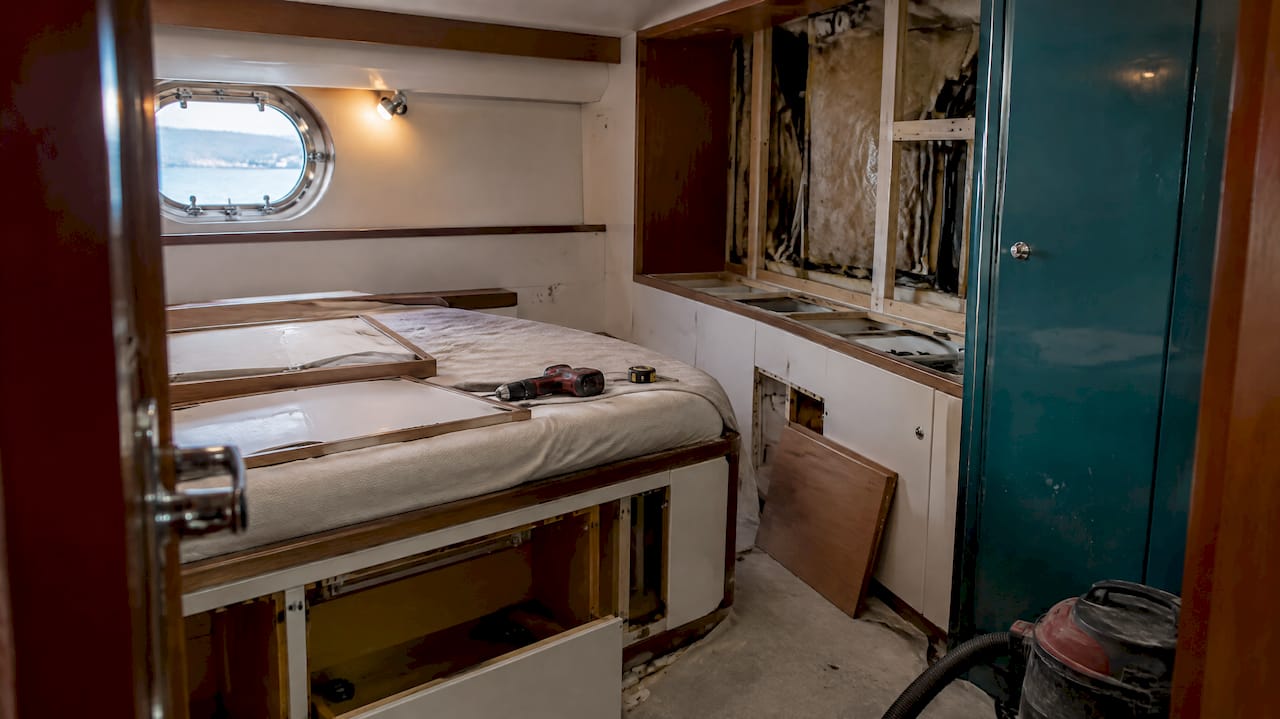
A yacht interior refit is compliant when the new layout, materials and equipment still meet the rules of your flag state and class, and when you can prove it on paper. Cosmetic work is not automatically exempt. Fire-tested materials, clear escape routes, unchanged stability and a complete document file decide whether the yacht returns to service without trouble. This guide sets out what to check before the first panel comes out, who to tell, and what to keep afterwards.
TL;DR
- Your flag state’s rules decide what applies. The yacht’s size, use (private or commercial) and flag all change the answer, so confirm the standard before you design anything.
- Tell the flag authority and class before the yard starts. Even cosmetic work can affect class or flag status through material safety or stability.
- Interior materials need fire-test evidence, and escape routes must stay open and unobstructed.
- Keep material certificates and fire-load calculations for the life of the yacht. Update them whenever an area is refurbished.
- A change of flag during a refit changes the rulebook, so plan registration and refit together.
Índice
- What “compliance” means in an interior refit
- Which interior changes involve the flag state
- Fire safety and interior materials
- Escape routes and openings
- Structure, weight, electrics and stability
- Documents and records to keep
- Surveys before the yacht returns to service
- Private versus commercial yachts, and how flags differ
- Where Vessel Flag fits into your refit
- Perguntas frequentes
- Fontes
What “compliance” means in an interior refit
In practice, compliance means three things: the work follows the technical standard your flag administration applies to the yacht, the materials and equipment carry the evidence that standard asks for, and any change to the certified condition of the yacht is reported and surveyed where required.
The flag state sits at the centre of this. Flag State Administrations are responsible for ensuring ships comply with safety and construction standards, and they often authorise Recognised Organisations to carry out surveys and issue certificates on their behalf. So the surveyor who walks through your refitted saloon may belong to a classification society, but the rules come from the flag.
Four factors decide which rules apply to you:
- Flag. Each administration publishes its own code or adopts others by reference.
- Use. A private yacht and a commercial yacht carrying paying guests are treated differently.
- Size. Gross tonnage and length move a yacht between regimes.
- Class. If the yacht is classed, the class society’s rules sit alongside the flag’s.
Flags also leave room for negotiation. Under the Maltese Commercial Yacht Code, for example, the Administration may consider alternatives or equivalents to a Code standard, provided they are reviewed and accepted by the Administration. That matters for interiors, where a designer’s preferred material or arrangement sometimes does not match the prescriptive text. The proposal has to be made in writing and accepted before the work, not argued afterwards.
Which interior changes involve the flag state
The more an interior change touches safety systems or the yacht’s certified condition, the more likely it is to need approval, notification or a survey. That typically includes lifesaving and safety arrangements, fire systems, pollution-prevention equipment, stability-sensitive changes and significant repairs, renewals or modifications, as one refit specialist’s overview of flag-state rules notes.
A useful working split:
| Type of interior work | Flag or class involvement | Porquê |
|---|---|---|
| Repainting, soft furnishings, loose furniture | Usually low, but check material fire data | Finishes and textiles can still be subject to fire-test rules |
| New joinery, linings, ceilings, bulkheads | Likely: plans and material evidence | Linings and divisions form part of the fire protection |
| Moving or removing doors, hatches, stairs | Likely: escape routes affected | Escape arrangements are a core safety item |
| Changes to galley, laundry or machinery-adjacent spaces | Likely: fire and electrical review | Higher fire risk spaces carry stricter rules |
| Heavy fittings, new tanks, structural openings | Yes: stability and structural review | Weight and structure change the certified condition |
Two points from industry guidance are worth keeping in front of you. First, the ICOMIA guide for large yachts doing maintenance work in marinas says owners should notify their Class and Flag authorities before starting any shipyard work, so that survey requirements are identified and any effect on class or flag status is determined. Second, the same guide makes the point that even cosmetic works can concern class or flag because of material safety or changes in vessel stability.
There is also a threshold to know about. Under the Maltese Commercial Yacht Code 2025, a yacht that undergoes repairs, alterations or modifications that substantially increase its service life or alter its dimensions must comply with the requirements for a new yacht. A refit scoped as “just interiors” can cross that line if it is big enough, and the standard you must meet then jumps. Ask the administration where it draws the line before you sign the work order.
Fire safety and interior materials
Fire protection is where most interior refit compliance work happens, because almost everything an interior contains is a fuel or a barrier.
SOLAS-based regimes divide a ship into fire zones and smaller spaces. SOLAS requires non-combustible linings, grounds, draught stops and ceilings, with exceptions, and sets space-specific rules for surface materials, fire loads and deck coverings. The same guidance matrix points to the Fire Test Procedures (FTP) Code for tests on non-combustibility, smoke and toxicity, divisions, surface flammability, deck coverings, textiles and upholstery.
What this means in a refit:
- Exposed finishes. Paints and varnishes on exposed surfaces must be tested so they do not produce excessive smoke or toxic fumes, in line with the FTP Code.
- Space by space. Requirements differ by type of space, so a material that is acceptable in a cabin may not be acceptable in a corridor or machinery area.
- Equipment marking. On EU-flagged yachts, materials typically need a Marine Equipment Directive wheelmark and FTP Code approval, with the certificates held on file, according to a refit contractor’s guide to what an interior refit has to prove. Treat that as a prompt to ask your own flag what it requires, not as a universal rule.
- Extinguishing media. For ships constructed on or after 1 January 2026, use or storage of PFOS-containing extinguishing media is prohibited, and removed substances must go to shore-based reception facilities. If your refit touches fixed or portable extinguishing equipment, check what is on board.
A practical habit: before a designer specifies a fabric, foam, veneer or coating, ask the supplier for the fire-test certificate and confirm with your surveyor that it suits that space. Do it at the specification stage. Rejecting a finished installation is far more expensive than rejecting a sample.
Escape routes and openings
Interior designers like to hide doors and simplify layouts. Escape arrangements are where that instinct collides with the rules.
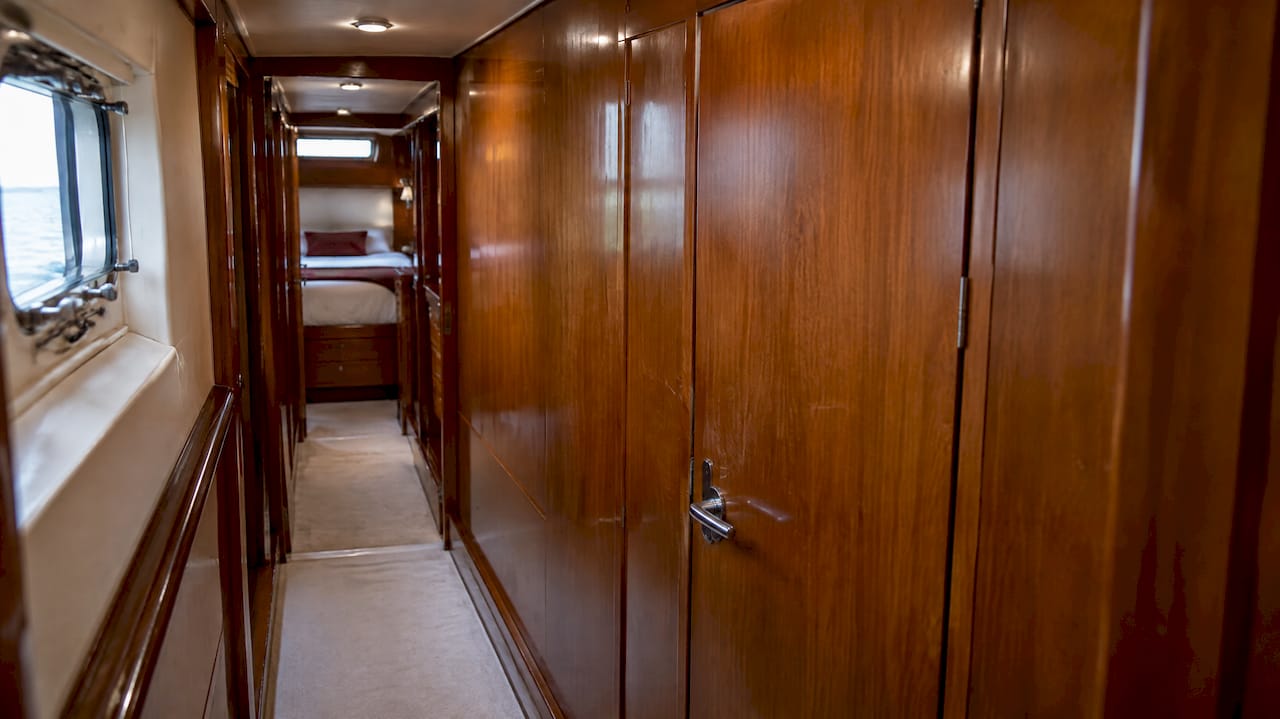
The UK Maritime and Coastguard Agency’s guidance on outfit and structural fire protection (MGN 629 Part 9) is a clear example for vessels under the UK regime. It says emergency escape routes from the wheelhouse and sleeping accommodation must be unobstructed, easily accessible and lead as directly as possible to an open deck. Hatches, doors, windows or skylights used for escape need a minimum clear opening of 500 mm x 380 mm. The same note requires emergency escape hatches or doors to stay unlocked when the vessel is occupied and to open from both sides without special tools or keys.
Other flags set their own figures, so use these as a checking example, not a universal rule. When you review a refit drawing, walk the route from every berth to open deck and ask:
- Has a new wardrobe, bar or bulkhead narrowed or blocked the route?
- Does any escape hatch now sit under a fixed table, sofa or carpet?
- Can every door on the route open without a key from either side?
- Is there a second way out where the layout used to provide one?
Structure, weight, electrics and stability
Interiors are heavier than they look. Stone, solid timber, new bathrooms, bigger galley equipment and extra air conditioning all add weight, and weight placed high or far from the centre changes stability. As noted above, even cosmetic works can concern class or flag through changes in stability. For anything beyond light decoration, ask the naval architect or class society whether the change is stability-sensitive, and expect them to want a weight estimate.
Piping and electrical work deserve the same attention. IACS has issued Recommendation 177 on machinery piping-system quality, covering fabrication, installation, commissioning and function tests, and it can also apply to repairs, modifications and retrofits on ships in service. IACS stresses that high standards in repairs and retrofits are crucial for limiting failure and keeping through-life safety. In an interior refit, that translates into pressure-testing new water, fuel-adjacent and hydraulic lines and recording the results, and having new electrical circuits installed and tested by someone qualified for marine work.
If the refit includes lifting appliances such as a tender crane or passerelle: those installed on or after 1 January 2026 must meet recognised classification society requirements or an acceptable equivalent, and be load tested and examined before first use and after major repairs, modifications or alterations.
Documents and records to keep
Compliance that cannot be shown does not count. Build the file as the work happens, not at handover.
The guidance is that owners should retain design, material and arrangement documentation and certificates, including fire-load calculations, for the life of the ship, and update the calculations when an area is refurbished. Future refit designers rely on those records to adjust or replace interiors safely.
A sensible refit file contains:
- Original and revised general arrangement and fire-control plans.
- Fire-test certificates and approval marks for every board, laminate, textile, deck covering, paint and varnish.
- Fire-load calculations, revised for each refurbished area.
- Written correspondence with the flag, class and surveyor, including any accepted alternatives or equivalences.
- Pressure-test, electrical-test and commissioning records for new systems.
- Weight and stability notes where the work was stability-sensitive.
- Photographs of concealed work before it is closed up.
One coordination tip from the same guidance: when a space is handed to a subcontractor, meet with the builder, subcontractor and the flag or recognised organisation to go through drawings and fire-load calculations. Early communication saves rework. The flag-state implications should be reviewed while the refit scope is being formed, not after the yacht is committed to a yard schedule.
Your insurer is another party to inform when the yacht’s interior, value or systems change. A boat insurance guide is a good place to refresh how cover and valuation work before you update the declared details.
Surveys before the yacht returns to service
The working rule is that significant changes to structure, equipment, systems, fittings, arrangements or materials can trigger an additional survey, as does an important repair or renewal. Which survey, and who performs it, depends on your flag and class.
Plan the end of the refit as a sequence:
- Pre-agree the survey scope with the flag or its recognised organisation while the scope is being drawn up.
- Hold inspection points before linings and ceilings close, so concealed fire protection and wiring can be seen.
- Run function tests on alarms, detection, lighting, ventilation and any new systems.
- Survey on completion and have any amended certificates or endorsements issued by the flag or its authorised body.
- Update the crew’s safety plans and drills to match the new layout.
Some flags waive certain surveys for particular yacht types or sizes. Our guide to what flags waive and what still applies in yacht survey exemptions covers that, and it is worth reading before you assume a refit needs no inspection.
Private versus commercial yachts, and how flags differ
The single biggest swing factor is whether the yacht is private or commercial. The Maltese Commercial Yacht Code shows the pattern. It is intended for commercial yachts carrying no more than 12 passengers. Private yachts under 500 GT are advised to comply voluntarily, and private yachts of 500 GT or more must comply as far as reasonable and practicable. It also gives mutual recognition to yachts entitled to fly another EU Member State’s flag.
Two consequences follow:
- A private yacht that later enters charter may face a stricter standard, so refitting to the commercial standard from the start can avoid a second round of work.
- Changing flag during or after a refit changes the applicable rulebook. Materials and arrangements accepted by one administration may need re-examination by another.
The second point is why we advise owners to settle the flag first, or at least to shortlist it, before the interior is specified. If you are still choosing, our overview of registo internacional de iates sob bandeira estrangeira explains the options, and if you already have a flag but want to move, a yacht deletion certificate is part of leaving the old registry.
Our view: decide the flag before you draw the interior
We prepare and file registration applications for private owners, companies and brokers under eight flags: Poland, San Marino, UK Part 1, Malta, Palau, the Marshall Islands, the Cayman Islands and the Cook Islands. We also handle other flags on request. That gives us a particular view of refits: the expensive mistakes rarely come from the joinery. They come from the order of decisions.
An owner commissions a beautiful interior, then discovers the target flag applies a different standard for the yacht’s use or size. Or an owner changes flag mid-refit and the certificates in the file no longer match the administration’s expectations. Both are avoidable if registration is planned alongside the design brief.
Our advice is simple. Pick the flag and the intended use (private or charter) first. Ask that administration, through your surveyor, how it treats your planned scope. Keep every material certificate. Then let the designer work within known limits.
We are a private consultancy, not a registry. Certificates are issued by the flag registries, and we prepare and file the paperwork for them, fully remotely, with published one-off prices for the main flags.
Vessel Flag
Where Vessel Flag fits into your refit
If your refit is tied to a registration, a change of flag or a new ownership structure, we can handle the paperwork while your yard and designer handle the work. Published one-off prices start at €290 for San Marino, €320 for Poland, €550 for UK Part 1 and €849 for Malta. Marshall Islands is a €250 service fee plus registry fees, and Cayman Islands a €450 service fee plus registry fees. Palau is from €700. We also arrange MMSI numbers and ship radio licences, company formation for yacht ownership, and transfers between flags. Interior design, insurance and transport are available through our services page, with details on request.

For a UK Part 1 yacht, owners can register personally if eligible, through an existing company (UK or an eligible foreign company, such as a Delaware corporation) or through a new UK LTD. A UK company is not always required. Our serviço de constituição de empresas covers the options when a structure is needed. After a refit that adds or replaces radio equipment, the MMSI and ship radio licence should match the new set-up: in the UK the licence takes one day, and our MMSI radio licence page lists the prices by flag.
Perguntas frequentes
Do I need flag approval for a purely cosmetic interior refit?
Not always, but you should not assume so. Industry guidance says even cosmetic works can concern class or flag because of material safety or stability changes. Ask your surveyor or the flag administration before work begins, and keep fire-test certificates for the materials you use.
How long should I keep refit certificates and fire-load calculations?
Keep them for the life of the yacht. Future refit designers rely on them to alter or replace interiors safely, and the calculations should be updated whenever an area is refurbished.
Does a private yacht have to meet commercial yacht standards?
It depends on the flag, size and use. Under the Maltese code, for example, private yachts under 500 GT are advised to comply voluntarily, while private yachts of 500 GT or more must comply as far as reasonable and practicable. Check the position with your own administration.
Can I propose an alternative to a code requirement?
Often yes. Some administrations, Malta’s among them, may accept alternatives or equivalents to a standard, but only after review and acceptance by the administration. Submit the proposal in writing before the work, with supporting evidence.
Fontes
- IMO: Surveys, verification and certification
- Malta Commercial Yacht Code (2015)
- Malta Commercial Yacht Code (2025)
- Flag State Rules in a Yacht Refit: Surveys, Certificates
- ICOMIA guide for large yachts carrying out maintenance work in marinas
- Guidance materials matrix for accommodation spaces (IMO rules)
- Navigating the minefield of regulations relating to marine interiors
- What a yacht interior refit has to prove
- MCA MGN 629 Part 9: Outfit and structural fire protection
- IMO Resolution MSC.532(107)
- IACS Recommendation 177 on machinery piping systems
- Boat insurance guide
Ready to line up the flag before your refit? See the relevant flag page, such as UK Part 1 yacht registration ou Malta yacht registration, then get a consultation with Vessel Flag.
VesselFlag is a private consultancy that prepares and files yacht registration applications for owners. We are not a government body or flag registry; certificates are issued by the relevant registry. This article is general information, not legal advice.