

A Port State Control (PSC) inspection is a visit by an officer of the country you are visiting. They check that your yacht, its equipment and its crew meet international rules. Most visits start with your certificates and a walk round the vessel. Detention is the serious outcome, and it is usually avoidable with valid paperwork and well-maintained safety equipment. This guide is for owners, captains and brokers of larger and commercial yachts, and explains how an inspection runs, what is looked at and what to do before and after.
TL;DR
- PSC is the inspection of foreign ships in national ports. The IMO describes it as checking ship condition, equipment, manning and operation against international rules.
- Inspectors start with certificates and a general examination. Expired certificates, missing flag State endorsements and defective safety equipment are the typical problems.
- Detention is considered when a ship cannot safely sail, fight fires, abandon ship or keep watertight integrity, not for cosmetic faults.
- Preparation is mostly document control, planned maintenance of fire and life-saving gear, and a crew member who knows the vessel and meets the officer at the gangway.
- Your flag choice and its registry support affect how well your paperwork stays in order.
Índice
- What a PSC inspection of a yacht is
- Which yachts can be inspected
- How an inspection proceeds
- What inspectors check on a yacht
- Common deficiencies on yachts
- When a yacht can be detained
- How to prepare for an inspection
- Where your flag and paperwork fit in
- Registration and radio licences with Vessel Flag
- Perguntas frequentes
- Fontes
What a PSC inspection of a yacht is
Port State Control exists because a flag State cannot be everywhere. Instead, the country whose port you enter checks foreign ships itself. According to the IMO, the aim is to verify that the ship and equipment comply with international regulations, that the ship is manned and operated accordingly, and so to protect safety, security and the marine environment.
The inspection is not a survey for your certificates. The Paris MoU guidance says the report is not a declaration of seaworthiness and is not a survey for issuing or renewing statutory certificates. It describes the inspection as a sampling process that gives a snapshot of the vessel’s condition at the time of the visit. That is useful to remember: the officer sees what is in front of them on the day, so the day-to-day state of the yacht is what counts.
Which yachts can be inspected
Any foreign ship can be inspected. The Swedish Transport Agency says that all foreign ships may be inspected, but selection is risk-based. The criteria include the quality of the flag State, the company’s performance history, earlier inspection results, and the ship’s type and age.
That has two practical consequences for yacht owners:
- Your record follows you. Clean previous inspections lower your risk profile, and a poor history raises it.
- Your flag matters. The flag State’s own standing is one of the selection inputs.
Private and commercial yachts
Requirements differ with use and size. Commercial yachts carry the full certification burden, and several flag registries publish PSC advice for them. In the United States, the Coast Guard’s policy letter CG-CVC 15-04 says foreign-flagged yachts of 300 gross tons or more must submit a Notice of Arrival and hold a Certificate of Financial Responsibility. Yachts certificated under SOLAS or other commercial and international codes are screened and, depending on points and priority, may receive a safety exam. If you are planning a US cruise, our guide to foreign yacht registration for US owners covers the flag side.
In Europe, the Cayman Islands Shipping Registry’s Yachtmaster’s Handbook explains that in the Paris MoU region a yacht reports 24 hours before arriving at a port or anchorage, or before leaving the previous port if the voyage will be shorter. Where the yacht is subject to an expanded inspection, 72 hours’ notice of arrival is required. Always confirm the current notification rules of the port you are entering.
How an inspection proceeds
O Paris MoU describes three layers.
- Initial inspection. The officer reviews the ship’s certificates and documentation, then carries out a general examination of overall condition, safety standards and compliance with the applicable conventions. Operational procedures may be checked to see that the crew can perform key safety functions.
- More detailed inspection. This follows when there are clear grounds to believe the ship, equipment or crew do not substantially comply. Missing or invalid certificates and observed deficiencies are examples. Ships flying the flag of a State that has not ratified all relevant Paris MoU instruments are also subject to a more detailed inspection.
- Expanded inspection. The Swedish Transport Agency says this is for high-risk ships and certain ship types.
The officer also keeps professional discretion. The Paris MoU’s own instructions say that its guidance does not restrict the officer in the scope of the inspection or in using professional judgement. Do not assume a checklist from last year will be the only thing examined this year.
At the end, the master receives a report of the results.
What inspectors check on a yacht
The Swedish Transport Agency lists the main areas: certificates and documentation, ship condition, fire safety, life-saving appliances, working and living conditions, and operational procedures. The US Coast Guard’s guidance adds detail on the walk-through. Officers should check that life-saving and firefighting equipment is sufficient for the people on board and properly maintained, and that the crew know their emergency duties. They also carry out limited testing of navigation and pollution prevention equipment and look at machinery and public spaces for safety hazards.
A practical way to think about it:
| Area | What the officer is likely to want to see |
|---|---|
| Documents | Registry certificate, safety and radio certificates, crew documents, all valid, endorsed and on board |
| Radio | A valid ship radio licence and MMSI that match the vessel’s details |
| Fire safety | Detection and alarm working, fire doors closing, pumps starting, crew drills understood |
| Life-saving | Lifeboats, rafts and lighting ready, engines starting when required |
| Hull and machinery | Watertight doors closing, no exposed cabling, no corrosion damage |
| Crew and living conditions | Manning in line with the safe manning document, wages and conditions in order |
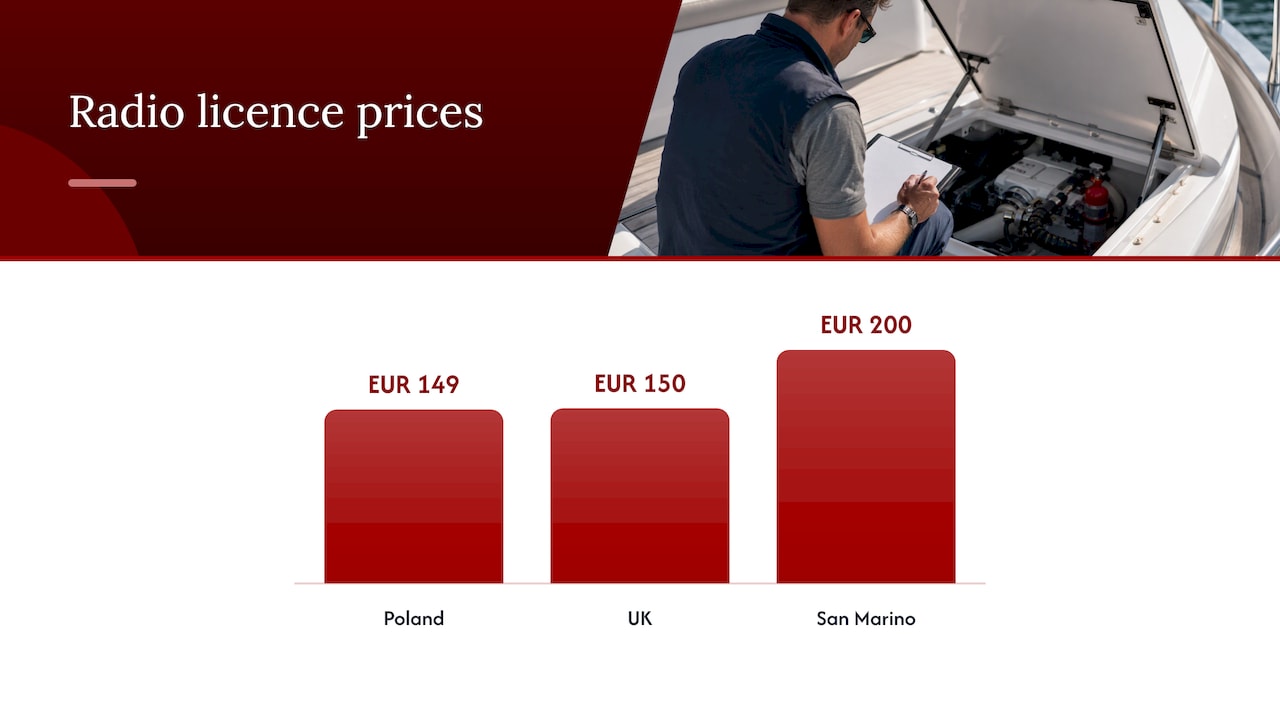
Radio paperwork is often the quiet gap. If your MMSI or radio licence is out of step with your flag or vessel details, it is cheap to fix before a port call. Our MMSI and ship radio licence service is priced at EUR 149 for Poland, EUR 150 for the UK and EUR 200 for San Marino, VAT included, with no annual fees.
Common deficiencies on yachts
The Cayman Islands Shipping Registry’s PSC advice for commercial yachts says that after recent detentions, notably in Italy, it is paramount that all mandatory certification, records and documentation are valid and available on board. Its typical deficiencies include:
- expired certificates
- no flag State endorsements
- charts missing or uncorrected for the intended voyage
- a missing Garbage Management Plan
- a non-functioning BNWAS (bridge navigational watch alarm system)
SAFETY4SEA reports yacht-specific findings that include boarding arrangements, reduced-height guardrails and bulwarks that need a risk assessment, and storage and firefighting procedures for lithium-ion batteries and battery-powered toys. These are findings for Cayman-flagged vessels in 2020, but the themes apply to any large yacht with tenders and toys.
More serious defects lead to detention. The classification society Dromon Bureau of Shipping lists examples from recent inspections: exposed electric cabling, a holed engine room funnel, severely corroded watertight doors that would not close, inoperative emergency lighting at the lifeboat embarkation area, an emergency fire pump that could not be started within 20 minutes, a lifeboat engine that would not start within 5 minutes, and a malfunctioning fire detection system. Almost all of these are maintenance and testing failures, which a planned maintenance routine catches.
When a yacht can be detained
Under IMO Resolution A.1052(27), a ship is substandard if its hull, machinery, equipment or operational safety is substantially below the required standard, or if the crew does not conform to the safe manning document. Causes include missing principal equipment, substantial deterioration, insufficient operational proficiency, or insufficient manning or certification.
When deciding on detention, the officer asks whether the ship has valid documentation and the required crew, and whether the ship and crew can:
- navigate safely and operate the engine room safely
- maintain propulsion and steering
- fight fires and abandon ship quickly and safely
- prevent pollution and maintain stability and watertight integrity
- communicate in distress and provide safe, healthy conditions on board
If any answer is negative, the ship should be strongly considered for detention. The US Coast Guard guidance adds that detention should be used only if the vessel is substandard and unfit to proceed to sea or an unreasonable risk to the environment.
After a detention
In principle, all deficiencies should be rectified before departure. The Paris MoU instruction says that in a detention all deficiencies are marked to be rectified before departure at the first visit. Once all possible efforts have been made in the port of detention, the officer may change the action code for non-detainable deficiencies so the vessel can sail on to a port where they can be fixed.
Contact your flag registry quickly. The Cayman Islands handbook says the master and owner should notify the registry first, and that it will usually carry out its own flag State inspection soon after a justified detention. Other registries have their own rules. For example, Barbados requires a root cause analysis within 30 days of detention unless agreed otherwise, and evidence of wage payments where wages were the issue. Ask your own registry what it requires.
If repairs need funding, early planning helps. Owners comparing vessel financing decisions will find that clear costings and a documented corrective plan make a request easier to assess.
How to prepare for an inspection
BIMCO advises that good preparation, an open mind and a positive attitude matter. The officer should be met at the gangway and accompanied by an appointed, competent person, and first impressions influence the rest of the inspection.
A working routine looks like this:
- Keep a certificate register. List every certificate, its expiry, the survey or endorsement it needs and where the original is. Review it monthly, and before every voyage.
- Check flag endorsements. Expired or unendorsed certificates are among the most common findings, so confirm endorsements with your registry in good time.
- Update charts and publications for the intended voyage, and keep the Garbage Management Plan on board.
- Test, do not assume. Run emergency fire pump, emergency generator, emergency lighting, fire doors, watertight doors, alarms and lifeboat engines on a schedule and log the results.
- Drill the crew. Everyone should know their emergency duties and where equipment is.
- Appoint the escort. One competent person, usually the captain or chief engineer, meets the officer and knows where everything is.
- Give notice correctly. Make the arrival notifications that the port and region require.
- Plan the close-out. If deficiencies are raised, answer them in a clear structure. RightShip’s guidance suggests sections for the finding, explanation, immediate cause, root cause analysis, corrective actions, preventative measures and approval. It also warns against vague causes such as “human error” without elaboration.
Where your flag and paperwork fit in
Our view at Vessel Flag is that most PSC trouble begins long before the port call, in paperwork that has drifted: a certificate that expired, a radio licence that no longer matches the yacht, or an ownership change that was never reflected in the registry.
We are a private consultancy, not a registry. We prepare and file registration applications, and the flag registries issue the certificates. That division is useful in practice: you have one team keeping the application file, MMSI details and ownership structure consistent, while the registry handles the certificates themselves.
Because the flag State’s quality is one of the factors in how ships are selected, we encourage owners to choose a flag that fits how the yacht is used, then keep its documents current. We work with eight flags with published prices: Poland, San Marino, UK Part 1, Malta, Palau, the Marshall Islands, the Cayman Islands and the Cook Islands. We are a listed agent with the San Marino and Palau registries, and we can arrange company formation, the MMSI radio licence and transfers between flags. Our process is fully remote, with published one-off prices.
Vessel Flag
Registration and radio licences with Vessel Flag
If your registration, ownership structure or radio licence needs to be put in order before your next cruise, Vessel Flag prepares and files the applications for you, remotely, at published one-off prices. Examples: Poland registration from EUR 320, San Marino from EUR 290 and UK Part 1 from EUR 550. For UK Part 1, owners can register personally if eligible, through an existing company (UK or an eligible foreign one, such as a Delaware corporation), or through a new UK LTD. Provisional papers for Poland take 2 to 5 days. The San Marino provisional certificate takes 2 to 6 days and is not guaranteed. The UK MMSI licence takes 1 day. The Polish MMSI licence takes 4 to 6 weeks after registration.
See our international yacht flag registration overview or compare Poland, San Marino and UK Part 1. For radio, see our MMSI number registration page.
Perguntas frequentes
Do private yachts get PSC inspections?
Any foreign ship can be inspected, and selection is risk-based. How much applies depends on size, use and the conventions that cover the vessel. Where parts of the conventions do not apply, the officer assesses whether the ship is acceptable for safety, health and the environment, taking account of size, type and the intended voyage.
How long does a PSC inspection take?
There is no fixed duration. It depends on the layer of inspection and on what the officer finds. A clean initial inspection is mainly a review of certificates and a walk-through, while a more detailed or expanded inspection takes longer. The Paris MoU guidance says that officers keep professional discretion on scope.
What happens if deficiencies are found?
The master receives a report. The officer decides on action, including whether any deficiency is a ground for detention. In principle, deficiencies should be rectified before departure. In a detention, all deficiencies are marked for rectification before leaving, and your flag registry should be informed promptly.
Can anyone report a yacht to the port State?
Yes. IMO Resolution A.1052(27) says that a crew member, professional body, association, trade union or other interested person can submit information in writing about a ship that appears substandard. This is one more reason to keep crew conditions in order.
Ready to put your yacht’s papers in order? Choose your flag on our flag registration pages, for example Registo de iates em San Marino, and then get a consultation with Vessel Flag.
Fontes
- IMO: Port State Control
- Transportstyrelsen: Port state control
- Paris MoU: Inspection type
- Paris MoU: General principles to be applied in a PSC inspection
- USCG policy letter CG-CVC 15-04
- Cayman Islands Shipping Registry: Yachtmaster’s Handbook
- Cayman Islands Shipping Registry: PSC advice for commercial yachts
- SAFETY4SEA: PSC performance onboard Cayman Islands vessels
- Dromon Bureau of Shipping: Alert on detainable deficiencies
- IMO Resolution A.1052(27)
- Barbados Maritime Services Registry: Bulletin 006
- BIMCO: Inspection regime Paris MoU
- RightShip: PSC inspection closeout guidance
- The Owners Club: Port State Control
- Kapvoy: Vessel financing
VesselFlag is a private consultancy that prepares and files yacht registration applications for owners. We are not a government body or flag registry; certificates are issued by the relevant registry. This article is general information, not legal advice.