
If you searched for Poland temporary registration and you own a boat, you are in the right place. Most pages for that phrase cover residence addresses or cars. This guide covers vessels. In Polish practice, “temporary” can mean two different things for a yacht: the interim paper you hold while your application is processed, and the formal status of temporary Polish nationality for a ship that stays in a foreign register. We explain both, what each costs, what it does not let you do, and how to pick the route that fits your situation.
TL;DR
- For yachts and small craft under 24 m, the practical “temporary” document is the certificate of submission. It is issued once your application is checked as complete, and you can use it until the registration document arrives or a refusal is delivered (REJA24 guide for owners).
- Temporary Polish nationality is a separate, formal status under the Maritime Code. It lets a vessel fly the Polish flag while its foreign registry entry is suspended, subject to Polish manning and safety rules (Kochanowski, 2017).
- The standard REJA24 application fee is 80 PLN, and registration is not subject to stamp duty (REJA24 FAQ).
- A recreational Polish-flagged yacht is private use only. Charter, bareboat or crewed, is not allowed (REJA24 requirements).
- Registration alone does not make a yacht legal to operate: safety documents and qualified crew still apply.
Índice
- What “temporary registration” means for a vessel in Poland
- Which route fits your boat
- Who is eligible
- Documents you should prepare
- Where and how to apply
- Fees and timing
- What temporary registration does not let you do
- Validity and what happens when it ends
- Our perspective
- Let us handle the Polish file
- Perguntas frequentes
- Fontes
What “temporary registration” means for a vessel in Poland
Poland has two regimes, and owners mix them up often.
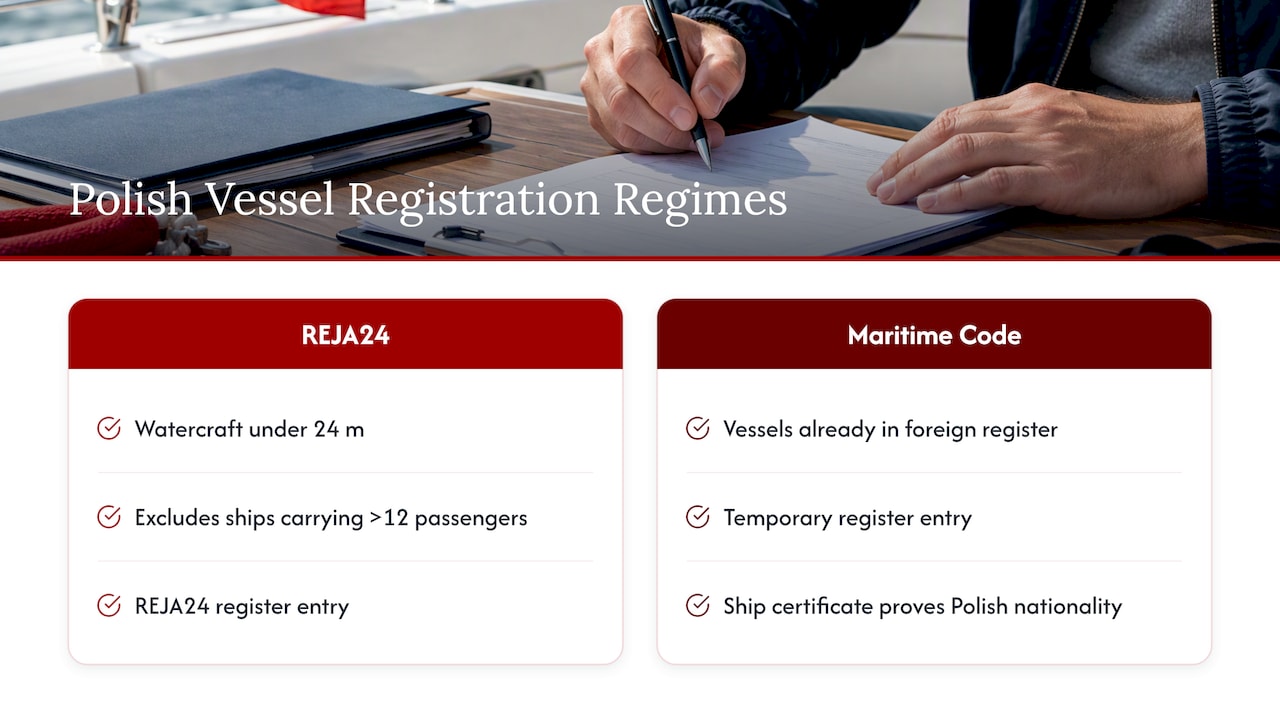
The first is the register of yachts and other watercraft under 24 m in length, run through the REJA24 system under the Act of 12 April 2018. This is where nearly all pleasure boats and private yachts are registered. The law does not apply to passenger ships carrying more than 12 passengers, which go into the Register of Ships under the Maritime Code (REJA24 requirements and documents).
The second is the Polish Register of Ships under the Maritime Code, which has its own provision for temporary nationality. A vessel with temporary Polish nationality is entered in a temporary register, and after entry it receives a ship certificate proving its Polish nationality (Kochanowski, 2017).
So when someone says “I have temporary Polish registration,” ask which one they mean. The answer changes the paperwork, the cost and what you can do with the boat.
The certificate of submission: the everyday meaning
Under REJA24, once the registration authority verifies that your application is complete, it issues a certificate of submission. You may use it until the registration document is issued or a refusal decision is delivered (REJA24 guide for owners). For an owner who has just bought a boat and wants to move it, this is the interim document that matters.
It is not a different type of registration. It is evidence that a complete application is pending. Treat it as a bridge, not a destination.
Temporary Polish nationality: the formal status
This status is for a vessel that already sits in another register. It allows the vessel to fly the Polish flag while remaining in its foreign underlying register, after its previous nationality has been suspended. The operator must comply with Polish manning and safety rules (Kochanowski, 2017).
This is closer to a bareboat-style flag change than to a quick pleasure-boat registration. It matters mostly for ships and commercial operations, and it is rarely what a private yacht owner needs.
Which route fits your boat
| Situation | Likely route | What to expect |
|---|---|---|
| Private yacht under 24 m, bought abroad, you want the Polish flag | Standard REJA24 registration, with the certificate of submission while you wait | Application checked, interim certificate, then the registration document |
| Inland-waterway vessel from another EU state | Temporary entry under the Inland Navigation Act | Proof of right to dispose of the vessel and consent from the permanent-registration state |
| Seagoing ship that must keep a foreign underlying register | Temporary Polish nationality under the Maritime Code | Foreign nationality suspended, Polish manning and safety rules apply |
| Passenger ship over 12 passengers | Register of Ships, not REJA24 | Full ship requirements |
If your boat is a pleasure yacht bought outside Poland, the first row is almost certainly you. We cover that case step by step in our guide to the Polish flag for a yacht bought abroad.
Who is eligible
Eligibility depends on the regime. For inland-waterway vessels, Poland’s Inland Navigation Act allows temporary entry of a non-Polish vessel where the persons named in the Act provide evidence of the right to dispose of the vessel and written consent from the competent authorities of the state of permanent registration. The same provision covers a vessel owned by an individual citizen of another EU Member State or a legal person established in another EU Member State, provided ownership evidence and the required documents are supplied (consolidated Act, 2025).
For seagoing temporary nationality, the vessel loses the status if a requirement in Article 13 § 1 ceases to be met, the authorized period expires without extension, the operator asks to end it, the operator breaks the rules in that section, or a decision under Article 18 is issued. The loss takes effect when the vessel is removed from the Polish ship register on a Maritime Chamber order (Kochanowski, 2017).
For US owners, the question we hear most is whether a non-EU owner can use the Polish flag at all. Eligibility turns on the ownership structure and the regime, so look at our overview of foreign yacht registration for US owners before you plan around a particular route.
Documents you should prepare
The official sources we reviewed do not give one fixed list that fits every vessel, so treat the following as a working checklist and confirm it with the registration point you use. What applications of this kind generally turn on is:
- Proof of ownership. A bill of sale or purchase contract, and the chain of title if the boat changed hands.
- Proof of the previous registration status. If the vessel was registered elsewhere, evidence of that and of its deletion or suspension. For temporary entry of an inland vessel, the Act specifically asks for consent from the state of permanent registration (consolidated Act, 2025).
- Identity and, for companies, corporate documents. Passport for an individual owner; registry extracts and authority to sign for a company.
- Vessel details. Make, model, hull number, length, engine data and photographs.
- Payment of the fee. See the next section.
Foreign-language documents usually need to be translated before a Polish office will accept them. Our note on yacht document translation for registration lists which documents to translate and which can stay as they are.
Where and how to apply
REJA24 applications can be filed electronically or on paper, in person, at a registration authority. The portal lists more than 380 registration points, including county and city offices and named boating associations (REJA24 e-services).
Two practical consequences follow:
- The registration document is collected in person. It must be picked up at the registration point and cannot be mailed to you (REJA24 e-services). If you live in the US, plan for a visit or arrange for someone authorized to act for you.
- The office you choose matters. Different registration points work at different speeds and with different levels of experience with foreign-bought vessels.
A typical sequence looks like this:
- Choose the regime and registration point.
- Assemble and translate the documents.
- Submit the application and pay the fee.
- Receive the certificate of submission once the application is confirmed complete.
- Collect the registration document when it is issued.
Fees and timing
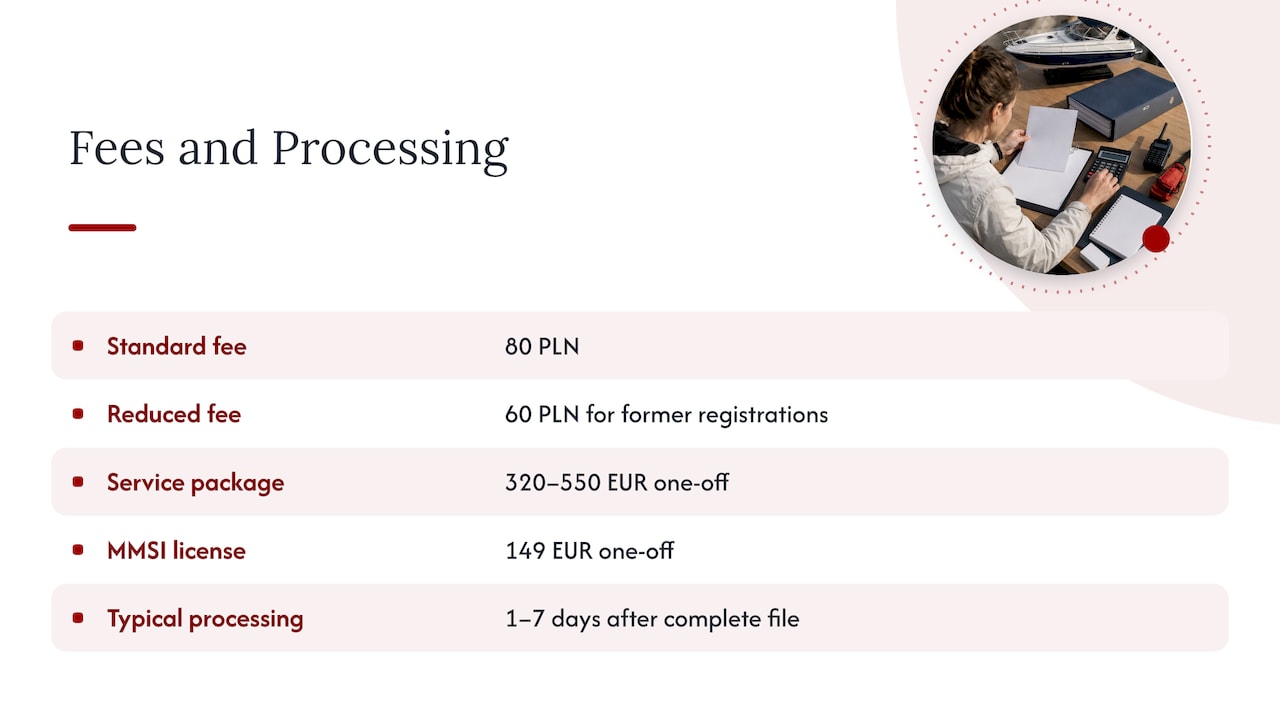
The standard REJA24 application fee is 80 PLN. A reduced fee of 60 PLN applies to a previously registered vessel that must be re-registered under the former-registration transition rules. Registration is not subject to stamp duty, because applications carry their own public-law fees (REJA24 FAQ).
That is the state fee only. The cost of getting there, including translations, travel, any technical inspection and professional handling, comes on top. Our fixed-fee Poland flag registration service is published at 320 to 550 EUR one-off, depending on the package, and the Polish MMSI license is 149 EUR one-off.
On timing, the official pages give no single processing time, so do not rely on a number from a forum. What we can say from our own work is that provisional registrations across the six main registries we handle typically take 1 to 7 days once the file is complete. The word that matters is complete: missing consent letters and untranslated documents cause most delays.
If you are weighing Poland against another flag on cost over several years, our 5-year cost comparison of San Marino and Poland sets the numbers side by side.
What temporary registration does not let you do
This is where owners get caught.
It does not make the boat legal to operate by itself. Every yacht must meet Polish safety and technical requirements, confirmed by an appropriate document, and be manned by a qualified crew (REJA24 requirements).
A safety certificate may be required. The Yacht Safety Certificate is mandatory for seagoing commercial yachts of any size and for seagoing recreational yachts over 15 m. For recreational yachts up to 15 m it is recommended but not obligatory (REJA24 requirements).
It does not allow charter. A recreational yacht may be used for private purposes only. Polish law does not allow it to be used commercially, including bareboat or crewed charter (REJA24 requirements). The line is drawn by use, not by whether money changes hands, which we explain in private vs commercial yacht registration. If charter is your plan, choose a different flag before you buy.
It does not cover radio. Your boat still needs a ship station license and, if you want an MMSI, one issued in the flag state’s name. Our page on the Poland radio license, MMSI and SRC walks through the sequence.
Validity and what happens when it ends
The certificate of submission lasts only until the registration document is issued or a refusal is delivered (REJA24 guide for owners). If you are told it has a fixed number of days, ask the office to show you where that is written.
For temporary Polish nationality, the status ends when the authorized period expires without extension, among other triggers listed above. So before the period runs out you must either ask for an extension or move the vessel to a permanent solution. Do not wait until the last week: removal from the Polish ship register on a Maritime Chamber order is what makes the loss effective (Kochanowski, 2017).
Our perspective
We handle registrations under six major flags every day, and the pattern with Poland is consistent. Owners rarely fail because Poland is hard. They fail because they start before they know which regime applies, and then discover that the interim paper they were given does not do what they assumed.
Our advice is short. Decide the use of the boat first: private or commercial. Decide where it will actually sail, because that determines which safety documents and radio licenses you need. Only then pick the flag. Poland suits a private yacht owner who wants a European flag at a modest published cost and who does not need charter. If any of those assumptions is wrong, another registry will serve you better, and we will say so rather than file an application that will not do the job.
We also push owners to treat the interim certificate as a clock, not a result. The goal is the registration document in your hand, with the radio license and insurance lined up behind it.
— VesselFlag
Let us handle the Polish file
If you want the paperwork done correctly the first time, we manage the whole file: document checks, translations, submission, follow-up with the registration point and the Polish MMSI license. Pricing is fixed and published. Poland flag registration runs 320 to 550 EUR one-off, and the Polish MMSI license is 149 EUR one-off.
Start on the Poland flag registration page, or see our other services for insurance and transport.
Perguntas frequentes
Is temporary registration in Poland the same for a boat and for a person’s address?
No. Address registration for foreigners is a residence matter handled by municipal offices, and it is unrelated to vessel registration. For a boat, “temporary” refers to the certificate of submission under REJA24 or to temporary Polish nationality under the Maritime Code.
Can I sail my boat while the application is pending?
The certificate of submission can be used until the registration document is issued or a refusal arrives (REJA24). You must still meet the safety, equipment and crew requirements, and the boat cannot be chartered. Confirm with the registration point before a long passage.
Can someone else submit the application for me?
Applications can be filed electronically or on paper in person at a registration point (REJA24). The registration document itself must be collected at the point and cannot be posted. We act for owners who cannot travel, so ask us how the authorization is set up for your case.
How much does it cost?
The standard state fee is 80 PLN, or 60 PLN for the reduced re-registration case, with no stamp duty (REJA24 FAQ). Our fixed-fee service for Polish registration is 320 to 550 EUR one-off, plus 149 EUR for the Polish MMSI license if you need it.
Can a US owner use the Polish flag?
It depends on the regime and on how the vessel is owned. Owners from outside the EU often use a company structure, and the right choice depends on your use of the boat. Our guide for US owners of foreign-flagged yachts covers the options.
Fontes
- Wademekum właściciela jednostki pływającej, REJA24
- Registration of vessels in the Polish Register of Ships, Kochanowski (2017)
- Inland Navigation Act, consolidated text, Sejm (2025)
- e-Services of the REJA24 system
- REJA24 FAQ
- Requirements and documents, REJA24