

For most owners the electronic certificate is the faster, safer-to-store option, and registries that issue it treat it as legally equal to paper. The catch is that acceptance depends on the flag. Some registries want a verified electronic original, some still issue paper, and port officials may ask for a printout. Choose after you know what your registry issues, what your cruising plan demands and how you will prove the document is genuine.
TL;DR
- An e-certificate carries the same content as the paper original, plus an electronic signature and a way to verify it online. Where a registry approves it, it has the same administrative effect as paper.
- E-certificates are dispatched immediately. Paper originals travel by courier and can arrive late, which matters when a sale, charter or departure is waiting.
- Always keep the certificate, in whichever form, accessible onboard. Some authorities ask for a printed copy at port entry, and laminating a paper certificate can invalidate it in Canada.
- Rules differ by flag, so confirm with your registry which form it issues, how it is verified and what foreign ports expect.
- A screenshot is not a certificate. Verify through the registry’s official channel.
Índice
- What actually differs between the two
- Is an e-certificate legally the same as paper?
- Security: which is harder to fake?
- Delivery time and day-to-day handling
- Inspections, port calls and international voyages
- Does the vessel need a paper original onboard?
- Do rules vary by flag and vessel type?
- What to confirm with your registry before relying on an e-certificate
- Which should you choose?
- How we see it
- Registering with the right certificate from the start
- Perguntas frequentes
- Fontes
What actually differs between the two
A paper registration certificate is a physical original, signed and stamped by the registry. According to the Korean Register’s FAQ on e-certificates, only one original copy of a paper certificate is considered valid, and it must be onboard. If it is lost, damaged or delayed, you are waiting for a replacement.
An e-certificate contains the same content. What changes is the form of authentication: the Korean Register explains that it carries an electronic signature and a verification link, and can be downloaded online. Anyone checking it can confirm it against the issuer’s server instead of judging a stamp by eye.
O 2026 IMO circular on electronic certificates sets the baseline for what a proper e-certificate looks like. It must be protected from unauthorized edits, carry a unique tracking number for verification, show visible confirmation of who issued it and use an electronic signature. Note that this circular is written for ships under international conventions. Many yachts and small craft are registered under national or private-yacht rules, so the principle applies, but the exact format depends on your registry.
Side-by-side comparison
| Criterion | Paper certificate | E-certificate |
|---|---|---|
| Form | Physical original, hand-signed and stamped | Electronic file with electronic signature |
| Verification | Visual check of seal and signature | Unique number, online verification with the issuer |
| Delivery | Courier, can be delayed | Dispatched electronically right after issue |
| Loss or damage | Replacement needed | Re-download from the issuer’s system |
| Tamper protection | Depends on seals and physical security | Edits invalidate the document |
| Port or inspection use | Accepted where original is required | Accepted by many authorities, printout sometimes requested |
| Tracking of expiry | Manual | Alerts possible in digital systems |
Is an e-certificate legally the same as paper?
Where the registry has approved it, yes. Vanuatu’s maritime administrator states in Circular No. 026 that approved electronic Registry and statutory certificates, with an authorized electronic signature, a unique identifier and a QR code or equivalent, have the same administrative effect as authorized paper documents, subject to applicable conventions and law.
Legislation has moved the same way elsewhere. Hong Kong’s amendment ordinance on electronic certificates and log-books came into force on 1 August 2023, giving electronic certificates the same legal effect as their paper counterparts. The Marshall Islands authority, in its February 2025 notice, treats RMI electronic documents bearing an electronic signature as valid originals, and requires that they can be printed onboard when needed.
The point for you: “valid” always means valid under the issuing registry’s rules. An electronic file from a registry that does not issue them is just a file. Conversely, a registry may issue paper only, and you cannot choose otherwise.
Security: which is harder to fake?
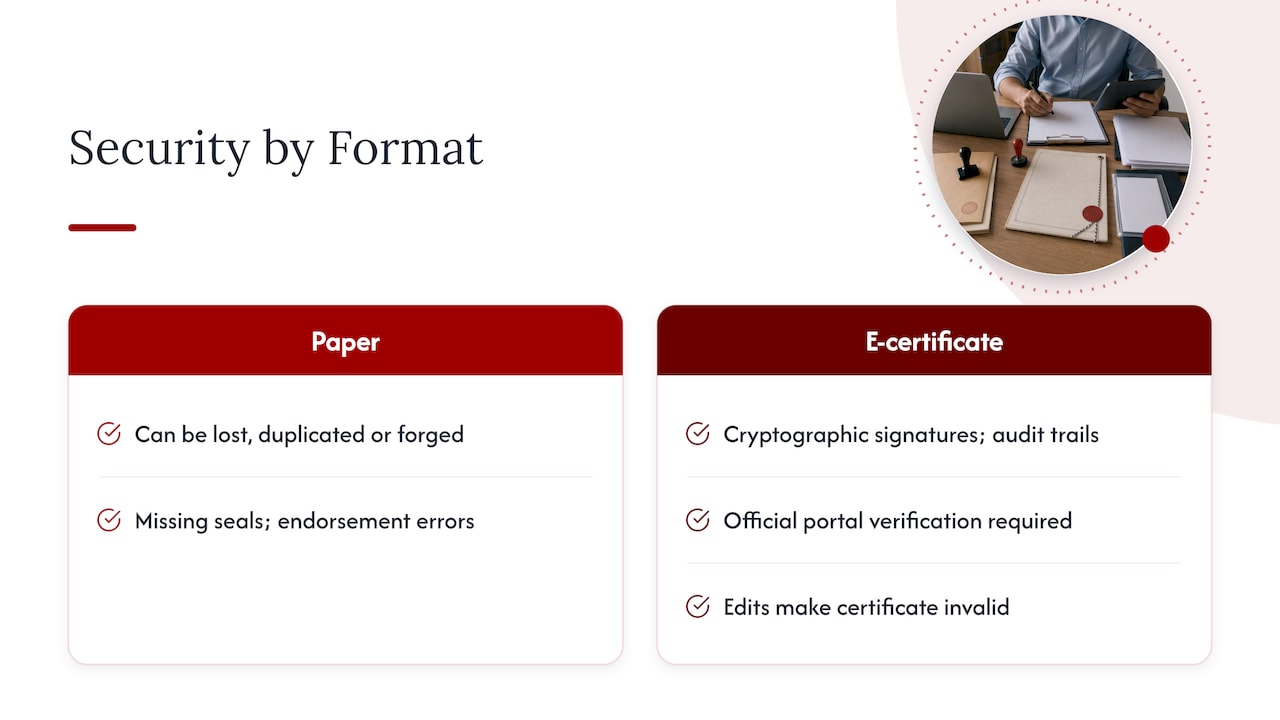
Paper has a reputation for being trustworthy because you can hold it. In practice, it is the easier one to alter or forge. A May 2025 PDMS article on digital certificates notes that paper certificates can be lost, duplicated or forged, while digital ones use cryptographic signatures, audit trails and access controls.
The Korean Register makes a similar point: electronic signatures and online server validation reduce falsification risk, and any attempt to modify a certificate makes it invalid. It also says e-certificates help avoid problems common in Port State Control inspections that stem from paper errors, such as missing seals or improperly endorsed documents.
There is one practical consequence. Vanuatu’s administrator warns that screenshots, copied QR images and third-party database entries do not replace verification through the official portal. So the security of an e-certificate lives in the verification step. Keep the original file as issued, keep the verification link or number, and do not send around edited or re-saved copies.
Delivery time and day-to-day handling
Speed is the most visible difference. A 2023 EMSA presentation on electronically issued certificates describes paper certificates as hand-signed and stamped, creating the administrative burden of physical delivery and possible courier delays, which electronic dispatch removes. Paper may not arrive in time. An e-certificate is dispatched immediately.
For an owner, this shows up in three situations:
- Buying or selling. A buyer waiting on registration documents can start the next step the day the certificate is issued rather than after a parcel clears customs.
- Charter start dates. A late courier can delay a season’s first booking.
- Remote owners. If you live in one country and the boat is in another, paper means someone has to receive and carry it to the vessel.
Digital systems also help afterward. The PDMS report says they allow automatic tracking and expiry alerts, whereas paper management is manual and raises the risk of carrying outdated or superseded certificates. EMSA adds that digital certificates support the report-only-once principle and machine-to-machine data exchange with systems such as Port State Control databases.
Inspections, port calls and international voyages
This is where owners worry most, and the practical answer is: carry the certificate in a form the officer can check, and be ready to print.
- Printing. ClassNK’s e-certificate manual says there is no need to print e-certificates, but a printed version can be provided on request for port entry or departure procedures or Port State Control inspections.
- Keeping a notice onboard. The Bahamas Maritime Authority accepts electronic certificates that follow the IMO circular of the time and advises keeping a copy of its notice onboard to help other authorities accept them.
- Access onboard. The Kiribati Ship Registry’s August 2026 marine circular requires e-certificates to be readily accessible onboard and controlled through the vessel’s Safety Management System.
- When paper is still required. Vanuatu may issue or accept a paper instrument where a mandatory instrument, a competent authority, a technical contingency or a written registry decision calls for it.
A sensible kit for a yacht using an e-certificate: the file on a device that does not depend on mobile signal, a printed copy in the document folder, and the verification link or number saved separately. The printout is a convenience for the officer, not the legal original.
Does the vessel need a paper original onboard?
It depends on the flag and on whether the registry issues electronic originals. Two examples show how different the answers can be.
Transport Canada says on its page for after you apply that owners must always carry a copy of the registry certificate onboard, and that laminating a paper certificate invalidates it as an official document. So if your certificate is paper, protect it with a plain sleeve or folder, not lamination.
The Marshall Islands, by contrast, treats a signed electronic document as a valid original, as long as it can be printed onboard on demand.
The lesson is not to memorize one flag’s rule. Ask your registry two questions: is the certificate I receive the original, and what must I be able to show on board?
Do rules vary by flag and vessel type?
Yes, and this is the part generic guides skip. The sources above come from different registries, and they differ in approval requirements, format, verification method and the circumstances where paper remains necessary. Several of them are written for commercial ships under IMO conventions, while private yachts and pleasure craft fall under a mix of national and registry rules. The form your yacht gets is set by the registry that issues it, not by general principle.
Expect these variations when you compare flags:
- Whether electronic certificates are issued at all for your vessel type.
- Whether the electronic version is the original or a copy of a paper original.
- How verification works (portal, QR code, tracking number).
- Whether a port-of-call or insurer may ask for a printed or certified copy.
What to confirm with your registry before relying on an e-certificate
Transport Malta’s Merchant Shipping Notice 139 from October 2017 encourages owners to consult their recognized organization to confirm whether replacing paper certificates with electronic versions suits them, and to check foreign-port entry and clearance requirements. That advice works for any flag. Use this checklist:
- Does the registry issue an electronic version for my vessel, and is it the original?
- How does a third party verify it, and is that official channel available to them without an account?
- Will the registry still issue paper if I need it for a bank, insurer, buyer or specific port?
- Which authorities in the places I plan to visit have accepted it?
- Where must the certificate be kept onboard, and in what form?
- What happens to expiry dates? Vanuatu’s Circular No. 034 clarifies that converting a valid paper certificate to electronic does not extend the original survey, audit or expiry date.
That last point catches owners out. Switching format is administrative. It does not renew anything.
Which should you choose?
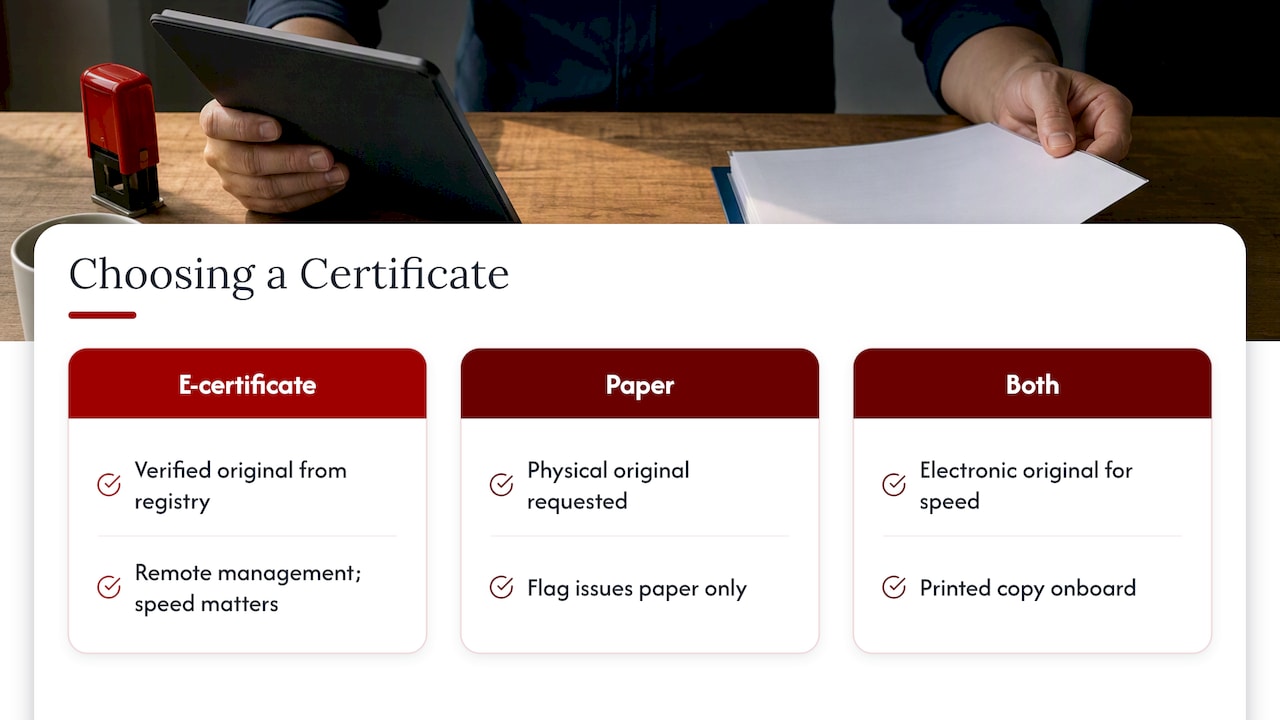
Choose the e-certificate when your registry offers it as a verified original, you travel or manage the vessel remotely, and speed matters. Choose or also request paper when a bank, buyer, insurer or a specific authority has told you it wants a physical original, or when your flag issues only paper. Many owners end up with both: the electronic original for speed and storage, a printed copy in the onboard folder.
Documents that travel with the certificate matter too. Registries asking for proof of ownership and identity often want supporting papers; see our guides on the builder certificate for yachts, proof of address for yacht registration e translating yacht documents for registration so nothing delays issue.
How we see it
We handle registrations under several flags every day, and the question of paper versus electronic almost never has a single answer. It has a flag-specific one. The owner who asks “which is better” is usually really asking “which will get my vessel moving sooner and be accepted where I sail.”
Our approach is to treat the certificate as the end of a clean file, not the start. Complete, correctly translated and consistent paperwork is what makes a provisional registration in one to seven days realistic, and it is what makes either form of certificate usable. We tell owners to settle three things up front: which form their chosen registry issues, how it is verified, and what their itinerary will demand.
Our advice is to have the electronic original for speed and an accessible printed copy onboard, wherever the registry allows both. That combination covers the officer who wants to scan a code and the one who wants paper in hand. And we keep the file organized so the next step, such as an ownership transfer or a radio license, does not stall on a missing document.
Vessel Flag
Registering with the right certificate from the start
If you are choosing a flag, the certificate form is one of several details we confirm with you before filing. We manage registration paperwork under San Marino, Poland, UK Part 1, Malta, Palau, Langkawi and other flags, with published one-off fees that start at 290 EUR for San Marino and 320 EUR for Poland. Compare options on our flag registration pages, or go straight to the Malta yacht registration page if that is your flag. Prices on each page show what is included.
After registration, most boats also need radio identity. Our Malta radio license guide explains how to avoid form delays and get your MMSI listed, and our services page covers MMSI licensing, insurance and transport.
Perguntas frequentes
Is an e-certificate as valid as a paper certificate?
Where the registry has approved electronic issue, yes. Vanuatu, for example, gives approved electronic certificates the same administrative effect as authorized paper ones, and Hong Kong’s law has done so since 1 August 2023. Validity always rests on the issuing registry’s rules, so confirm that yours issues electronic originals.
Can I print an e-certificate and use the printout?
Usually you can, and officers sometimes ask for it. ClassNK notes that printed versions can be provided on request for port entry or departure or Port State Control inspections. The printout supports the electronic original, so keep the verification link or number with it.
Can I switch from paper to electronic later, or the other way around?
That depends on the registry. Some allow replacement, but it is an administrative change only. Vanuatu states that converting a valid paper certificate to electronic does not extend the survey, audit or expiry date. Ask your registry before you request the change.
Is a screenshot of my e-certificate acceptable?
Not as a substitute. Vanuatu’s administrator says screenshots, copied QR images and third-party database entries do not replace verification through the official portal. Keep the original file and share the official verification route.
Should I laminate my paper certificate?
No. Transport Canada states that laminating a paper registry certificate invalidates it as an official document. Use a protective folder or sleeve instead, and keep a copy onboard as your registry requires.
Fontes
- Korean Register: FAQ on e-certificates
- IMO Circular FAL-LEG-MEPC-MSC.1/Circ.1 on electronic certificates
- Vanuatu Circular No. 026: Electronic Registry and statutory certificates
- Vanuatu Circular No. 034: Clarification on replacement of certificates
- Reed Smith: Hong Kong gives full legal effect to electronic certificates
- Marshall Islands maritime authority notice, February 2025
- PDMS: Digital certificates in maritime, myths vs reality
- EMSA: Electronically-issued certificates, 2023
- ClassNK e-Certificate User Manual
- Bahamas Maritime Authority: Electronic Statutory Certificates
- Kiribati Ship Registry: Marine Circular 37
- Transport Canada: After you apply
- Transport Malta: Merchant Shipping Notice 139