
Yes, you can convert a pleasure yacht to commercial registration, but the vessel can only hold one mode at a time, and switching triggers full commercial certification scaled to your yacht. Start with three moves: confirm eligibility against your target flag’s rules, appoint a Recognized Organization or surveyor, and line up your insurance and crewing plan before you file anything.
TL;DR:
- Structural and safety assessments must confirm the yacht can handle commercial loads before initiating the conversion process.
- Crossing specific size and tonnage thresholds, such as 15 meters, 24 meters, or 500 gross tons, can significantly increase survey and certification requirements.
- Completing conversion requires coordinating surveys, submitting detailed reports, and paying fees, often taking several weeks depending on yacht condition and remedial work needed.
- Maintaining commercial registration involves ongoing compliance with safety, manning, insurance, and inspection standards, regardless of whether the yacht is actively chartered.
- Dual-mode or temporary schemes exist but still enforce full commercial standards during operation, and structural suitability remains the key compatibility factor.
Índice
- What Certificates and Surveys Does Pleasure-to-Commercial Conversion Require?
- What Size and Tonnage Thresholds Change the Rules?
- How Do You Complete the Conversion Step by Step?
- What Changes Operationally Once You’re Commercially Registered?
- Can You Operate in Dual Mode Instead of Fully Converting?
- Why the Conversion Conversation Usually Starts in the Wrong Place
- Get Professional Help Registering Your Commercial Yacht
- Sources
- FAQ
What Certificates and Surveys Does Pleasure-to-Commercial Conversion Require?
Commercial registration replaces your pleasure paperwork with a full statutory package. There is no partial version. Registries treat “commercial” as an all-or-nothing status, which means every certificate below has to be current and correct before your flag state issues a new Certificate of Registry.
For most yachts, expect to obtain or renew:
- Safety Construction and Safety Equipment Certificates confirming the hull, machinery, and lifesaving gear meet commercial standards
- A radio certificate covering communications equipment appropriate to your operating area
- Tonnage and load line certificates, which reset how the vessel is measured and loaded once it’s commercial
- A minimum safe manning document specifying required crew numbers and qualifications
Larger vessels carry extra obligations. Yachts above the typical ISM threshold need a Safety Management Certificate, an International Ship Security Certificate under the ISPS Code, and documented evidence of Maritime Labour Convention compliance for crew welfare and contracts.
Your Recognized Organization does the technical legwork here. It issues Certificates of Survey and class notations that flag administrations rely on before granting commercial status, and registry guidance is explicit that a vessel holds one Certificate of Registry at a time. Before you approach a class society, gather your stability booklet, crew certifications, insurance declarations, and vessel particulars. Missing paperwork is the single most common reason conversions stall.
What Size and Tonnage Thresholds Change the Rules?
Length and tonnage decide which code applies to your yacht, and that code decides how much work the conversion actually involves. Confirm these numbers before you commit to a flag or a class society, because moving from one band to the next can mean a materially different survey scope.
Three thresholds matter most:
- 15 meters: often the point where load line and manning requirements start applying in a more formal way
- 24 meters: a common trigger for full Large Yacht Code or equivalent national commercial yacht codes
- 500 gross tons: where SOLAS-level requirements and additional safety management obligations tend to kick in
Most flags apply something built on the UK’s LY2/LY3 framework or a national equivalent, and the operational consequence is real: crossing a threshold can add manning requirements, security certification, or additional surveys you didn’t budget for. Staying in Class throughout matters too, since registry guidance requires survey reports from a Recognized Organization as part of the application, and a lapsed class certificate resets your eligibility clock.
How Do You Complete the Conversion Step by Step?
The path from pleasure to commercial registration follows a fairly predictable sequence, though timing varies by flag and by how much remedial work your yacht needs.
- Assess the vessel. Get a structural and stability appraisal, check insurance implications early, and pick the flag and class society you’ll work with. A donor hull whose stability and structure already meet commercial standards makes everything downstream faster and cheaper, and industry analysis on conversion economics backs this up: structural suitability is the deciding factor in whether conversion beats new-build on cost.
- Appoint your Recognized Organization or surveyor. Schedule the initial surveys and start any remedial work they flag.
- Submit survey reports to the flag administration. This is where class notations and certificates get formally reviewed.
- File the registry application. You’ll typically surrender your private/pleasure certificate, complete new forms, and pay applicable fees before a Commercial Certificate is issued.
Timelines vary, but plan on several weeks for initial surveys, additional time for any remedial work your surveyor identifies, and a further stretch for flag administration processing once reports are submitted. Budget for survey fees, any structural or equipment upgrades, and administrative or certification charges, since these three buckets make up most of the total cost.
Pro Tip: Line up your Recognized Organization survey dates before you submit anything to the registry. Flag administrations process applications faster when the survey reports arrive complete and pre-validated, rather than trickling in over several weeks.
If you want a structured breakdown of the paperwork stage, VesselFlag’s step-by-step registration guide walks through what each filing actually requires.
What Changes Operationally Once You’re Commercially Registered?
Commercial registration isn’t a one-time paperwork exercise. It resets how you run the yacht every single day it’s in commercial mode.
- Minimum safe manning becomes enforceable, meaning you need crew holding the specific certifications your manning document lists
- Insurance shifts from pleasure cover to P&I and commercial liability arrangements, and your insurer will expect updated declarations
- Survey intervals continue on a schedule, and Safety Management System documentation has to stay current, not just filed once
- Port State Control inspections become more likely, and enforcement follows whatever your certificate currently says, not how you’re using the yacht that week
That last point catches owners off guard more than any other. Registry guidance states plainly that commercial certificate holders must meet commercial standards at all times, whether or not a charter is actively underway. There’s no dialing it back to pleasure standards between bookings. For a broader rundown of what stays on your compliance calendar, VesselFlag’s compliance requirements guide covers the documents you’ll need to keep current.
Can You Operate in Dual Mode Instead of Fully Converting?
Some flags offer a middle path. Pleasure Yachts Engaged in Trade (PYET) schemes and other dual-mode arrangements let certain yachts switch between pleasure and commercial use without a full permanent re-registration, provided the owner meets strict conditions.
- Eligibility usually depends on length, continued class membership, and a track record of continuous compliance
- Owners typically must notify the registry in advance before switching modes
- Temporary admission and VAT-paid status can allow limited commercial activity for short charters in some waters, but rules differ sharply by jurisdiction, as VesselFlag’s guide to the 18 month temporary admission rule explains for non-EU yachts operating in EU waters
The caveat that trips people up: Antigua & Barbuda’s dual-mode circular is explicit that whenever you’re operating commercially, commercial standards apply in full. Dual mode isn’t a discount version of compliance.
Why the Conversion Conversation Usually Starts in the Wrong Place
Most advice on this topic jumps straight to certificates and fees, which is understandable but backwards. The real decision point is whether your hull was ever built to take commercial-grade stability and structural loads. Get that wrong and every certificate downstream becomes more expensive to earn, because you’re retrofitting a structure rather than certifying one that already qualifies.
We think owners underrate how much this single judgment call shapes the whole project. A yacht with documented commercial-class bones can move through survey and flag issuance in a matter of months. One that doesn’t can drag remedial work out for a year or more, and the cost gap between those two outcomes has little to do with paperwork and everything to do with the hull you started with.
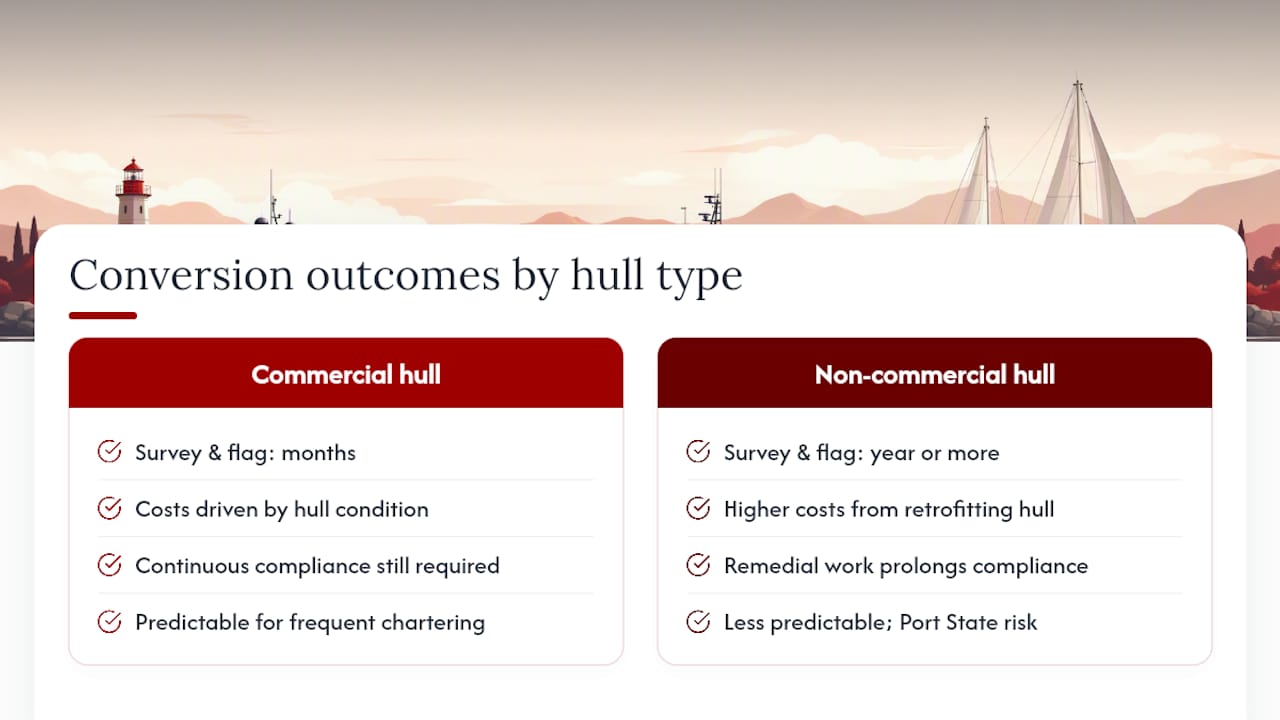
The other overlooked point: dual-mode and PYET options get sold as flexibility, but they demand the same continuous compliance a full conversion does. If you’re chartering more than occasionally, a permanent commercial registration is usually the more predictable path, not the more restrictive one. Owners who treat conversion as a one-time filing exercise, rather than an operational shift, are the ones who get caught out by Port State Control later.
Start with the structural assessment. Everything else on this list follows from what that appraisal tells you.
— VesselFlag
Get Professional Help Registering Your Commercial Yacht
Conversion paperwork multiplies fast once class surveys, flag forms, and insurance declarations all need to land in the right order. Professional yacht registration services handle that coordination directly, working across multiple flag jurisdictions to streamline contacts for registration, MMSI and AIS setup, and insurance introductions.
Specialized yacht registration services add value in timeline management: pre-validating documentation and coordinating survey slots with Recognized Organizations before filing, which helps prevent flag administrations from returning incomplete applications. That single step often shaves real weeks off the process. If you’re ready to move from pleasure to commercial status, start your commercial vessel registration with Vesselflag and get a clear scope of surveys, fees, and timeline for your specific yacht before you commit to a flag.
Sources
- PLEASURE YACHTS ENGAGED IN TRADE (Cayman Islands Shipping Registry guidance)
- Antigua & Barbuda Circular: Pleasure Yachts engaged in trade (Dual-Mode Registration)
- The Restomod Thesis — Why a Commercial Hull Wins | Xplorer Yachts
FAQ
Can a pleasure yacht legally become a commercial vessel?
Yes. It requires full commercial certification, including safety, tonnage, load line, and manning documents, and the vessel cannot hold pleasure and commercial status simultaneously.
What size yacht needs a Safety Management Certificate?
Vessels approaching or exceeding 500 gross tons typically need an ISM Safety Management Certificate, along with security certification under the ISPS Code.
How long does pleasure-to-commercial conversion take?
Expect several weeks for initial surveys plus additional time for remedial work and flag administration processing, though the total varies with how much your yacht needs to reach commercial standard.
Does commercial registration affect my insurance?
Yes. Commercial registration requires new insurer declarations and typically shifts coverage toward P&I and commercial liability policies rather than standard pleasure cover.
Can I switch between pleasure and commercial use as needed?
Some flags allow dual-mode or PYET registration, but they require continuous compliance and advance notice before switching, and commercial standards apply fully whenever the yacht operates commercially.
Who handles the technical surveys during conversion?
A Recognized Organization or appointed surveyor conducts the required surveys and issues the certificates flag administrations need before granting commercial status; professional registration services can help coordinate this process alongside registry filing.