
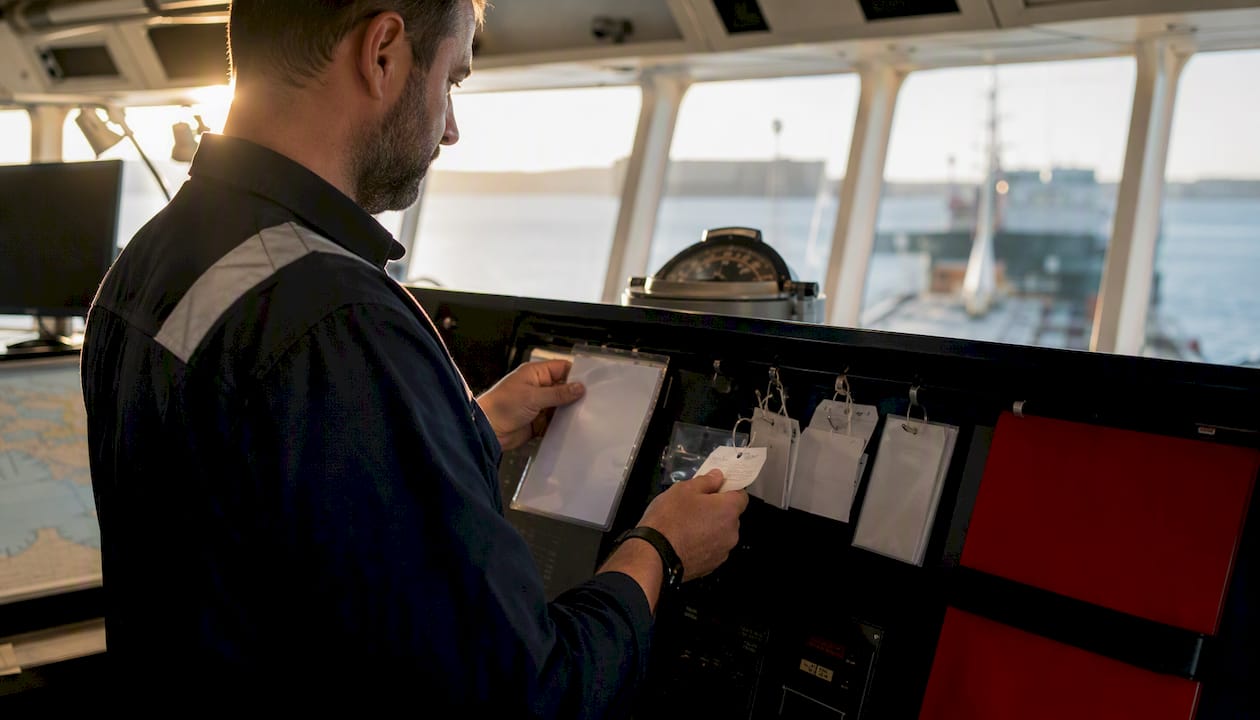
Maritime compliance is the operational backbone of every lawful vessel. It determines whether a ship can enter a port, carry cargo, secure insurance, and keep its crew legally aboard. In the U.S., the U.S. Coast Guard (USCG) enforces compliance through Title 46 and Title 33 of the Code of Federal Regulations, layering domestic requirements on top of International Maritime Organization (IMO) conventions. The result: U.S.-flagged vessels carry a double compliance burden that operators cannot manage by reading IMO guidance alone.
The role of compliance in maritime operations breaks into five core functions:
- Statutory certification: Maintaining valid certificates (SOLAS Safety Equipment, MARPOL, Load Line, ISPS, STCW endorsements) that prove a vessel meets minimum international standards.
- Operational controls: Running a Safety Management System (SMS) under the ISM Code that embeds procedures, watchkeeping protocols, and corrective-action loops into daily operations.
- Evidence and records: Keeping Oil Record Books, crew rest logs, drill records, and audit reports that Port State Control (PSC) inspectors verify on arrival.
- Incident response: Maintaining vessel and facility response plans, running drills, and documenting exercises so authorities see a functioning emergency system, not just a binder on a shelf.
- Risk control for charterers and insurers: Demonstrating a clean PSC record and current certificates, which directly affects charter acceptance and P&I club premiums.
U.S.-flagged vessels face both IMO requirements and, in many cases, stricter domestic mandates. Relying solely on international guidance risks non-compliance with USCG-specific rules under CFR Titles 46 and 33.
Maritime compliance, in practical terms, is the full set of rules, certificates, processes, audits, and behaviors that keep a vessel lawful and operational across every jurisdiction it enters. The scope is wider than most operators initially expect. It covers international conventions administered by the IMO, national laws enforced by bodies like the USCG, technical rules set by classification societies such as the American Bureau of Shipping (ABS), commercial requirements from charterers and P&I clubs, and the internal management systems that tie all of it together.
For a Designated Person Ashore (DPA), that scope translates into a continuous workload: tracking certificate expiries, scheduling surveys, reviewing SMS records, and responding to PSC findings. For a vessel master, it means daily operational decisions that must align with procedures documented in the SMS. For charterers and insurers, it means demanding evidence of compliance before a fixture is confirmed or a policy is issued. Understanding where each stakeholder’s responsibility begins and ends is the starting point for any serious compliance program.
Principais conclusões
Maritime compliance is the operational and legal foundation that determines whether a vessel can trade, earn charter income, and maintain insurance coverage across every jurisdiction it enters.
| Ponto | Detalhes |
|---|---|
| Compliance is operational continuity | Expired certificates or incomplete records can trigger PSC detention and halt commercial operations immediately. |
| U.S. rules exceed IMO minimums | U.S.-flagged vessels must meet both IMO conventions and stricter USCG requirements under CFR Titles 46 and 33. |
| A CMS is living governance | An effective Compliance Management System embeds accountability into daily operations, not just a document archive. |
| Evidence matters more than certificates | PSC inspectors verify that records, drills, and corrective actions are current, not just that certificates exist. |
| Vesselflag accelerates compliance | Vesselflag’s flag registration and documentation services help owners close certificate gaps and meet flag-state requirements faster. |
Índice
- How did maritime compliance regulations develop over time?
- What international conventions and U.S. rules govern maritime compliance?
- Who enforces compliance, and who is responsible for it?
- What are the core compliance areas operators manage daily?
- How do Safety Management Systems and the ISM Code work in practice?
- What should vessel and facility response plans include?
- How do you build a living Compliance Management System?
- What does Subchapter M show about U.S. enforcement in practice?
- What compliance failures cause the most damage?
- What does a realistic compliance roadmap look like?
- What technology and regulatory changes should operators prepare for?
- A practitioner’s perspective on compliance as a business decision
- Vesselflag’s compliance and registration services
- Fontes
- Perguntas frequentes
How did maritime compliance regulations develop over time?
The modern regulatory framework did not arrive fully formed. It grew in response to disasters.
The first iteration of the International Convention for the Safety of Life at Sea (SOLAS) dates to 1914, a direct response to the Titanic sinking two years earlier. The convention has been revised multiple times since, with the 1974 version and its 1978 Protocol forming the current baseline. MARPOL, the primary pollution-prevention convention, followed the 1967 Torrey Canyon grounding off the UK coast, which released roughly 119,000 tons of crude oil and exposed the absence of any international pollution framework. The International Chamber of Shipping identifies SOLAS, MARPOL, COLREGs, the Load Line Convention, ISPS, ISM, STCW, and MLC as the principal instruments that now form the global baseline.
The International Regulations for Preventing Collisions at Sea (COLREGs), adopted in 1972, standardized navigational rules across flag states. The USCG Nav Rules Handbook reflects U.S. adoption and implementation of COLREGs, which apply to all vessels on U.S. navigable waters. The ISM Code, which became mandatory in 1998 for most vessel types, emerged from a pattern of accidents attributed to management failures rather than equipment failures. The ISPS Code followed the September 11, 2001 attacks, entering force in 2004. The Maritime Labour Convention (MLC), effective 2013, consolidated crew welfare standards that had previously been scattered across dozens of separate instruments.
The pipeline from international standard to national law runs through flag states. The IMO sets the standard; member states ratify conventions and enact domestic legislation. The U.S. does this through the CFR, with the USCG as the primary enforcement body. Member states can, and often do, exceed IMO minimums, which is why U.S. operators cannot treat IMO compliance as the finish line.
What international conventions and U.S. rules govern maritime compliance?
The table below maps the principal conventions to their operational scope and U.S. enforcement mechanism.
| Convention / Code | Operational Scope | U.S. Enforcement |
|---|---|---|
| SOLAS | Vessel construction, fire safety, lifesaving appliances, radio | USCG, Title 46 CFR |
| MARPOL | Oil, chemical, sewage, garbage, air emissions, ballast water | USCG, Title 33 CFR |
| COLREGs | Collision avoidance, navigational lights and signals | USCG, Title 33 CFR |
| Código ISM | Safety Management Systems, DOC and SMC certification | USCG, ABS and recognized organizations |
| ISPS Code | Ship and port facility security plans, PFSO/SSO roles | USCG, Title 33 CFR |
| STCW | Seafarer certification, training, and watch standards | USCG National Maritime Center |
| Load Line Convention | Maximum load limits, freeboard marks | USCG, ABS surveys |
| MLC | Crew contracts, rest hours, wages, medical care | USCG, Title 46 CFR |
The IMO functions as a standard-setting body within the United Nations system. It does not inspect vessels directly. That work falls to flag states, which issue statutory certificates and verify compliance through their own administrations or through delegated recognized organizations (ROs). Port states conduct independent inspections when a vessel calls at their ports, and they can detain any vessel that fails to meet the standards of a ratified convention, regardless of flag.
Classification societies like ABS occupy a distinct but overlapping role. They develop technical rules, conduct plan reviews, and perform surveys that verify structural and mechanical fitness. While classification is technically voluntary, flag and port states routinely require it as a condition of registration or port entry. ABS, as a U.S.-based classification society, works closely with the USCG on survey delegation for U.S.-flagged vessels.
One compliance dimension that sits outside the IMO framework but carries serious operational consequences: sanctions. The Office of Foreign Assets Control (OFAC) administers U.S. sanctions programs that affect vessel operators directly. Calling at a sanctioned port, carrying cargo for a sanctioned entity, or using a sanctioned flag registry can trigger civil and criminal penalties. OFAC’s sanctions programs page is the primary reference for current designations and compliance expectations.
Who enforces compliance, and who is responsible for it?
Compliance accountability is layered, and the layers do not always align neatly.
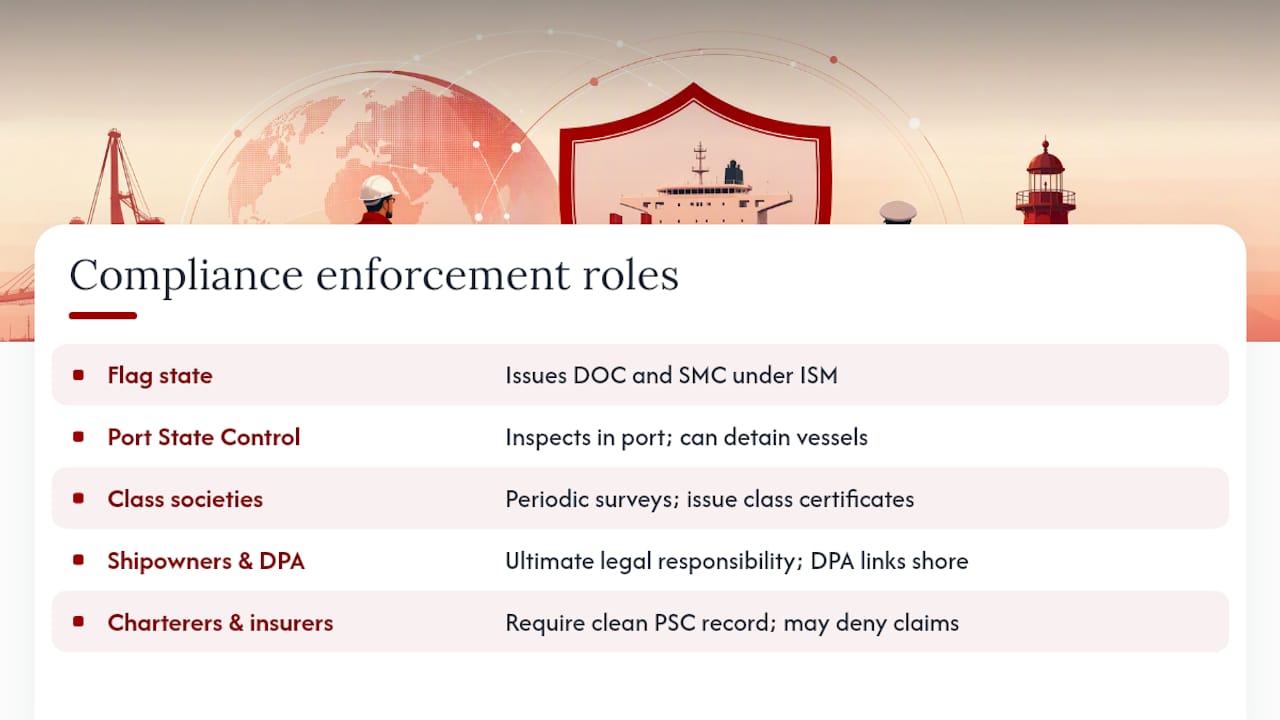
Flag states issue the statutory certificates that prove a vessel meets IMO standards. They conduct or delegate initial surveys, verify SMS documentation, and issue the Document of Compliance (DOC) and Safety Management Certificate (SMC) under the ISM Code. The role of flag state compliance is foundational: without valid flag-state certification, a vessel cannot legally trade internationally.
Port State Control operates independently of the flag state. PSC officers board vessels during port calls and inspect certificates, records, equipment, and crew competency. They can issue deficiency notices or, in serious cases, detain a vessel until deficiencies are corrected. The Paris MOU, Tokyo MOU, and U.S. Coast Guard’s own PSC program each maintain targeting systems that flag high-risk vessels for priority inspection.
Sociedades de classificação verify technical fitness through periodic surveys: annual, intermediate, and special (drydock) surveys on a five-year cycle. Their survey reports and class certificates are evidence that PSC inspectors and insurers rely on. ABS, for example, publishes its rules and survey requirements publicly, and its endorsements carry weight with USCG inspectors.
Shipowners and operators carry ultimate legal responsibility. The DPA, required under the ISM Code, is the shore-based link between management and the vessel. The DPA must have direct access to the highest level of management and must be able to act on safety and compliance concerns without commercial pressure overriding the decision. Fleet compliance managers coordinate certificate tracking, survey scheduling, and audit preparation across a fleet. Where owners use registration agents or compliance consultants, those third parties can build processes and prepare documentation, but they do not absorb legal liability. Effective owners use consultants to build resilient internal processes that outlast staff turnover.
Charterers and insurers enforce compliance commercially. A time charterer will typically require a clean PSC record and current certificates before confirming a fixture. P&I clubs condition coverage on compliance with class requirements and may exclude claims arising from non-compliance. Operators who treat compliance as a back-office function often discover its commercial weight only when a charter is rejected or a claim is denied.
Compliance strategies for maritime operations require constant alignment as trade routes, sanctions, and bilateral agreements shift. That is not a one-time setup task.
What are the core compliance areas operators manage daily?
Safety (SOLAS and ISM)
SOLAS compliance covers vessel construction standards, fire detection and suppression systems, lifesaving appliances (lifeboats, life rafts, EPIRBs), and radio communications. Evidence required: Safety Equipment Certificate, Safety Construction Certificate, Safety Radio Certificate, fire drill records, and lifeboat maintenance logs. Survey cycle: annual endorsements with a full renewal every five years. Cost drivers: equipment upgrades, drydock surveys, and crew training.
Environmental compliance (MARPOL and ballast water)
MARPOL divides into six annexes covering oil, noxious liquids, packaged goods, sewage, garbage, and air emissions. The Oil Record Book (ORB) is the primary evidence document for Annex I compliance. PSC inspectors examine ORB entries closely for gaps, erasures, or entries that do not match engine room logs. Ballast Water Management Conventions require type-approved treatment systems on most vessels. Air emissions compliance now includes Energy Efficiency Existing Ship Index (EEXI) and Carbon Intensity Indicator (CII) ratings under MARPOL Annex VI. Cost drivers: ballast water treatment system installation, scrubber retrofits or low-sulfur fuel costs, and emissions monitoring software.
Security (ISPS)
ISPS requires a Ship Security Plan (SSP), a Ship Security Officer (SSO), and a Port Facility Security Officer (PFSO) on the facility side. Evidence required: International Ship Security Certificate (ISSC), SSP (kept confidential but available to flag state), security drill records, and Declaration of Security (DoS) logs. Cost drivers: security equipment, SSO training, and periodic security audits.

Crewing (STCW and MLC)
STCW sets the certification and watch-keeping standards for officers and ratings. Every officer must hold a valid STCW certificate of competency endorsed by the flag state. MLC covers employment agreements, rest hours, wages, repatriation, and medical care. Evidence required: STCW certificates, MLC Maritime Labour Certificate, rest-hour records, and crew agreements. The USCG National Maritime Center issues U.S. STCW endorsements. Cost drivers: training courses, medical examinations, and flag-state endorsement fees.
Classification and technical standards (ABS)
ABS rules cover hull, machinery, electrical systems, and stability. Classification surveys run on an annual/intermediate/special cycle. Evidence required: ABS class certificate, survey reports, and condition of class notations. Cost drivers: drydock fees, structural repairs, and machinery overhauls.
The comparison below summarizes enforcement and evidence by area.
How do Safety Management Systems and the ISM Code work in practice?
The ISM Code requires every company operating a ship to implement an SMS and obtain a Document of Compliance (DOC) for the company and a Safety Management Certificate (SMC) for each vessel. The DOC is issued to the company after an initial audit verifying that the SMS meets ISM requirements. The SMC is issued to the vessel after a separate audit confirming the SMS is actually implemented onboard.
A functioning SMS contains eight core components: a safety and environmental protection policy; defined responsibilities and authority; procedures for safe ship operations; emergency preparedness procedures; reporting and analysis of non-conformities, accidents, and near-misses; maintenance of the ship and equipment; documentation; and company verification, review, and evaluation through internal audits. The last component is where most operators fall short. Internal audits are not a formality. They are the mechanism by which management identifies gaps before a PSC inspector does.
The audit cycle runs on a five-year certificate period with an intermediate verification between the second and third anniversary. PSC inspectors will check that the DOC and SMC are current, that the onboard SMS matches the company’s approved system, and that records of internal audits, drills, and corrective actions are complete and recent. A vessel with a valid SMC but no evidence of recent internal audits or corrective-action follow-through will attract deficiency notices.
In daily operations, SMS controls appear as checklists, standing orders, permit-to-work systems, and maintenance schedules. A well-implemented SMS means the master does not have to decide from scratch how to handle a confined-space entry or a fuel transfer. The procedure exists, the crew knows it, and the record proves it happened.
What should vessel and facility response plans include?
Response plans are the operational complement to the SMS. Where the SMS governs routine operations, response plans govern what happens when something goes wrong.
A vessel response plan should include:
- Command structure: Who is in charge during an emergency, who deputizes, and how command transfers if the master is incapacitated.
- Communication lines: VHF channels, satellite contact numbers for the DPA, flag state emergency contacts, and local coast guard frequencies for the operating area.
- Pollution contingency: Procedures for oil spill containment, notification to USCG National Response Center (1-800-424-8802), and coordination with Oil Spill Response Organizations (OSROs).
- SAR coordination: Distress signal procedures, EPIRB activation, lifeboat muster, and coordination with MRCC (Maritime Rescue Coordination Center).
- Spare parts and logistics: Critical spare inventory, supplier contacts, and port agent details for the vessel’s trading area.
Exercise frequency matters as much as the plan itself. SOLAS requires fire and abandon-ship drills at least monthly. ISPS requires security drills quarterly and a full security exercise at least once every calendar year. MARPOL pollution drills should align with the Vessel Response Plan (VRP) requirements under 33 CFR Part 155 for U.S. waters. After any real incident, authorities will expect a written incident report, a root-cause analysis, and a corrective action plan with completion dates. Evidence of prior drills is the first thing a USCG investigator will request.
Dica de profissional: Keep a single drill log that records date, type of drill, participants, findings, and corrective actions. A unified log is far easier to present to a PSC inspector than scattered entries across multiple binders.
How do you build a living Compliance Management System?
A proactive Compliance Management System is not a digital filing cabinet. It is a governance structure that embeds accountability into daily operations and prevents detentions rather than responding to them.
Implementation follows a logical sequence:
- Gap assessment: Audit current certificates, survey status, SMS documentation, and crew records against applicable requirements. Identify what is expired, missing, or non-conforming.
- Policy and roles: Draft or update the company safety and environmental policy. Assign named individuals to DPA, SSO, and fleet compliance manager roles with written authority and reporting lines.
- Records and digital tools: Centralize certificate tracking, survey schedules, and drill records in a system that generates alerts before expiry. Tools like VoyageX AI offer real-time monitoring, centralized documentation, and predictive alerts that reduce the risk of an expiry slipping through.
- Internal audit: Schedule and conduct internal SMS audits before external verifications. Use findings to generate corrective actions with owners and deadlines.
- Corrective actions: Track every finding to closure. An open corrective action with no completion date is a red flag for any external auditor.
- Continuous monitoring: Review the CMS at least annually at management level. Update procedures when regulations change, when incidents occur, or when trading patterns shift.
A sample compliance calendar for a mid-size operator might look like this: January, review certificate expiry schedule for the year; March, conduct internal ISM audit; June, intermediate DOC/SMC verification window; September, ISPS security exercise; October, annual ABS survey; December, management review and CMS update.
External consultants add value beyond paperwork preparation. A good maritime compliance consultant will design the evidence workflow, train the DPA and master on audit readiness, and identify regulatory changes before they become deficiencies. Owners should invest in consultancy when entering a new flag registry, after a detention, or when building a CMS from scratch. Once the system is running, in-house capability with periodic external review is usually sufficient.
For hazardous cargo operators, the UK compliance guide for hazardous cargo haulage offers a useful parallel framework for documentation and risk management that complements MARPOL dangerous goods requirements.
What does Subchapter M show about U.S. enforcement in practice?
Subchapter M of Title 46 CFR, which became fully effective in 2018, extended mandatory inspection requirements to towing vessels operating on U.S. navigable waters. Before Subchapter M, towing vessels were largely uninspected. The rule requires a Certificate of Inspection (COI), a USCG-accepted Towing Safety Management System (TSMS), and periodic inspections either by the USCG directly or by a third-party organization (TPO) accepted by the USCG.
The compliance path under Subchapter M illustrates how U.S. enforcement works in practice. An operator must first choose between direct USCG inspection or a TPO audit route. Either way, the vessel must pass a hull and machinery examination, demonstrate a functioning TSMS, and maintain records of drills, maintenance, and crew qualifications. The COI is then issued with a validity period tied to the inspection cycle.
Operators who missed the initial compliance deadline faced immediate operational consequences: vessels without a COI could not legally operate. Detention in this context means lost revenue from the first day, plus the cost of emergency surveys, corrective work, and re-inspection. Common cost drivers included stability letter updates, fire suppression system upgrades, and TSMS documentation development. The lesson from Subchapter M is straightforward: U.S. enforcement does not grandfather existing operations. When a new rule applies, the compliance clock starts immediately.
What compliance failures cause the most damage?
The most common compliance failures are administrative, not technical. Expired certificates, incomplete Oil Record Books, insufficient crew rest records, and gaps in ISM documentation account for a large share of PSC detentions. Even minor administrative omissions can trigger detention and daily financial losses that exceed the cost of the original remediation.
A typical escalation pattern: a vessel arrives at a U.S. port with an expired radio license. The PSC inspector notes the deficiency. During the inspection, the inspector also finds that the Oil Record Book has a two-week gap and that the last internal ISM audit was 18 months ago with no corrective actions recorded. What started as a single administrative gap becomes a multi-deficiency detention. The vessel sits at the dock while the owner arranges emergency surveys, documentation updates, and a re-inspection. Charter hire continues to accrue. The charterer may invoke off-hire provisions. The P&I club opens a file.
Consequences of non-compliance follow a predictable hierarchy:
- Detention: Immediate operational stoppage, daily costs, and a public record on PSC databases.
- Fines: USCG civil penalties for MARPOL violations can reach significant amounts per violation per day.
- Charter rejection: A vessel with recent detentions will fail vetting by major charterers and oil majors.
- Insurance impact: P&I clubs may increase deductibles, restrict coverage, or decline renewal for vessels with repeated non-compliance.
- Blacklisting: Vessels detained multiple times within a MOU region can be banned from ports in that region for a defined period.
Sanctions non-compliance carries a separate and more severe consequence set. Operators who fail to screen counterparties against OFAC designations risk civil penalties, criminal prosecution, and loss of access to the U.S. financial system.
For cargo operators managing container logistics, the UK container transport compliance checklist provides a useful cross-reference for documentation gaps that can affect port clearance.
What does a realistic compliance roadmap look like?
| Timeframe | Priority tasks |
|---|---|
| — | Audit all certificates; renew expired or near-expiry items; verify crew STCW endorsements; confirm Oil Record Book is current and complete |
| 3–12 months | Conduct internal ISM audit; schedule overdue surveys; implement digital certificate tracking; update SMS procedures for any regulatory changes |
| 12+ months | Establish annual management review cycle; plan drydock survey; assess EEXI/CII compliance trajectory; evaluate flag registry alignment with trading pattern |
The main cost drivers in a compliance remediation program are: drydock and structural surveys; equipment retrofits (BWTS, fire systems, navigation equipment); crew training and STCW re-certification; consultancy for SMS development or ISM audit preparation; compliance software for certificate and emissions tracking; and flag-state or classification society fees for new surveys and endorsements.
Three steps to reduce PSC exposure this week:
- Pull every certificate and log the expiry date in a single spreadsheet or tracking system. Flag anything expiring within 90 days.
- Contact your classification society or flag state to schedule any overdue surveys before a port call triggers a PSC inspection.
- Assign the DPA role in writing if it is currently informal, and confirm the DPA has direct access to senior management.
A lista de verificação da documentação marítima is a practical starting point for operators who need to map their current document status against statutory requirements.
What technology and regulatory changes should operators prepare for?
The direction of maritime regulation is toward data-driven enforcement and digital evidence. Several trends are already affecting compliance programs:
- Remote and virtual surveys: Classification societies including ABS have expanded remote survey capabilities, allowing certain inspections to be conducted via video link with onboard crew. This reduces drydock time and travel costs but requires reliable connectivity and trained crew who can present equipment correctly.
- Real-time compliance dashboards: Platforms that aggregate certificate expiry dates, survey schedules, PSC inspection history, and emissions data into a single interface are moving from optional to expected. Digital monitoring tools with predictive alerting reduce the risk of an expiry being missed across a fleet.
- Emissions monitoring and CII reporting: MARPOL Annex VI now requires annual CII ratings and a Ship Energy Efficiency Management Plan (SEEMP). Regulators are moving toward verified fuel consumption data rather than self-reported figures, which means operators need auditable emissions records, not just estimates.
- Expanded cybersecurity obligations: IMO Resolution MSC-FAL.1/Circ.3 requires cyber risk management to be incorporated into the SMS by the first annual verification after January 1, 2021. USCG has issued its own cybersecurity guidance for vessels calling at U.S. ports, and formal rulemaking is advancing.
The technology investments with the clearest return on compliance cost are certificate tracking software, fuel and emissions logging systems, and SMS integration platforms that connect onboard records to shore-based management. Piloting these in certificate tracking first gives operators the fastest visibility into their highest-risk gaps.
A practitioner’s perspective on compliance as a business decision
The framing that compliance is a cost center misses what it actually does to commercial risk. A vessel with a clean PSC record, current certificates, and a documented SMS is a fundamentally different commercial asset than one that is technically seaworthy but administratively patchy. Charterers know this. Vetting systems like SIRE and CDI exist precisely to quantify that difference, and the gap between a vessel that passes and one that fails vetting is not always a major technical deficiency. Often it is a missing drill record or an SMS procedure that has not been updated since the last regulatory change.
The practical tip from Vesselflag’s experience working with vessel owners across multiple flag registries: prioritize the certificates that PSC inspectors open first. The ISSC, the SMC, the IOPP certificate, and the crew’s STCW endorsements are the documents that determine whether an inspection stays routine or escalates. Get those in order before worrying about secondary documentation. And when you are registering under a new flag or transitioning registries, use a registration agent who understands the flag state’s specific survey delegation arrangements. The role of registration agents in vessel compliance is not just paperwork. It is knowing which recognized organization the flag state accepts and what evidence format the flag administration actually requires.
Vesselflag’s compliance and registration services
Vessel owners who need to close compliance gaps quickly have a specific problem: the documentation requirements for registration, flag-state certification, and statutory surveys are not standardized across jurisdictions, and the cost of getting them wrong is a detention or a failed charter vetting.
Vesselflag handles registo da bandeira under multiple international jurisdictions, including fast-track options that reduce the time between application and statutory certificate issuance. The service covers end-to-end paperwork management, MMSI licensing, and compliance consultancy that maps your vessel’s current certificate status against the requirements of your chosen flag. For owners who need to verify their documentation before a port call or charter fixture, the vessel compliance checklist is the fastest way to identify gaps. To start, review your registration options or request a documentation check at Vessel Flag.
Fontes
The following primary sources and authoritative references were used throughout this article. Each is listed with a note on its type and relevance.
- Introduction to Maritime Regulations (extracts)
- Nav Rules Handbook
- OFAC (Office of Foreign Assets Control)
- OFAC sanctions programs and information (Treasury)
- The Principal Regulations Governing Maritime Safety | International Chamber of Shipping
Perguntas frequentes
What is maritime compliance?
Maritime compliance is the set of certificates, procedures, audits, and records that keep a vessel legally operational under international conventions (IMO) and national laws such as U.S. CFR Titles 46 and 33. It covers safety, environmental protection, security, crew welfare, and technical classification standards.
What is the main role of compliance in maritime operations?
Compliance ensures a vessel can legally enter ports, carry cargo, maintain insurance, and keep its crew aboard. It functions as the operational and legal framework that prevents detentions, charter rejections, and enforcement penalties.
What is seafarer compliance under STCW?
STCW compliance requires every officer and rating to hold a valid certificate of competency issued or endorsed by the flag state, covering their specific rank and vessel type. The USCG National Maritime Center issues U.S. STCW endorsements, and PSC inspectors verify these certificates during port-state inspections.
How does Port State Control enforcement work in the U.S.?
The USCG conducts PSC inspections on foreign-flagged vessels calling at U.S. ports, checking certificates, records, equipment, and crew qualifications. Vessels with deficiencies receive written notices; serious deficiencies result in detention until corrected and re-inspected.
Can Vesselflag help with flag registration and compliance documentation?
Yes. Vesselflag provides flag registration services under multiple international jurisdictions, including documentation management, MMSI licensing, and compliance consultancy that maps a vessel’s certificate status against flag-state requirements.