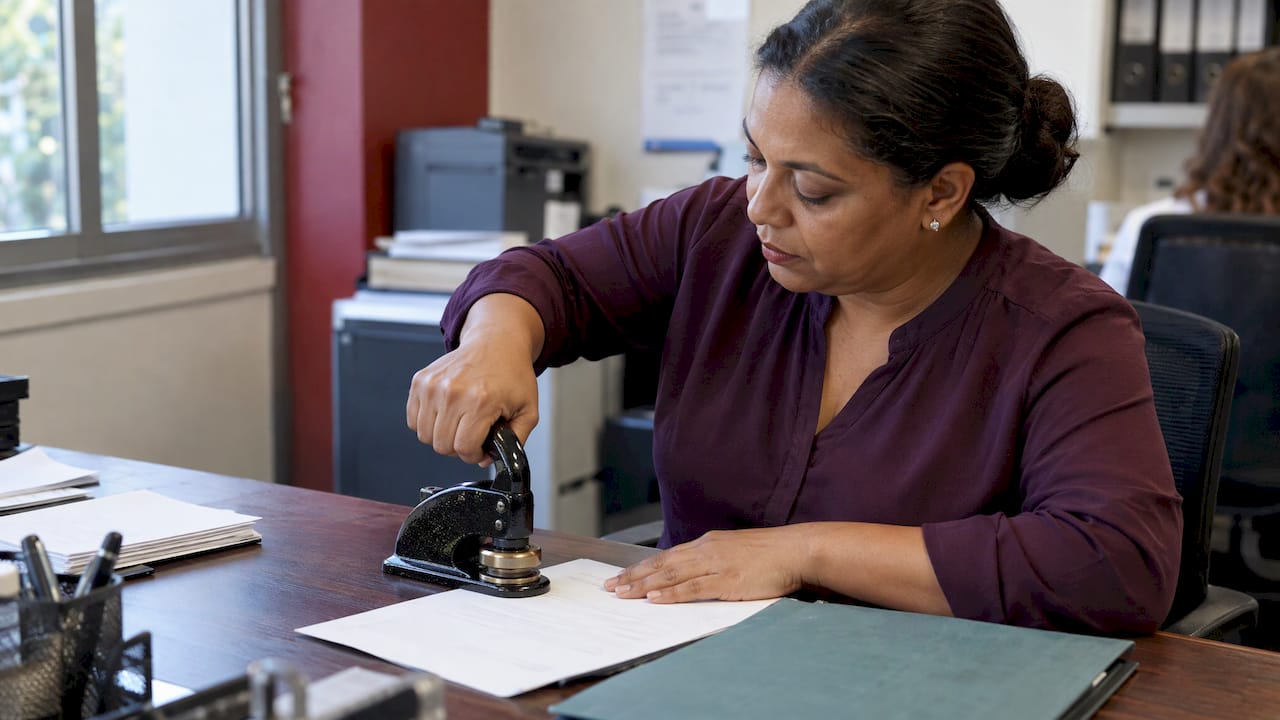
Consular legalisation is the process by which a foreign government confirms that the signature, seal or stamp on a document is genuine, so the paper can be relied on in another country. For yachts, it comes up when a bill of sale, power of attorney or company paper signed in one country must be filed with a registry in another. If both countries belong to the Hague Apostille Convention, an apostille normally replaces it. If either does not, the destination country’s embassy or consulate usually has to legalise the document.
The rest of this guide shows which yacht papers are affected, how to choose between an apostille and legalisation, what the UK route costs, and how to settle the question with the registry before you spend money.
In breve
- Consular legalisation is the fallback when an apostille is not accepted, typically because one country is not a Hague Convention member.
- Bills of sale, powers of attorney and company documents are the papers most often questioned. Registries differ, so ask the registry first.
- The UK Legalisation Office charges £45 (paper) or £35 (e-Apostille). Paper takes up to 25 working days, an e-Apostille up to 2.
- British embassies cannot legalise documents. Legalisation happens in the country where the document was issued.
- Vessel Flag prepares and files registration applications remotely and can tell you which authentication route a given flag expects.
Sommario
- What consular legalisation means for a yacht file
- Apostille or legalisation: which applies
- Which yacht documents may need it
- The order of steps for a typical file
- Where the documents get legalised
- Planning around the timing
- Our view: ask the registry first, then work backwards
- Choosing a flag with the paperwork in mind
- How Vessel Flag helps
- FAQ
- Fonti
What consular legalisation means for a yacht file
Legalisation is a chain of verification. A government body in the country of origin authenticates the signature, seal or stamp on your document, and a body of the destination country then confirms that authentication. The Owners’ Club handbook describes it as a process used when documents must be relied upon in a foreign jurisdiction.
In practice, a yacht file meets this in three situations:
- A purchase. You buy a boat from a seller in one country and register it in another. The registry wants proof the seller really transferred title.
- A company owner. The yacht will be held by a company, and the registry wants proof that the company exists and that the signatory may act for it.
- A change of flag. A previous owner or a former registry issues papers that the new flag has to trust.
The registry never has to take your word for any of this. Authentication is how it takes someone else’s.
Apostille or legalisation: which applies
The dividing line is the 1961 Hague Convention. An apostille is accepted instead of consular legalisation when both the issuing country and the destination country are contracting states. The apostille is a single certificate, issued in the country where the document was made, that verifies the signature and seal.
Where one side is not a party, the document goes through legalisation: the local embassy or consulate of the recipient country legalises it.
| Situation | Usual route |
|---|---|
| Issuing and destination countries both in the Hague Convention | Apostille |
| Destination country not in the Convention | Legalisation by the destination country’s embassy or consulate |
| Issuing country not in the Convention | Legalisation in the issuing country, then by the destination’s consulate |
| Registry states it accepts documents without either | Follow the registry, in writing |
Two cautions apply. First, the Convention has limits: it does not cover documents executed by diplomatic or consular agents, or administrative documents dealing directly with commercial or customs operations. A customs or VAT paper may therefore need a different treatment from a bill of sale.
Second, membership is not the whole story. Appleby Global notes that some Hague states still ask for extra consular legalisation, so the requirement has to be verified in advance rather than assumed. For a quick look at which countries are members, this apostille countries list is a practical starting point, but the registry’s own instructions always come first.
Which yacht documents may need it
No single list applies to every flag. These are the papers that most often attract an authentication request:
- Bill of sale. The most common. The MYBA sale addendum requires the bill of sale to be notarially attested and apostilled or legalised by a consul of the country where the buyer will register the vessel.
- Power of attorney. If an agent signs for you, the registry wants proof that you authorised them. Norway’s maritime authority, for example, requires foreign title documents and powers of attorney to be notarised and then legalised or apostilled before registration.
- Documenti aziendali. Certificate of incorporation, register of directors, and a resolution authorising the purchase.
- Deletion certificate. Proof that the yacht has left its previous register.
- Certificato del costruttore. For new builds or boats without earlier papers.
- Identity and address evidence. Sometimes needs certification. Our guide to proof of address for yacht registration covers what registries accept.
Some registries ask for none of this. The Liberian registry, for instance, states that consularisation or apostille is not required for vessel registration documents in its flag transfer guidance. That is one registry’s position, and it should not be assumed for another.
The order of steps for a typical file
The sequence matters because each stage depends on the one before. Getting it wrong means repeating a step and paying twice.
- Ask the registry. Confirm in writing which documents need authentication and in what form. Yacht registries may require documents to be authenticated in a particular way, so agree the method with all parties at the outset.
- Prepare the original correctly. The document should be signed in front of a notary, with the notary’s details visible. A photocopy of an unsigned draft cannot be authenticated.
- Notarise. The notary confirms identity and signature.
- Apostille or legalise. In the Hague case, the competent authority of the issuing country adds the apostille. Otherwise, you start the legalisation chain.
- Translate if required. Authenticate first or translate first depending on the registry. Our note on yacht document translation for registration explains what usually needs translating.
- Send the originals or certified copies as the registry directs.
If you are signing at the closing of a purchase, bring the apostille question into the sale contract itself. Many buyers lose weeks because the seller signed before anyone knew the form required.
Where the documents get legalised
A common misunderstanding is that your own embassy can stamp your papers. It cannot. British embassies, high commissions and consulates cannot legalise documents of any kind. And an apostille cannot be obtained through the UK Legalisation Office for documents issued outside the UK: those must be legalised in the country where they were issued.
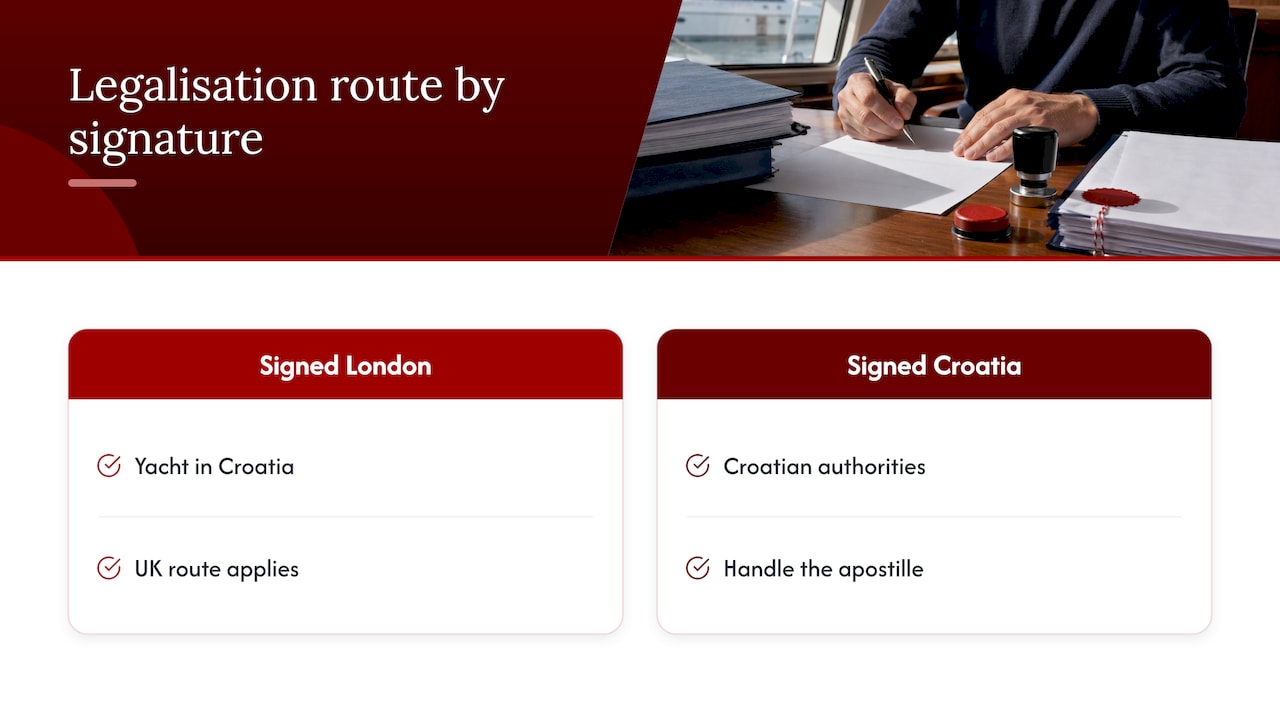
So the working rule is simple: authenticate in the country where the document was signed. If your yacht is in Croatia but the bill of sale was signed in London, the UK route applies. If the seller signed in Croatia, Croatian authorities handle the apostille.
UK fees and timings
For documents signed in the UK, the official figures are:
| Service | Fee | Typical time |
|---|---|---|
| Standard paper-based | £45 per document | Up to 25 working days, plus postage or courier |
| e-Apostille | £35 per document | Up to 2 working days |
These are the government fees only. Notary, courier and any embassy charges for a non-Hague destination are extra. Check the GOV.UK page for the current fees before you order, because they change.
Before choosing the e-Apostille, confirm that the receiving registry accepts an electronic apostille. If it insists on paper, the faster option can cost you time.
Planning around the timing
Authentication is often the slowest step in a registration, and it is the one owners start last. A few habits keep it from holding up the file:
- Order before you need it. Request the apostille as soon as the bill of sale is signed, not when the registry asks.
- Authenticate several originals at once if you expect to use them with more than one authority, such as a registry and a bank.
- Keep a scanned set. Many registries start review from scans, then ask for originals. Keep copies of registration, ownership and supporting papers together.
- Do not let documents go stale. Some registries accept only recent company certificates. Ask what age is acceptable.
- Check names and spellings. A mismatch between passport, company papers and bill of sale will cause questions that no stamp fixes.
Our view: ask the registry first, then work backwards
Owners tend to assume the stamp is the hard part. In our files, the hard part is knowing which stamp, in which order, for which registry. Each of the flags we work with, Poland, San Marino, UK Part 1, Malta, Palau, the Marshall Islands, the Cayman Islands and the Cook Islands, has its own way of handling foreign paperwork, and requirements can differ by case, such as whether you own personally or through a company.
That is why we start every file by confirming what the chosen registry expects, then tell the owner exactly what to sign, notarise and authenticate before anything is posted. Because the service is fully remote, this saves owners from sending originals on a guess.
Our role is to prepare and file the application. The flag registry decides on it and issues the certificate. We do not guarantee processing times, but we do aim to make sure the file is complete when it arrives.
VesselFlag
Choosing a flag with the paperwork in mind
Document burden is a fair factor when you compare flags, alongside cost and eligibility. Our published one-off prices are a useful guide:
| Bandiera | Vessel Flag price |
|---|---|
| San Marino | from EUR 290 |
| Polonia | from EUR 320 |
| Regno Unito Parte 1 | from EUR 550 |
| Malta | from EUR 849 |
| Palau | from EUR 700 |
| Isole Marshall | EUR 250 service fee plus registry fees |
| Isole Cayman | EUR 450 service fee plus registry fees |
The Cook Islands are quoted per yacht. We also handle other flags on request, with terms confirmed case by case. Authentication costs paid to notaries and authorities are separate from our fees.
A few examples of how this plays out:
- Buying abroad for a Polish flag. Our guide to a Polish flag for a yacht bought abroad walks through what the purchase papers need. Provisional papers in Poland take 2 to 5 days once the file is accepted.
- UK Part 1. Owners can register personally if eligible, through an existing company (UK or eligible foreign, such as a Delaware corporation) or through a new UK LTD. A UK company is not always required.
- US-based owners. If you live in the United States, see our guide to foreign yacht registration for US owners, where notarisation and apostille questions come up early.
- Company ownership. If a company will hold the boat, company formation for yacht ownership is available as UK LTD from EUR 485, or Delaware LLC from EUR 455 (EUR 605 with apostille). The apostille on the company papers is one fewer thing to arrange yourself.
How Vessel Flag helps
Vessel Flag is a private consultancy. We prepare and file yacht and boat registration applications for owners, companies and brokers, remotely. We are not a registry or a government body, and certificates are issued by the flag registries.
For documents, that means we check your file against the chosen registry’s requirements, tell you what needs notarising and authenticating, and file the application once it is complete. We are a listed agent with the San Marino and Palau registries, and we offer a UK local representative service.
Owners who also need a radio licence can add it to the same order: MMSI licences are EUR 149 for Poland, EUR 150 for the UK and EUR 200 for San Marino, VAT included, with no annual fees. Our pagina dei servizi lists the rest.
FAQ
Is an apostille the same as consular legalisation?
No. An apostille is a single certificate from the country where the document was issued, accepted by other Hague Convention states. Consular legalisation is a longer chain that involves the destination country’s embassy or consulate. The apostille replaces legalisation only when both countries are parties to the Convention.
Can my embassy legalise my yacht documents?
Usually not in the way owners expect. British missions, for example, cannot legalise documents at all. Legalisation is carried out in the country where the document was issued, and by the destination country’s representation where the chain requires it.
Which yacht documents does a registry usually question?
The bill of sale and any power of attorney are the most frequent, followed by company papers and deletion certificates. Which of them need authentication depends on the registry, so confirm with it before you notarise anything.
How long does UK apostille take?
The UK Legalisation Office says paper applications take up to 25 working days plus postage, and an e-Apostille up to 2 working days. Those are official estimates, not promises, so check the GOV.UK page for the current position before planning a closing date.
Do all registries ask for legalisation?
No. Some state that consularisation or apostille is not required for registration documents. Others demand it for specific papers. Treat each registry separately and get its position in writing.
Fonti
- Document Authentication, The Owners’ Club
- Get your document legalised: Overview, GOV.UK
- Documents for British people abroad, GOV.UK
- How to join and implement the Hague Apostille Convention, HCCH
- Legalisation and apostilles, Appleby Global
- MYBA addendum to the Memorandum of Agreement
- Transfer ownership of a ship, Norwegian Maritime Authority
- Flag transfer in laid up status, Liberian Registry
Ready to register? Choose your flag on our flag registration pages or book a consultation and we will tell you which documents your chosen registry needs authenticated.
Raccomandato
- Traduzione dei documenti di immatricolazione dello yacht: cosa tradurre
- Certificato di costruttore di yacht: cos'è e come ottenerlo
VesselFlag is a private consultancy that prepares and files yacht registration applications for owners. We are not a government body or flag registry; certificates are issued by the relevant registry. This article is general information, not legal advice.