

Securing a yacht’s legal status in Malta means bypassing common delays and red tape many European yacht owners know all too well. Malta stands out with its robust legal framework and a respected international flag, trusted by maritime authorities and financial institutions worldwide. If you want smooth registration with full compliance and flexible ownership options, Malta’s process prioritizes speed and clarity whether your vessel is for private leisure or commercial use.
Índice
- Malta Yacht Registration Explained
- Private Versus Commercial Yacht Pathways
- Legal Requirements and Ownership Structures
- Tax Benefits and VAT Optimization Strategies
- Comparing Malta With Other Yacht Flags
Principales conclusiones
| Punto | Detalles |
|---|---|
| Malta’s Yacht Registration Advantages | Malta offers a fast and efficient registration process with a respected international flag recognized by ports and insurers worldwide. |
| Distinction Between Private and Commercial Registration | The registration type affects operational costs, tax obligations, and regulatory compliance, making it crucial to select the correct pathway based on intended use. |
| Tax Benefits for Commercial Operations | Commercial yachts gain significant VAT exemptions and tax advantages on earning income through chartering, making it more financially attractive for business activities. |
| Ownership Structure Flexibility | Malta allows various ownership structures, including direct, corporate, and leasing options, to meet different ownership goals and financial strategies effectively. |
Malta Yacht Registration Explained
Malta has become a top destination for yacht owners across Europe who need reliable, efficient registration without unnecessary bureaucracy. The island’s robust legal framework for yacht registration gives you access to a respected flag recognized worldwide by ports, insurers, and maritime authorities. Whether you own a luxury superyacht or operate a commercial vessel, Malta’s system accommodates both private and commercial vessels seamlessly.
What makes Malta different from other European flags? The registration process combines legal clarity with practical efficiency. You get a respected international flag without the delays common in other jurisdictions. The system accepts registrations from EU citizens and legally constituted entities, making it accessible whether you operate independently or through a corporate structure.
How the Maltese Registration System Works
The registration framework is straightforward. You’ll work with the official Ship and Yacht Registry, which operates 24/7 to handle your documentation and ensure full international maritime compliance. The process doesn’t restrict crew nationality, which gives you flexibility in hiring and operations.
Here’s what happens during registration:
- Submit required documentation to establish ownership and vessel details
- Company formation (if needed) with competitive costs compared to other flags
- Verification of financier rights and security interests
- Official registration within the Maltese registry system
- Flag issuance and maritime documentation ready for immediate use
The timeline for Malta yacht registration moves faster than you might expect from a European jurisdiction. Once your paperwork is complete and verified, the flag state processes your registration promptly.
Key Benefits for Yacht Owners
Malta delivers specific advantages that other registries struggle to match. The jurisdiction recognizes and protects financier rights clearly, which matters significantly if you’ve taken a mortgage or loan against your vessel. Banks and insurance companies understand Maltese maritime law, reducing complications during financing discussions.
Ownership transfers happen without unnecessary restrictions. You can sell your yacht and transfer it to a new owner without the red tape that burdens some flags. This flexibility keeps your options open in a dynamic market.
Malta’s maritime registry combines European credibility with operational flexibility—no crew restrictions, no ownership limitations, and protected financing rights.
En strategic Mediterranean location offers practical advantages too. Your vessel benefits from a flag recognized throughout European ports and beyond, reducing potential documentation challenges during your cruising season.

Consejo profesional: Prepare your vessel documentation and ownership proof early—Maltese authorities process applications quickly once they receive complete files, so having everything ready before you submit accelerates the entire registration timeline.
Private Versus Commercial Yacht Pathways
Your choice between private and commercial registration fundamentally shapes how you operate your yacht, what taxes you pay, and which regulations govern your vessel. Malta recognizes this distinction clearly, offering two separate pathways designed to match your actual use and business model. The difference isn’t just bureaucratic—it affects everything from processing speed to operational costs.
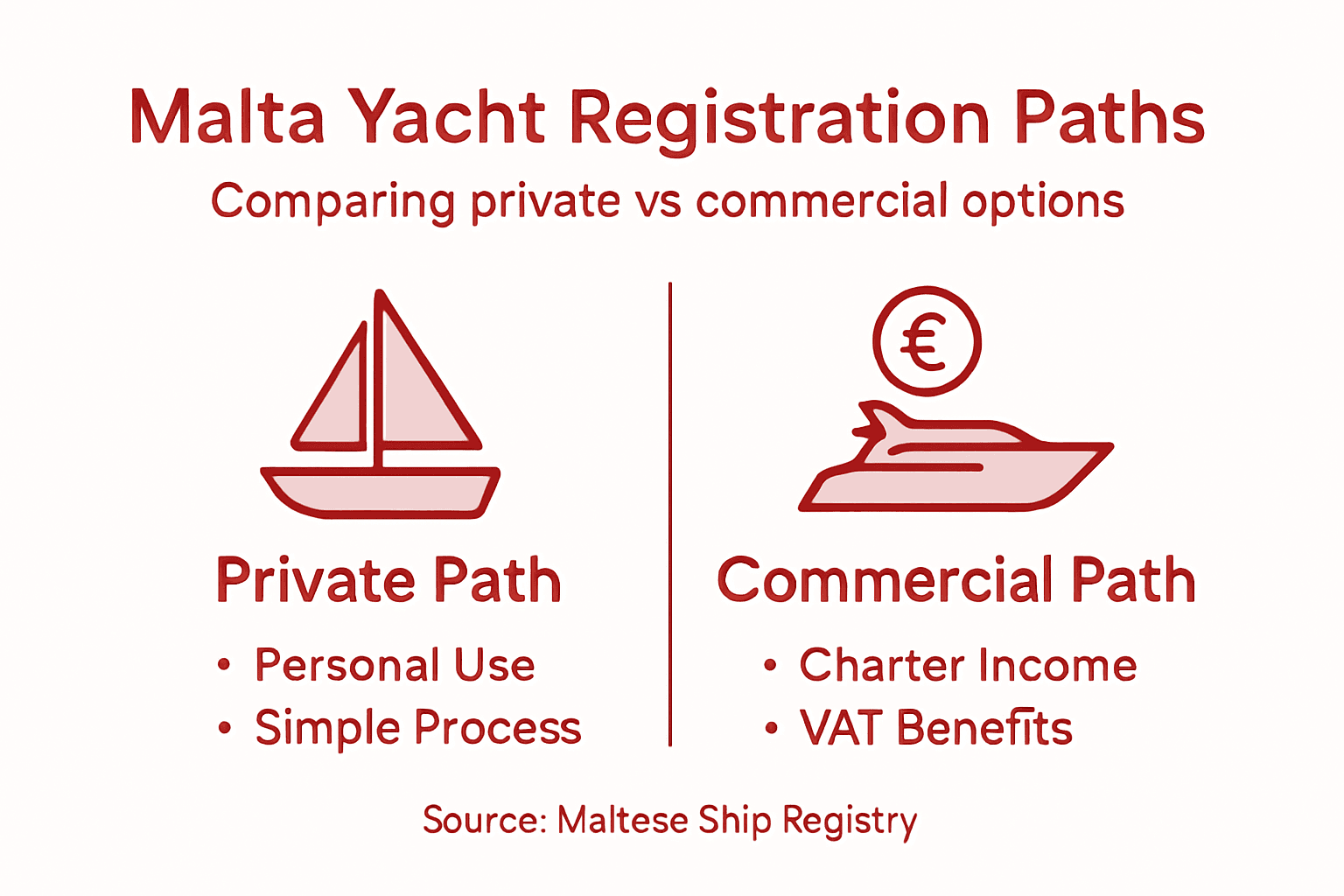
Private yachts are registered for personal pleasure and leisure use only. You’re not chartering the vessel, generating income from it, or operating it commercially. This pathway follows a simpler, faster registration process because the compliance requirements are lighter. Commercial yachts, by contrast, are vessels you operate for hire or business purposes, which triggers stricter regulations and longer processing timelines.
Understanding Registration Categories
The Maltese system uses intended use to determine registration category. Your choice here locks in specific regulatory obligations and tax treatments, so getting this right from the start matters significantly.
Private yacht registration involves a two-stage process:
- Provisional registration (establishes your initial claim to the flag)
- Permanent registration (finalizes ownership and compliance after verification)
This two-stage approach moves relatively quickly. Once you submit complete documentation, Malta typically completes private registration within weeks, not months.
Here’s a side-by-side summary of Malta yacht registration pathways:
| Pathway Type | Main Purpose | Registration Speed | Compliance Level |
|---|---|---|---|
| Private Yacht | Personal pleasure | Rapid | Minimal |
| Commercial Yacht | Charter/business | Slower | Rigorous |
This comparison helps clarify which path suits your operational goals.
Commercial yacht registration requires stricter compliance. You must satisfy the Commercial Yacht Code, which enforces operational safety standards, crew certifications, and vessel maintenance requirements. Processing takes longer because authorities conduct more thorough verification of your operational procedures and safety protocols.
Tax and Financial Advantages
Here’s where commercial registration becomes attractive financially. Commercial yachts qualify for significant tax breaks that private yachts cannot access:
- VAT exemptions on operational supplies and maintenance costs
- Low effective income tax rates on charter revenues
- Relief on chartering and related business expenses
If you’re chartering your yacht seasonally or full-time, these tax savings compound quickly. The VAT exemptions alone can offset registration expenses within a season or two of active charter operations.
Private yachts don’t access these commercial incentives. You’re not chartering, so the tax code treats you differently. However, private registration costs less upfront and involves fewer compliance obligations.
Commercial registration unlocks significant VAT relief and tax advantages for charter operations—but only if your vessel genuinely operates commercially under the proper registration category.
Choosing Your Path
Ask yourself one clear question: Will you generate income from this yacht? If yes, pursue commercial registration despite longer processing times. The tax savings justify the additional compliance requirements. If your yacht is purely personal, private registration gets you flagged faster with minimal regulatory burden.
Misclassifying your vessel creates problems. Register privately, then later start chartering, and you’ll face reclassification issues. Register commercially when you’ll never charter, and you’re paying for compliance you don’t need. Match your registration category to your realistic business model.
Consejo profesional: Before finalizing your registration choice, calculate projected charter revenues against the VAT exemptions and tax rates you’d receive—commercial registration makes financial sense only if your income projections justify the extended processing timeline and compliance costs.
Legal Requirements and Ownership Structures
Yacht ownership in Malta doesn’t follow a one-size-fits-all model. You can register directly in your name, create a corporate structure, or establish a leasing arrangement. The structure you choose affects liability, taxation, privacy, and operational control. Understanding these options before registration prevents costly restructuring later.
Malta’s legal framework accommodates multiple ownership models because different owners have different priorities. Some prioritize asset protection. Others focus on tax efficiency. Still others need operational flexibility across multiple jurisdictions. The Maltese system supports all these scenarios through compliant structures.
Ownership Structure Options
Direct personal ownership is the simplest approach. You register the yacht in your own name, maintaining full control and transparent ownership. This option works well for smaller yachts or owners who value straightforward administration over structural complexity.
Corporate ownership through limited companies or special purpose vehicles provides significant advantages:
- Asset protection and liability separation
- Enhanced privacy (corporate entity holds title, not your personal name)
- Tax optimization through corporate structures
- Simplified ownership transfers and estate planning
- Compliance with international institutional investor requirements
Holding companies represent another layer, particularly useful for complex ownership involving multiple stakeholders or cross-border assets. These structures keep operational control separate from ownership, enabling flexibility in management and taxation.
Operational leasing arrangements unlock additional tax benefits. Your Maltese company can enter a leasing contract with you as the lessee, creating VAT optimization opportunities while maintaining operational control.
Legal Compliance Requirements
Regardless of structure, all Maltese yacht ownership must comply with EU maritime laws and disclosure requirements. Your chosen structure must align with regulations across jurisdictions where your yacht operates.
Corporate owners must maintain proper documentation showing:
- Beneficial ownership disclosure
- Corporate governance records
- Financial statements demonstrating legitimate business purpose
- Compliance with anti-money laundering regulations
Corporate ownership structures require professional guidance to ensure compliance across all applicable jurisdictions—cutting corners on documentation creates significant legal exposure.
Personal ownership requires fewer administrative layers but offers less asset protection. You remain personally liable for the yacht’s operation and obligations.
Choosing Your Structure
Ask yourself: Do you want privacy? Do you need liability protection? Will you operate this yacht commercially? Are you planning succession or estate transfer? Your answers shape the optimal structure.
Small pleasure yachts often work fine with direct ownership. Larger vessels, commercial operations, or those held by institutional investors typically benefit from corporate structures. Professional guidance ensures your chosen structure delivers the tax and protection benefits you expect.
Consejo profesional: Establish your ownership structure before registering your yacht—restructuring afterward triggers administrative delays and potential tax complications, whereas planning structure upfront aligns registration, taxation, and compliance seamlessly.
Tax Benefits and VAT Optimization Strategies
Malta’s tax system for yacht owners delivers real financial advantages, but only if you understand how they work and structure your operations properly. The jurisdiction offers a tonnage tax system that eliminates income tax on qualifying yacht income, combined with VAT mechanisms that reward commercial operators. These benefits aren’t automatic—they require strategic planning and compliance.
The Malta flag advantage starts with what you don’t pay. Malta exempts qualifying yacht income from income tax, eliminating the primary tax burden that yacht owners face in other jurisdictions. Add in zero stamp duty on vessel sales and corporate share transfers, plus exemption from succession and donation duties, and the financial picture becomes compelling for serious yacht operators.
Understanding the Tonnage Tax System
Malta’s tonnage tax system provides exemption from income tax on vessel operations meeting specific criteria. This applies to commercial yacht income, charter revenues, and related maritime business. The system aligns with EU tax directives, ensuring legitimacy across European ports and jurisdictions.
Qualifying for tonnage tax requires:
- Operating the yacht commercially (chartering, leasing, or professional maritime use)
- Maintaining proper documentation of vessel operations
- Establishing real substance in Malta’s maritime sector
- Compliance with EU regulations and transparency requirements
The tonnage tax isn’t simply a loophole—it’s a legitimate EU-approved framework designed to support maritime commerce. European tax authorities recognize and accept this system when properly implemented.
VAT Optimization Through Commercial Operations
Commercial yacht operations unlock VAT refunds and recovery mechanisms unavailable to private owners. When you charter your yacht, you qualify for VAT refunds on operational supplies, maintenance costs, and vessel improvements. These refunds compound significantly over time.
Operational leasing arrangements create additional optimization. Your Maltese company can lease the yacht to you or another operator, structuring VAT recovery while maintaining operational control. This requires careful documentation but delivers substantial tax efficiency.
Private yachts cannot access these VAT benefits. If you’re not chartering, you pay standard VAT on all costs without refund eligibility.
VAT optimization only works for genuinely commercial operations—claiming commercial status without legitimate charter activity triggers audit risk and penalties far exceeding any tax savings.
Real Substance Requirements
Malta now emphasizes actual substance over structural optimization. Following EU rule changes, the jurisdiction requires demonstrated business purpose, proper bookkeeping, and transparent operations. You cannot simply register a yacht and claim tax benefits—you must operate it.
This shift actually strengthens Malta’s reputation. Professional yacht owners appreciate stricter standards because they prevent aggressive tax schemes that invite regulatory scrutiny on all registrations.
Build real substance through documented charter activity, professional crew, established client relationships, and regular operational records. This legitimacy protects your tax position and prevents future reclassification.
Consejo profesional: Document all charter activity meticulously from day one—detailed logbooks, client agreements, and financial records establish the real substance that justifies your tax benefits if regulators ever review your operations.
Comparing Malta With Other Yacht Flags
Malta isn’t your only option for yacht registration, but it competes strongly against alternatives because it balances regulatory rigor with practical advantages. Understanding how Malta stacks up against other flags helps you make an informed choice that matches your priorities. The comparison reveals why Malta has become Europe’s largest maritime flag.
Other flags might seem simpler or cheaper on the surface. Some offshore jurisdictions promise minimal paperwork and rock-bottom fees. But simplicity without substance creates problems. You want a flag that ports recognize, that banks trust for financing, and that stands up to regulatory scrutiny. Malta delivers on all three fronts.
Malta Versus Offshore Flags
Offshore jurisdictions like Palau or Panama offer speed and low costs, but they lack the legal credibility Malta provides. Banks hesitate to finance vessels under offshore flags because the regulatory oversight is weaker. Insurance underwriters demand higher premiums. Port authorities occasionally scrutinize offshore-flagged vessels more closely.
Malta’s advantage here is straightforward. The jurisdiction maintains stringent EU regulatory compliance combined with attractive fiscal incentives, creating a flag that regulators respect. You get speed and efficiency without sacrificing credibility.
Offshore flags work well for specific situations, but they carry reputational baggage that Malta avoids entirely.
Malta Versus Other European Flags
European alternatives like United Kingdom Part 1, Poland, or Gibraltar each offer advantages. But none match Malta’s combination of tax benefits, regulatory framework, and prestige.
Consider the key differences:
- Tax treatment: Malta offers tonnage tax and VAT optimization unavailable elsewhere
- Financial institution support: EU banks understand and accept Maltese maritime law
- Processing speed: Malta’s 24/7 registry moves faster than competitors
- Prestige factor: Malta ranks as Europe’s largest maritime flag globally
- Fleet size: Malta’s sixth-largest world fleet demonstrates institutional confidence
Other European flags demand longer processing times or offer weaker tax structures. Some restrict crew nationality or impose stricter ownership requirements. Malta’s flexibility combined with credibility makes it the practical choice for serious operators.
To better understand flag choices, here’s a quick comparison of Malta and major alternatives:
| Jurisdicción del pabellón | Regulatory Reputation | Typical Processing Speed | Tax Incentives Available |
|---|---|---|---|
| Malta | High, EU compliance | Fast | Extensive, VAT relief |
| Offshore (Panama/Palau) | Lower, less oversight | Very fast | Limitado |
| Other European (UK/Poland) | Strong, EU alignment | Moderado | Moderado |
This overview highlights why Malta is favored by serious yacht operators.
The Prestige and Credibility Factor
Yacht registration isn’t purely technical. The flag you fly signals something about your vessel and operation to ports, clients, and potential buyers. A Maltese flag indicates professional standards, EU compliance, and serious maritime operations.
This credibility matters during charter marketing, sale transactions, and port visits. Captains notice which flags receive priority berthing. Clients recognize which flags indicate reliable operations. Buyers research flag reputation when evaluating purchase decisions.
Malta’s reputation as Europe’s largest maritime flag creates operational advantages beyond what the legal framework alone provides—ports recognize the flag, insurance companies understand it, and professional operators respect it.
Smaller or lesser-known flags don’t offer this intangible but real advantage.
Making Your Flag Decision
Speed and cost matter, but they shouldn’t be your only criteria. Ask yourself what the flag communicates about your operation. Do you need tax optimization? Do you plan significant commercial activity? Will you operate primarily in European waters? Do you value prestige and professional standing?
If you answered yes to most of these, Malta outperforms competitors. If you need bare-minimum registration for a small vessel with no commercial plans, offshore flags might suffice despite their limitations.
Consejo profesional: Before choosing a flag, contact potential charter clients and ask which registries they prefer—their preferences often reveal which flags carry operational advantages in your target market.
Simplify Your Malta Yacht Registration Journey with Expert Support
Navigating Malta’s yacht registration system can feel complex with its legal nuances, tax optimization strategies, and rigorous compliance requirements. Whether you are focused on securing the prestigious Malta flag for your private or commercial yacht, understanding ownership structures, or maximizing VAT advantages, the process demands precision and expert guidance. Key challenges include choosing the right registration pathway, aligning your ownership model with legal and tax goals, and ensuring timely completion without costly delays.
En VesselFlag.com, we specialize in turning these challenges into smooth solutions. Our platform offers comprehensive yacht and boat registration services worldwide with a deep focus on Malta’s unique regulations. Benefit from our streamlined processes, expert consultancy, and ancillary services including corporate registration and MMSI licensing. We take pride in fast, compliant registrations that protect your investment, optimize your tax position, and reinforce your vessel’s credibility. Ready to move forward confidently? Explore our detailed offerings in Registro de banderas and discover why choosing Malta through VesselFlag ensures your yacht commands respect on international waters.
Start your Malta yacht registration now with the trusted experts at VesselFlag. Visit https://vesselflag.com to get personalized assistance that aligns perfectly with your yacht ownership and business goals. Don’t wait until compliance or financial complexities slow you down. Secure your yacht’s future under Malta’s respected flag today.
Preguntas frecuentes
What are the benefits of registering a yacht in Malta?
Malta offers a respected international flag, efficient registration processes, legal protection for financier rights, and tax advantages such as VAT exemptions for commercial operations.
How does the yacht registration process in Malta work?
The registration involves submitting documentation to the Ship and Yacht Registry, verifying ownership and rights, and obtaining flag issuance—often completed within weeks.
What are the differences between private and commercial yacht registration in Malta?
Private registration is for personal use with minimal compliance, while commercial registration is for vessels used for hire, requiring stricter regulations and offering tax benefits.
What ownership structures can I choose when registering my yacht in Malta?
Owners can register yachts directly in their name, through a corporate structure, or establish leasing arrangements, allowing for flexibility based on asset protection, taxation, and operational needs.