
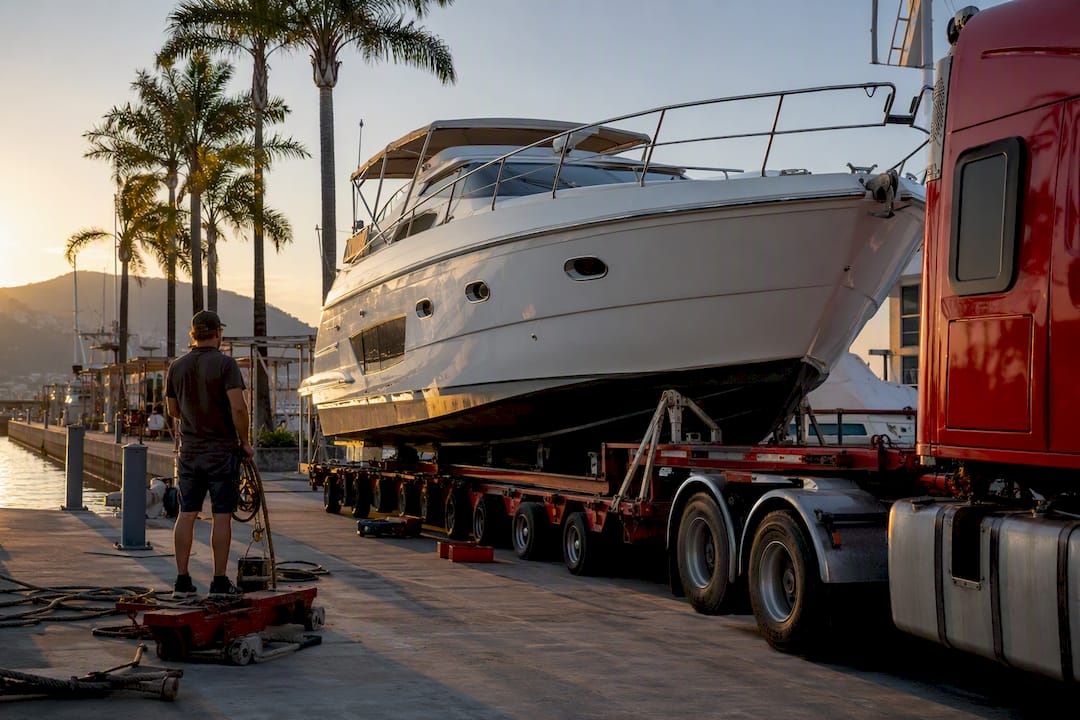
Moving a yacht by land typically runs from a few hundred to several thousand dollars for short overland hauls, while ocean shipping via RoRo or LoLo service can range broadly depending on size and route. Cross-country trucking can climb into the tens of thousands for larger boats needing permits and escorts. The single best move before booking anything: get two itemized quotes and insist on a signed pre-shipment condition survey.
En resumen:
- Overland yacht transport costs typically range from $4 to $20 per mile, with large boats needing permits and escorts increasing expenses significantly.
- Ocean shipping options vary widely: RoRo can cost $15,000 to $40,000 for 35 to 60-foot vessels, while heavy-lift semi-submersibles may exceed $100,000 for larger yachts.
- Major cost factors include vessel dimensions, permits, port fees, insurance premiums, and route seasonality, which can all cause substantial price fluctuations.
- Obtaining detailed, line-item quotes with accurate vessel specs, proof of insurance, and a pre-shipment condition survey helps prevent unexpected charges.
- Proper documentation, registration, and coordinated logistics with a single provider like VesselFlag reduce delays, demurrage fees, and overall transport costs.
Índice
- How Much Does Yacht Transport Cost by Method and Size?
- What Drives the Price of Yacht Shipping?
- What Should Be in an Itemized Yacht Transport Quote?
- How Do You Prepare a Yacht for Transport?
- How Does Registration Paperwork Affect Transport Costs?
- Where Owners Actually Lose Money on Yacht Transport
- Get an Itemized Yacht Transport Quote Through VesselFlag
- Sources
- Preguntas frecuentes
How Much Does Yacht Transport Cost by Method and Size?
Pricing splits sharply by method, and method is largely dictated by vessel length, beam, and whether the boat needs to cross an ocean or just a few states.
Overland transport works on a per-mile basis for shorter distances, with owners commonly quoted $4 to $20 or more per mile depending on boat width and whether the route needs a pilot car. A 30-foot boat on a standard trailer might move a few hundred miles for $1,500 to $3,500. A 45-foot yacht requiring a wide-load permit and two escort vehicles can push past $10,000 for the same distance, purely because of the permit and escort layer.
Ocean freight changes the math entirely. RoRo, LoLo, and semi-submersible heavy-lift methods each carry distinct cost bands tied to vessel size and how the boat gets loaded:
- RoRo (roll-on/roll-off): Cheapest ocean option for boats that can drive onto the vessel using their own power or a trailer; typically $15,000 to $40,000 for boats in the 35 to 60 foot range on major trade routes.
- LoLo (lift-on/lift-off): Crane-loaded, used for boats without wheels or with fixed keels; costs climb with weight and crane time, often $25,000 to $70,000.
- Semi-submersible heavy lift: Reserved for superyachts and vessels over 80 feet that can’t use standard cranes; costs regularly exceed $100,000 and can approach $150,000 on long-haul routes.
- Professional delivery crew: A licensed crew sails the boat itself, charged as a daily rate covering crew, fuel, and provisions, from a few hundred dollars a day for a small coastal hop to several thousand daily for larger yachts on longer passages.
Per-mile and per-foot estimates are useful for rough budgeting on domestic overland moves, but they break down fast for international ocean freight. Bespoke pricing is the norm for specialist and heavy-lift shipments because route, seasonality, and lifting complexity swing the price too much for a flat formula to hold. Treat any per-mile or per-foot number you see online as a starting point for conversation, not a quote.
What Drives the Price of Yacht Shipping?
Four factors move the number on your quote more than anything else, and most owners underestimate at least one of them.
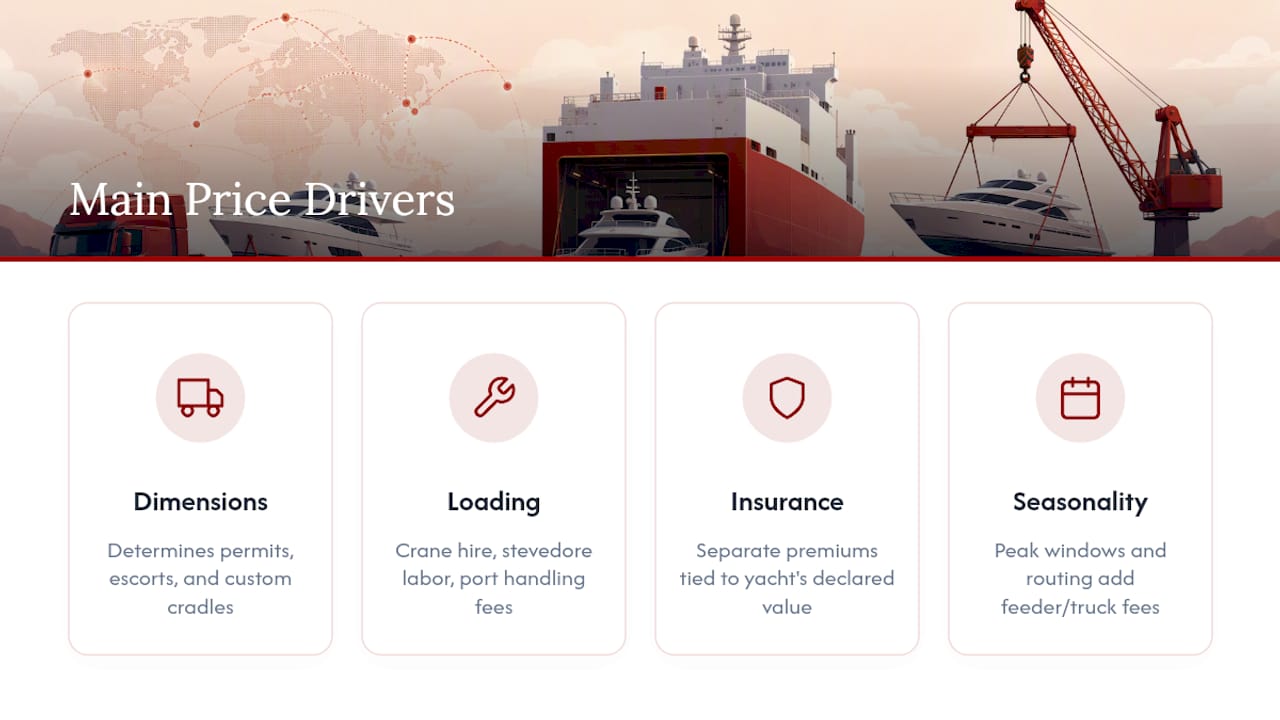
Length, beam, and height determine whether your boat needs a wide-load permit, a police escort, or a custom cradle. A boat under 8.5 feet wide often travels without a permit in most states; go wider, and you’re paying for permits and escort vehicles on every state line you cross. Height matters just as much for overland moves, since bridges and overpasses set a hard ceiling on what a trailer can carry.
For the marine leg, crane hire, stevedore labor, and port handling fees stack up fast, especially at smaller or remote ports where cranes aren’t sitting idle waiting for your boat. Precise vessel measurements decide the loading method, and getting them wrong at the quote stage is one of the most common reasons final invoices run higher than expected.
Insurance is its own line item, not an add-on. Marine transit coverage, cargo insurance, and liability protection during loading and unloading all carry separate premiums tied to your yacht’s declared value.
Seasonality and routing round out the list. Shipping during peak relocation windows (spring in the Northern Hemisphere, when snowbirds and charter fleets move) costs more than off-season bookings, and a remote destination port adds trucking or feeder-vessel fees on top of the main freight cost.
Consejo de experto: Ask your shipper about upcoming group sailings before you book. Carriers running scheduled return routes sometimes split costs across several boats, and that seasonal timing can shave thousands off a solo booking.
What Should Be in an Itemized Yacht Transport Quote?
A vague quote is how owners end up with a bill $3,000 higher than expected. Send shippers a complete spec sheet and demand a line-item breakdown before you commit to anything.
- Provide exact specs and photos. LOA, beam, height with mast up and down, displacement, and whether the mast needs removal.
- Request separate line items for cradle rental, loading and offloading labor, inland trucking, crane or lift fees, port charges, insurance, and any permits or escort vehicles.
- Ask for proof of carrier insurance limits in writing, including what’s covered during loading and transit versus what falls back on your own policy.
- Require a pre-load condition survey signed by both you and the carrier’s representative, with photos timestamped before the boat leaves your dock.
- Negotiate on flexibility. Offering flexible pickup dates, agreeing to combine your shipment with a regular sailing, or removing the mast yourself can all lower the quoted price.
Two quotes side by side, broken into these same categories, make it obvious where one shipper is padding a number and where another is genuinely cheaper.
How Do You Prepare a Yacht for Transport?
Preparation work you do yourself often shows up as savings on the invoice, because less handling time for the crew means fewer billed labor hours.
- Write a signed condition report with photos and serial numbers for the engine, electronics, and hull, matching what yacht shipping checklists recommend as a baseline for any damage claim later.
- Remove or secure loose gear, unstep the mast if the shipper requires it, and drain fluids if asked, since owner prep work reduces crane and stevedore hours on the loading day.
- Confirm your cradle is compatible with the vessel’s lifting points, and label every part you remove so nothing goes missing at the destination.
- Gather ownership paperwork, customs documents for international routes, and your current insurance policy details before pickup day.
Consejo de experto: Take photos of every serial number and hull identification mark before the crew arrives. A five-minute task now saves weeks of dispute if something goes missing in transit.
How Does Registration Paperwork Affect Transport Costs?
Documentation problems are one of the most overlooked cost drivers in yacht transport, and they rarely show up until the boat is sitting at a port racking up storage fees.
Fast, correct registration and MMSI and AIS setup speed up customs clearance, and customs delays are where per-day storage and demurrage charges quietly accumulate. Owners who coordinate registration and insurance before the boat ships tend to avoid those hold-ups entirely.
- Correct paperwork lets a boat clear customs on the first pass instead of sitting in a queue for review.
- Coordinated crane bookings and cradle specs that match the insurer’s preferred procedures reduce the odds of a delay claim.
- A bundled arrangement covering registration, insurance, and transport coordination under one point of contact cuts the administrative back and forth that otherwise adds days to a move.
Where Owners Actually Lose Money on Yacht Transport
The single most expensive mistake is leaving mast removal until the shipper’s crew shows up. It always costs more on the day than it would have cost a rigger the week before, and it delays loading for every other boat scheduled that day. Missing paperwork runs a close second: a registration document that doesn’t match the hull number on the bill of lading can stall a boat at customs for days.
Crew delivery beats commercial shipping when the route is coastal and time isn’t critical. Commercial freight wins for ocean crossings or tight schedules. Bundling registration, insurance, and transport coordination under one provider consistently comes in cheaper than juggling three separate vendors, mostly because nobody’s waiting on someone else’s paperwork.
— VesselFlag
Get an Itemized Yacht Transport Quote Through VesselFlag
Coordinating a yacht move usually means juggling a shipper, an insurer, and a registration office that don’t talk to each other, and every gap between them costs you money in delays. VesselFlag handles registration under the flag jurisdiction that fits your situation, MMSI and AIS licensing, insurance coordination, and cradle and lifting logistics under a single point of contact, so you get one invoice and one team accountable for the timeline instead of three.
That single-point setup is what cuts the clearance delays and demurrage fees discussed above. Correct paperwork before the boat ships means customs has nothing to flag, and coordinated insurance means your carrier’s preferred procedures and your policy’s requirements match from day one. If you’re planning a transport in the next few months, request an itemized quote and registration review before you book a shipper, not after.
Sources
For deeper reading on the logistics side, see VesselFlag’s guide to yacht delivery logistics and the vessel insurance checklist for owners preparing a move.
- Yacht Shipping Pricing | Peters & May | Global Logistics
- How Much Does It Cost to Transport a Yacht? – A Complete Guide
- How To Ship A Yacht: Costs, Cradles, Insurance & Checklist
Preguntas frecuentes
How much does it cost to move a 40-foot boat?
Overland transport for boats around 30 to 45 feet often runs from a few hundred to over ten thousand dollars depending on distance, permits, and escort requirements. By ocean freight using RoRo or LoLo service, expect roughly $15,000 to $40,000 depending on route and season.
Can a 40-foot yacht cross the Atlantic?
Yes, a well-prepared 40-foot yacht can cross the Atlantic under its own power with an experienced delivery crew, though most owners choose commercial RoRo shipping instead to avoid the time, fuel, and weather risk of a multi-week passage.
What is the average price of a 100-foot yacht?
A 100-foot yacht’s purchase price varies enormously by age and condition, but transporting one typically requires semi-submersible heavy-lift shipping, which regularly runs $100,000 to $150,000 depending on route and port access.
What is the 12-person rule on a yacht?
This generally refers to passenger limits under commercial vessel classification rules, where carrying passengers for hire triggers stricter safety and crewing requirements; the exact threshold and requirements depend on the vessel’s flag state and registration category.
What paperwork do I need before shipping my yacht?
You need proof of ownership, current registration documents, a signed pre-shipment condition survey, and proof of marine transit insurance with your declared value confirmed, plus customs documentation for any international route.

[…] breakdown of what yacht transport costs by method and vessel size goes deeper on how these components stack up for different boat sizes. Build in buffer time for […]
[…] What Yacht Transport Costs by Method and Vessel Size […]