

باختصار:
- Yacht registry directly influences vessel valuation by affecting insurance premiums, financing options, and market perception. Choosing a reputable registry with White List status enhances compliance, reduces costs, and attracts buyers. Owners should prioritize proactive registration management aligned with their resale market and tax position to protect asset value.
Yacht registry is the formal process by which a vessel receives legal nationality under a sovereign state’s flag, and the role of yacht registry in valuation is far more direct than most owners realize. The flag your yacht flies determines which safety, environmental, and labor laws apply to it. Those laws shape your insurance premiums, your financing options, your tax exposure, and ultimately what a buyer will pay. Registries like the Red Ensign Group, the Marshall Islands, and the Cayman Islands each carry distinct reputations that lenders, insurers, and buyers factor into every transaction.
How does yacht registry influence the valuation process?
Flag state registration affects regulations, crew qualifications, taxes, insurance terms, and global reputation. That is not a background administrative detail. It is the foundation of a yacht’s financial identity.

Regulatory compliance and safety standards
Every yacht operating commercially or crossing international waters must comply with conventions including SOLAS (Safety of Life at Sea), MARPOL (marine pollution prevention), and the MLC (Maritime Labour Convention). The flag state determines which version of these rules applies and how strictly they are enforced. A yacht registered under a well-regulated flag arrives at any port with a credible compliance record. A yacht under a poorly regarded flag faces heightened scrutiny from Port State Control inspections, and PSC inspection failures trigger costly repairs and operational restrictions that directly reduce vessel value.
Insurance premiums and coverage terms
Insurance underwriters and Protection and Indemnity clubs assess flag registry status when pricing risk. Yachts on reputable registries pay lower premiums and face fewer coverage restrictions. A yacht flying a flag from a “Grey List” or “Black List” registry, as classified by the Paris Memorandum of Understanding on Port State Control, signals elevated risk to underwriters. That signal translates directly into higher annual costs and tighter policy terms, both of which reduce net asset value.
Lender confidence and financing access
White List registries signal compliance with international standards, attracting lenders and insurers. Banks and marine finance specialists treat flag state as a proxy for asset quality. A yacht registered under the Marshall Islands or Cayman Islands registry is far easier to finance than one flying an obscure or unrecognized flag. That financing accessibility increases the pool of potential buyers, which supports resale value.
نصيحة من الخبراء: Before listing a yacht for sale, confirm that its registry status is current and in good standing. Buyers’ surveyors check flag state compliance as a standard step, and a lapsed or problematic registration can stall a deal or reduce the offer price.
Offshore vs. onshore registration: how does each affect value?
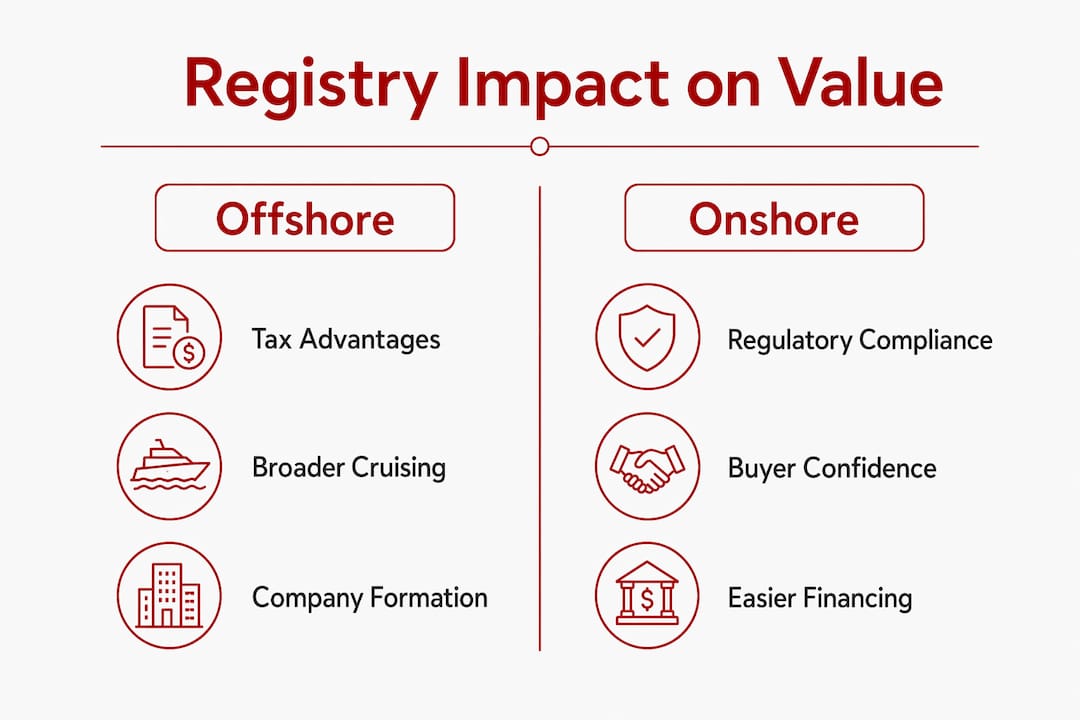
The distinction between offshore and onshore registration is one of the most consequential choices in the yacht valuation process. Each model carries different tax treatment, operational flexibility, and market perception.
| العامل | Offshore registration | Onshore registration |
|---|---|---|
| المعاملة الضريبية | Often avoids VAT and income tax for non-residents | Subject to domestic VAT and tax rules |
| Operational flexibility | Broader cruising rights, charter eligibility | May restrict international operations |
| Crew employment law | International labor conventions apply | Domestic labor law applies |
| Compliance complexity | Higher, requires specialist management | Lower, more standardized |
| Lender preference | Varies by jurisdiction reputation | Generally straightforward for domestic lenders |
| Insurance market | Favorable for top-tier offshore flags | Standard domestic market terms |
Offshore flags allow non-citizen company formation, temporary admission regimes, and broader cruising rights, but they require more complex compliance management. That complexity is a real cost. Owners who underestimate it often accumulate compliance gaps that surface during surveys and depress valuations.
Tax implications vary widely and depend on owner tax residency, usage, and registry jurisdiction. A non-resident owner using a Cayman Islands or Malta registration may legitimately defer or reduce VAT exposure, which improves the net economics of ownership. However, the same structure applied incorrectly creates tax liability that a buyer’s due diligence will uncover.
Key considerations when comparing offshore and onshore options:
- Charter revenue: Offshore registries often permit commercial charter operations in international waters without domestic tax exposure.
- Crew contracts: Onshore registrations tie crew employment to domestic labor law, which can increase operating costs.
- Resale market: European buyers often prefer EU-flagged vessels with documented VAT-paid status. American buyers frequently favor U.S. Coast Guard documentation.
- Hidden costs: Offshore compliance requires specialist agents, annual audits, and ongoing fees that onshore registrations typically do not. Reviewing registration cost structures before committing to a flag is non-negotiable.
Which registries offer the best balance for valuation and compliance?
The registries that consistently support strong valuations share three traits: international recognition, rigorous safety oversight, and favorable treatment by insurers and lenders.
| Registry | Key strength | Best suited for |
|---|---|---|
| Red Ensign Group (UK, Cayman, BVI) | Gold standard reputation, strong regulatory framework | Superyachts, charter operations, financing |
| جزر مارشال | Fast processing, White List status, global acceptance | Commercial and private yachts seeking financing |
| مالطا | EU membership, VAT advantages, MCA-equivalent standards | European charter market, EU-based owners |
| بالاو | Cost-effective, recognized internationally | Smaller yachts, budget-conscious owners |
| بنما | Large fleet, widely accepted, affordable fees | Commercial operators, cost-focused owners |
The Red Ensign Group is regarded as the gold standard for superyachts, with strong regulatory frameworks and reputable classification societies. Cayman Islands registration, in particular, is the preferred choice for yachts above 24 meters that operate commercially. The Cayman registry’s alignment with MCA (Maritime and Coastguard Agency) standards means surveyors, insurers, and buyers treat these vessels as fully compliant by default.
Malta offers a compelling alternative for owners operating in European waters. EU flag status means VAT-paid documentation is straightforward, and the Malta registry aligns with both MCA and EU regulations. For owners who charter in the Mediterranean, Malta registration removes a significant friction point in the resale process.
نصيحة من الخبراء: If you plan to sell your yacht within five years, choose a registry that your target buyer pool recognizes. A U.S. buyer will favor USCG documentation. A European buyer will favor an EU flag with VAT-paid status. Matching your registry to your exit market is one of the most underused tactics in yacht ownership valuation.
What steps should owners take to protect value through registry choices?
Choosing the right registry is a decision that requires the same rigor as any other investment decision. The steps below reflect what experienced owners and investors actually do, not what brochures suggest.
Assess your tax position first. Your personal tax residency and the yacht’s intended use determine which registries create tax efficiency and which create liability. Consult a maritime tax specialist before selecting a flag, not after.
Verify White List status. Confirm that your chosen registry appears on the Paris MOU or Tokyo MOU White List. White List registry selection protects owner investment by aligning vessel value with international financing and insurance markets.
Understand ongoing obligations. Registration is not a one-time event. Annual renewals, safety certificate updates, crew certification checks, and survey requirements all carry deadlines. Missing them creates compliance gaps that appear in pre-purchase surveys.
Keep documentation current. Lapsed certificates of registry, expired safety equipment records, or missing crew documentation reduce a yacht’s appraised value. Buyers and their surveyors treat documentation gaps as negotiating leverage.
Match the registry to your financing plan. If you intend to borrow against the yacht or sell to a financed buyer, choose a registry that marine lenders accept without conditions. The Marshall Islands and Cayman Islands registries are the most broadly accepted by international marine finance institutions.
Engage specialist support. Proper registration management requires specialist expertise to complete correctly and maintain over time. Errors in the initial registration process are expensive to correct and can cloud title, which is a serious valuation risk.
الوجبات الرئيسية
Yacht registry is a direct financial variable in valuation, not a background administrative formality. Owners and investors who treat it as such protect their asset value at every stage of ownership.
| نقطة | التفاصيل |
|---|---|
| Registry drives valuation | Flag state affects insurance, financing, taxes, and resale price in measurable ways. |
| White List status matters | Registries on the Paris MOU White List attract better lenders and lower insurance premiums. |
| Offshore vs. onshore tradeoffs | Offshore flags offer tax and operational advantages but require specialist compliance management. |
| Registry must match exit market | Align your flag choice with the buyer pool you expect at resale to avoid value discounts. |
| Documentation gaps cost money | Lapsed certificates and missing records give buyers leverage to reduce offer prices. |
The registry decision is more financial than administrative
At Vesselflag, we work with owners and investors across dozens of jurisdictions, and the pattern we see repeatedly is this: registry is treated as a checkbox, not a strategy. Owners pick a flag based on cost or convenience, then discover years later that their insurer charges a premium surcharge, their lender requires a re-flagging before approving a loan, or their buyer’s surveyor flags compliance gaps that kill the deal.
The registries that consistently protect value are not always the cheapest or the fastest to obtain. The Red Ensign Group flags, the Marshall Islands, and Malta cost more and require more documentation than many alternatives. But that rigor is exactly what makes them valuable. A buyer paying $5 million for a yacht wants certainty. A registry with a strong international reputation provides that certainty in a way that a low-cost, obscure flag simply cannot.
The other pattern we see is owners who change registries without understanding the tax consequences. Re-flagging can trigger VAT events, affect crew employment contracts, and reset compliance timelines. Those costs are real and often exceed the savings that motivated the change. Proactive registry management, from day one of ownership, is the only approach that consistently protects asset value over time.
— Vesselflag
Vesselflag’s registration services for owners focused on valuation
Selecting the right flag state is one of the highest-leverage decisions a yacht owner or investor makes. Vesselflag provides registration services across a wide range of international flags, including Malta, Palau, UK Part 1, and others, with clear timelines, transparent fees, and compliance support built into every engagement.
Whether you are registering a new acquisition or re-flagging an existing vessel to improve its market position, Vesselflag’s team guides you through the full process. The platform’s complete registration guide covers flag selection, documentation requirements, and ongoing compliance obligations. For owners comparing registration types, the yacht vs. boat registration resource clarifies the legal distinctions that affect valuation and financing. Protecting your asset value starts with getting the registry decision right.
الأسئلة الشائعة
What is the role of yacht registry in valuation?
Yacht registry establishes a vessel’s legal nationality and compliance framework, which directly affects its insurance premiums, financing access, tax exposure, and resale price. Buyers, lenders, and insurers all use flag state status as a proxy for asset quality.
Which yacht registries are best for financing and resale?
The Marshall Islands, Cayman Islands, and Red Ensign Group registries are the most broadly accepted by international marine lenders and are preferred by buyers in the superyacht market. Their White List status signals compliance with international safety and labor standards.
Does yacht registration affect insurance costs?
Yes. Insurance underwriters and P&I clubs assess flag registry status when pricing coverage. Yachts registered under well-regulated, White List flags pay lower premiums and face fewer coverage restrictions than those under poorly regarded flags.
What is the difference between offshore and onshore yacht registration?
Offshore registrations typically offer tax advantages and broader operational flexibility, including international charter rights, while onshore registrations follow domestic tax and labor rules. Offshore compliance is more complex and requires specialist management to avoid gaps that reduce valuation.
How often does yacht registration need to be renewed?
Registration renewal requirements vary by jurisdiction, but most registries require annual renewal along with updated safety certificates and crew documentation. Letting any of these lapse creates compliance gaps that appear in pre-purchase surveys and reduce appraised value.