

Most owners split the decision in two: pick a flag state (Cayman Islands, Marshall Islands, Malta, or Isle of Man/UK Part I) to satisfy operational and safety rules, then pick a separate ownership jurisdiction to handle tax, liability, and privacy. The flag governs where the vessel is inspected and how it’s crewed. The entity governs who’s exposed if something goes wrong, and how much of the ownership costs are deductible. Get the two decisions backward, and U.S. owners in particular can end up with a compliant boat and an indefensible tax position.
باختصار:
- The choice of flag state impacts inspection, crew certification, and port acceptance, with Cayman Islands, Marshall Islands, Malta, and Isle of Man being the dominant options for large yachts.
- Owners should separate the vessel’s flag from its ownership structure, often using LLCs, SPVs, or limited partnerships, to protect against liability and enhance privacy.
- Correctly aligning the vessel’s operational, tax, and ownership locations is crucial, especially considering lender approval lists and the impact of VAT, SALT limits, and state sales tax.
- Timely documentation, early setup of corporate structures, and coordination of registration processes can significantly reduce vessel registration delays.
- Flag selection depends more on cruising geography and charter plans than prestige, making strategic pairing of flag and ownership structure essential for compliance and efficiency.
جدول المحتويات
- What Are the Leading Yacht Owning Jurisdictions?
- Which Ownership Structures Do Yacht Owners Actually Use?
- What Tax Rules Apply to U.S. Yacht Owners?
- How Do You Choose a Flag and Ownership Jurisdiction Step by Step?
- How VesselFlag Handles Registration From Decision to Delivery
- Flag Choice Comes Down to Geography More Than Prestige
- Ready to Register? Here’s the Fastest Path Forward
- المصادر
- الأسئلة الشائعة
What Are the Leading Yacht Owning Jurisdictions?
A flag state controls the operational side of ownership: safety inspections, crew certification, tonnage measurement, and which ports and charter markets will accept the vessel without extra scrutiny. It has nothing to do with who owns the boat on paper. Three registries dominate the large-yacht market, and each fits a different owner profile.
- Cayman Islands. Part of the Red Ensign Group, Cayman covers a substantial share of the 40-meter-plus fleet and is recognized for prestige by resale buyers and charter brokers. Lenders financing superyachts frequently name Cayman as one of their approved flags, which matters more than most owners expect once a mortgage is involved.
- Marshall Islands. Fast, inexpensive, and popular with U.S. owners who want minimal friction and a registry that understands American ownership structures. It lacks Cayman’s cachet but rarely creates problems at the dock.
- Malta. An EU flag that opens Mediterranean charter markets without the extra layer of paperwork non-EU vessels face. The tradeoff is VAT complexity and a heavier compliance load than Cayman or Marshall carries. Owners planning to register in Malta should budget extra time for VAT structuring before the first Mediterranean season.
- Isle of Man / UK Part I. Strong for owners who want a jurisdiction built around corporate ownership, with registry staff experienced in SPV and trust structures.
The practical consequence shows up at the fuel dock, not in a lawyer’s office. A flag absent from the Paris MoU white list can trigger extra port state inspections. A flag missing from your lender’s approved list can delay financing by weeks.
Which Ownership Structures Do Yacht Owners Actually Use?
Owners separate the flag from the owning entity for three reasons: liability protection, privacy, and tax planning. If the yacht sits in your personal name, a collision or crew injury claim reaches your personal assets. Put the vessel inside a dedicated entity, and the exposure generally stops at the entity’s assets.
Three structures come up repeatedly:
- Delaware or other U.S. LLC. Familiar to American owners, simple to set up, and useful when the vessel operates mostly in U.S. waters.
- Isle of Man SPV. A special-purpose vehicle that holds title to the yacht and nothing else, isolating it from other business risk. These entities can obtain separate legal personality, which is what makes the liability wall hold up.
- Limited partnership. Common where a managing general partner (often the SPV itself) runs the vessel while limited partners hold passive ownership.
Here’s the trap almost nobody warns new owners about: a limited partner who starts making operational decisions, hiring crew, or negotiating charter contracts can be reclassified as a general partner. Once that happens, the limited liability protection disappears for that person, defeating the entire point of the structure.
نصيحة من الخبراء: Keep a hard line between ownership and management. Use a professional yacht management company, maintain a registered office separate from any owner’s home address, and never let a passive owner sign crew contracts or fuel invoices personally. Corporate registration setups built this way hold up far better under audit or litigation than informal arrangements assembled after the fact.
What Tax Rules Apply to U.S. Yacht Owners?
The IRS doesn’t care what your yacht cost. It cares whether you can prove it’s a second home or a real business, not a hobby with a tax angle attached. Deductions are only credible when the vessel meets one of those two tests, backed by contemporaneous documentation rather than a memory of how the boat got used last summer.
Three checkpoints matter most:
- Bonus depreciation and placed-in-service timing. A yacht must be fully ready for its intended business use, crewed, insured, and documented, before it counts as placed in service. Miss that window because refit work ran late, and the depreciation year moves with it.
- Genuine charter activity. Occasional personal use dressed up as a charter business rarely survives scrutiny. The IRS looks for a real profit motive, not paperwork built to justify a deduction after the fact.
- State sales and use tax. Rates run from 0% to more than 8% depending on where the boat is purchased or based, and some states cap the total tax owed on a sale, which changes the math on where to close.
The SALT ceiling changes the payoff. Federal SALT deduction limits mean high earners often can’t fully offset state sales and property tax on a large yacht purchase, even in a state with favorable caps, which makes the choice of purchase state worth modeling before signing anything.
Keep trip logs, charter contracts, and maintenance records from day one. Lenders and insurers will ask for the same paperwork the IRS wants, so building one clean file serves both audiences.
How Do You Choose a Flag and Ownership Jurisdiction Step by Step?
- Define your cruising ground and use case. Mediterranean charter work points toward Malta. Private use across the Caribbean or U.S. coastline usually favors Cayman or Marshall Islands.
- Check lender and insurer approved flag lists before falling in love with one. A beautiful flag choice that your lender won’t finance is a dead end.
- Map your tax exposure. Confirm state sales/use tax at the purchase and home-port states, then decide whether an LLC, SPV, or limited partnership fits, and where the registered office should sit.
- Assemble documentation early. Corporate formation papers, proof of ownership, insurance binders, and crew certifications all have to arrive before survey and flag application, so start the paperwork chain the same week you sign the purchase agreement.
Owners chartering through operators like Exotica Charters in specific cruising regions should confirm flag acceptance with the charter operator before finalizing registration, since some markets are stricter about non-EU flags than others.
How VesselFlag Handles Registration From Decision to Delivery
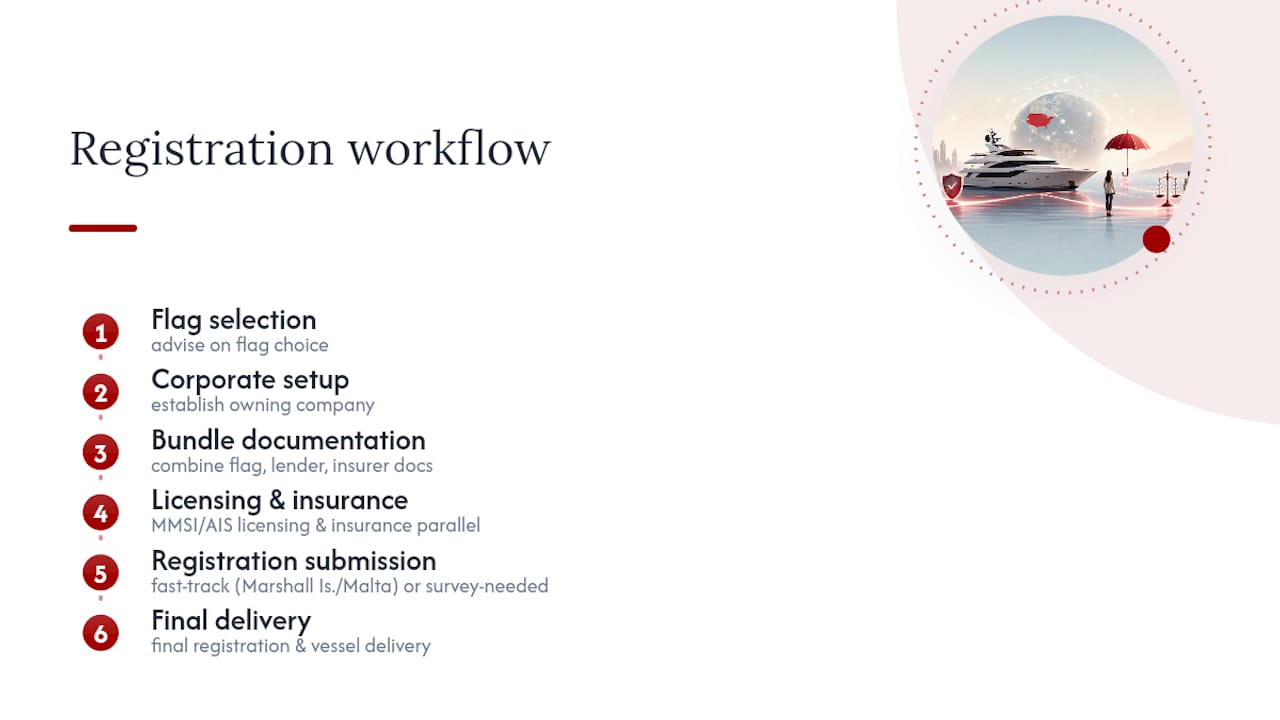
Vesselflag advises on flag selection, sets up the owning corporate structure, and coordinates MMSI/AIS licensing and insurance in parallel rather than sequentially, which is where most delays happen. Fast-track registrations under flags like Marshall Islands or Malta typically move faster than standard filings that require additional survey coordination; exact timelines and fees depend on vessel size and flag. Because documentation for the flag, the lender, and the insurer often overlaps, handling it as one coordinated file cuts down on the back-and-forth that usually stalls a registration for weeks.
Flag Choice Comes Down to Geography More Than Prestige
The rule of thumb we’d give any owner: let your cruising geography and charter ambitions pick the flag, and let your tax and liability exposure pick the entity. An owner running Mediterranean charters all season has little reason to fight Malta’s VAT complexity for the sake of Cayman’s prestige. An owner who never leaves U.S. coastal waters gains nothing from an EU flag’s market access.
Cross-structure setups, an Isle of Man entity paired with a Marshall Islands flag, say, can make sense when financing or insurance demands it. Just know that every added layer means another set of records an auditor or claims adjuster will eventually ask to see.
— VesselFlag
Ready to Register? Here’s the Fastest Path Forward
Most registration delays don’t come from the flag choice itself. They come from documentation arriving out of order, insurance binders missing when the survey happens, or a corporate structure that gets finalized after the flag application is already filed. Vesselflag runs flag selection, corporate setup, and MMSI/AIS and insurance coordination as one connected process instead of three separate ones, which is the difference between a registration that closes in weeks and one that drags for months.
If you already know your cruising ground and rough entity preference, the fastest next step is a straightforward one: work through Vesselflag’s complete yacht registration guide to see the exact documents you’ll need, then request a consultation to lock in your flag and ownership structure before survey season gets booked up.
المصادر
Verify flag-specific rules against the Paris MoU white list, Red Ensign Group publications, and current IRS guidance, and confirm anything tax-specific with a maritime tax adviser.
This article is general information, not a substitute for advice from a qualified financial advisor. Consult a qualified financial professional about your own circumstances before acting on anything here.
- Cayman Islands shipping registry reaches record boat count
- Are yachts tax deductible? IRS rules explained – LegalClarity
- Paris MoU procedures library
- Navigating the world of corporate yacht ownership – Baker Tilly
الأسئلة الشائعة
What Is the 12-Person Rule on a Yacht?
A vessel carrying a limited number of passengers can typically operate under simpler passenger-vessel regulations than larger commercial ships, which is why so many charter yachts are built and crewed to stay under that threshold.
Where Do Billionaires Keep Their Yachts?
Large private yachts cluster around the Mediterranean in summer, the Caribbean in winter, and increasingly the Middle East, with flag registration in Cayman, Marshall Islands, or Malta chosen based on where the owner cruises and charters most.
What Is the 10 Percent Rule for Yachts?
Definitions vary by lender and insurer, and no single universal percentage rule governs yacht ownership; owners should confirm any specific down payment, depreciation, or usage threshold with their financing institution rather than assume a standard figure applies.
Can You Legally Live on a Yacht?
Yes, in most jurisdictions, though it depends on the flag state’s residency and berthing rules, local marina regulations, and whether the vessel is registered for private or commercial use.

[…] Lender, Insurer, Tax: Flag & Jurisdiction for U.S. Yacht Owners […]