

باختصار:
- A new build yacht contract is a bespoke legal document that governs every stage from design to delivery, ensuring clarity on responsibilities, payment, and dispute resolution. It must contain precise schedules, specifications, change procedures, and protections like progressive title transfer and refund guarantees to mitigate construction risks. Negotiating this contract before payments and understanding detailed technical specifications are essential to avoid disputes and ensure the yacht performs as intended.
A new build yacht contract is the bespoke legal agreement that governs every stage of designing, constructing, and delivering a vessel that does not yet exist. Think of it as the project’s operating manual: it defines who builds the yacht, what it must do, how and when you pay, and what happens if the yard defaults. The Shipbuilders’ Association of Japan (SAJ) form and similar standard templates exist, but most serious builds use heavily negotiated, custom agreements. Negotiate this contract before any significant payment leaves your account.
نصيحة من الخبراء: Never sign a yard’s first-draft contract without specialist shipbuilding counsel reviewing it. Yards draft their templates to protect themselves, not you.
جدول المحتويات
- What is a new build yacht contract, and who signs it?
- Essential clauses every yacht construction contract must contain
- Why your technical specifications are your strongest protection
- How change orders should work during the build
- Stage payments, escrow, and progressive title transfer
- Sea trials, acceptance, and warranty obligations
- Protecting yourself from shipyard insolvency and project risk
- Governing law, arbitration, and dispute resolution
- Typical build timelines and cost contingency for U.S. buyers
- Pre-signing checklist for buyers
- الوجبات الرئيسية
- The contract is the build — treat it that way
- Vesselflag supports you from delivery through compliance
- Useful sources
- الأسئلة الشائعة
What is a new build yacht contract, and who signs it?
The typical parties are the buyer (owner), the shipyard or builder, and often a naval architect or designer. On larger projects, subcontractors and an owner’s representative also appear. The three main contract structures are:
- Turnkey: The yard delivers a complete, ready-to-use yacht. Maximum yard responsibility, but the buyer has less design control.
- Build-only: The buyer supplies the design; the yard constructs to that specification. Risk of design-build interface gaps sits with the buyer.
- Design & build: The yard owns both design and construction. Streamlined accountability, but the buyer must scrutinize performance guarantees carefully.
Production yachts follow fixed specifications with limited negotiation leverage. Semi-custom builds allow equipment and layout changes within a base platform, typically adding 15–25% to base price and extending timelines. Fully custom yachts involve a blank-sheet design, maximum buyer control, and the longest build windows. Understanding the yacht brokerage regulatory framework that applies to your project type helps clarify which contract model fits your situation.
Essential clauses every yacht construction contract must contain
A well-structured contract includes precise schedules, specification annexes, and variable-price mechanisms. Before signing, confirm these clauses are present and negotiated:
- Payment schedule: Milestone triggers, amounts, and the bank account into which funds are paid.
- Delivery date and delay compensation: Liquidated damages are typically set at 1% of contract value per week of delay, with a cap between 5% and 10% of the total contract value, after which the yard owes no further compensation.
- Technical specifications and drawing package: Incorporated by reference with a clear precedence rule (contract > drawings > specs, or vice versa).
- Change-order procedure: Written addenda only, with explicit cost, schedule, and performance impacts.
- Warranty and defect notification: Duration, scope, and the deadline for notifying defects after discovery.
- Termination rights and refund guarantees: Triggers for buyer termination and the mechanism for recovering installments.
- Governing law and arbitration: London Maritime Arbitrators Association (LMAA) arbitration under English law is the industry default for international builds.
نصيحة من الخبراء: Insist that the contract state explicitly which document controls in case of conflict between the main agreement, the drawings, and the technical specifications. Ambiguity here is the single most common source of expensive disputes.
Why your technical specifications are your strongest protection
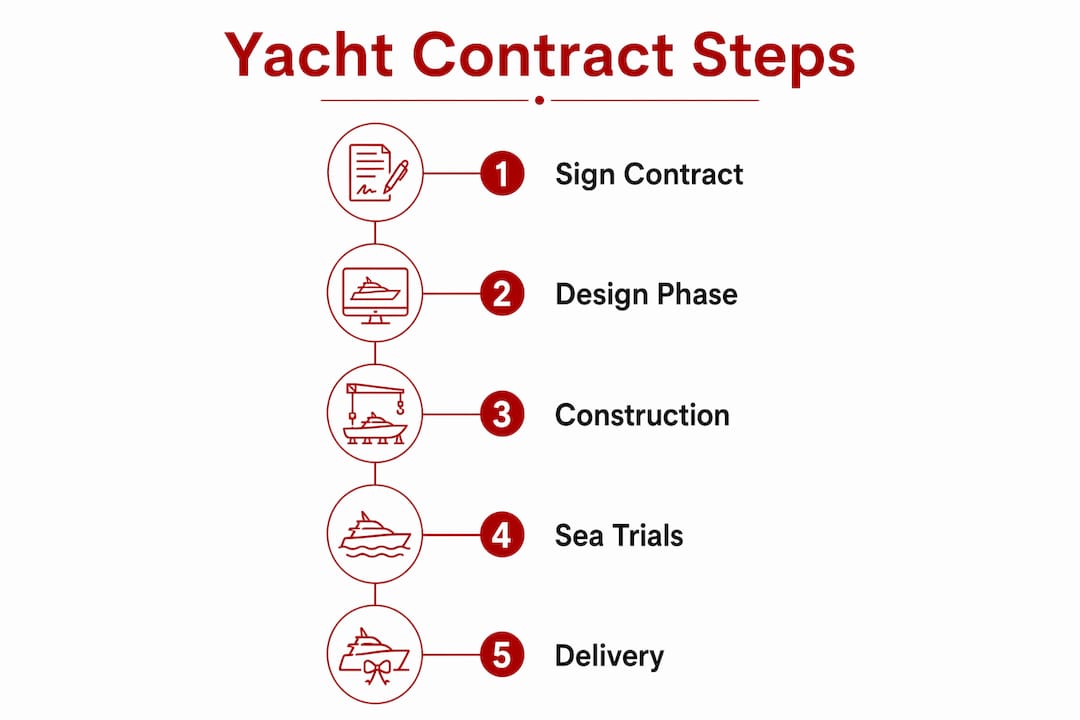
Industry practice splits the new-build package into three interlinked documents: the main legal agreement, the drawing package, and the detailed technical specifications. Discrepancies between them are a primary source of disputes. Vague specs give the yard room to deliver a vessel that is technically compliant but commercially disappointing.

Every specification should quantify: maximum speed, cruising range, displacement, stability criteria (GM, GZ curves), fuel consumption at stated speeds, noise and vibration limits, and the exact make and model of major equipment. Paint finish standards, interior material grades, and joinery tolerances belong there too.
Engage an independent naval architect before signing to audit the spec package. Their fee is trivial compared to the cost of a performance shortfall discovered at sea trials. Compliance with اللوائح التنظيمية البحرية and classification society requirements (Lloyd’s Register, Bureau Veritas, DNV) should also be written into the specification, not left as an afterthought.
نصيحة من الخبراء: Ask the yard to confirm in writing which classification society rules apply and at what revision date. Rules change during a 3–5 year build, and you need the contract to specify which edition governs.
How change orders should work during the build
Change orders must be documented as addenda with explicit impact assessments on cost, delivery date, and vessel performance. A practical procedure:
- Owner submits a written change request describing the modification in technical terms.
- Yard issues a written proposal within an agreed window (typically 14 days) covering cost, schedule impact, and any performance effect.
- Independent technical evaluation if the parties dispute the yard’s pricing — use pre-agreed unit rates or a third-party estimator.
- Both parties sign a formal addendum before any work begins. No verbal approvals, ever.
- Update the master schedule to reflect any delivery-date adjustment.
Addenda are normal over a 2–5 year build. Treat them as tools for reaffirming cooperation, not as signs of a troubled project. The danger is scope creep: undocumented verbal changes that accumulate into significant cost and schedule overruns.
نصيحة من الخبراء: Pre-agree unit rates for common change categories (steel work per ton, electrical per meter run, joinery per square meter) at contract signing. Negotiating rates mid-build, when you need the yard’s cooperation, is a weak position.
Stage payments, escrow, and progressive title transfer
Stage payments commonly require between 50% and 70% of contract value to be paid before delivery. Aggressive front-loading increases buyer risk. Prefer milestone-based payments tied to physical progress: keel-laying, hull completion, systems integration, sea trials, and delivery.
Sample refund guarantee language: “The Builder shall procure and maintain a refund guarantee issued by a first-class bank, in a form acceptable to the Buyer, for the full amount of all installments paid, such guarantee to remain in force until delivery of the Vessel or repayment of all installments.”
| Payment structure | Buyer risk | Recommended? |
|---|---|---|
| Calendar-based (monthly) | High — no link to physical progress | لا يوجد |
| Milestone-based (progress-linked) | Moderate — tied to verifiable events | نعم |
| Front-loaded (above 70% pre-delivery) | Very high — maximum exposure to insolvency | Avoid |
| Escrow with milestone release | Low — funds held by neutral third party | Best practice |
Practitioners recommend securing a refund guarantee that obliges the builder to return installments if they fail to complete the vessel or face bankruptcy. Prefer tier-one bank pay-on-demand guarantees over surety wrappers, which can be slower and harder to call.
Progressive title transfer is the other key protection. Draft checkpoints at assembly start, hull completion, and systems integration so that title to work-in-progress passes to the buyer at each stage. If the yard becomes insolvent, you own the vessel rather than joining a queue of unsecured creditors. Corporate ownership structures can further simplify title transfer and post-delivery registration.
Sea trials, acceptance, and warranty obligations
Acceptance is not automatic at delivery. A proper protocol includes:
- Pre-delivery sea trials: Speed runs, range calculations, stability checks, and systems testing against the specification.
- Punch list: A written record of deficiencies the yard must remedy before or shortly after formal acceptance.
- Formal acceptance certificate: Signed by both parties, triggering the final payment and starting the warranty clock.
Industry-standard warranty periods run 12 months from delivery, though negotiating 24 months is achievable on larger builds. Defect notification deadlines are commonly 14 days from discovery. The warranty should cover structure, mechanical systems, electrical systems, paint, and joinery — not just the hull.
نصيحة من الخبراء: Retain 5–10% of contract value as a final payment until the punch list is closed. Releasing the full balance at delivery removes your primary leverage for getting defects fixed promptly.
Protecting yourself from shipyard insolvency and project risk
Legal advisors highlight shipyard financial failure as a major risk. Concrete protections to insist on:
- Tier-one bank pay-on-demand refund guarantee covering all installments paid.
- Performance bond or parent-company guarantee if the yard is a subsidiary.
- Progressive title transfer with registered security interest where local law permits.
- Right to remove the vessel from the yard on defined default events (insolvency filing, cessation of work for more than 30 days).
- Subcontractor disclosure and flow-down terms requiring key subcontractors to honor their obligations to the buyer if the yard defaults.
- Builder’s risk and hull insurance maintained throughout construction, with the buyer named as additional insured.
نصيحة من الخبراء: Before signing, request the yard’s last two years of audited accounts and its current order book. A yard running at full capacity with thin margins is a different risk profile from one with a healthy backlog and strong capitalization.
Understanding vessel insurance essentials before the build starts helps you coordinate builder’s risk coverage with your own hull policy at delivery.
Governing law, arbitration, and dispute resolution
English law with LMAA arbitration is the industry default for international yacht builds. English law has deep precedent in shipbuilding disputes, and LMAA awards are enforceable in over 160 countries under the New York Convention.
- Resist exotic governing law or arbitration seats that limit your enforcement options.
- Include an expert determination clause for purely technical disputes (performance shortfalls, specification interpretation) — faster and cheaper than full arbitration.
- Draft a dispute escalation ladder: senior management meeting (14 days) → mediation (30 days) → arbitration.
- Secure interim injunctive relief rights to prevent the yard from disposing of the vessel or materials during a dispute.
نصيحة من الخبراء: Agree on a named technical expert or an appointment mechanism (e.g., appointment by Lloyd’s Register) before signing. Arguing over who the expert is during a live dispute wastes time and money.
Typical build timelines and cost contingency for U.S. buyers
Semi-custom builds typically run 24–36 months from contract signing to delivery. Fully custom yachts take 36–60 months, with the longest slippage usually occurring in the outfitting and commissioning phase, not the steel work.
| Build type | Typical timeline | Key cost drivers |
|---|---|---|
| Semi-custom | 24–36 months | Equipment upgrades, change orders |
| Fully custom | 36–60 months | Design iterations, regulatory additions, currency shifts |
Primary cost drivers beyond the base contract price: scope changes, premium equipment brand selections, classification society additions, currency fluctuation (most European yards price in euros), and yard order-book pressure affecting labor allocation. Budget a contingency of 10–15% of contract value for change orders and unforeseen items. Factor in insurance costs, owner’s representative fees, and classification society survey fees, which sit outside the build contract.
Pre-signing checklist for buyers
- Engage specialist shipbuilding counsel and an independent owner’s representative before any negotiation begins.
- Complete financial due diligence on the yard: audited accounts, order book, banking relationships.
- Insist on a complete drawing package and detailed technical specifications before signing.
- Negotiate milestone-based payments and a tier-one bank refund guarantee.
- Set pre-agreed change-order unit rates and a written change-order procedure.
- Define sea-trial protocols, acceptance criteria, and punch-list procedures in the contract.
- Confirm governing law, arbitration seat, and expert determination mechanism.
- Require progressive title transfer checkpoints and builder’s risk insurance with buyer named as additional insured.
- Plan وثائق اليخوت and flag registration well before delivery — registration timelines can affect your delivery logistics.
نصيحة من الخبراء: Reject the yard’s first-draft contract entirely if it lacks refund guarantees, milestone payments, or a clear termination right. These are not negotiating chips — they are baseline protections.
الوجبات الرئيسية
A new build yacht contract is the project’s control center: negotiate it before any payment, secure refund guarantees and progressive title transfer, and never rely on vague technical specifications.
| نقطة | التفاصيل |
|---|---|
| Negotiate before paying | Sign nothing and pay nothing significant until the full contract, specs, and drawing package are agreed. |
| Milestone payments reduce risk | Tie every installment to a physical build milestone; avoid calendar-based or front-loaded schedules. |
| Liquidated damages have a cap | Delay compensation is typically set at 1% of contract value per week, capped at 5% to 10% of the contract value—after which the yard owes no further damages. |
| Progressive title transfer protects you | Staged title transfer at keel-laying, hull completion, and systems integration keeps you out of the creditor queue if the yard fails. |
| Vesselflag supports post-delivery | Once the vessel is accepted, Vesselflag handles flag registration, MMSI licensing, insurance coordination, and ongoing compliance. |
The contract is the build — treat it that way
The conventional wisdom in yacht commissioning is that the design is the hard part. It is not. The contract is. A stunning design delivered under a weak agreement can leave a buyer with a vessel that underperforms its specification, a yard that has absorbed its liquidated-damages cap and stopped caring about delays, and no practical remedy when things go wrong.
What experienced buyers understand — and first-timers rarely do — is that the technical specifications are not an annex to the contract. They are the contract, in practical terms. Every ambiguity in the spec is a future dispute. Every missing performance metric is a gap the yard will fill in its own favor. The legal boilerplate matters, but it is the specification that determines whether the yacht you receive matches the one you imagined.
Planning registration and compliance from day one, not as an afterthought at delivery, is equally undervalued; consider logistics early with services like Cape Town Cruise Transfers — V&A Cruise Terminal Shuttle & Shore Excursions. Flag selection, MMSI licensing, and documentation requirements interact with the contract’s title-transfer provisions and delivery logistics. Vesselflag works with owners at this stage to make sure the compliance side is ready when the vessel is.
Vesselflag supports you from delivery through compliance
The build ends at acceptance. What comes next — flag registration, MMSI licensing, insurance placement, and ongoing compliance — is where many owners lose momentum. Vesselflag specializes in exactly this transition, handling تسجيل اليخوت under multiple international flags (San Marino, Malta, UK Part 1, Palau, and others), MMSI radio licensing, insurance introductions, and full documentation management.
For U.S. owners completing a new build, the registration decision should be made before delivery, not after. Vesselflag’s team manages the paperwork, coordinates with classification societies, and keeps your vessel compliant across jurisdictions. Start your registration process with Vesselflag before your acceptance certificate is signed.
Useful sources
- Yacht Building Contracts – The Legal Framework — foundational legal overview of bespoke new-build agreements and yard templates.
- New-Build Bible: Contract Do’s and Don’ts — practical clause-level guidance on specifications, change orders, and document synchronization.
- The First Owner’s Reference — New Build vs Brokerage — stage-payment norms, liquidated damages benchmarks, and advisor recommendations.
- Superyacht New-Build and Refit Contracts: Legal Advice — refund guarantee structures and milestone-payment best practices.
- Risks and Mitigations in Yacht Construction — insolvency risk, progressive title transfer, and termination rights.
- Yacht Construction Contracts: Core Elements and Their Evolution — addenda management and the contract as a living document.
This article is general information, not legal advice. Confirm current rules and contract terms with a qualified maritime attorney for your specific situation.
الأسئلة الشائعة
What is a new build yacht contract?
A new build yacht contract is a bespoke legal agreement governing the design, construction, and delivery of a vessel that does not yet exist, covering payment schedules, technical specifications, warranties, and termination rights.
How long does a new build yacht take to complete?
Semi-custom builds typically take multiple years; fully custom yachts take longer, with the longest delays usually occurring during outfitting and commissioning.
What are liquidated damages in a yacht construction contract?
Liquidated damages compensate the buyer for delivery delays, typically calculated as a small weekly percentage of contract value, capped at a moderate percentage of the total contract value.
Why does progressive title transfer matter?
Progressive title transfer passes ownership of work-in-progress to the buyer at defined build milestones, so if the yard becomes insolvent, the buyer owns the vessel rather than standing as an unsecured creditor.
When should I plan flag registration for a new build?
Registration planning should begin well before delivery. Vesselflag recommends selecting your flag jurisdiction and preparing documentation during the final build phase so registration is complete at or shortly after acceptance.