
Yes, a UK limited company can own a yacht, and doing so is one of the most common ways to secure Part 1 registration when personal eligibility rules don’t cooperate. The immediate filing package is a Declaration of Eligibility (MSF 4727), an MCA Bill of Sale (MSF 4705), the company’s Certificate of Incorporation, and safety certificates if the vessel exceeds 24 meters. Before signing anything, get a maritime solicitor or a registration specialist to review the transfer, because printed signatures and notarization requirements trip up more transactions than any tax question.
TL;DR:
- UK companies are the standard method for achieving strong Part 1 registration support and access to registered marine mortgages.
- Non-UK owners must often form a UK company to qualify for Part 1 registration post-Brexit, as individual eligibility rules have tightened.
- Proper corporate governance, notarized paperwork, and early coordination with insurers and lenders are critical to avoid delays and legal issues.
- Choosing between UK Part 1, SSR, or Part 4 depends on vessel size, purpose, mortgage needs, and resale plans, with Part 1 offering the strongest title support.
- A streamlined registration process with professional assistance minimizes errors, reduces processing time, and ensures compliance with all procedural requirements.
جدول المحتويات
- Why Owners Choose UK Company Yacht Ownership
- UK Part 1 vs. SSR vs. Part 4: Which Register Fits?
- How to Register a Yacht Under a UK Company: Step-by-Step
- Setting Up the Owning Company: Governance and Tax Basics
- Insurance, Mortgages, and Operations Under Corporate Ownership
- Common Mistakes That Undermine UK Company Yacht Ownership
- VesselFlag’s Support for UK Company Yacht Registration
- Liability and Risk Management Beyond the Basics
- UK Companies vs. Offshore Structures for Yacht Ownership
- How Brexit Changed UK Company Yacht Registration
- Transferring Yacht Ownership Between Companies or to Corporate Ownership
- When a UK Company Makes Sense, and When It Doesn’t
- Get Your UK Company Yacht Registration Handled Right
- Where to Verify UK Company Yacht Ownership Rules
- Sources
- الأسئلة الشائعة
Why Owners Choose UK Company Yacht Ownership
Corporate ownership isn’t a loophole. It’s the standard route for anyone who wants a yacht that behaves like a real asset rather than a personal possession with a hull.
The main draw is title strength. Part 1 registration supports registered marine mortgages and carries stronger international recognition than the alternatives, which matters enormously the moment a lender or a buyer wants proof of clean title. A company on the register also draws a clear line between the vessel’s liabilities and the owner’s personal estate, assuming the paperwork actually backs that separation up.
Owners who benefit most from this structure include superyacht owners needing marine mortgages, charter operators wanting liability limited to one entity, groups using single-purpose vehicles (SPVs) for clear accounting, and buyers planning resale in a few years who desire clear title chains.
VAT and refit logistics push some owners toward a UK-flagged corporate structure too, particularly when European port access and customs clarity matter more than saving on incorporation costs.
UK Part 1 vs. SSR vs. Part 4: Which Register Fits?
Three registers exist under the UK Ship Register, and picking the wrong one creates headaches later, especially around resale or financing.
Part 1 is the full title register. It’s the only one that supports registered mortgages, and it offers the strongest legal title for high-value leisure and commercial vessels. Anyone financing a yacht, or planning to sell it with unquestionable title history, ends up here.
The Small Ships Register (SSR, Part 3) is a lighter-touch option built for UK resident private owners running smaller leisure craft under set thresholds. It’s fast and cheap, but it doesn’t support mortgages and it carries less weight internationally.
Part 4 governs bareboat charter registration, a mechanism used when a vessel is registered on a different national register but chartered without crew under UK terms for a defined period.
Here’s where it gets complicated post-Brexit. Some non-UK individuals can no longer apply for or renew Part 1 registration in their own name, which is precisely why forming a British company has become the practical workaround for EU and other non-UK buyers who still want the Part 1 title strength. The company, not the individual, becomes the registered owner, and eligibility runs through the corporate entity’s UK registration status instead.
- Part 1: full title, mortgages supported, strongest international standing
- SSR (Part 3): UK residents only, no mortgage support, simpler and cheaper
- Part 4: bareboat charter mechanics, time-limited and purpose-specific
- Companies commonly bridge the post-Brexit eligibility gap for non-UK owners
How to Register a Yacht Under a UK Company: Step-by-Step
Getting a yacht into corporate ownership, or transferring an existing Part 1 vessel into a company’s name, follows a fairly rigid sequence. Skip a step and the UK Ship Register will bounce the application back.
- Form or activate the owning company. Most owners use a single-vessel SPV. Document the company’s authority to acquire the vessel through a board resolution before you touch any transfer paperwork.
- Complete the Declaration of Eligibility (MSF 4727). This confirms the company meets Part 1 eligibility rules.
- Complete the MCA Bill of Sale (MSF 4705). This is the actual transfer instrument recording the change of ownership.
- Attach the Certificate of Incorporation when the buyer is a body corporate, which the registry uses to verify that the company exists and is validly formed.
- Add safety documentation for larger yachts, including a Large Yacht Certificate or Code Certificate, a tonnage survey, and any Continuous Synopsis Record (CSR) amendment the vessel needs.
- Sort the radio license. Obtain or transfer the ship radio license through Ofcom, and budget the five-year registration fee, roughly £105.
- Print and sign everything. The register does not accept digital signatures on these forms, and notarization is required for certain owner categories.
Pro Tip: Submit the Certificate of Incorporation and the Declaration of Eligibility together, not sequentially. Registries process paired corporate documents faster than piecemeal submissions, and it avoids a second round of correspondence over missing context.
Processing timelines vary by season and vessel size, but budgeting several weeks from first submission to confirmed registration is realistic for most corporate transfers. A dedicated Part 1 registration service can shorten that window by catching document errors before submission rather than after.
Setting Up the Owning Company: Governance and Tax Basics
The company structure only protects you if it’s built correctly, and that means more than filing incorporation papers and calling it done.
Single-vessel SPVs remain the dominant structure because they keep one yacht’s liabilities, contracts, and financing entirely separate from any other asset the owner holds. That separation depends on genuine governance, not just a certificate. Keep shareholder resolutions, board minutes, and any nominee arrangements on file, because a company can reduce personal exposure and shield assets, but it does not guarantee protection from liability or non-compliance risk if the paperwork doesn’t hold up under scrutiny.
Tax questions surface fast once a company owns the yacht:
- VAT on the purchase price, and whether temporary admission or VAT suspension applies to the vessel’s intended cruising pattern
- VAT exposure on refit work, particularly when the yacht moves between jurisdictions during the work
- Circumstances where VAT becomes unavoidable, typically tied to permanent import or extended use inside EU waters
- Personal tax exposure for shareholders or directors, which varies enough by circumstance that generic advice is close to useless
None of this is a DIY exercise. A maritime legal structures guide covers the governance mechanics, but the tax side needs a specialist who understands both UK corporate tax and the owner’s home jurisdiction.
Insurance, Mortgages, and Operations Under Corporate Ownership
Once the company is the registered owner, day-to-day operations shift in ways that catch first-time corporate owners off guard.
Insurers scrutinize corporate policies differently than personal ones. Expect requests for P&I cover, civil liability certificates, and proof of the company’s operational structure before a policy gets underwritten. A yacht registered to a shell entity with no operating history sometimes faces higher premiums or more conditions until the insurer has a track record to assess.
Registering a mortgage against a Part 1 vessel adds another layer: the mortgage must be recorded on the register itself, and any future sale or transfer has to account for that registered charge before title can move cleanly. Skip this step and a sale can stall for weeks while lenders sort out discharge paperwork.
- Corporate ownership generally simplifies crew immigration and customs handling, since the vessel’s paper trail is unambiguous
- Registered mortgages protect lenders but also lock the sale process into a specific sequence
- Refit logistics benefit from clear UK registration, though the UK’s own refit infrastructure has gaps that cost the country an estimated £10 million to £15 million in lost superyacht revenue annually
- Professional yacht management alongside a proper corporate structure tends to lower total operating friction across crew, customs, and VAT handling
Refit partners matter here too. Products like the Dust Free Film yacht paint system reflect the kind of specialized refit infrastructure that makes a real difference when a corporately owned vessel needs work done without extending downtime.
Common Mistakes That Undermine UK Company Yacht Ownership
Most problems with corporate yacht ownership trace back to sloppy execution, not bad strategy.
- Assuming the company automatically shields you personally. It doesn’t, unless corporate formalities, separate bank accounts, and documented decision making back it up.
- Submitting incomplete or unsigned transfer paperwork. Missing notarization or a skipped signature line is the single most common cause of registration delays.
- Ignoring VAT and residence questions until after purchase. By the time the vessel is cruising, the tax exposure is already locked in.
- Failing to document the vessel’s intended use. Charter, private use, and mixed use each carry different tax and insurance consequences, and registries and insurers both ask.
Pro Tip: Before you sign a single form, confirm your insurer and any mortgage lender are comfortable with the exact corporate structure you’re proposing. Switching structures after underwriting has started is far more expensive than getting it right the first time.
VesselFlag’s Support for UK Company Yacht Registration
We handle the procedural side of corporate yacht registration across multiple flag jurisdictions, including UK Part 1. This includes preparing MSF 4727 and MSF 4705 filings, coordinating Certificate of Incorporation requirements, and managing Ofcom radio license applications alongside the registration paperwork.
A registration filing rejected over a missing notarization or an unsigned bill of sale costs an owner week. Catching that before submission, not after, is the entire value of working with someone who processes these forms routinely.
- Corporate setup and SPV documentation support for owners forming a UK company specifically to hold a vessel
- Coordination of translations and notarization requirements across jurisdictions
- Direct handling of Part 1 change-of-ownership submissions and follow-up correspondence with the registry by experienced professionals
Liability and Risk Management Beyond the Basics
Legal separation between owner and company is a starting point, not a finished job. Real risk management means actively managing the gap between what the corporate structure promises on paper and what actually holds up when something goes wrong.
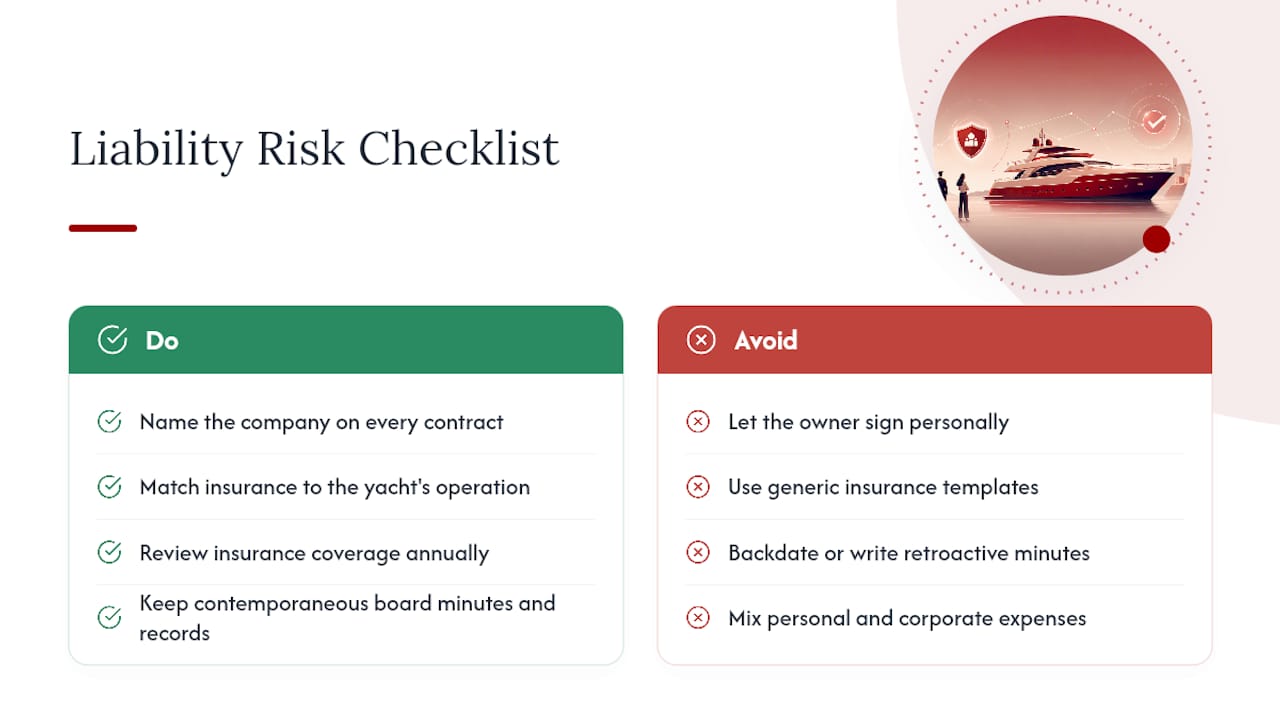
Start with contractual clarity. Every charter agreement, crew contract, and management agreement should name the company as the contracting party, consistently, with no informal shortcuts where the individual owner signs personally out of convenience. That kind of inconsistency is exactly what a court or an insurer points to when arguing the corporate veil should be set aside.
Insurance and indemnity structures need to match the company’s actual operating profile, not a generic template. A charter operation carries different liability exposure than a private-use yacht, and a policy written for one doesn’t cover the other adequately. Review coverage annually, not just at renewal, because a change in cruising area, crew size, or charter frequency can quietly outpace what the policy was built to handle.
Governance discipline is the part owners skip most often. Annual board minutes, arm’s length transactions between the owner and the company, and clean separation of personal and corporate expenses all matter more than people expect. Regulators and courts have consistently pierced corporate structures that exist on paper but not in practice. Document decisions as they happen, not retroactively when a dispute forces the question.
UK Companies vs. Offshore Structures for Yacht Ownership
Offshore jurisdictions, think classic yacht-registration havens outside the UK, get pitched constantly as the simpler, cheaper alternative to a UK company. Sometimes they are. It depends entirely on what the owner actually needs from the structure.
Offshore companies typically offer lighter incorporation requirements, fewer ongoing filing obligations, and in some cases more favorable tax treatment on the underlying corporate entity. For an owner who never plans to finance the vessel, never plans to sell into a market that scrutinizes title chains closely, and mainly wants privacy and low administrative overhead, an offshore SPV can be the more practical option.
Where the UK company wins is title strength and financing access. Offshore structures generally can’t offer the same registered mortgage mechanism that Part 1 provides, and international buyers or lenders sometimes view offshore-flagged, offshore-owned vessels with more caution during due diligence, particularly on resale. UK companies also carry ongoing compliance obligations, annual returns, confirmation statements, and filed accounts, that offshore jurisdictions often waive or simplify. That compliance burden is real, but it also produces a documented, verifiable ownership history that plenty of buyers and lenders find reassuring rather than burdensome. For a high-value vessel intended for resale or financing within five years, that verifiable trail usually outweighs the lighter offshore filing load.
How Brexit Changed UK Company Yacht Registration
Brexit didn’t close the UK Ship Register to non-UK owners, but it did narrow the personal eligibility rules significantly. Some individuals who could once register a yacht in their own name under Part 1 now find that route closed or restricted, particularly around renewals.
The practical fix has been corporate ownership. A UK-incorporated company, properly formed and documented, can hold Part 1 registration on behalf of owners who no longer qualify individually. That’s not a workaround in the sense of exploiting a loophole. It’s simply how eligibility rules are written now, and it explains why company formation queries around yacht ownership have become so routine among maritime solicitors handling non-UK clients.
There’s a second, less obvious effect. VAT and customs treatment for vessels moving between the UK and the EU changed materially after Brexit, which means refit timing, cruising itineraries, and even where a vessel spends winter now carry tax consequences that didn’t exist a decade ago. Owners planning a UK company structure should map the vessel’s intended movement pattern against current VAT and customs rules before finalizing the corporate setup, not after the yacht is already registered and moving.
Transferring Yacht Ownership Between Companies or to Corporate Ownership
Moving a yacht from individual ownership into a company, or between two UK companies, follows largely the same paperwork trail as any other Part 1 change of ownership, with a few extra considerations layered on top.
The core filing package stays the same: Declaration of Eligibility (MSF 4727), Bill of Sale (MSF 4705), and Certificate of Incorporation for the receiving company. What changes is the due diligence around the transaction itself. A transfer from an individual to a company they control needs a documented sale, even if it’s effectively a restructuring rather than an arm’s length purchase, because tax authorities and registries both expect a genuine transaction record, not an informal reassignment.
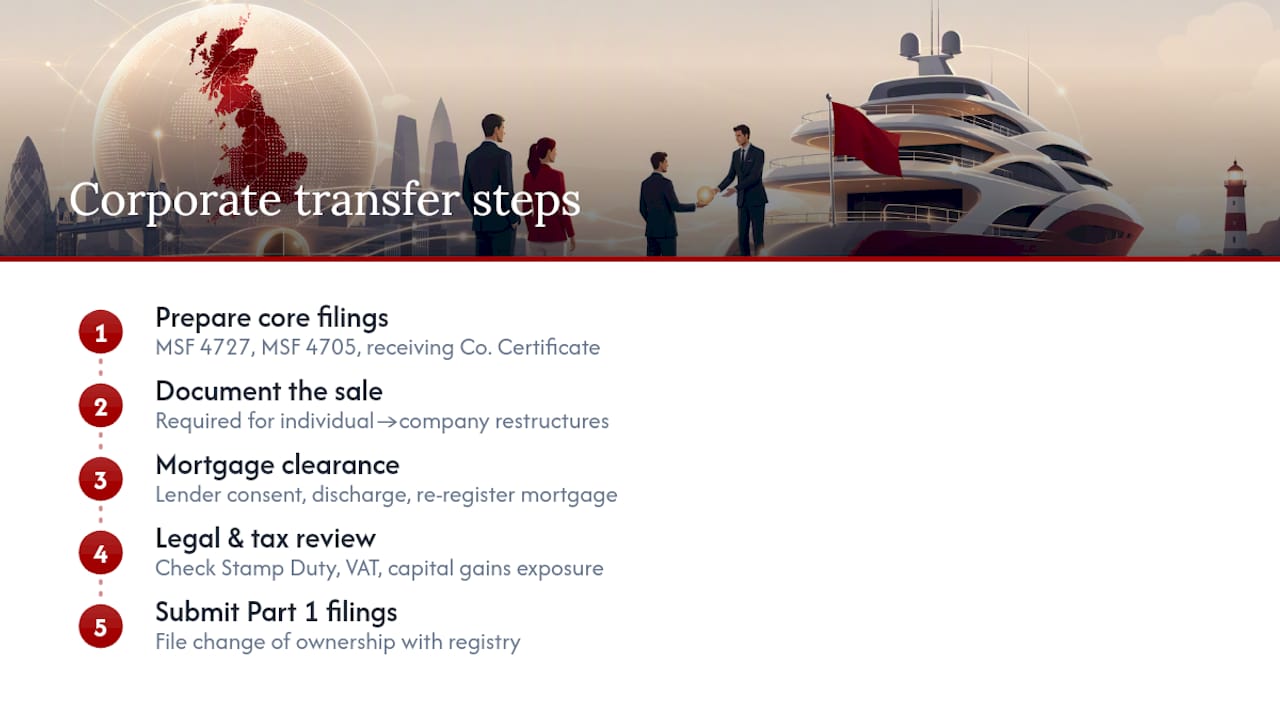
Existing mortgages complicate company to company transfers considerably. If the vessel carries a registered mortgage, the lender needs to consent to the transfer and the mortgage typically needs to be discharged and re-registered against the new corporate owner. Skipping that step, or assuming it happens automatically, is one of the more expensive mistakes owners make during a restructuring.
Legal counsel matters most here, more than in a straightforward first-time registration. A maritime solicitor can confirm whether the transfer triggers Stamp Duty considerations, VAT liability, or capital gains exposure, all of which vary depending on how the sale is structured and priced between the two entities.
When a UK Company Makes Sense, and When It Doesn’t
The UK company route earns its complexity when mortgage financing, resale clarity, or high vessel value are on the table. Anyone chasing a clean title chain for a future sale should lean this direction.
If cost, refit timing, or simpler residency rules matter more than title strength, another Red Ensign registry or a different corporate structure may serve better. Time the switch around renewal dates and refit schedules, not mid-season, to avoid compounding delays.
— Vesselflag
Get Your UK Company Yacht Registration Handled Right
There are practical alternatives to piecing together a UK company yacht registration on your own through scattered solicitor calls and repeated form rejections. One point of contact handling corporate setup, MSF form preparation, and Ofcom radio license coordination together can streamline the process compared to managing multiple separate providers that do not coordinate.
Before reaching out, gather your company’s Certificate of Incorporation, proof of the vessel’s current registration status, and any existing mortgage documentation if applicable. That single step cuts the back and forth that typically stretches a registration timeline by days. From there, Vesselflag can walk through eligibility, prepare the Declaration of Eligibility and Bill of Sale, and manage the notarization requirements that trip up so many first-time corporate filings.
Ready to move forward? Start with the دليل شامل لتسجيل اليخوت to see exactly what the process involves for your specific vessel and ownership structure.
Where to Verify UK Company Yacht Ownership Rules
- UK Ship Register: Part 1 change of ownership guidance and MSF forms
- Companies House company lookup for verifying corporate owners
- Ofcom guidance on ship radio license applications and renewals
This article is general information, not a substitute for advice from a qualified lawyer. Consult a qualified legal professional about your own circumstances before acting on anything here.
Sources
- Large Yacht Change of Ownership (Part 1) | UK Ship Register
- UK Boat Registration Guide: Part 1, SSR and Legal Explained | Lester Aldridge
- UK Yacht Registration Changes Explained: What Every Yacht Owner Needs to Know – Berthon International
- Why is the UK losing £10m-£15m as superyachts bypass Britain
الأسئلة الشائعة
Can I Buy a Boat Through My Business in the UK?
Yes. A UK limited company can purchase and register a yacht, and this is a standard route for owners who want Part 1 title strength, marine mortgage eligibility, or liability separation from personal assets.
Does the British Royal Family Still Own a Yacht?
The Royal Yacht Britannia was decommissioned and now operates as a museum ship in Edinburgh; the royal family has not owned an active seagoing yacht since.
What Is the 12 Person Rule on a Yacht?
Vessels carrying more than a set passenger number typically fall under stricter commercial passenger vessel safety codes and certification requirements, which is why charter operators structuring their business need to check passenger limits against their intended Certificate class early.
Who Currently Owns the World’s Largest Yacht?
Ownership of the world’s largest yachts frequently changes hands and is often held through corporate or offshore structures rather than disclosed personal ownership, which is itself a common reason high-value owners choose company registration.
What Documents Do I Need to Register a Yacht Under a UK Company?
You need the Declaration of Eligibility (MSF 4727), the MCA Bill of Sale (MSF 4705), the company’s Certificate of Incorporation, and safety certificates for yachts over 24 meters, all printed and signed with notarization where required.