

باختصار:
- Vessel registration transfer is a complex legal process essential for compliance, ownership clarity, and border crossings. Proper preparation, complete documentation, and understanding jurisdiction-specific rules are crucial to avoid delays or legal issues. Engaging experienced professionals ensures smooth transfers and long-term vessel ownership integrity.
Picture this: you’ve just purchased a sailing yacht in Florida, but the previous owner registered it under a Cayman Islands flag with an unresolved bank lien still attached. You’re planning to cross into the Bahamas in three weeks. Without a clean, properly transferred registration in hand, port authorities won’t clear your vessel, your insurance won’t cover you, and your planned departure becomes a legal standstill. This scenario plays out more often than most buyers expect. Transferring vessel registration is not a formality. It’s a legal process with real consequences for compliance, insurance, border crossing, and ownership clarity, and the rules vary dramatically depending on where your vessel is registered and where you’re headed.
جدول المحتويات
- Understanding vessel registration and why transfer is required
- Essential documents and prerequisites for a smooth transfer
- How to transfer vessel registration: step-by-step process
- Common mistakes, troubleshooting, and tips for efficiency
- What owners get wrong about vessel registration transfers
- Streamline your next vessel registration transfer
- الأسئلة الشائعة
الوجبات الرئيسية
| نقطة | التفاصيل |
|---|---|
| Know your jurisdiction | Laws and paperwork for vessel registration transfer differ greatly by state, country, and type of vessel. |
| Assemble documents early | Collect notarized bill of sale, lien releases, and all ownership documents to fast-track approval. |
| Follow exact steps | Complete each transfer step in sequence and use official channels to minimize errors and penalties. |
| Avoid common pitfalls | Check for outstanding liens, adhere to deadlines, and review all forms before submitting. |
| Stay compliant in 2026 | UBO disclosure and international registry standards are now key to avoiding fines or legal issues. |
Understanding vessel registration and why transfer is required
Vessel registration is the official record that ties a boat or yacht to an owner, flag state (the country whose laws govern the vessel), and specific regulatory framework. When ownership changes, or when a vessel moves from one flag to another, that record must be updated through a formal transfer process. Failing to do so leaves both buyer and seller exposed to liability.
Transfer becomes necessary in several situations beyond a straightforward sale:
- Change of ownership through private sale, auction, or inheritance
- Flag change when moving to a new registry for legal, operational, or cost reasons
- Termination of a bareboat charter (a lease arrangement where the charterer, not the owner, registers the vessel temporarily)
- Corporate restructuring that changes the registered owner entity
- Relocation to a new state or country requiring re-registration
Understanding global registration differences matters because the rules are not uniform. In the United States alone, there are two separate registration systems: state registration and federal documentation through the U.S. Coast Guard (USCG). At the state level, 37 U.S. states issue titles, meaning the seller signs a title assignment, both parties sign a notarized bill of sale, and the buyer submits everything to the state agency with applicable fees and tax. The new title is typically issued within 2 to 6 weeks. In 13 states that don’t issue titles, you rely on a notarized bill of sale plus a registration transfer application.
Internationally, the differences are even sharper. Flags like Malta, Cayman Islands, Marshall Islands, and Palau each have unique documentation requirements, processing timelines, and fee structures. Some allow transfers to be executed in international waters; others require in-person submission or notarized documents filed through an appointed agent.
There are also important edge cases to understand before you proceed. Bareboat registration restrictions mean that a vessel registered under a bareboat arrangement cannot be freely transferred until the charter agreement is formally terminated. Similarly, USCG documented vessels cannot simultaneously hold a state title, so if your vessel has federal documentation, any state-level title is invalid. Liens and mortgages must be formally released before transfer can proceed, and certain registries, such as Malta and Cayman, will approve transfers executed in international waters provided notarized documents and GPS evidence of location are submitted.
| Registration type | Title issued? | Transfer method | Typical timeline |
|---|---|---|---|
| U.S. state (title state) | نعم | Title assignment + notarized bill of sale | 2 to 6 weeks |
| U.S. state (non-title state) | لا يوجد | Notarized bill of sale + transfer application | 2 to 4 weeks |
| USCG federal documentation | No state title | NVDC application + notarized documents | متفاوتة |
| International flag (e.g., Malta) | Registry certificate | Appointment of agent + flag-state docs | 2 to 6 weeks |
| جزر مارشال | Registry certificate | Online or agent submission | 3 to 10 days |
Essential documents and prerequisites for a smooth transfer
The biggest reason registration transfers stall or get rejected is not complexity. It’s incomplete preparation. Before you submit a single form, assemble and verify your document package.
Universal documents required across nearly all jurisdictions:
- Notarized bill of sale (with purchase price, vessel description, and signatures from both parties)
- Proof of current ownership (existing registration certificate or title)
- Lien or mortgage release documentation (if applicable)
- Government-issued ID for both buyer and seller
- Completed transfer or registration application form
- Applicable fees (often non-refundable, so accuracy matters)
Required documentation can expand significantly based on the flag state. International registries often require a deletion certificate (proof that the vessel has been removed from its previous registry) before they will accept a new registration. Without this, the vessel technically exists in two registries simultaneously, which creates legal problems.
Jurisdiction verification is a step many buyers skip, assuming the process works the same everywhere. It doesn’t. Key documents universally include a notarized bill of sale, proof of ownership, lien release, and a completed application form, but what “completed” means varies by jurisdiction. Some states require a dealer’s affidavit. Some flag states require a surveyor’s certificate of class.

Before initiating any transfer, conduct a title or lien search through the appropriate agency. In the U.S., the USCG National Vessel Documentation Center (NVDC) maintains a public record of documented vessels, including recorded mortgages. Skipping this step and discovering a lien mid-transfer is one of the most common and costly delays in the process. A pre-transfer lien search is essential to avoid disputes, and for large yachts, purchasing the owning company rather than the vessel itself can sometimes bypass the transfer requirement entirely.
One more consideration that has become critical in 2026 is Ultimate Beneficial Owner (UBO) disclosure. UBO refers to the real human being who ultimately owns or controls a vessel, even if the registration is held by a corporate entity. UBO transparency rules are now embedded in IMO (International Maritime Organization) guidelines, and many flag states require UBO declarations as part of registration and transfer paperwork. Failing to disclose accurately can result in rejected applications or, in serious cases, asset freezes.
Pro Tip: Use a maritime legal professional or registration agent to conduct your lien and title search before signing a purchase agreement. Discovering a hidden mortgage after closing creates legal complications that can take months to untangle.
How to transfer vessel registration: step-by-step process
The process differs across jurisdictions, but the core sequence follows a predictable structure. Here’s how to approach the four most common scenarios.
For U.S. state title states:
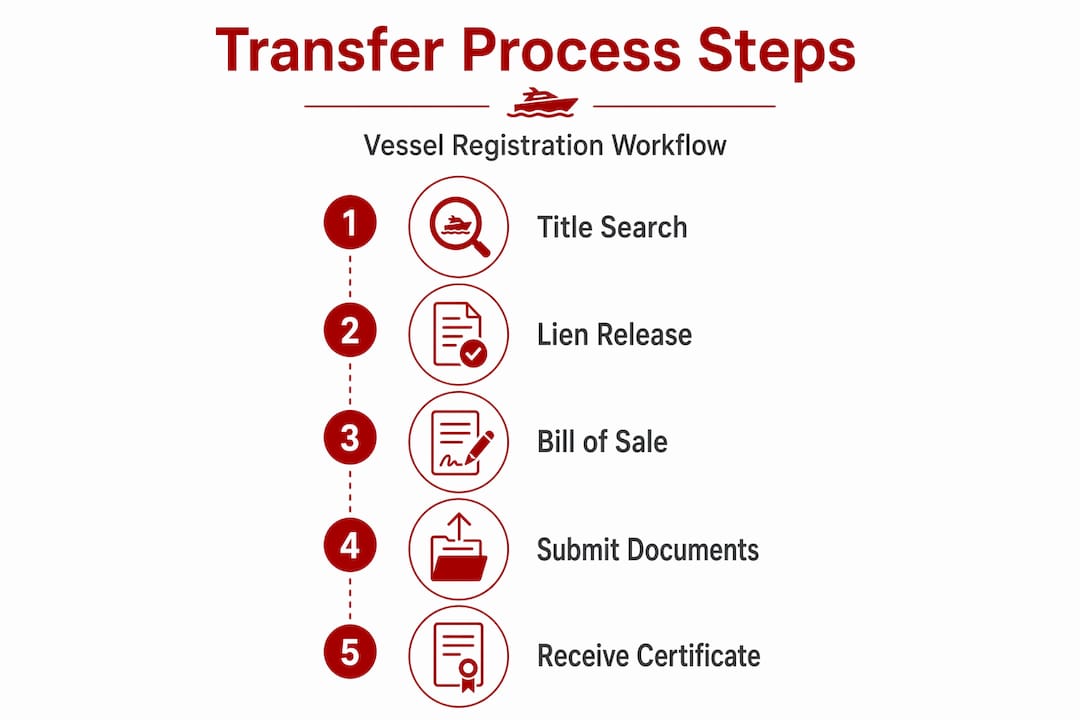
- Seller completes and signs the title assignment section on the back of the existing title.
- Both parties sign a notarized bill of sale that includes the hull identification number (HIN), vessel description, sale price, and date.
- Buyer submits the signed title, bill of sale, completed application form, and applicable fees to the state boating or DMV agency.
- Agency processes the application and issues a new title and registration in the buyer’s name.
For U.S. state non-title states:
- Both parties sign a notarized bill of sale.
- Buyer completes a registration transfer application.
- Buyer submits the bill of sale, prior registration documentation, application, and fees to the state agency.
For USCG federal documentation:
- Both parties complete a notarized bill of sale.
- Buyer submits a completed USCG form CG-1258 (Application for Initial Issue, Exchange, or Replacement of Certificate of Documentation).
- The application is submitted through the NVDC eStorefront, which reduces processing errors and tracks submission status.
- Fees are paid electronically; processing time varies but electronic submissions move faster.
For international flag states:
- Obtain a deletion certificate from the current flag state confirming removal from the existing registry.
- Appoint a local agent in the new flag state (required by most international registries).
- Submit vessel survey, notarized bill of sale, proof of UBO, deletion certificate, and applicable fee to the new registry through your agent.
- Receive a provisional certificate (valid for 3 to 6 months in most cases) while the permanent registration is processed.
Registration timeline expectations vary widely. Processing times range from 3 to 10 days for the Marshall Islands registry to up to 6 weeks for Cayman Islands. U.S. state transfers typically fall in the 2 to 6 week range. Missing state deadlines matters too: Hawaii, for example, requires transfer application submission within 20 days of purchase, and late filings carry financial penalties.
“Fees submitted to registration agencies are almost universally non-refundable. If your application is rejected due to incomplete documentation, you pay again. Getting it right the first time is not just about speed. It’s about protecting your money.”
For commercial vessels, the process adds additional layers including port state control compliance, class society certificates, and sometimes flag state inspections prior to approval.
Pro Tip: Electronic submission through official portals like the NVDC eStorefront significantly reduces human error and provides a trackable paper trail. Always save your submission confirmation and reference numbers.
Common mistakes, troubleshooting, and tips for efficiency
Even experienced operators make costly errors during vessel registration transfers. Here are the most common pitfalls and how to avoid or resolve them.
Most frequently failed items in transfer applications:
- Missing or incorrectly notarized bill of sale
- Lien or mortgage not formally released prior to submission
- Incorrect or incomplete hull identification number (HIN) on the application
- Using outdated forms (registries update forms without broad public notice)
- Failure to obtain a deletion certificate before approaching a new flag state
- Timing errors, such as missing Hawaii’s 20-day window or other state deadlines
If your application is rejected, don’t panic. Most agencies issue a deficiency notice specifying exactly what’s missing. Act on deficiency notices within the stated timeframe. Letting them lapse can require you to start the application from scratch, including paying fees again.
For bareboat charters and international transfers: USCG documented vessels cannot hold a state title at the same time, so if you’re transitioning from federal documentation to a state registration, you must first close out the NVDC record. Bareboat charters restrict transfers because the charterer holds temporary registration rights. The owner cannot transfer those rights until the charter period officially ends. Registries like Malta and Cayman have formal processes for in-transit transfers supported by GPS evidence, but you must contact the registry in advance to confirm approval.
For electronic notarization: most U.S. states now accept remotely notarized documents. Several international flag states are adopting similar standards. When in doubt, use a maritime attorney to certify documents rather than a general notary, as maritime-specific language and form requirements can trip up general practitioners.
Corporate ownership options are worth exploring when the vessel is held by a company. Purchasing the shares of the company that owns the yacht instead of the vessel directly can sometimes sidestep the full transfer process, though UBO disclosure rules still apply and legal review is essential.
Pro Tip: Build a digital folder with certified copies of all transfer documents immediately after completion. Port authorities in many jurisdictions can request proof of registration at any time, and having instant access prevents costly delays during inspections or border crossings.
What owners get wrong about vessel registration transfers
Here’s a perspective you won’t find in the standard registry FAQs: most registration headaches aren’t caused by paperwork errors. They’re caused by owners treating registration as a bureaucratic formality rather than a compliance framework.
Regulators, especially at the international level, are not just verifying that forms were filled out correctly. They’re tracing the chain of ownership, confirming that the beneficial owner is accurately disclosed, and checking whether the registration history is consistent with the vessel’s operational history. A registration that looks clean on the surface but has gaps in ownership continuity or unexplained flag changes raises red flags. It can delay port clearance, trigger additional inspections, or even result in a vessel being detained.
The other issue we see constantly is owners prioritizing speed over accuracy. Getting your registration transferred in three days sounds great until a lien that wasn’t properly cleared surfaces six months later when you’re trying to resell or refinance. A fast transfer with an underlying title defect is worse than a slower, thorough one. Transparency in ownership isn’t just a regulatory requirement in 2026. It’s the foundation of a vessel’s long-term legal health.
The smartest vessel owners we work with treat transfer as an audit opportunity. They use the process to clean up any historical documentation gaps, verify that every party in the ownership chain is correctly recorded, and confirm that the vessel’s records match its actual operational profile. That kind of diligence pays off every time you cross an international border.
Streamline your next vessel registration transfer
Navigating the transfer process across multiple jurisdictions is manageable when you have the right resources behind you. Whether you’re moving between U.S. state registries, switching from a domestic title to international documentation, or managing a complex bareboat charter transition, preparation and expert guidance make the difference between a smooth handover and a costly delay.
موقع VesselFlag.com offers detailed guides for every stage of the registration journey, from understanding تسجيل اليخوت مقابل تسجيل القوارب requirements to executing the full process of registering a yacht under your chosen flag. Our resources are built specifically for yacht owners and operators who need accurate, jurisdiction-specific information, not generic advice. If you need help maintaining registration validity for compliance across multiple flag states or planning a flag change, our platform connects you with the right information and support to move forward with confidence.
الأسئلة الشائعة
How long does it take to transfer vessel registration in most U.S. states?
Transfers typically take between 2 and 6 weeks depending on the state and how complete your documentation is when submitted. Electronic submission through official portals can sometimes accelerate this timeline.
Can you transfer vessel registration internationally while at sea?
Yes, international transfers at sea are possible with notarized documents and GPS evidence of location, but you must obtain prior registry approval. Registries like Malta and Cayman Islands have established procedures for this scenario.
What documents are required to complete a vessel registration transfer?
You’ll need a notarized bill of sale, proof of current ownership, a lien release if applicable, the prior registration certificate, and a completed transfer application form for the relevant jurisdiction.
What happens if you submit transfer documents late?
Late submissions can trigger financial penalties and in some cases void your application entirely. Hawaii enforces a strict 20-day submission deadline after purchase, and similar timeframes apply in other jurisdictions.
Why is Ultimate Beneficial Owner (UBO) transparency now essential?
IMO 2026 UBO guidelines require registries to identify the real human behind any corporate vessel ownership structure to deter fraud and ensure that registration records reflect actual control of the vessel.