

باختصار:
- Yacht registration in 2026 emphasizes verification, transparency, and due diligence over speed, aiming to prevent fraud. Owners must prepare consistent documentation, verify beneficial ownership, and adhere to new IMO guidelines to ensure smooth registration processes. Different flag models offer varying compliance levels, so strategic choice and expert assistance are crucial for success ahead of stricter standards.
Yacht registration has never been a paperwork formality, but 2026 is making that clearer than ever. With 529 ships falsely flying country flags identified in the 2025-2026 period, the maritime registration trends 2026 landscape is shifting hard toward verification, transparency, and due diligence. If you own or operate a yacht and plan to register or re-register under any international flag this year, the rules of engagement have changed. This guide walks you through every major development, from new IMO guidelines to flag model comparisons, so you can move forward with confidence instead of guesswork.
جدول المحتويات
- Understanding the 2026 IMO ship registration guidelines
- Analyzing 2026 statistical trends in major yacht registration flags
- New compliance priorities for yacht owners under 2026 registration rules
- Comparing international maritime registration models for yachts in 2026
- Practical steps for yacht owners to navigate 2026 registration trends
- Why 2026 marks a turning point in yacht registration compliance
- Streamline your yacht registration in 2026 with expert assistance
- الأسئلة الشائعة
الوجبات الرئيسية
| نقطة | التفاصيل |
|---|---|
| New IMO guidelines | The 2026 IMO guidelines introduce rigorous due diligence and transparency standards for ship registration to prevent fraud. |
| Trend data importance | Official flag registry statistics help yacht owners understand real-time registration flows and trends. |
| Verification over speed | Registration speed now depends on fulfilling verification and ownership checks, not just quick paperwork. |
| Registration models vary | Yacht owners should choose between open, closed, or hybrid flags based on compliance needs and operational goals. |
| Preparation reduces delays | Consistently aligned ownership and identity documents minimize verification back-and-forth and speed approval. |
Understanding the 2026 IMO ship registration guidelines
For decades, there was no single binding international framework governing how countries register ships under their flags. That gap created fertile ground for abuse. The International Maritime Organization stepped in this year by approving its first-ever international ship registration guidelines, a milestone that directly shapes how every flag state handles your yacht’s registration going forward.
These guidelines are not a treaty, so flag states are not legally compelled to adopt them overnight. But as a practical matter, registries that ignore them risk reputational damage and reduced international acceptance. The vessel registration trends in 2026 are already moving in the direction these guidelines point.
The five main focus areas of the IMO guidelines are:
- Governance: Clear administrative structures and accountability within flag state registries
- Quality assurance: Consistent standards for how applications are reviewed and approved
- Ownership verification: Checking that declared owners are who they say they are, including beneficial ownership
- Identity checks: Validating vessel identity against existing records to prevent duplicate or ghost registrations
- Information sharing: Cooperation between flag states to flag suspicious applications or duplicate registrations
Here is what this means for the practical side of registration. In the past, a fast turnaround was the primary selling point for many open registries. Today, speed still matters, but the path to a quick registration now runs through verification quality. Meeting the efficient registration requirements in 2026 means getting your documents right before you submit, not just submitting fast.
A few realities many yacht owners have not yet absorbed:
- Beneficial ownership now requires documentation, not just a declaration
- Identity checks may cross-reference multiple databases, not just your submitted paperwork
- Registries are increasingly communicating with each other about flagged vessels
Analyzing 2026 statistical trends in major yacht registration flags
Data tells a story that anecdotes cannot. The UK Department for Transport publishes monthly ship register statistics that track vessel entries and exits with counts and gross tonnage, giving yacht owners a concrete view of real registration flows rather than marketing claims.

Understanding this data starts with two concepts: flagged-in (vessels joining a register) and flagged-out (vessels leaving). Net change, the difference between the two, is the clearest indicator of a registry’s momentum. A flag losing more vessels than it gains may be tightening its rules, losing competitive appeal, or both.
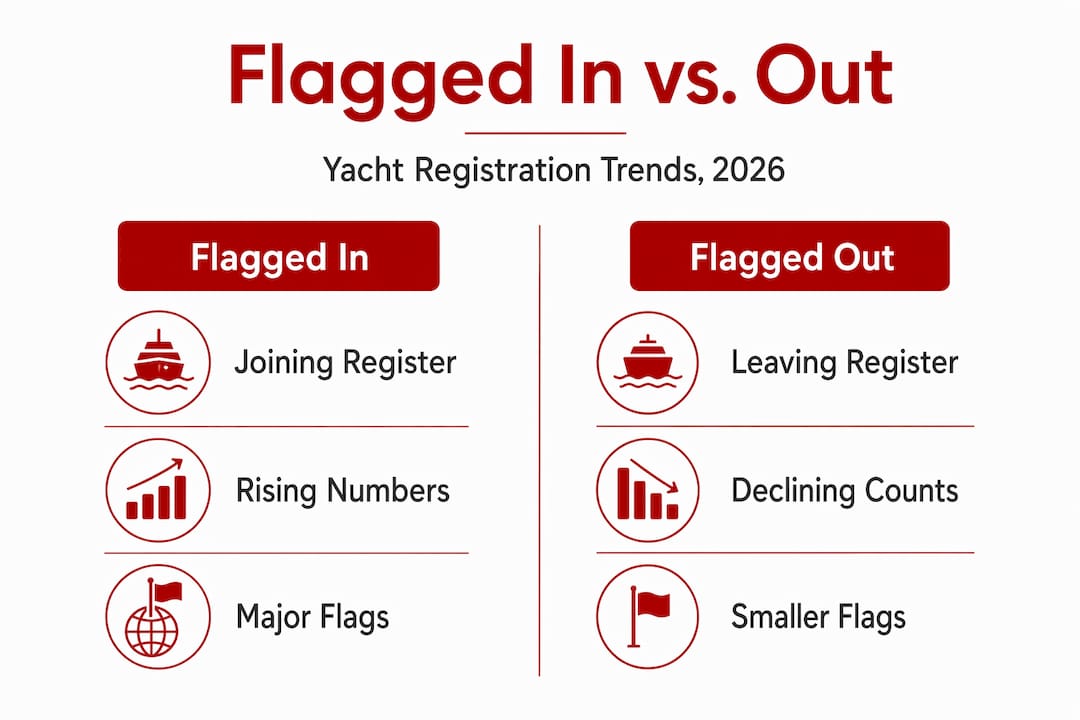
Here is a snapshot of what official UK Ship Register data illustrates about registration dynamics:
| Metric | What it measures | Why it matters to yacht owners |
|---|---|---|
| Flagged-in count | New vessels entering the register | Shows how attractive a flag is |
| Flagged-out count | Vessels leaving the register | Signals dissatisfaction or policy changes |
| Net change | Flagged-in minus flagged-out | Overall momentum of the registry |
| Gross tonnage shifts | Commercial weight of changes | Distinguishes yacht vs. commercial trends |
| Monthly variance | Month-on-month fluctuation | Reveals policy or seasonal effects |
Several patterns stand out when analyzing the 2026 data:
- Registers with strong verification reputations are holding or growing vessel counts despite new compliance requirements
- Registers that relied primarily on speed and minimal scrutiny are seeing higher flagged-out numbers as owners migrate to more reputable flags
- Some flags show seasonal spikes around regulatory deadlines, suggesting owners are making reactive rather than planned registration decisions
For a full walkthrough of how to read and use this kind of data, the vessel registration process global guide breaks it down flag by flag.
New compliance priorities for yacht owners under 2026 registration rules
The 2026 shift is not about more paperwork. It is about cleaner, more consistent paperwork. Flag state offices now emphasize beneficial ownership verification and identity consistency more than how quickly you can submit a form. That distinction changes your preparation strategy entirely.
The documents most yacht owners need to have ready and aligned include:
- Proof of ownership: Bill of sale, builder’s certificate, or court order, with no naming inconsistencies across documents
- Beneficial ownership declaration: Clear identification of the ultimate individual owner, even if a corporate entity holds title
- Identity documentation: Passport or national ID matching the name on all ownership documents exactly
- Vessel measurements: Tonnage, dimensions, and hull identification numbers consistent across all supporting records
- Previous registration certificate or deletion certificate: Required if the vessel was previously flagged elsewhere
The most common cause of registration delays in 2026 is not missing documents. It is conflicting information across documents you already have. A middle name appearing in one place but not another, a company name with a slight spelling variation, or a vessel measurement that differs by a decimal between the builder’s certificate and the survey report can all trigger a verification hold.
Following yacht registration best practices means doing an internal consistency audit before you submit anything. Check every document against every other document.
Pro Tip: Create a single master reference sheet with your vessel’s name, dimensions, hull ID, owner name, and company name exactly as they appear on your primary ownership document. Use that sheet to verify every other document before submission. This one habit eliminates the most common cause of registry back-and-forth.
إن registration compliance checklist published by specialists in international yacht flags covers exactly these consistency checks in a format you can work through before you pick up the phone.
Comparing international maritime registration models for yachts in 2026
Not every flag works the same way. The future of ship registration lies in understanding three core models and how the 2026 IMO guidelines affect each one differently.
| الطراز | Eligibility | Oversight level | Registration speed | IMO guideline impact |
|---|---|---|---|---|
| Open registry | Any nationality | Variable, often lighter | Typically fast | Greater scrutiny pressure |
| Closed registry | Citizens or residents only | High, nationally governed | Moderate to slower | Already aligned in many cases |
| Hybrid registry | Conditional access | معتدل | معتدل | Opportunity to differentiate |
Each model has a distinct profile for yacht owners:
- Open registries (think Panama, Palau, Marshall Islands) allow owners of any nationality to register. They have historically competed on price and speed. Under 2026 guidelines, the quality of their verification processes is now under scrutiny. Open registries adapting quickly to IMO standards will maintain their appeal. Those that do not are seeing owners move on.
- Closed registries (such as the UK Part 1) restrict registration to nationals or residents but maintain stronger legal protections and international recognition. Their existing governance often aligns closely with the new IMO guidelines, giving them an advantage in credibility.
- Hybrid registries like Malta, San Marino, and Langkawi occupy a middle ground, offering broader access than closed registries while maintaining more structure than pure open registers. These are often the best fit for internationally active yachts.
For context on Florida yacht safety compliance tips, U.S.-flagged vessels face a separate but parallel trend toward stricter documentation requirements, which mirrors the international shift.
Pro Tip: If your yacht operates commercially in European waters, a Malta or UK Part 1 registration carries more weight with port state authorities than a lesser-known open registry. The time saved in port inspections alone often justifies the extra documentation effort at registration.
Review the full breakdown of types of maritime registrations to match these models to your actual operational profile.
Practical steps for yacht owners to navigate 2026 registration trends
Knowing the landscape is not the same as knowing what to do next. Here is a clear, ordered sequence for navigating the registration process under 2026 rules:
- Audit your existing documents. Pull together every ownership, identity, and vessel record you have and check for naming and measurement consistency before you approach any registry.
- Determine your flag eligibility. Based on your nationality, company structure, and where your yacht operates, identify which flags you actually qualify for.
- Evaluate registry reputations. Use official data (like the UK DfT monthly statistics) and check whether your shortlisted flags have announced alignment with IMO 2026 guidelines.
- Prepare a beneficial ownership structure document. If a company owns the vessel, map the ownership chain clearly to the individual level before submitting anything.
- Select your flag and initiate contact. Ask the registry directly what their current verification timelines look like and whether they have specific requirements triggered by the IMO guidelines.
- Respond to verification queries within 48 hours. Delays in responding to registry requests are one of the top causes of extended processing times. Have your documentation accessible.
- Obtain your certificate and set up ancillary services. MMSI and AIS setup, insurance registration, and Port State Control documentation should all follow immediately after your certificate is issued.
Pre-submission internal consistency checks reduce verification delays in today’s stricter environment, and this is one step many owners still skip. The how to register a yacht guide offers a detailed walkthrough of each stage, and the registration timelines fast track resource shows realistic timelines by flag so you can plan around them.
Pro Tip: Ask your chosen registry whether they have updated their internal processes in response to the 2026 IMO guidelines. A registry that cannot answer that question directly is probably behind the curve.
Why 2026 marks a turning point in yacht registration compliance
Here is an uncomfortable truth about how yacht registration used to work. For many owners, registration was primarily a box-checking exercise. You submitted documents, paid the fee, and received a certificate. The flag’s job was to issue paper. Your job was to supply it fast.
That model worked until it didn’t. The lack of a binding international framework before 2026 left a gap wide enough for fraudulent operators to exploit repeatedly. The 529 fraudulent flag cases identified in the most recent period are not an anomaly. They are the predictable result of a system that prioritized speed over verification for decades.
What changes in 2026 is not just the guidelines themselves but what those guidelines signal to port state authorities, insurers, and charter operators. A registration from a flag that visibly meets IMO standards will carry more practical weight than one from a registry that has not updated its processes since 2010. That gap will widen over the next few years.
For yacht owners, the practical implication is this: registration is now a compliance function, not an administrative one. The owners who treat it that way, investing time in document quality and choosing flags with genuine governance credibility, will experience smoother port entries, faster insurance approvals, and fewer headaches if their vessel is ever subject to inspection.
The maritime registration trends compliance data backs this up. Registries aligning with the 2026 guidelines are already differentiating themselves, and the market is responding. Choosing a flag now is a decision about what kind of verification environment you want to operate in for the next five to ten years, not just the next twelve months.
Streamline your yacht registration in 2026 with expert assistance
Navigating the 2026 registration landscape on your own is possible, but the margin for error is smaller than it used to be. A single document inconsistency can trigger weeks of back-and-forth with a registry. The wrong flag choice can mean poor acceptance at the ports where you actually cruise.
موقع VesselFlag.com gives yacht owners a faster, cleaner path through this new environment. From the comprehensive yacht registration guide that covers every major flag option with real timelines and costs, to expert consultation on whether you need to understand yacht vs. boat registration differences for your specific vessel type, the platform is built for exactly this kind of complexity. You can also use the resources on how to ensure yacht registration validity to keep your certificate compliant long after it is issued. Get your registration right the first time.
الأسئلة الشائعة
What are the main changes in ship registration regulations in 2026?
The 2026 regulations introduce the IMO’s first international guidelines covering due diligence, transparency, and fraud prevention, with a focus on ownership verification and information sharing among flag states.
How can yacht owners use official data to understand registration trends?
Yacht owners can analyze monthly ship register statistics like the UK’s FLE0100 tables to track vessels joining or leaving flags, helping identify popular flags and optimal timing for registration decisions.
Why is verification now more important than submission speed for registration?
Because the 2026 IMO guidelines focus on due diligence and ownership verification, your registration timeline depends far more on how quickly you satisfy verification requests than how fast you submit the initial application.
What are the benefits of choosing different flag registration models for my yacht?
Open, closed, and hybrid flag models differ in eligibility, oversight, and operational flexibility, so selecting the right model should reflect your yacht’s operational geography, your commercial or private use, and your compliance priorities.
How can I prepare my yacht’s registration documents effectively under 2026 rules?
Review all ownership, identity, and vessel records for naming and measurement consistency before submission, respond quickly to verification queries, and use an expert checklist to catch conflicting information before it causes delays.