

Registering a boat company internationally presents maritime entrepreneurs with a maze of regulations, documentation requirements, and compliance obligations that vary dramatically across flag states. Without proper guidance, you risk costly delays, legal complications, and operational restrictions that can undermine your business from day one. This comprehensive guide walks you through every critical step of the registration process, from understanding fundamental requirements and preparing essential documentation to executing your application and maintaining ongoing compliance. Whether you’re launching a charter operation, establishing a yacht management company, or expanding your maritime business globally, you’ll discover actionable strategies to navigate international registration efficiently while protecting your investment and ensuring legal standing across jurisdictions.
جدول المحتويات
- Understanding Boat Company Registration Requirements
- Preparing To Register Your Boat Company: Checklist And Documentation
- Step-By-Step Process To Register A Boat Company Internationally
- Verifying Your Boat Company Registration And Ensuring Compliance
- Discover Expert Yacht And Boat Registration Services
Key takeaways
| نقطة | التفاصيل |
|---|---|
| Flag state selection matters | Your choice of flag determines tax obligations, regulatory requirements, and operational flexibility across international waters. |
| Documentation drives success | Complete, accurate paperwork including ownership proof, safety certificates, and corporate documents accelerates approval and prevents rejection. |
| Stepwise execution reduces errors | Following a structured registration sequence from application through final certification minimizes delays and compliance gaps. |
| Ongoing verification protects status | Regular compliance checks, timely renewals, and proper record keeping safeguard your company’s legal standing internationally. |
Understanding boat company registration requirements
Registering a boat company establishes your legal right to operate vessels commercially under a specific flag state’s jurisdiction. Boat registration involves legal documentation required by flag states to establish ownership and compliance, creating a permanent record that connects your business entity to your vessels. This process goes beyond simple vessel documentation because it establishes your company’s maritime identity, determines your tax obligations, and defines which international regulations govern your operations.
Flag state selection represents your most consequential decision during registration. Each flag offers distinct advantages: some provide favorable tax structures, others streamline administrative processes, while certain flags enhance your vessel’s credibility in premium charter markets. Your flag choice affects everything from crew nationality requirements to safety inspection standards and insurance costs. Popular options like Malta offer EU benefits, San Marino provides efficient processing, and Poland delivers competitive pricing with solid regulatory frameworks.
You’ll need specific mandatory documents regardless of which flag you pursue. These typically include proof of vessel ownership through bills of sale or builder’s certificates, corporate registration documents establishing your business entity, safety and seaworthiness certificates from recognized surveyors, and comprehensive insurance coverage meeting flag state minimums. Additional requirements often include radio licenses, tonnage certificates, and evidence of key yacht compliance requirements specific to your intended operations.
International maritime law creates the framework within which all flag states operate. The United Nations Convention on the Law of the Sea establishes baseline standards, while individual flag states add their own requirements. Understanding this hierarchy helps you anticipate which regulations apply to your specific situation and how different jurisdictions interpret international standards differently.
Preparing to register your boat company: Checklist and documentation
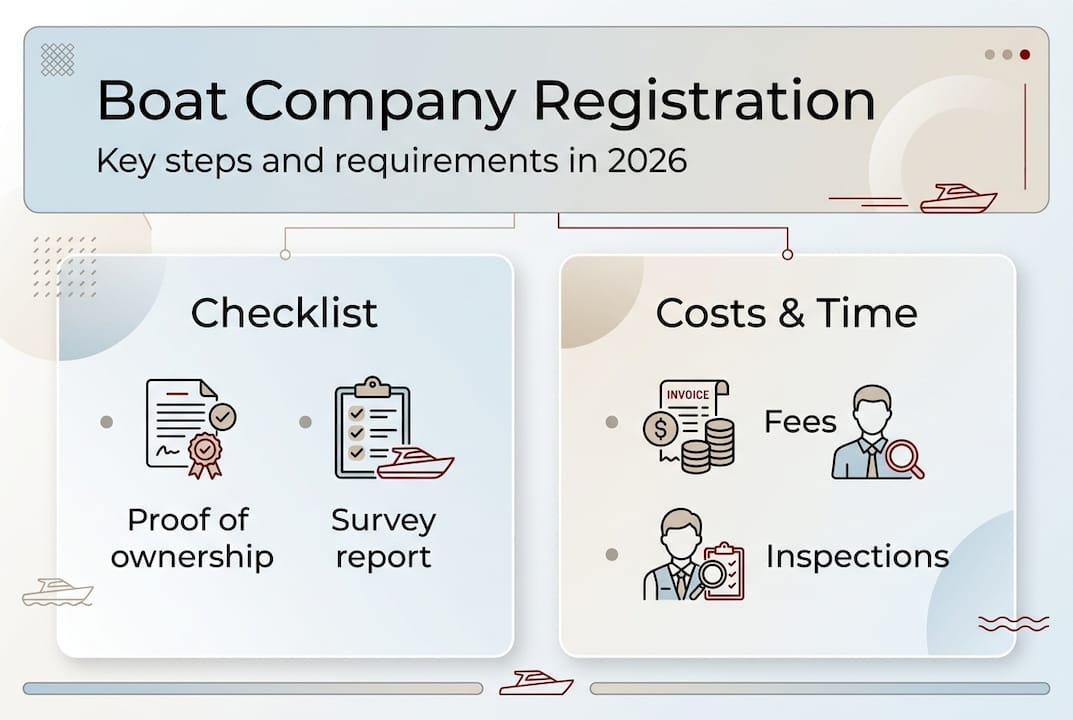
Proper preparation minimizes delays and strengthens compliance in registration processes, transforming what could be a months-long ordeal into a streamlined procedure. Start by gathering ownership documentation that proves your legal right to the vessel. This includes original purchase agreements, bills of sale with notarized signatures, and any previous registration certificates if the vessel was registered elsewhere. For newly built vessels, you’ll need builder’s certificates and construction documentation.
Your corporate documentation package must establish your business entity’s legitimacy. Required items typically include articles of incorporation or formation documents, business licenses, tax identification numbers, and beneficial ownership declarations identifying all individuals with significant control over your company. Many flag states now require enhanced due diligence documents including passport copies, proof of address, and professional references for company directors and shareholders.
Technical certificates validate your vessel’s seaworthiness and safety compliance. Essential certifications include:
- Marine survey reports completed within the past 12 months by accredited surveyors
- Safety equipment inventory documenting life-saving appliances, fire suppression systems, and navigation equipment
- Tonnage measurement certificates calculated according to International Convention standards
- Insurance certificates showing hull coverage and protection and indemnity liability meeting flag state minimums
- Radio station licenses and MMSI numbers for vessels equipped with communication systems
Pro Tip: Create digital copies of every document before starting your application, organizing files by category in cloud storage. This preparation saves hours when authorities request additional information or clarification during processing.
Flag selection requires analyzing multiple factors against your operational priorities. Consider these key decision points in a structured comparison:
| Factor | Considerations | Impact on Operations |
|---|---|---|
| Tax structure | Corporate tax rates, VAT obligations, tonnage tax schemes | Annual operating costs, profit margins |
| Registration timeline | Processing speed, document requirements, inspection schedules | Time to operational status |
| Operating regions | Port access, treaty benefits, regional restrictions | Market reach, charter opportunities |
| Compliance burden | Inspection frequency, reporting requirements, crew regulations | Administrative overhead, staffing flexibility |
| Costs | Initial fees, annual renewals, survey requirements | Budget planning, cash flow |
Financial prerequisites extend beyond registration fees. Budget for initial survey costs ranging from $2,000 to $15,000 depending on vessel size, legal consultation fees for document review, translation services if your documents aren’t in the flag state’s official language, and working capital to cover the 30 to 90 day processing period before you can legally operate. Review efficient vessel registration requirements 2026 for current fee structures across popular flags.

Your preparation checklist should also account for flag-specific nuances. Some jurisdictions require physical vessel inspections before approval, while others accept recent survey reports. Certain flags mandate local agent representation, adding ongoing costs but providing valuable navigation through bureaucratic processes. Research whether your chosen flag requires vessels to visit its waters periodically or allows permanent foreign operation. Understanding these details prevents surprises that could derail your timeline or budget. Consult the vessel registration guide San Marino Malta Poland for jurisdiction-specific preparation requirements.
Step-by-step process to register a boat company internationally
Following a structured registration process reduces errors and ensures timely compliance, transforming complex bureaucratic requirements into manageable sequential tasks. Execute these steps methodically to maintain momentum and avoid costly backtracking.
Submit your initial application package to your chosen flag state’s maritime authority or authorized agent. Include all corporate documents, ownership proof, and vessel specifications. Most modern registries accept electronic submissions through secure portals, though some still require original documents by courier. Pay the initial application fee at this stage, typically ranging from $500 to $5,000 depending on vessel size and flag choice.
Await preliminary review and respond promptly to any requests for clarification or additional documentation. Authorities typically complete initial assessment within 5 to 15 business days. They’ll verify your corporate standing, confirm document authenticity, and assess whether your vessel meets basic eligibility criteria. Quick responses to information requests prevent your application from moving to the bottom of the processing queue.
Schedule and complete required inspections or surveys if your flag mandates physical vessel examination. Coordinate with approved surveyors who understand your flag’s specific requirements. The surveyor will examine hull integrity, safety equipment, navigation systems, and compliance with international conventions. Survey reports must be submitted directly to the registry by the surveyor to maintain independence and credibility.
Finalize corporate registration if your flag requires establishing a local company structure. Some jurisdictions allow foreign companies to register vessels directly, while others mandate creating a subsidiary or special purpose vehicle under their corporate law. This step involves additional legal fees and may require appointing local directors or establishing registered office addresses.
Complete payment of final registration fees and any applicable taxes once your application receives provisional approval. Fee structures vary significantly: some flags charge based on vessel length or tonnage, others use flat rates, and a few employ annual tonnage tax schemes that replace traditional corporate taxes. Verify exact amounts before this stage to avoid payment delays.
Receive your official registration certificate and carved marking requirements. Your certificate proves your vessel’s legal status and must be kept aboard at all times. You’ll also receive specifications for displaying your vessel’s name, port of registry, and official number on the hull. Some flags issue physical certificates while others provide secure digital versions with verification codes.
Pro Tip: Maintain a detailed timeline spreadsheet tracking each step’s submission date, expected response time, and actual completion. This documentation proves invaluable if disputes arise and helps you identify bottlenecks requiring follow-up.
Different flag states offer varying advantages in their registration processes:
| Flag State | Processing Time | Key Advantages | Typical Costs |
| — | — | — |
| San Marino | 3-4 weeks | Fast processing, EU recognition, minimal bureaucracy | $3,000-$8,000 initial |
| Malta | 6-8 weeks | Full EU benefits, strong maritime reputation, comprehensive services | $5,000-$15,000 initial |
| Poland | 4-6 weeks | Competitive pricing, EU access, straightforward requirements | $2,500-$6,000 initial |
| Palau | 2-3 weeks | Rapid approval, minimal inspections, flexible operations | $2,000-$5,000 initial |
Common pitfalls during registration include submitting outdated survey reports, providing corporate documents without proper authentication or apostille certification, and failing to disclose all beneficial owners as required by modern transparency regulations. Another frequent mistake involves misunderstanding tonnage measurement requirements, with applicants submitting incorrect calculations that require expensive re-measurement. Avoid these errors by using the yacht registration checklist 6 steps as your verification tool before submission.
When interacting with maritime authorities, maintain professional communication and respond within stated timeframes. Many registries operate with small staffs processing hundreds of applications, so courteous persistence gets better results than aggressive demands. If using an agent or consultant, ensure they provide regular status updates and copies of all correspondence. Your agent should explain any technical requirements in plain language and help you understand how decisions at each stage affect your long-term operational flexibility.
Verifying your boat company registration and ensuring compliance
Ongoing verification and compliance checks safeguard against legal and operational risks that could invalidate your registration or expose your company to penalties. Once you receive your registration certificate, immediately verify its authenticity through your flag state’s official registry database. Most modern maritime authorities maintain online verification systems where you can confirm your vessel’s registration status, expiration date, and any notations or restrictions using your official number or IMO identifier.
Maintain meticulous compliance through these essential ongoing tasks:
- Submit annual renewal applications and fees 60 to 90 days before expiration to prevent lapses in registration status
- Schedule periodic safety inspections according to your flag’s requirements, typically annually or biennially depending on vessel type and age
- Update registration records within 30 days of any material changes including ownership transfers, vessel modifications, or corporate structure changes
- File required operational reports such as crew lists, voyage declarations, or tonnage tax returns according to your flag’s schedule
- Maintain current insurance coverage meeting or exceeding flag state minimums, providing updated certificates to authorities promptly
Your record keeping system should preserve all registration documents, correspondence with maritime authorities, survey reports, and proof of fee payments for at least seven years. Digital document management systems with automated backup prevent loss of critical records that you may need to prove compliance history or resolve disputes. Organize files chronologically and by category, making specific documents quickly retrievable when authorities request verification.
“Maintaining continuous compliance isn’t just about avoiding penalties. It protects your company’s reputation, ensures uninterrupted operations, and preserves the significant investment you made in establishing proper registration. A single compliance lapse can trigger cascading problems including port state control detentions, insurance coverage disputes, and charter contract breaches.”
Multi-flag operations present unique compliance challenges when you operate vessels under different registries simultaneously. Each flag imposes distinct requirements for inspections, reporting, and documentation that rarely align on timing or format. Create separate compliance calendars for each registered vessel, assign responsibility for monitoring deadlines to specific team members, and consider using specialized maritime compliance software that tracks requirements across multiple jurisdictions. The complexity of managing different regulatory frameworks makes professional support particularly valuable. Services offered through ensure yacht registration validity help coordinate compliance across multiple flags efficiently.
Common post-registration challenges include confusion about which jurisdiction’s rules apply in international waters, difficulty obtaining timely survey appointments in remote locations, and navigating conflicting requirements when your flag state’s rules differ from port state control expectations. Address these proactively by understanding that while your flag state governs your vessel’s registration, port states can inspect and detain vessels that don’t meet international safety standards regardless of flag. Maintain compliance with both your flag’s requirements and broader international conventions to avoid operational disruptions.
When registration issues arise, document everything and communicate promptly with your maritime authority. Most problems stem from misunderstandings or administrative errors that resolve quickly with proper explanation. If facing serious compliance concerns, engage maritime legal counsel experienced in your flag’s jurisdiction before the situation escalates. Early intervention often prevents minor issues from becoming registration-threatening problems that could ground your vessels or expose your company to significant penalties.
Discover expert yacht and boat registration services
Navigating international boat company registration requires specialized knowledge of maritime regulations, flag state requirements, and compliance procedures that most entrepreneurs don’t possess. موقع VesselFlag.com eliminates this complexity by providing comprehensive registration services that handle every aspect of the process from initial consultation through final certification and ongoing compliance support. Our team brings deep expertise across multiple flag jurisdictions including San Marino, Malta, Poland, Palau, and others, ensuring you select the optimal flag for your specific operational needs and business objectives.
We manage documentation preparation, coordinate with maritime authorities, schedule required inspections, and track your application through completion. Our services extend beyond initial registration to include MMSI licensing, vessel insurance placement, and ongoing compliance management that protects your investment long term. Whether you’re registering your first vessel or managing a growing fleet across multiple flags, our streamlined processes and transparent pricing deliver the efficiency and reliability your business demands. Explore our detailed yacht registration guide to understand how professional support accelerates your registration timeline, or review our yacht registration validity services to discover how we maintain your compliance across jurisdictions. Visit our comprehensive boat registration process explanation to see how we simplify complex maritime regulations into clear, actionable steps.
Frequently asked questions
How long does it typically take to register a boat company internationally?
Registration timelines vary significantly by flag state, ranging from two weeks for streamlined jurisdictions like Palau to eight weeks or more for comprehensive registries like Malta. Your preparation quality dramatically affects processing speed since incomplete documentation triggers delays for clarification requests. Most registrations complete within four to six weeks when applicants submit properly organized, complete documentation packages and respond promptly to authority requests.
What factors influence the choice of flag state for my boat company registration?
Your flag decision should balance tax efficiency, regulatory burden, operational flexibility, and market perception against your specific business model. Consider where you’ll operate primarily, whether EU access matters for your charter business, how much administrative complexity you can manage, and what your target clients expect regarding flag reputation. Review the detailed vessel registration guide comparing popular options to match flag characteristics with your priorities.
Can I operate my boat company under multiple flags simultaneously?
Yes, operating vessels under different flags is common for larger fleets, but each vessel can only carry one flag at a time. Multi-flag strategies let you optimize tax treatment, access different markets, and distribute regulatory risk across jurisdictions. However, this approach multiplies compliance obligations since you must satisfy each flag’s distinct requirements for inspections, reporting, and documentation. Professional compliance support through multi-flag compliance services helps manage these complex obligations efficiently.
What are the most common mistakes to avoid during boat company registration?
The most costly errors include submitting incomplete ownership documentation, using outdated survey reports that authorities reject, failing to properly authenticate corporate documents with apostilles when required, and underestimating processing timelines which creates operational pressure. Many applicants also neglect to verify their chosen flag’s specific requirements before starting, discovering incompatibilities after investing time and money. Use the comprehensive registration checklist to systematically verify you’ve addressed all requirements before submission, preventing delays and rejection.