
A Delaware LLC makes sense for yacht ownership when asset protection, predictable dispute resolution, and privacy from public record matter more than saving a few hundred dollars in duplicate filing fees. It makes less sense when you cruise and dock in a single home state where a local LLC would do the same job for less paperwork. The Delaware Division of Corporations processes formations quickly and keeps member names off the public record, and the Delaware Court of Chancery gives owners a specialized business court with decades of case law on entity disputes. Neither of those benefits, though, changes how or where you register the boat itself. That’s a separate legal track running through DNREC or a flag state, not through Delaware’s corporate filing office.
Here’s the two-line version, before you commit to reading the rest:
- Use a Delaware LLC if you have multiple owners, expect outside investment or financing, want a governance structure a lender or insurer will recognize, or plan to hold multiple vessels under separate liability shields.
- Skip Delaware if you own one boat, dock it in your home state, and never plan to bring in co-owners or outside capital. A local LLC (or, in some states, no entity at all) usually costs less and avoids foreign qualification headaches.
If a compliance question comes up that touches beneficial ownership reporting, the FinCEN rules and IRS pass-through treatment matter more than most owners expect. That’s covered further down.
الوجبات الرئيسية
A Delaware LLC protects yacht owners through liability isolation and dispute predictability, but it never substitutes for separate vessel registration under DNREC’s principal-use rule or an equivalent flag authority.
| نقطة | التفاصيل |
|---|---|
| Match structure to use case | Delaware fits multi-owner, multi-state, or investor-facing ownership; single-state private owners often do better with a home-state LLC. |
| Formation and registration are separate | The Division of Corporations forms the LLC; DNREC or a flag registry handles the actual vessel registration. |
| Budget for two fee layers | Expect the $110 formation fee and $300 annual franchise tax due June 1, plus foreign qualification costs if you operate elsewhere. |
| Privacy has real limits | Member names stay off public filings, but court orders and FinCEN BOI reporting can still surface ownership. |
| Maintain formalities year-round | Separate bank accounts, clean bookkeeping, and adequate insurance keep the liability shield intact against maritime claims. |
| Registration still needs handling | VesselFlag supports the corporate-to-flag handoff with registration, MMSI/AIS setup, and compliance tracking once the LLC is formed. |
جدول المحتويات
- Why Delaware Works for Yacht Ownership
- When Delaware Is the Wrong Choice
- How Delaware LLC Ownership Interacts With Vessel Registration
- Setting Up a Delaware LLC to Hold a Yacht
- What Delaware LLC Yacht Ownership Actually Costs
- How Much Privacy Does a Delaware LLC Really Provide?
- Matching Ownership Structure to Cruising and Charter Plans
- Protecting the LLC’s Liability Shield Long-Term
- What a Registration Specialist Would Tell You to Do Next
- Where VesselFlag Fits Into Your Delaware LLC Plan
- المصادر
- الأسئلة الشائعة
Why Delaware Works for Yacht Ownership
The three real advantages of a Delaware LLC have nothing to do with the boat and everything to do with the entity wrapped around it.
Liability isolation. An LLC separates your personal assets from claims tied to the vessel. If someone gets hurt aboard or the boat causes property damage, a plaintiff generally has to go after the LLC’s assets first, not your house or your investment portfolio. Delaware’s LLC Act also gives creditors of a member only a “charging order” remedy in most cases, meaning a creditor can claim distributions but can’t force the sale of the vessel or step into management. That’s a meaningfully different position than being sued as an individual owner.
Contract-first governance. Delaware’s LLC statute is built around freedom of contract. Your operating agreement, not a rigid state template, controls almost everything: how profits split, who can veto a sale, what happens if one owner wants out. For a yacht held by multiple family members or investors, that flexibility is worth more than people initially realize.
Court of Chancery predictability. Delaware’s business court decides entity disputes without juries and has produced a deep body of precedent that lawyers can cite with real confidence. For a boat worth hundreds of thousands or millions of dollars with several owners, that predictability reduces the risk of a messy, unpredictable fight later.
Most private-use owners also get pass-through federal tax treatment, meaning the LLC itself doesn’t pay federal income tax. Profits and losses flow to your personal return, per IRS guidance on LLC taxation. That’s not a Delaware-specific perk. Any single-member or multi-member LLC gets it by default. Delaware’s edge is procedural and legal, not fiscal.
Delaware’s real selling point for yacht owners isn’t a tax break. It’s a court system built for exactly the kind of ownership disputes that come up when three siblings each put money into the same 60-foot boat and later disagree about who gets to use it in August.
نصيحة من الخبراء: When drafting the operating agreement, prioritize four clauses above everything else: voting thresholds for major decisions (sale, refinance, major refit), a buy-sell mechanism triggered by death, divorce, or bankruptcy of a member; capital call procedures for unexpected repairs or insurance shortfalls, and transfer restrictions that prevent a member from selling their stake to an outsider without consent. Skip these and you’re relying on Delaware’s statutory defaults, which are generic and rarely fit a yacht’s actual usage pattern.
When Delaware Is the Wrong Choice
Delaware’s reputation as the default LLC state leads a lot of owners to form there reflexively, without checking whether it actually fits their situation. Often it doesn’t.
- Foreign qualification burden. If you operate primarily from Florida, Rhode Island, or California, you’ll likely need to register the Delaware LLC as a “foreign” entity in your home state anyway, which means paying that state’s registration fee on top of Delaware’s.
- Duplicate annual compliance. You now track two sets of deadlines, two registered agent renewals, and potentially two annual fee structures instead of one.
- No home-state simplicity. A single-owner boat docked at one marina in one state gains little from Delaware’s governance flexibility since there’s no dispute to predict.
- Lender and insurer friction. Some regional lenders and insurers are more comfortable underwriting a vessel owned by an LLC formed in the state where it’s actually used, and may ask extra questions about a Delaware entity with no local footprint.
Here’s a rough illustration of the duplicate-cost problem, using representative figures rather than any specific state’s exact fee (check your own state’s numbers before deciding):
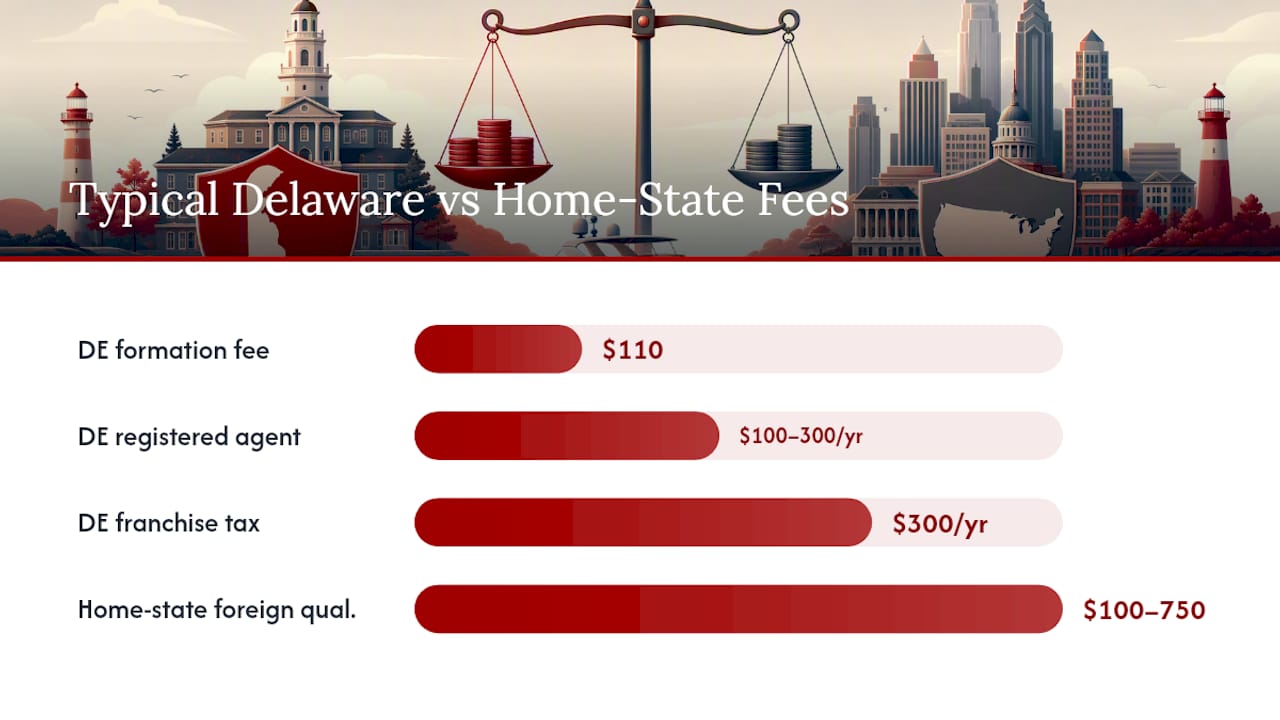
- Delaware Certificate of Formation: $110, plus a registered agent fee, often $100 to $300 a year.
- Foreign qualification in your home state: commonly $100 to $750 depending on the state, plus that state’s own registered agent requirement.
- Delaware’s flat $300 franchise tax, due every year regardless of the LLC’s income or activity.
- Your home state’s own annual report or franchise fee, layered on top.
Add it up and a single-boat, single-state owner can spend two to three times what a simple home-state LLC would cost, for governance flexibility they’ll likely never use. LegalClarity’s analysis of Delaware formations makes the same point: Delaware pays off for multi-state operations, investor-facing entities, or complex governance, not for straightforward single-location ownership.
Red flags that you should probably stay home-state: you’re the sole owner, the boat never leaves one state’s waters, you have no plans to bring in co-owners or investors, and your insurer and marina are both local to that state.
How Delaware LLC Ownership Interacts With Vessel Registration
This is the point where most owners get confused, so it’s worth being blunt: forming a Delaware LLC and registering your vessel are two completely separate legal actions handled by two completely different agencies.
The Delaware Division of Corporations handles entity formation. It doesn’t register boats. Vessel registration and titling go through Delaware DNREC if you want to register the boat in Delaware itself, or through your home state’s equivalent agency, or through an international flag registry if you’re flagging abroad.
DNREC enforces a state of principal use rule. In practice, if a vessel is used in Delaware waters for more than roughly 60 consecutive days, that use can establish Delaware as the boat’s principal-use state, which is what actually qualifies it for Delaware registration. An LLC formed in Delaware but operating a boat that never touches Delaware water gains nothing toward state registration eligibility just from the entity’s home state. Owners flying past this distinction sometimes assume forming the LLC in Delaware automatically lets them register the boat there. It doesn’t.
| Requirement | Handled by | Typical documents |
|---|---|---|
| Entity formation | Delaware Division of Corporations | Certificate of Formation, registered agent designation |
| Vessel registration/titling | DNREC (or home state equivalent) | Government-issued ID, bill of sale, Manufacturer’s Certificate of Origin (MCO) or existing title, hull identification number |
| International flagging | Flag state registry | Proof of ownership, tonnage certificate, radio license, survey documents depending on flag |
If your LLC owns a boat principally used in, say, New Jersey, you’ll register the vessel with New Jersey’s marine agency, not DNREC, regardless of where the LLC itself was formed. Trying to register in Delaware without meeting the principal-use threshold typically gets rejected or flagged during the application review.
Setting Up a Delaware LLC to Hold a Yacht
Once you’ve decided Delaware fits, the formation sequence itself is straightforward. Here’s the order that avoids the most common delays.
- Choose and reserve a name. It needs to be distinguishable from existing Delaware entities and typically includes “LLC” or “Limited Liability Company.”
- Appoint a Delaware registered agent. State law requires a registered agent with a physical Delaware street address, since Delaware LLC formation guidance confirms out-of-state owners can’t act as their own agent without a Delaware presence.
- File the Certificate of Formation. This costs $110 and is the only document that becomes part of the public record.
- Draft the operating agreement. This stays private, is never filed with the state, and is where all the substantive governance terms live.
- Obtain an EIN from the IRS. Needed for banking, insurance, and tax filing even for single-member LLCs.
- Open a dedicated business bank account in the LLC’s name, funded separately from personal accounts.
Once the entity exists, several follow-up tasks matter just as much as the filing itself:
- Update or bind a new insurance policy naming the LLC as the insured owner.
- Complete the vessel’s title transfer or bill of sale into the LLC’s name.
- Determine flag or state registration based on where the boat is principally used, per the DNREC principal-use rule described above.
- Check whether you need to foreign-qualify in the state where you’ll actually dock and operate the vessel.
Timeline-wise, Delaware formation itself often completes within a few business days to two weeks depending on the provider and whether you pay for expedited processing. Vessel registration and title transfer usually add another two to six weeks, and international flag registration timelines vary considerably by registry, from a few days for some open registries to several weeks for others requiring surveys or physical inspection. Documentation to gather ahead of time: the LLC’s Certificate of Formation and EIN letter, the vessel’s existing title or MCO, a notarized bill of sale, and photo ID for all signing members.
نصيحة من الخبراء: Beyond the standard voting and buy-sell clauses, a yacht-specific operating agreement should address maintenance reserve funding (how much cash the LLC keeps on hand for haul-outs and repairs), the captain’s authority to make emergency decisions at sea, any limits on chartering the vessel to third parties, and the dispute venue clause confirming Delaware Chancery Court jurisdiction for internal disagreements. Generic LLC templates almost never cover these.
What Delaware LLC Yacht Ownership Actually Costs
Budget for two distinct cost layers: the one-time formation cost and the recurring annual obligations that follow for as long as the LLC exists.
- Certificate of Formation filing fee: $110, paid once.
- Registered agent service: typically $100 to $300 annually, ongoing for the life of the entity.
- Delaware annual franchise tax: a flat $300, due every year on June 1, regardless of the LLC’s revenue or whether the boat was even used that year.
- Foreign qualification fee (if you operate outside Delaware): varies by state, commonly $100 to $750, plus that state’s own recurring fee.
- Formation provider fees: if you use a service rather than filing yourself, expect an additional service charge on top of the state fee.
- Insurance and banking setup: varies by insurer and vessel value, but expect the LLC-named policy to require its own underwriting review separate from any personal policy history you had.
Delaware’s $300 franchise tax deadline deserves its own callout: miss June 1 and the state adds penalties plus interest that accrue until paid, and a delinquent LLC can eventually be voided by the state, which jeopardizes the liability shield you formed the entity for in the first place.
A rough illustrative budget: a US-based private owner forming in Delaware and foreign-qualifying in their home state might see first-year costs including the Delaware filing fee, registered agent, foreign qualification fee, and provider charges. Ongoing years typically include the Delaware franchise tax, registered agent renewal, and the home state’s own annual fee, all of which vary by state and provider. Actual numbers shift by state and provider, so treat this as a planning range rather than a quote.
How Much Privacy Does a Delaware LLC Really Provide?
Delaware’s privacy reputation is real but narrower than most owners assume. The Delaware Division of Corporations does not require member or manager names on the Certificate of Formation. Only the registered agent’s information becomes part of the public record. That means a casual public records search won’t turn up your name as the yacht’s owner.
That privacy has hard limits, though:
- Court-ordered discovery. If the LLC is sued or involved in litigation, opposing counsel can subpoena records that reveal ownership, including bank records and the operating agreement itself.
- FinCEN Beneficial Ownership Information (BOI) reporting. Under federal rules tied to the Corporate Transparency Act, many LLCs must report their beneficial owners to FinCEN, a Treasury Department bureau, even though that information isn’t published publicly. It exists for law enforcement and regulatory access, not general secrecy.
- Bank and insurer KYC requirements. Financial institutions require know-your-customer documentation regardless of what’s on the public state filing.
So Delaware shields you from casual public lookup, not from a subpoena, a regulator, or your own bank. Owners who treat LLC formation as a way to disappear from every possible record are setting themselves up for an unpleasant surprise later.
نصيحة من الخبراء: Before you ever apply for a boat loan or insurance quote in the LLC’s name, assemble the Certificate of Formation, EIN letter, operating agreement, and a clear ownership chart showing every member’s percentage stake. Banks and insurers routinely stall applications waiting on exactly this paperwork, and having it ready up front can cut weeks off underwriting.
Matching Ownership Structure to Cruising and Charter Plans
The right entity-and-flag combination depends almost entirely on where you cruise and whether you charter.
For US-resident owners cruising the Atlantic or Caribbean privately, a Delaware or Florida LLC paired with a US, Cayman, or Marshall Islands flag is a common and workable setup, according to industry guidance on yacht ownership structures. For international private cruising further afield, pairing a Delaware LLC as the owning entity with a Marshall Islands or Cayman flag tends to work well since both flags have straightforward international recognition and established processes for corporate-owned vessels. Mediterranean chartering is a different story: EU port authorities and charter regulations generally favor an EU-compliant entity or a Maltese-flagged structure, and a bare Delaware LLC is usually not the most efficient fit there.
| Ownership scenario | Recommended entity | Recommended flag |
|---|---|---|
| US private cruising, Atlantic/Caribbean | Delaware or Florida LLC | US or Cayman |
| International private cruising | Delaware LLC (holding entity) | Marshall Islands or Cayman |
| Mediterranean chartering | EU-compliant corporate structure | Malta or other EU-recognized flag |
Flag choice also drives your MMSI and AIS registration path, since the maritime mobile service identity number is typically issued through the flag state or its designated authority, and it affects which insurers will quote the policy. For a deeper look at how flag state selection shapes these operational details, it’s worth reading before committing to a jurisdiction.
One caution that saves owners real headaches: check with your intended lender before finalizing the entity and flag combination. Some lenders have preferences or outright restrictions tied to certain flags or offshore structures, and finding that out after you’ve already registered the vessel is far more expensive than finding out before.
Protecting the LLC’s Liability Shield Long-Term
Forming the LLC is the easy part. Keeping its liability protection intact requires ongoing discipline that a surprising number of owners let slide within the first year.
- Keep the LLC’s bank account entirely separate from personal accounts. Never pay for fuel, dockage, or repairs out of a personal card “to save time” and reimburse later.
- Maintain clean bookkeeping that clearly shows LLC income and expenses, even if the boat generates no revenue and is purely for private use.
- Document major decisions with written resolutions or meeting minutes, particularly for large purchases, refinancing, or ownership transfers.
- Carry insurance limits that actually match the vessel’s value and intended use, since underinsurance is one of the fastest ways a court finds the entity was never operated as a genuine business.
- Never treat LLC funds as a personal slush fund. Commingling is the single most common trigger courts cite when piercing an LLC’s liability shield in maritime injury and property-damage claims.
On insurance specifically: policies covering corporate-owned vessels sometimes carry different terms than personal-owner policies, including higher limits requirements or additional named-insured documentation, so confirm with your insurer that the policy explicitly names the LLC and matches how the vessel is actually used and chartered.
What a Registration Specialist Would Tell You to Do Next
Owners tend to approach this backward. They research entity formation exhaustively, then treat vessel registration as an afterthought, something to sort out after the LLC paperwork is done. That order causes real delays, because registration eligibility and flag choice should shape how you set up the entity, not the other way around. A vessel destined for Mediterranean charter work needs a different corporate answer than one that will spend its life on Chesapeake Bay, and deciding that after the LLC is already formed sometimes means unwinding and redoing part of the structure.
The practical path is to separate the two conversations early and run them in parallel: talk to maritime counsel about the entity, tax exposure, and financing implications, and talk to a registration specialist about flag eligibility, documentation, and timelines. Neither conversation substitutes for the other, and owners who try to get both answers from one advisor often end up with a structure that’s legally sound but operationally awkward.
Where VesselFlag Fits Into Your Delaware LLC Plan
Forming the entity is only step one. The vessel still needs to be titled, flagged, and kept compliant for as long as you own it, and that’s where the paperwork tends to pile up on owners who handled the LLC filing themselves. VesselFlag handles the registration side directly: corporate ownership setup that pairs with your existing or new Delaware LLC, flag registration across multiple international jurisdictions, MMSI and AIS setup, insurance introductions, and ongoing compliance monitoring so you’re not the one tracking renewal deadlines across two or three agencies.
If you’re still deciding between a US flag tied to your Delaware entity or an international flag suited to charter plans, a side-by-side look at yacht versus boat registration requirements is a useful starting point before you lock in a structure. None of this replaces independent legal or tax advice on the entity itself. It picks up exactly where formation leaves off. Get a consultation to check what your specific vessel, cruising region, and ownership setup actually requires before you file anything.
المصادر
- Delaware DNREC: Boat registration information
- Delaware Courts: Court of Chancery overview
- LegalClarity: Why are so many LLCs formed in Delaware?
This article is general information, not a substitute for advice from a qualified lawyer. Consult a qualified legal professional about your own circumstances before acting on anything here.
الأسئلة الشائعة
Why Do People Put Their Boats in an LLC?
An LLC separates the vessel’s liability from the owner’s personal assets, so a lawsuit or claim tied to the boat generally can’t reach the owner’s house, savings, or other investments.
What Are the Disadvantages of a Delaware LLC?
The main drawbacks are foreign qualification requirements and duplicate fees if you operate outside Delaware, plus the flat $300 annual franchise tax due every June 1 regardless of the boat’s use.
Can I Put a Boat Under My LLC?
Yes, but the LLC’s formation state and the boat’s registration state are separate matters. You still need to register the vessel with DNREC or your home state’s marine agency based on where it’s principally used.
Does Delaware Disclose LLC Ownership?
No, member and manager names aren’t listed on the public Certificate of Formation. Only the registered agent’s information is public, though ownership can still surface through court-ordered discovery or federal FinCEN beneficial ownership reporting.