

Choosing a flag? See our complete guide كيفية اختيار العلم المناسب ليختك with prices for 6 flags, or compare Poland vs San Marino vs UK Part 1.
باختصار:
- Your flag state determines your vessel’s legal identity, impacting trade, financing, and port inspections. Choosing a flag strategically avoids downstream costs caused by poor reputation, inspection risks, and limited market access, ensuring smoother operations and better commercial terms.
Your flag state is not a rubber stamp. It defines your vessel’s legal nationality, determines where you can trade, shapes your financing terms, and signals to ports, insurers, and charterers exactly what kind of operator you are. Understanding why choose a flag state strategically — rather than defaulting to the cheapest or most familiar option — is one of the most consequential decisions any yacht owner or commercial operator will make.
جدول المحتويات
- Key takeaways
- Why choose a flag state: the legal foundation
- Commercial and operational impact of your flag choice
- Comparing flag state types: what works for whom
- How to select a flag state strategically
- My take on flag state selection
- How Vesselflag helps you choose and register the right flag
- الأسئلة الشائعة
Key takeaways
| نقطة | التفاصيل |
|---|---|
| Flag state defines legal identity | Your vessel’s flag establishes its nationality, legal status, and the jurisdiction governing crew, safety, and operations. |
| PSC performance directly affects operations | Flags with strong inspection records face fewer detentions, reducing costly port delays and commercial disruptions. |
| Commercial terms depend on flag reputation | Insurance premiums, financing rates, and chartering opportunities all reflect how the market perceives your flag choice. |
| Alignment with ownership structure matters | Mismatched flag and ownership setup creates expensive compliance problems and potential loss of operating license. |
| Strategic selection beats cost-driven choice | Choosing a flag based solely on fees often triggers downstream costs that far outweigh the initial savings. |
Why choose a flag state: the legal foundation
Every vessel operating internationally sits within a framework established by the United Nations Convention on the Law of the Sea. UNCLOS Articles 91 through 94 define the core principles: a vessel may fly only one flag, that flag establishes its nationality, and there must be a genuine link between the ship and the state it registers under. This is not a technicality. It is the legal basis for every right and obligation your vessel carries at sea.
The genuine link concept means the flag state takes on real responsibilities. Flag state duties under Article 94 include maintaining a ship registry, exercising jurisdiction over the vessel, enforcing safety standards, verifying crew certification, and upholding labor conditions. When a flag state fails to meet these obligations, port state control authorities notice. Ports view visiting vessels through the lens of how well their flag’s fleet has historically performed on inspections.
Traditional registries vs. open registries
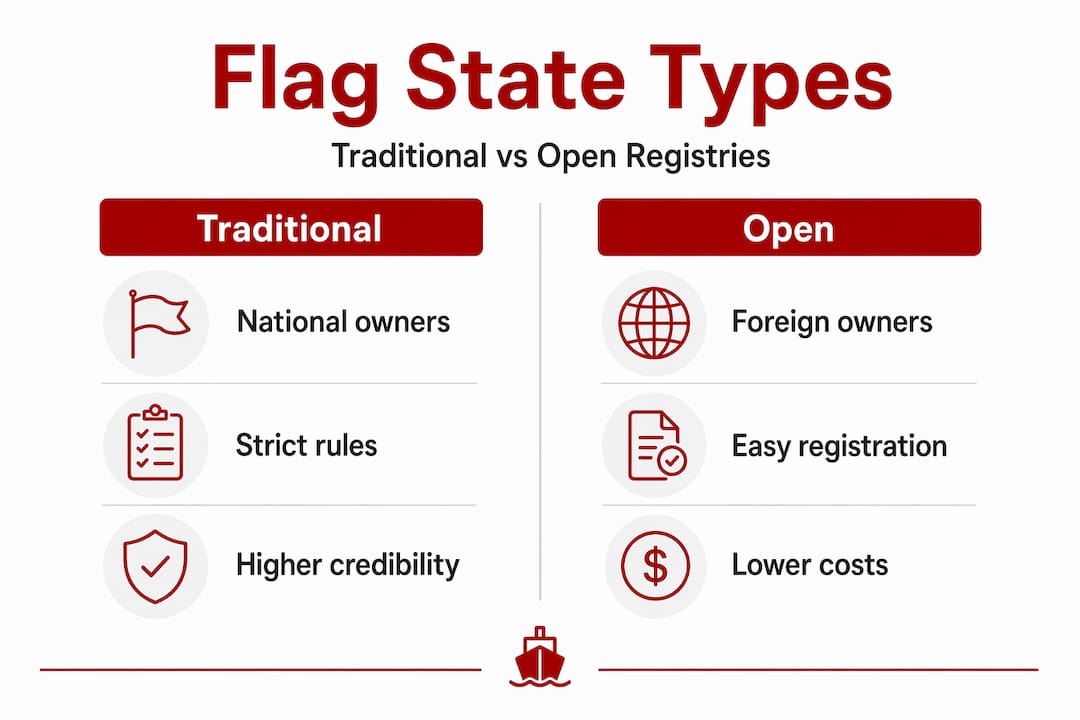
Traditional registries, often called closed registries, restrict registration to vessels owned by nationals of that country. Open registries, sometimes called flags of convenience, allow foreign owners to register their vessels under that state’s flag, typically offering lower costs and fewer regulatory barriers.
Open registries control over half of world tonnage and are widely used for their economic advantages. But they vary enormously in the rigor and credibility of their oversight. Some open registries have built genuinely strong compliance records. Others have not, and carrying their flag creates friction everywhere from insurance negotiations to port inspections.
Commercial and operational impact of your flag choice
The flag state advantages that matter most to working operators are not found in registration paperwork. They show up in real operations: how often you get stopped at port, whether charterers will book your vessel, and what rate your lender offers on a loan.

Port state control is the mechanism that makes flag reputation financially tangible. The Paris MoU evaluates flag performance based on inspection and detention rates over three years, publishing annual White, Grey, and Black lists. A vessel flying a flag on the White List faces lower inspection frequency and fewer detention risks. One on the Black List attracts targeted inspections. That distinction can mean the difference between a routine port call and a week-long delay with repair costs attached.
The commercial dimension goes further. Flag choice significantly influences the terms available from financial institutions and insurers. Banks assessing vessel financing consider the flag’s regulatory reputation. Underwriters price marine insurance partly on the basis of flag compliance history. Charterers and commercial operators maintain approved flag lists, and a vessel flying an unlisted flag may simply be ineligible for employment regardless of its physical condition.
نصيحة من الخبراء: Before registering, ask your intended insurer and any likely charterers whether your preferred flag appears on their approved list. This one check can save months of administrative remediation later.
Sanctions exposure adds another layer. Certain flags face enhanced due diligence and potential de-registration risk due to geopolitical concerns. If your vessel trades in regions with complex sanctions environments, your flag’s political relationships and regulatory standing become a direct operational variable, not an abstract concern.
Key commercial factors affected by your flag choice include:
- Port access and inspection frequency under PSC regimes (Paris MoU, Tokyo MoU, and others)
- Chartering eligibility based on counterparties’ approved flag lists
- Insurance premiums and coverage scope
- Financing rates and lender acceptance criteria
- Sanctions screening exposure and reputational scrutiny
Comparing flag state types: what works for whom
The decision between flag state types is rarely about picking the best flag in the abstract. It is about identifying the best fit for your specific ownership structure, trading routes, crew model, and commercial ambitions. Understanding the types of maritime registrations available is the starting point.
| Flag type | Key advantages | Typical drawbacks |
|---|---|---|
| Home country registry | Strong legal certainty; recognized globally | Often restrictive on crew nationality; higher costs |
| Quality open registry | Low costs; flexible crewing; good PSC record | Varies by jurisdiction; requires due diligence |
| Offshore registry | Tax efficiency; operational flexibility | Reputation depends heavily on the specific registry |
| Flags of convenience (low tier) | Lowest fees; minimal regulatory burden | PSC targeting; charterer rejection; insurance friction |
Flags like Malta, UK Part 1, and Palau have built genuine reputations for regulatory credibility while retaining competitive registration costs. Malta, as an EU member state, offers the added benefit of EU recognition for vessels operating in European waters. UK Part 1 registration carries significant weight with British and international charterers and lenders.
The danger zone is cost-only selection. An owner who chooses a flag because it is $500 cheaper per year may find that the flag’s Black List status triggers targeted inspections, that a planned insurer adds a premium surcharge, and that a preferred charterer declines the vessel outright. The math rarely favors the cheap option.
نصيحة من الخبراء: Cross-reference your shortlisted flags against both the Paris MoU and Tokyo MoU performance lists. The same flag’s risk profile can differ significantly between PSC regions depending on where your vessel primarily trades.
How to select a flag state strategically
Flag state selection criteria should flow from a structured analysis, not a quick internet search. The importance of flag states becomes clear when you treat the decision as part of your overall ownership and operational strategy from the start.
Define your vessel’s trading pattern. A vessel operating primarily in European waters faces Paris MoU inspections. One trading in Asia-Pacific operates under Tokyo MoU. Identify which PSC regimes apply and check each candidate flag’s performance record in those regions specifically.
Map your ownership structure. Misalignment between flag choice, ownership setup, and vessel use is one of the most common and costly mistakes in vessel registration. A corporate ownership structure, a trust, and individual ownership may each point to different optimal flags.
Assess compliance demands you can sustain. Some flags require annual audits, ISM certification, or regular flag state inspections. Flag administrations conduct ISM audits and assess shipping companies’ compliance with safety management regulations. An audit-heavy flag is not automatically a bad choice, but you need to know what you are committing to before registering.
Consult your commercial stakeholders. Speak with your insurer, your lender if financing is involved, and any likely charterers before finalizing a flag. Their requirements may narrow your shortlist considerably.
Evaluate the flag administration’s responsiveness. Processing times, certificate renewal speed, and the quality of support from the flag administration matter operationally. A flag that takes three months to issue certificates creates real friction.
For operators managing multiple vessels, a multi-flag strategy may make sense, matching each vessel’s flag to its specific trading route, crew composition, and commercial use. This requires more administrative coordination but can significantly reduce aggregate compliance risk and cost. The vessel registration process for each flag differs, so expert support becomes even more valuable at this scale.
My take on flag state selection
I’ve worked with enough yacht owners and commercial operators to know that flag state decisions go wrong most often when they are treated as one-time administrative tasks. The owner picks a flag, pays the fee, and files it away. Then, two years later, they discover their flag has slipped onto the Paris MoU Grey List, their insurer is asking questions, and a prospective charterer has rejected the vessel before a single negotiation starts.
What I’ve learned is that flag selection is increasingly strategic, influencing legal identity, financing options, and vessel operations in ways owners often don’t anticipate when they first register. The mistake is not usually choosing the wrong flag on purpose. It is failing to ask the right questions before choosing.
The operators I’ve seen get this right share one habit: they treat the flag decision as part of their vessel’s business plan, not an afterthought to it. They ask what markets they want to access, what counterparties they need to satisfy, and what compliance load their operation can realistically support. Then they select accordingly.
There is also a tendency to underestimate how much high-performing flags reduce inspection risk in practice. The operational value of fewer PSC stops, faster port turnaround, and cleaner compliance history compounds over years. It is not glamorous, but it is real money and real time.
— VesselFlag
How Vesselflag helps you choose and register the right flag
Choosing the right flag is only valuable when the registration itself is executed correctly. A poorly filed registration, missing documentation, or misaligned ownership paperwork can undermine even the best flag choice.
Vesselflag provides expert support across the full flag selection and registration process, from helping yacht owners and commercial operators evaluate their options across flags like Malta, UK Part 1, Palau, San Marino, and others, to managing the complete documentation and filing process. Whether you are registering a yacht for the first time or registering a commercial vessel across multiple jurisdictions, Vesselflag’s team brings practical compliance expertise to every registration. The platform also covers ancillary needs including MMSI licensing, vessel insurance, and corporate registration setup. If you want flag state selection handled as the strategic decision it actually is, Vesselflag is built for exactly that.
الأسئلة الشائعة
What does a flag state actually determine for your vessel?
A flag state establishes your vessel’s legal nationality, the regulatory framework it operates under, and the jurisdiction responsible for enforcing safety, crew, and labor standards. It also affects port access, insurance terms, and chartering eligibility.
Why does flag state choice affect insurance and financing?
Insurers and lenders assess flag reputation as a proxy for compliance risk. Flags with strong PSC performance records and credible oversight attract better terms, while flags with poor records signal higher risk and often result in higher premiums or restricted financing.
What is the difference between an open registry and a traditional registry?
Traditional registries limit registration to nationals of that country, while open registries allow foreign owners to register vessels there, typically offering lower costs and greater flexibility. Quality varies widely across open registries, making due diligence critical.
How often should you review your flag state choice?
Flag performance lists update annually, and your vessel’s trading routes or commercial relationships may change. Reviewing your flag choice every one to two years against current PSC data and your operational needs is a sound practice.
Can a vessel be re-flagged if the initial choice no longer fits?
Yes, vessels can be re-flagged, but the process involves administrative coordination, potential gap periods in documentation, and costs. Getting the initial selection right avoids this friction entirely.