

Most yacht registries want to know where the owner can be reached, and many ask you to prove it with a recent utility bill, a bank statement or a residence document that matches your passport. The details depend on the flag. Some registries ask for a personal address document, some ask only for company papers, and a few handle the question through the owner’s declared address alone. This guide explains how the requirement works in practice, what to prepare, and what to do if you live aboard or have no land address.
TL;DR
- Proof of address is a separate item from proof of identity and proof of ownership. Expect to supply all three, in different documents.
- A recent utility bill or bank statement in your name, matching the address on your application, is the safest document to prepare. Not every flag asks for it.
- Companies are usually asked for corporate papers such as a registered office, and the individuals behind them may still need to be identified.
- Live-aboard owners should check the registry’s rules early. Florida, for one, allows a post office box in defined circumstances.
- Documents not in English often need a certified or notarized translation, so budget time for it.
جدول المحتويات
- Why registries ask for an address at all
- Address, identity and ownership are three different checks
- Documents commonly accepted as proof of address
- How requirements differ by flag
- Individual owner or company: what you submit
- What if you live aboard or have no land address
- Translation, certification and notarization
- A preparation checklist before you apply
- Our perspective
- Let us check your documents before you file
- الأسئلة الشائعة
- المصادر
Why registries ask for an address at all
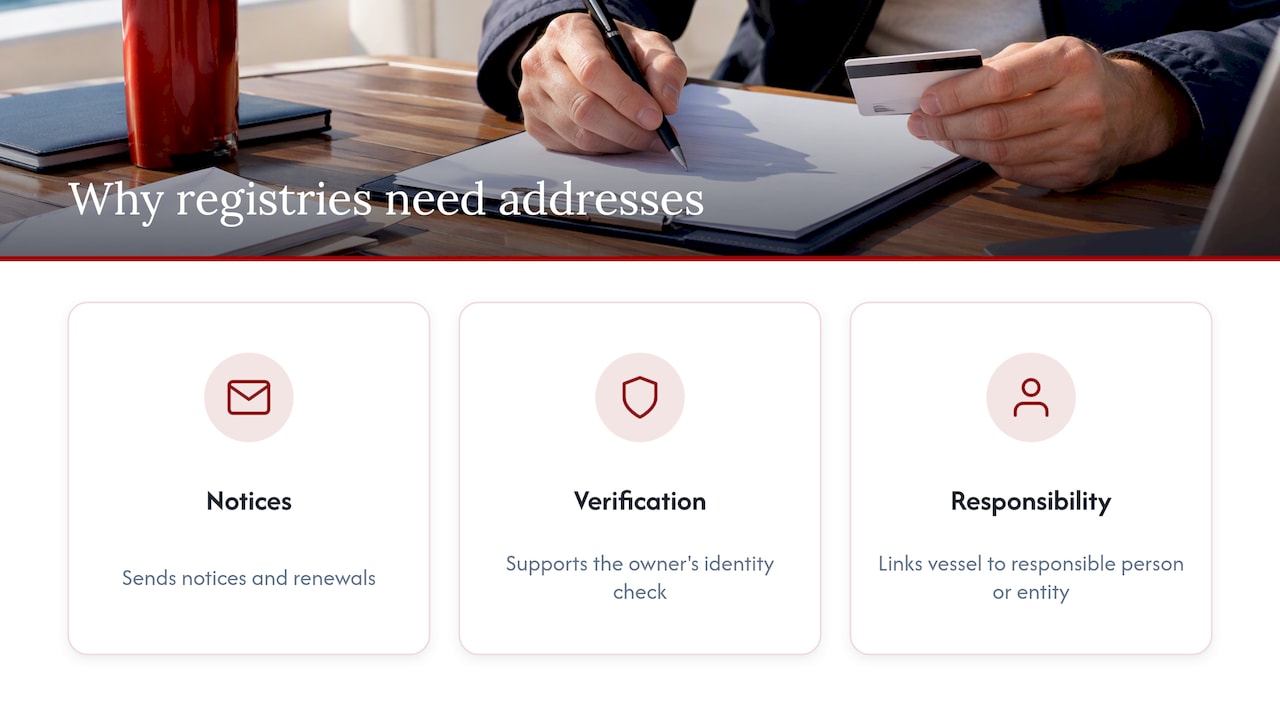
A flag registry is a government function. It issues a Certificate of Registry, and in doing so it needs a reachable, identifiable owner. The address does three jobs: it lets the registry send notices and renewals, it supports the identity check, and it helps the authority link the vessel to a person or entity that can be held responsible.
The International Maritime Organization points the same way. Its guidelines on the registration of ships say flag States should obtain and verify passports or official identification of natural persons, along with beneficial-ownership information where it applies. Address evidence is one piece of that verification picture, and registries apply it in their own way.
The practical effect: a registry cares less about a particular document type than about whether your papers tell one consistent story. Name, address and identity should line up across every page you submit.
Address, identity and ownership are three different checks
Owners often send one document and expect it to cover everything. It rarely does.
| Check | What it answers | Typical documents |
|---|---|---|
| Identity | Who are you? | Passport or national ID card |
| العنوان | Where can you be reached? | Recent utility bill, bank statement, residence certificate |
| Ownership | Does the vessel belong to you? | Bill of sale, builder’s certificate, previous registry deletion certificate |
The UK government’s ship registration privacy notice shows the split clearly. It lists a recent utility bill confirming name and address among the personal identification evidence, and treats proof of vessel ownership as its own category.
So a passport proves who you are but not where you live, and a bill of sale proves the purchase but not who you are. Prepare each one separately.
Documents commonly accepted as proof of address
No single list applies to every flag. Across the registries and compliance processes we see, the same document types come up again and again:
- Utility bill. Gas, electricity, water or a landline or broadband bill showing your name and the service address. Mobile phone bills are often rejected in address checks generally, so do not lead with one. A UK company-formation guide, for instance, notes that a mobile bill is usually not accepted as a utility bill for that purpose.
- Bank or credit card statement. Usually must show your name, address and a recent date. Print the PDF statement in full rather than a screenshot of a banking app.
- Government-issued document. A tax notice, a residence permit, or a certificate of domicile where your country issues one.
- Driver’s license showing your address. Accepted by many processes as a secondary item, though a registry may treat it as identity rather than address.
- Lease or mortgage statement. Useful if you do not hold utilities in your own name.
What “recent” means varies, and many organizations ask for something dated within the last three months. We do not treat that as a universal rule, because registries set their own. Ask for the current requirement before you order a certified copy.
How requirements differ by flag
The wording of the rule changes from registry to registry, and the differences are real.
Registries that ask for personal address documents
Switzerland is a clear example. The Swiss maritime navigation office says applications must include the address, telephone number and email of all owners. Its French-language guidance adds that non-Swiss owners must provide copies of residence or establishment permits and current certificates of domicile, together with passport or ID copies. That is a strict, document-heavy approach to proof of residence.
Registries that focus on ownership and corporate paperwork
The UK Ship Register’s Part 1 pleasure-vessel checklist concentrates on ownership, corporate, survey, deletion and radio documents. It does not list a separate proof-of-address document for this application. It does say that supporting documents not in English require a notarized translation (the UK source spells it “notarised”). Even so, the government’s privacy notice above shows that identification evidence, including a utility bill, may be part of what the authority handles. Treat the checklist as the minimum and have an address document ready in case you are asked.
The United States
US Coast Guard documentation sits under federal rules in 46 CFR Part 67. Section 67.113 requires the owner to designate a managing owner on the application, and deals with the address and the duty to report a change of address. In other words, the address on file is a continuing obligation, not a one-time form field. State registration is a different system with its own residency rules.
If you are a US owner thinking about a foreign flag, our guide to foreign yacht registration for US owners covers what changes.
Individual owner or company: what you submit
The ownership structure changes which address you prove.
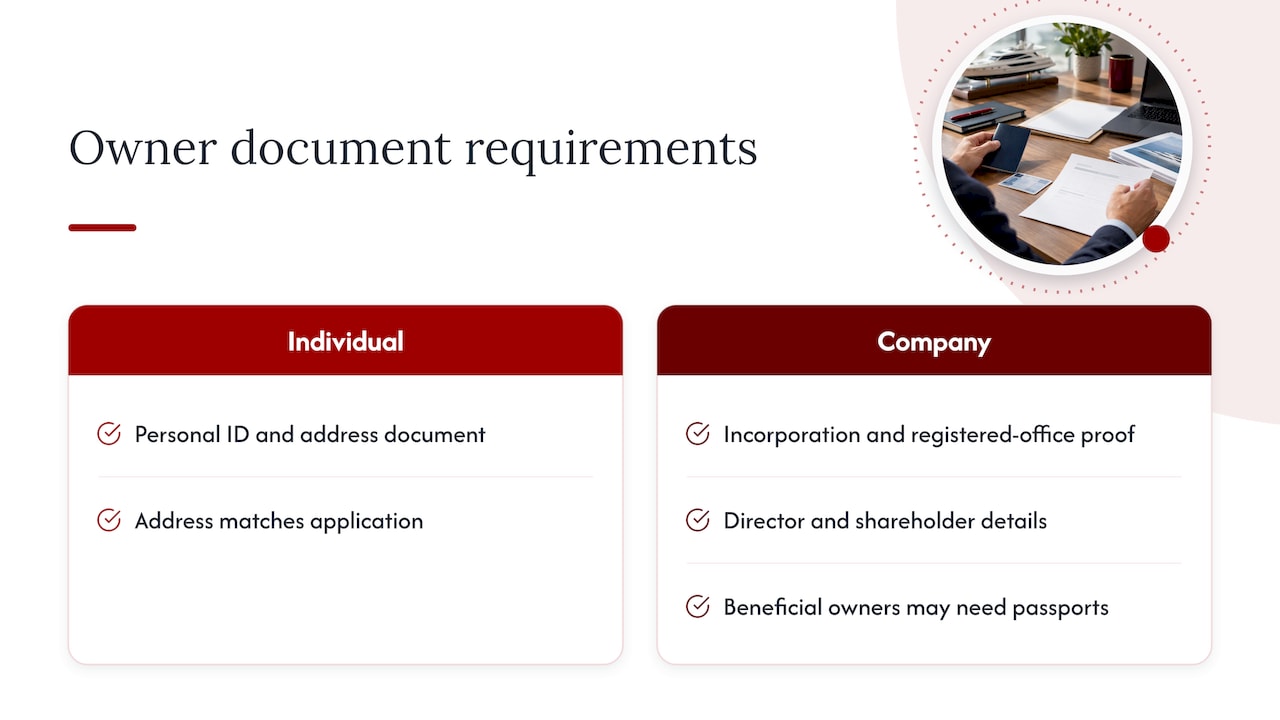
Individual owner. You supply personal identification and a personal address document. The address should match the one on the application and, ideally, on your insurance and bill of sale.
Company owner. The registry normally wants corporate documents: certificate of incorporation, proof of the registered office, and details of directors and shareholders. The IMO’s emphasis on beneficial ownership means the people behind the company may still be identified with passports and sometimes personal address evidence. Company papers often replace the personal bill for the vessel owner on paper, but not the identity checks on the humans involved.
Many owners choose a company because it separates the yacht from personal assets and may suit the intended flag. If you go that route, we can set up a UK LTD. for 349 EUR or a USA LLC for 499 EUR alongside a registration. Whether a company is right for you depends on your use of the yacht, and the line between private and commercial use is explained in our piece on how use, not payment, decides private or commercial registration.
What if you live aboard or have no land address
This is the case that confuses most owners, and the one forums fill up with. Cruisers with a residence card in one country and only a boat to live on ask what to put in the address box.
There is no universal answer, but there are patterns:
- Check whether the rules allow an alternative. Florida law is explicit: under Section 328.48 of the Florida Statutes, the commission may authorize a live-aboard owner whose primary residence is the vessel to provide a post office box address instead of a physical residential or business address. That is a state registration rule, not a flag-state rule, but it shows the logic: a registry may accept a mailing address where the vessel itself is home.
- Use a stable mailing address. A family member’s address, a registered mail-forwarding service or a marina office may work, where the registry accepts it. Be honest about what it is.
- Bring a document that matches. A bank statement or tax document sent to the same mailing address is easier to explain than a bill from a different place.
- Declare it up front. Tell the registry or your agent that you live aboard before you submit, not after a rejection.
Do not invent a residential address, and do not borrow a utility bill that is not yours. A mismatch can stall an application or put the registration at risk later.
Translation, certification and notarization
If your address document is not in English, expect to translate it. The UK Ship Register states that non-English supporting documents require a notarized translation. Other registries have their own language rules, and some want certified rather than notarized copies.
To avoid doing it twice:
- Ask which documents actually need translation. Only the ones the registry will read do.
- Keep the translation attached to a clear copy of the original.
- Make sure names are spelled the same way as in your passport.
Our page on yacht document translation for registration explains what to translate and what to leave alone.
A preparation checklist before you apply
Use this list to avoid the most common delays:
- Passport or national ID, valid and legible.
- One address document dated recently, in your own name, showing the same address as on the application.
- A second address document from a different source, in case the first is rejected.
- Proof of ownership: bill of sale, builder’s certificate and, for a used yacht, the deletion certificate from the previous registry.
- Company documents if a company will own the yacht.
- Translations for any foreign-language items the registry will read.
- A note on any difference, such as a recent move or a live-aboard situation.
The common mistake is not a missing document. It is a mismatch: one spelling of a name on the passport, another on the bill, and a third on the bill of sale.
Our perspective
We work every day with the main registries we cover, and the pattern is consistent. Owners rarely fail because they lack an address. They fail because the address evidence arrives late, in the wrong form, or does not match the rest of the file. A bill that is a few weeks too old, a translation missing, a company address that differs from the one on the bill of sale: each costs days.
The flag matters too. A registry that asks for a personal domicile certificate is a poor fit for an owner who lives aboard and has none, while a registry that works mainly from corporate papers may suit a company-owned yacht far better. We would rather talk through that before you pay for a registration than after a rejection. Choosing the flag around your documents, not the other way round, saves the most time.
This is why we publish the cost and timeline for each flag, and why we ask for the full document set at the start of an order.
— علم السفينة
Let us check your documents before you file
If you are comparing flags, we can tell you which address evidence each one will ask for and prepare the paperwork end to end. Our published one-off fees include UK Part 1 registration from 550 to 1050 EUR, Poland from 320 to 550 EUR, and Malta from 780 to 2420 EUR. Provisional registration typically takes 1 to 7 days once the file is complete.
Bought your yacht abroad? Our guide to the Polish flag for a yacht bought abroad shows how the paperwork flows when the seller and the buyer are in different countries.
الأسئلة الشائعة
Do I always need proof of address to register a yacht?
Not always as a separate document. Some registries, such as the UK Ship Register for Part 1 pleasure vessels, list ownership and corporate papers without a dedicated address item. Others, such as Switzerland, require residence evidence from non-Swiss owners. Ask which applies to your flag before you apply.
Is a utility bill enough as proof of address?
A recent utility bill in your name, showing the address you declare, is the most widely accepted document. It does not replace proof of identity or proof of ownership, which are checked separately. Keep a bank statement as a backup.
What can I use if I live on my boat?
Use a stable mailing address and tell the registry that you live aboard. In Florida, state law lets the commission authorize a post office box for a live-aboard owner. Other registries set their own rules, so confirm before filing.
Does a company owner need a proof of address?
A company usually proves its registered office through corporate documents. The individuals behind it may still need to show identification, in line with beneficial-ownership checks that the IMO guidelines describe.
Do I need to translate my address document?
If the registry reads it and it is not in English, probably yes. The UK Ship Register asks for a notarized translation of non-English supporting documents. Confirm the exact form with the registry or your agent.
المصادر
- Registering a yacht, Swiss Maritime Navigation Office
- Immatriculation d’un yacht, Swiss Maritime Navigation Office
- Pleasure Vessel New Registration (Part 1), UK Ship Register
- Ship registration privacy information notice, GOV.UK
- Guidelines on the Registration of Ships, IMO
- Chapter 328, Section 48, 2026 Florida Statutes
- 46 CFR Part 67, Documentation of Vessels, eCFR
- What counts as acceptable proof of address in the UK?