If you operate a yacht commercially under 24 meters and carry passengers, MCA coding almost certainly applies to you. Start by reviewing the Sport or Pleasure Vessel Code and contacting an authorized Certifying Authority to begin the SCV1 application.
TL;DR:
- The 12 passenger cap excludes the master, working crew, and children under one; vessels at or above 24 meters follow the Large Yacht Code instead.
- New vessels entering service must meet the 2025 Code immediately, while existing certificates transition at renewal or within three years; renewal timing determines applicable clauses.
- The heel test and stability assessment set the permitted area category; check charter routes, equipment, and the skipper’s endorsement against that limit before booking.
- Certificates last five years, but annual inspections check equipment, systems, and vessel condition; missed checks can threaten validity, insurance coverage, and commercial operations.
جدول المحتويات
- What MCA coding is and which yachts it covers
- The 2025 Sport or Pleasure Vessel Code: what changed and the phased rollout
- Core requirements owners must plan for
- Application and survey process: SCV1, SCV2, and the five-year cycle
- Practical preparation checklist from practitioners
- Differences between MCA coding and alternative certification codes for yachts
- Specific insurance requirements or implications linked to MCA coded yachts
- Implications of MCA coding on flag state selection and registration process
- Comparison of MCA coding benefits for both commercial and non-commercial yacht operators
- Typical operational restrictions and implications for chartering MCA coded yachts
- Detailed overview of compliance audits during the certificate validity period
- Owner perspective: balancing commercial opportunity and compliance effort
- How VesselFlag supports your coding readiness
- الأسئلة الشائعة
- Sources
What MCA coding is and which yachts it covers
MCA coding is the certification process that allows a small vessel to operate commercially for sport or pleasure under UK law. The Sport or Pleasure Vessel Code applies to vessels under 24 meters in load line length that carry no cargo and no more than 12 passengers. If your boat sits above that length threshold, you fall into a different regime entirely, covered by the Large Yacht Code instead.
Counting passengers correctly matters because the threshold decides which rules apply to you. Under the Merchant Shipping (Passenger Ship Safety: Small Vessels) Regulations 2023, a passenger excludes the master, crew employed on the business, and children under one year of age, so your working crew does not count toward the 12-passenger limit.
Coding obligations typically get triggered by:
- Running paid charter trips, whether day trips or multi-day cruises
- Offering crewed excursions, fishing trips, or diving expeditions for a fee
- Using the vessel for any commercial operation that carries fare-paying passengers
A yacht used purely for private pleasure, with no payment changing hands, stays outside this framework. The moment money crosses hands for carrying people, coding becomes a legal requirement rather than a choice. For a fuller breakdown of where that line sits, our guide on commercial yacht status walks through the legal criteria in more depth.
The 2025 Sport or Pleasure Vessel Code: what changed and the phased rollout
The regulatory landscape for small commercial vessels shifted substantially at the end of 2025. The 2025 Regulations consolidate a patchwork of older colour codes and MGN 280 guidance into a single Sport or Pleasure Vessel Code, phased in from December 12, 2025.
The rollout does not hit every owner at once:
- New vessels entering service must comply with the new code immediately
- Existing coded vessels transition at their next renewal, or within three years at the latest
- Transitional arrangements allow many existing standards already met to carry over without rework
One practical shift worth knowing: the updated code was written to better accommodate modern propulsion and vessel design, including hybrid and electric systems, while keeping safety expectations central.
If your certificate is coming up for renewal in 2026 or 2027, talk to your Certifying Authority early about which specific new-code clauses will apply at that renewal. The timing of your renewal date, not the calendar year, decides which rulebook governs your next survey.
Core requirements owners must plan for
Every coded yacht gets assigned an area category that defines where it can legally operate, and that assignment flows directly from a stability assessment carried out during survey. Area categories run on a scale covering different operating zones from the most sheltered waters to worldwide, unrestricted service, with appropriate safety equipment and construction standards to match.
Here is roughly how the categories break down in practice:
- Category 6 and 5: unrestricted or near-unrestricted sea areas, demanding the highest stability margins and full safety equipment fits
- Category 4 to 2: progressively more sheltered coastal and estuary waters, with equipment and manning scaled down accordingly
- Category 1 and 0: rivers, canals, and fully sheltered waters, where requirements are lightest
Your stability category allocation, decided during the out-of-water survey and heel test, caps which area category you can be assigned. A yacht that performs well in the stability assessment can often be coded for a wider operating area; one with marginal stability gets restricted to calmer waters regardless of how well-equipped it is otherwise.
Equipment expectations scale with area category and include life rafts or appropriate flotation equipment, fire-fighting gear, navigation lights, VHF radio, and bilge pumping arrangements sized to the vessel. Manning requirements follow a similar logic: skippers need commercial endorsements appropriate to the area category, plus valid medical certificates and, for many categories, sea survival training.
Pro Tip: Match your intended charter area to a realistic stability outcome before you commission any refit work, so you don’t pay for equipment your area category doesn’t require.
For owners running charter operations specifically, our charter yacht coding guide goes deeper into how area category choices affect what you can advertise to clients.
Application and survey process: SCV1, SCV2, and the five-year cycle
The administrative workflow runs on two core forms. SCV1 is the application you submit to start the process, declaring the vessel’s particulars and intended use. SCV2 is the survey report your surveyor completes once the physical inspection is done.
Certifying Authorities carry out that inspection. These are bodies authorized by the MCA, and many owners work with surveyors operating under IIMS or YDSA arrangements, both of which function as MCA-recognized Certifying Authorities for small commercial vessels.
A typical survey sequence includes:
- An out-of-water condition survey examining the hull, through-hull fittings, and underwater gear
- A heel test to establish stability characteristics and confirm the area category
- A review of safety equipment, fire-fighting gear, and navigation systems against the area category assigned
- A list of outstanding works if anything fails, often requiring a second visit before the surveyor signs off
According to IIMS Certifying Authority guidance, an initial coding certificate runs for five years, subject to annual inspections to confirm the vessel remains in compliant condition throughout that period. Fees and exact timelines vary by Certifying Authority and vessel size, so get a quote directly from the surveyor you plan to use. Once your documentation and MMSI details are in order, our guide to yacht documentation requirements covers what paperwork typically needs to accompany the application.
Practical preparation checklist from practitioners
Owners who pass coding surveys on the first attempt tend to do the same handful of things before the surveyor ever steps aboard.
- Haul out early and clean the hull thoroughly. A clean, dry hull lets the surveyor assess condition without guesswork, and proper hull cleaning timing before haul-out avoids wasted yard time.
- Assemble your paper trail in advance. Service logs, stability data, crew certificates, and current insurance documents should all be ready before the surveyor arrives, not chased down afterward.
- Walk the boat yourself against the checklist first. Fire extinguishers in date, navigation lights working, bilge pumps tested: catching these yourself avoids an easily preventable fail.
- Budget time and money for a second visit. Industry guidance from YDSA notes that coding is a holistic process covering construction, machinery, stability, and safety management, not just a box-ticking equipment check, and a re-visit is common enough to plan for rather than treat as a failure.
Pro Tip: Book your haul-out slot and your surveyor’s availability together, since misaligned scheduling is one of the most common reasons coding surveys slip by weeks.
Coordinating early with your chosen Certifying Authority, rather than waiting until the week of survey, consistently shortens the path to a clean certificate.
Differences between MCA coding and alternative certification codes for yachts
MCA coding sits alongside, rather than instead of, other certification pathways, and which one applies depends mainly on vessel length and use. Yachts under 24 meters operating commercially for sport or pleasure fall under the Sport or Pleasure Vessel Code described above. Yachts at or above 24 meters move into the Large Yacht Code framework, which carries more extensive construction, manning, and safety requirements suited to bigger vessels and longer voyages.
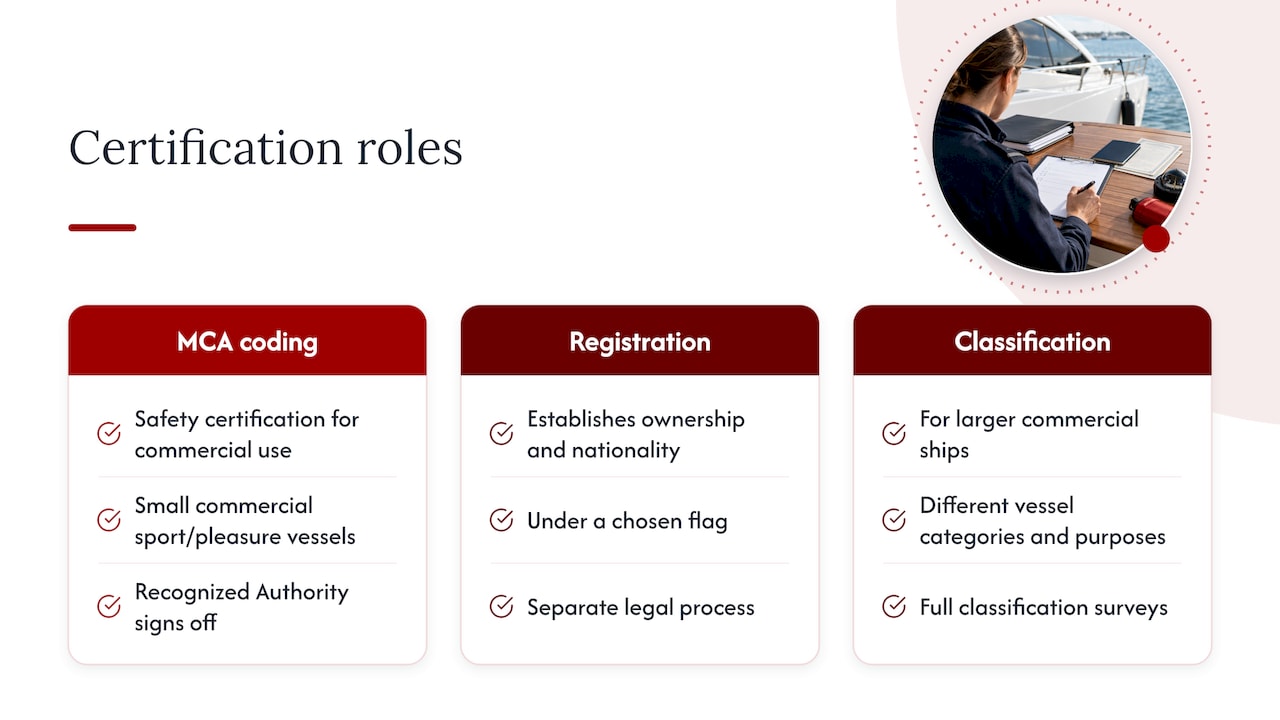
There is also a distinction between coding and flag state registration. Coding is a safety certification confirming the vessel meets construction and equipment standards for commercial use. Registration is a separate legal process establishing ownership and nationality under a chosen flag. A yacht can be registered under one flag and coded under UK rules if it operates commercially from UK waters or under a UK flag, since the code applies to UK vessels wherever they operate and to non-UK vessels operating from UK ports while in UK waters.
Owners sometimes confuse MCA coding with classification society certification used on larger commercial ships, but the two serve different vessel categories and different regulatory purposes. Coding is specifically designed for small commercial vessels under the sport or pleasure definition, with a lighter administrative footprint than full classification surveys, while still requiring a recognized Certifying Authority to sign off on compliance.
Specific insurance requirements or implications linked to MCA coded yachts
Insurers generally treat a coded yacht differently from a purely private pleasure vessel, because coding confirms the boat has passed an independent safety survey against a defined standard. That can work in your favor on premium and underwriting terms, since insurers have documented proof of stability assessment, equipment fit, and construction standard rather than relying on your own representations.
At the same time, commercial use for paying passengers typically requires a commercial or charter-specific insurance policy rather than a standard private pleasure craft policy. A private policy usually excludes commercial activity entirely, so operating coded charter trips on uninsured or incorrectly insured cover leaves you exposed if something goes wrong. Insurers writing commercial marine policies will generally want to see your coding certificate as part of underwriting, since it demonstrates the vessel has met the area category and safety equipment standard relevant to how you intend to operate it.
Getting insurance sorted alongside your coding application, rather than afterward, avoids a gap where your certificate is ready but your cover is not. Our team can liaise on vessel insurance arrangements as part of broader registration support, so coding, registration, and cover move forward together instead of in sequence.
Implications of MCA coding on flag state selection and registration process
The flag you register under and the coding regime you fall under are related but separate decisions, and getting the order right saves time. A UK-flagged vessel operating commercially for sport or pleasure in UK waters needs UK coding regardless of where you cruise afterward. A vessel flagged elsewhere but operating commercially from a UK port also falls under the Sport or Pleasure Vessel Code while it is in UK waters, since the code’s scope extends to non-UK vessels operating from UK ports.
That overlap means your choice of flag does not exempt you from UK coding if your operating pattern touches UK waters commercially. It does, however, affect other things: documentation requirements, tonnage measurement conventions, and which maritime administration handles your ongoing paperwork. Owners weighing UK Part 1 registration against flags like Malta or Poland often find the registration choice comes down to tax treatment, mortgage financing needs, or international recognition rather than coding itself, since coding runs on a separate track tied to where and how the vessel actually operates.
We handle flag registration across multiple jurisdictions, including تسجيل اليخوت في مالطا and تسجيل علم بولندا, and can advise on how your registration choice interacts with your coding obligations before you commit to either.
Comparison of MCA coding benefits for both commercial and non-commercial yacht operators
For commercial operators, coding is the gateway to legally earning money from the vessel. Without a valid certificate, charter, paid excursions, and fare-paying trips are simply not permitted, so coding directly unlocks revenue that an encoded yacht cannot generate.
Non-commercial owners are not legally required to code a purely private pleasure vessel, but some choose to anyway. A yacht surveyed to coding standard carries documented proof of stability assessment and equipment condition that can support a stronger resale position, since a buyer gets independent verification rather than just a seller’s word. It can also ease insurance underwriting even for private use, for the same reason coded vessels tend to get favorable commercial terms.
The tradeoff sits mainly in ongoing cost and administrative effort. Coding brings survey fees, annual inspections, and a five-year renewal cycle that a purely private yacht does not need to carry. For an owner who never intends to charter or carry paying passengers, that ongoing commitment may outweigh the resale or insurance benefit. For anyone planning even occasional commercial use, coding is not optional, so the comparison is less about weighing pros and cons and more about confirming which category your operating plans actually put you in.
Typical operational restrictions and implications for chartering MCA coded yachts
A coding certificate does not grant unlimited commercial freedom. Your area category sets a hard operational boundary: a yacht coded for category 2 coastal waters cannot legally run a category 5 offshore charter, regardless of how capable the boat might seem. Advertising or running trips outside your assigned area category breaches your certificate and exposes you to enforcement action.
Passenger numbers are similarly fixed. Your certificate specifies a maximum passenger count, and that figure cannot be exceeded even informally, since it is tied directly to the safety equipment and evacuation arrangements the vessel was surveyed against. The skipper’s own commercial endorsement also needs to match the area category the vessel is coded for, so a crew change can affect what trips you are legally able to run even if the boat itself has not changed.
Seasonal and route planning benefits from treating these limits as fixed inputs rather than afterthoughts. Owners building a charter brochure or seasonal itinerary should check the coded area category against every route on offer before taking bookings, since a last-minute discovery that a popular trip exceeds the certificate is far costlier than planning around it from the outset. Our charter yacht coding guide covers how to structure a charter program around these restrictions from the start.
Detailed overview of compliance audits during the certificate validity period
A coding certificate is not a one-time pass. The five-year cycle runs alongside annual inspections, confirmed by IIMS Certifying Authority guidance, meaning your Certifying Authority checks the vessel’s condition against the original coding standard at least once a year throughout the certificate’s life.
These annual checks are not a repeat of the full initial survey but a condition audit confirming safety equipment remains in date, fire-fighting gear is serviceable, navigation systems function, and no structural or mechanical deterioration has occurred that would undermine the original stability assessment. Think of it as a maintenance checkpoint rather than a fresh certification exercise.
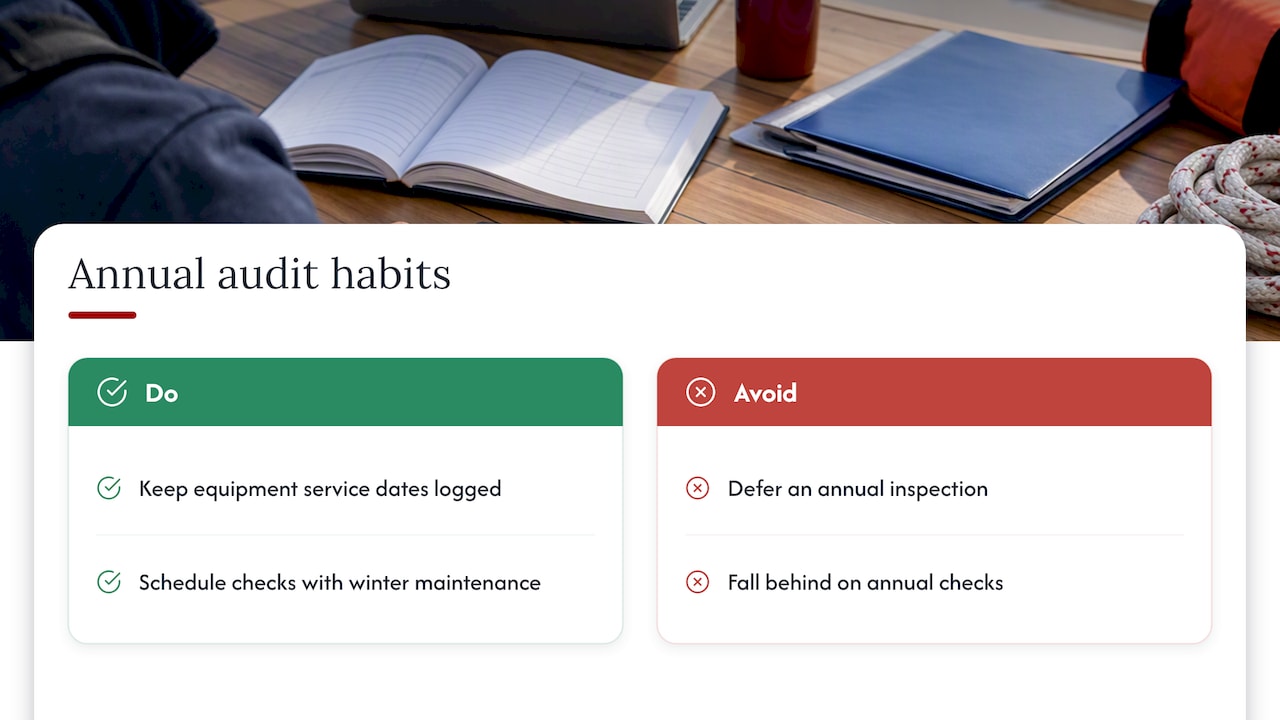
Owners who treat the annual inspection as routine, rather than scrambling each year, tend to fare better. Keeping a running log of equipment service dates, extinguisher recharges, and any repairs carried out between inspections gives the surveyor a clear paper trail and shortens the audit considerably. Falling behind on a single annual check can put the certificate’s validity at risk, which in turn affects insurance cover and your legal ability to continue commercial operations, so this is not an item to defer. Building the annual inspection into your regular haul-out or winter maintenance schedule, rather than treating it as a separate event, is the simplest way to keep the certificate current without extra yard visits.
Owner perspective: balancing commercial opportunity and compliance effort
Coding looks like a cost until you weigh it against what it unlocks. A certificate turns a yacht into an income-generating asset, and the owners who resent the expense most are usually the ones treating survey prep as a one-off scramble rather than folding it into their normal winter haul-out and maintenance routine.
— VesselFlag
How VesselFlag supports your coding readiness
Getting a yacht survey-ready involves more paperwork than most owners expect, and we take on the parts that sit outside the Certifying Authority’s remit. We handle MMSI radio licensing, document preparation, and liaison work that keeps your registration and insurance arrangements moving while your surveyor handles the technical inspection.
Our support around coding readiness typically covers:
- MMSI radio license applications and AIS setup, often needed before a survey can be finalized
- Flag registration across jurisdictions including تسجيل اليخوت في المملكة المتحدة الجزء 1 and تسجيل اليخوت في مالطا
- Insurance liaison to align your commercial cover with your coding timeline
- Document management so paperwork is ready before your surveyor asks for it
If you are preparing a yacht for MCA coding and want the registration and licensing side handled while you focus on the survey itself, start with our UK Part 1 Yacht Registration service and we will take it from there.
الأسئلة الشائعة
What are the different MCA coding categories?
MCA coding assigns vessels an area category from 0 to 6, where category 0 covers the most sheltered inland waters and category 6 covers unrestricted, worldwide service. The category a yacht receives depends on its stability assessment during survey, which also determines the equipment and manning requirements that apply.
What is the 10% rule for yachts?
If you have seen this term used elsewhere, it likely refers to a specific financing, tax, or chartering convention rather than a coding requirement, so check the source carefully before relying on it.
What is the 12 person yacht rule?
The Sport or Pleasure Vessel Code applies to vessels carrying no more than 12 passengers, which is the threshold separating small commercial coding from passenger ship regulations that apply to larger capacities. Crew and children under one year are excluded from that count under the Merchant Shipping (Passenger Ship Safety: Small Vessels) Regulations 2023.
What certification do you need to work on a yacht?
Crew working on a coded commercial yacht generally need a commercial endorsement appropriate to the vessel’s area category, along with a valid seafarer medical certificate. Many roles also require sea survival training, with the exact requirements scaling to the area category the vessel is coded for.
How long does an MCA coding certificate last?
An initial MCA coding certificate runs for five years, but it is not a “set and forget” document: annual inspections by your Certifying Authority confirm the vessel remains compliant throughout that period. Missing an annual check can put the certificate’s validity at risk.