
A yacht tonnage certificate documents a measured gross and net tonnage used for registration and regulatory compliance. Owners of yachts subject to the ITC 1969 framework, commonly those 24 meters and over, must hold an International Tonnage Certificate or an approved national equivalent to register, pay fees, and pass inspections.
TL;DR:
- Commercial yachts under 24 meters may still require a full International Tonnage Certificate, while private yachts often use national documents whose rules vary by flag.
- Under ITC 1969, net tonnage cannot fall below 30% of gross tonnage; both measure volume, not vessel weight.
- Before booking, gather builder plans, previous certificates, and modification records; the surveyor measures enclosed spaces and supplies calculations, a report, and photographs.
- Structural alterations, flag changes, or hull extensions generally require cancellation and reissue, while minor changes may be recorded as annotations on the existing certificate.
جدول المحتويات
- What a tonnage certificate is: ITC 1969 and national variants
- Who needs a tonnage certificate and when
- How gross and net tonnage get calculated
- What happens during a tonnage survey
- Who issues the certificate and what comes after
- Timing and cost drivers for a tonnage survey
- Special cases: novel designs and yachts under 24 meters
- How the certificate supports registration and compliance
- A registration specialist’s take on staying audit ready
- How we help with tonnage measurement and registration
- الأسئلة الشائعة
- Sources
What a tonnage certificate is: ITC 1969 and national variants
Gross tonnage (GT) and net tonnage (NT) are volume measures, not weight figures, and they drive manning rules, safety requirements, and port fees under the International Convention on Tonnage Measurement of Ships. Yachts over the convention’s threshold need a full International Tonnage Certificate, while many smaller craft fall under simplified national tonnage documents instead.
- GT and NT are calculated independently, each following its own formula.
- The International Tonnage Certificate is issued by the flag Administration or by an organization it authorizes to act on its behalf.
- National equivalents exist for yachts that fall outside ITC 1969 scope, with requirements varying by flag.
Who actually stamps the certificate matters for timelines. Some flags handle measurement in house, while others delegate to a Recognized Organization working under the Administration’s authority.
Who needs a tonnage certificate and when
Length alone does not settle the question, since commercial use, flag rules, and trade patterns all factor into whether a yacht needs a full ITC or a simpler document.
- Yachts of 24 meters and above are the group most consistently captured by ITC 1969, though exact thresholds and interpretations vary by flag.
- Commercial yachts, even under 24 meters, sometimes need a full International Tonnage Certificate if they carry passengers or engage in trade.
- Private yachts under the threshold often qualify for a simplified national tonnage document, but owners should confirm this with their chosen registry before assuming it applies.
- Sailing or operating without the certificate required by your flag can delay registration, trigger inspection holds, or invalidate insurance claims tied to vessel particulars.
Our guide to commercial yacht status breaks down how that classification changes documentation needs beyond tonnage alone.
How gross and net tonnage get calculated
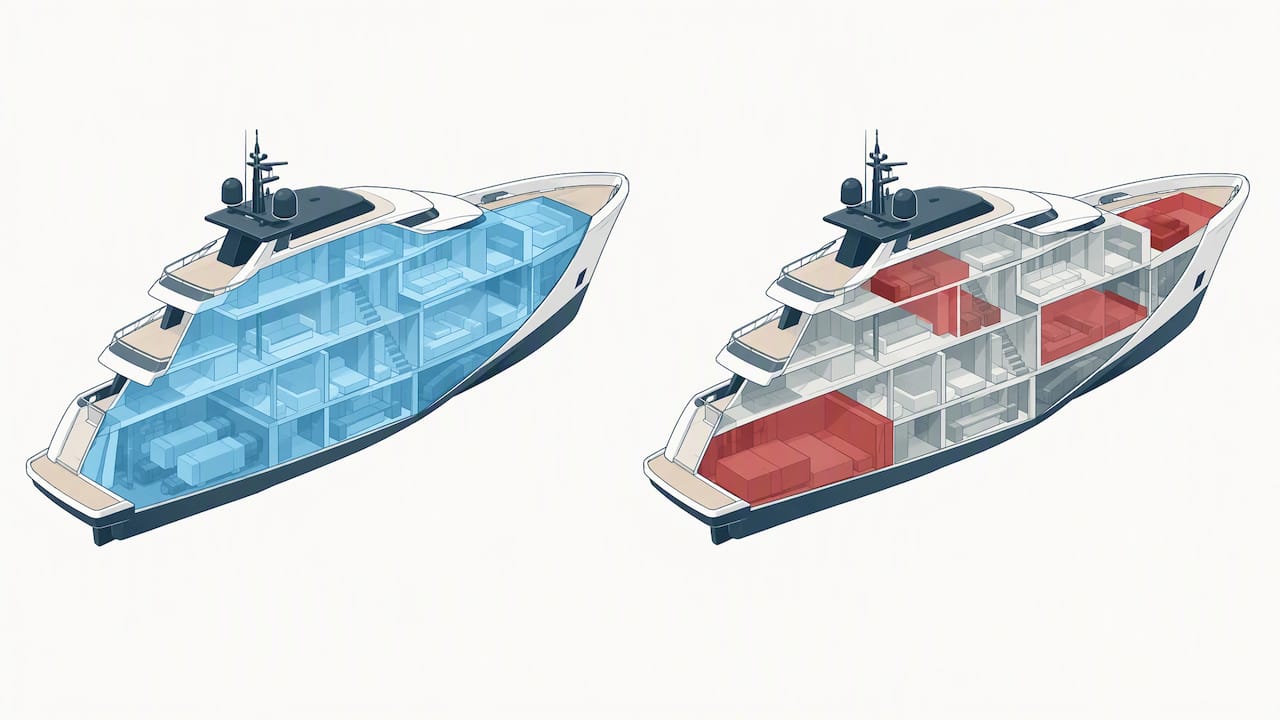
Gross tonnage is based on the moulded volume of all enclosed spaces aboard, while net tonnage reflects the volume of spaces used for cargo or passengers under the ITC 1969 formula referenced in 46 CFR § 69.69. Neither figure describes how much the yacht weighs or displaces in water.
Net tonnage can never be less than 30% of gross tonnage under ITC 1969 rules. That floor protects against measurement methods that would otherwise understate a vessel’s regulatory footprint.
- GT scales with enclosed volume, so adding a flybridge or enclosing a cockpit can raise it.
- NT scales with usable cargo or passenger space, subject to the 30% minimum against GT.
- Neither figure is interchangeable with displacement tonnage used for weight or load calculations.
Our breakdown of gross tonnage versus displacement walks through why owners sometimes confuse the two when budgeting for registration fees.
What happens during a tonnage survey
A tonnage survey is a structured process, not a quick walkthrough, and skipping preparation tends to add delay rather than save time.
- Gather documents first. Builder’s plans, offsets, prior tonnage certificates, and any structural modification records should be ready before the surveyor arrives.
- Expect a full onboard inspection. The surveyor measures enclosed spaces, notes exclusions such as certain open deck areas, and photographs layout details that affect the calculation.
- Review the deliverables. You receive calculation sheets, a written report, supporting photographs, and the documentation needed to apply for the certificate itself, following the deliverables described in UK tonnage survey guidance.
Pro Tip: Keep a folder of every structural drawing and prior survey report together; a surveyor who can review history quickly often finishes the onboard measurement faster.
Our documentation checklist for 2026 lists the paperwork owners typically assemble before a survey date is even booked.
Who issues the certificate and what comes after
The flag Administration either issues the International Tonnage Certificate directly or authorizes a Recognized Organization to measure the vessel and issue it on the Administration’s behalf, though the Administration retains ultimate responsibility for its accuracy, as the tonnage convention text describes.
- A finished certificate typically shows GT, NT, principal dimensions, and the measurement method applied.
- Annotations can record later changes without requiring a full reissue in minor cases.
- A structural alteration, a change of flag, or an extension to the hull generally requires the old certificate to be canceled and a new one issued.
Timing and cost drivers for a tonnage survey
Costs and timelines shift with vessel complexity, how far a surveyor has to travel, and how quickly the chosen flag Administration processes paperwork.
- A straightforward yacht with no recent modifications usually moves through survey and certification faster than one with custom layouts or added enclosed spaces.
- Preparation, the onboard survey itself, and certificate issuance each add distinct time, so total turnaround depends on how organized your documents are going in.
- Request an itemized estimate from your flag agent or Recognized Organization before booking, since travel fees and rush processing can swing the total significantly.
Special cases: novel designs and yachts under 24 meters
Not every yacht fits neatly into standard measurement tables. For genuinely novel hull or superstructure designs, Administrations can apply discretionary methods under what is commonly referenced as ITC Regulation 1.3, which means two similar-looking yachts under different flags can end up with different official tonnages.
- Yachts under 24 meters are frequently measured under national schedules rather than the full convention, and those schedules are not identical across flags.
- Malta’s measurement guidelines note that interpretations of enclosed versus excluded spaces can vary, which is exactly where disputes tend to start.
- When a measurement question has no clear answer in the schedule, the Administration itself provides the final interpretation.
Owners should treat yard “as-built” tonnage figures as provisional. Only a certificate from an Administration-recognized survey carries legal weight.
Consulting your flag early, before committing to a survey date, avoids the surprise of discovering mid-process that your design needs special handling.
How the certificate supports registration and compliance
Your tonnage figures feed directly into the registry record, manning requirements, and the fee schedule your flag applies, so an error here can ripple into other paperwork later.
- File the finished certificate with your registry as part of the permanent vessel record.
- Notify your insurer of the confirmed GT and NT, since policies are often written against these figures.
- Keep the surveyor’s report and calculation sheets on file for any future transfer, flag change, or insurance review.
When owners engage a registration service, coordination of the survey timeline alongside the paperwork is recommended, so the certificate lands in the registry file without a separate round of chasing documents. Our registration process guide covers what comes next once the certificate is in hand.
A registration specialist’s take on staying audit ready
Builder paperwork is a starting point, never a substitute for a certified survey; Administrations do not accept yard figures as official. Track every layout change, however minor, because an enclosed cockpit or added deckhouse can shift your gross tonnage enough to require re-measurement. Organized records from day one make a future ownership transfer or flag change considerably faster to process.
— VesselFlag
How we help with tonnage measurement and registration
Coordinating a tonnage survey alongside flag paperwork is where delays usually creep in, and that coordination is exactly what we handle for owners registering under سان مارينو, مالطا, UK Part 1, and several other flags.
For owners planning ahead, pairing a tonnage survey with tide and port planning tools like Nausika’s secondary port worksheet can help schedule the onboard inspection around workable weather and access windows.
- Survey coordination is arranged alongside registration filing, so the certificate and the flag application move together rather than in separate tracks.
- Supporting paperwork can include company setup where ownership structures require it and MMSI licensing once registration completes.
Request a checklist and a timeline quote for your chosen flag to understand what the survey and registration steps look like for your specific yacht.
الأسئلة الشائعة
What is the 10% rule for yachts?
There is no universal rule in tonnage measurement; the figure owners usually mean is the 30% minimum net tonnage rule, which sets NT at no less than 30% of GT under ITC 1969. Confirm which rule applies with your flag Administration rather than assuming a percentage from another context carries over.
How do I get my boat yacht certified?
Certification starts with confirming whether your flag requires a full International Tonnage Certificate or a national equivalent, then booking a surveyor to measure enclosed spaces and produce calculation sheets. The surveyor’s report feeds into the certificate application, which the Administration or its authorized organization then issues.
What does it mean if your boat is yacht certified?
It means an Administration or an authorized Recognized Organization has measured your vessel’s gross and net tonnage and issued documentation confirming those figures for registration and regulatory purposes. That certificate then supports fee calculations, manning requirements, and compliance checks tied to your flag.
What certificates are issued under SOLAS?
SOLAS governs safety equipment, construction, and operational certificates such as the Safety Equipment Certificate and Safety Radio Certificate, which are separate from tonnage documentation. The tonnage certificate itself comes from the International Convention on Tonnage Measurement of Ships, a distinct convention from SOLAS.
Can I dispute or correct a tonnage figure after certification?
Yes, but corrections go through the issuing Administration or Recognized Organization, not through a yard or independent recalculation. If an interpretation dispute arises over enclosed versus excluded spaces, the Administration provides the final ruling, as outlined in Malta’s measurement guidelines.
Sources
- 46 CFR § 69.69 — International Tonnage Convention (ITC 1969) references
- International Convention on Tonnage Measurement of Ships (IMO)
- Part A Chapter 6 — Survey and certification guidance (UK Marine Tech Branch)
- TM Measurement Guidelines for Yachts and Other Types of Vessels (Malta Transport)