

Most yacht and boat registrations under an international flag close somewhere between 24 hours and 12 weeks, and which end of that range you land on comes down almost entirely to paperwork readiness. Fast-track registrations, the ones that finish in a few days, typically require complete owner documentation, pre-delivery statutory certification already in hand, and an agent handling the filing rather than the owner navigating it solo. Standard timelines run longer because they involve a provisional certificate, a flag state or Recognized Organization (RO) survey, and sequential government processing rather than parallel handling.
A few real-world data points frame this well:
- بالاو can issue a provisional Certificate of Registry within 24 hours when documentation is complete.
- سان مارينو issues provisional certificates for three months, with extensions available up to six.
- Final, permanent registration across most flags typically takes 2 to 6 weeks once statutory certificates and deletion paperwork are settled.
الوجبات الرئيسية
Registration timelines depend on document completeness and prior-flag deletion far more than on which flag you choose, and fast-track processing compresses this by running verification steps in parallel instead of in sequence.
| نقطة | التفاصيل |
|---|---|
| Overall range | Registrations typically close between 24 hours (Palau fast-track) and 12 weeks (standard, missing-docs cases). |
| Biggest delay source | Deletion from a prior flag runs 3 to 10 days and often becomes the bottleneck. |
| Final registration window | Most flags issue permanent certificates in 2 to 6 weeks once documents and deletion are confirmed. |
| Speed lever | Running RO surveys, corporate formation, and document legalization concurrently cuts weeks off the total. |
| Vesselflag’s role | Coordinates document pre-checks, RO surveys, and electronic filing in parallel across Malta, San Marino, Palau, UK Part I, Poland, and Langkawi. |
جدول المحتويات
- What Determines How Long Registration Timelines Take?
- How Does the Registration Process Work Step by Step?
- How Long Does Registration Take Under Each Flag?
- How Can You Speed Up Vessel Registration?
- What Documents Do You Need and What Happens After Registration?
- Get Your Vessel Registered Without the Guesswork
- المصادر
- الأسئلة الشائعة
What Determines How Long Registration Timelines Take?
Seven variables decide whether your registration finishes in days or drags into months. Document completeness sits at the top of the list. A missing bill of sale, an unsigned builder’s certificate, or an outdated Continuous Synopsis Record (CSR) can each add a week or more while the registry waits on a resubmission.
Prior flag deletion is the second-biggest lever. If your vessel is currently registered elsewhere, the new flag state usually won’t issue permanent registration until it sees a deletion certificate from the old one, and that step alone commonly runs 3 to 10 days depending on how responsive the outgoing registry is.
Statutory certificates and RO reports matter just as much. Registries lean on Recognized Organizations for tonnage measurement, safety certification, and (where applicable) ISM and ISPS compliance checks. A vessel with current, valid RO paperwork sails through; one that needs a fresh survey adds days to weeks depending on surveyor availability.
Other factors that shift the timeline:
- Vessel age and condition: older vessels often trigger extra inspection requirements before a flag will accept them.
- Ownership structure: registering under a corporate entity instead of a personal name adds a company formation step if one doesn’t already exist.
- Mortgage filings: any financing on the vessel needs to be registered against the new flag, which can run in parallel or add delay if lenders are slow to respond.
- Flag administration workload: some registries process applications faster than others simply due to staffing and volume.
نصيحة من الخبراء: Engage a Recognized Organization and an agent at the same time, not sequentially. Surveys can run while ownership documents and corporate paperwork are still being assembled, which often shaves a week or more off the total calendar time.
How Does the Registration Process Work Step by Step?
Registration moves through five predictable stages, though the calendar time in each one varies by flag and by how prepared the owner is walking in.
- Pre-application and eligibility checks. The registry or agent confirms the vessel qualifies under that flag’s rules, reviews ownership documents, and flags any missing items. This usually takes 1 to 3 days when documents are ready.
- Statutory survey and RO certification. If certificates aren’t current, an RO survey is scheduled. This is the widest-ranging stage, anywhere from same-day (if certificates already exist) to several weeks if a physical survey has to be arranged.
- Provisional registration issuance. Once core documents check out, most flags issue a provisional certificate fast. Palau can do this in 24 hours; other flags typically take 1 to 3 days.
- Deletion from the prior registry, if the vessel was previously flagged elsewhere. This step alone runs 3 to 10 days and is one of the most common bottlenecks in the entire process.
- Final, permanent registration and certificate issuance. With deletion confirmed and statutory certificates in order, permanent registration typically closes in 2 to 6 weeks.
| Stage | Standard Time | Fast-Track Time | Common Dependency |
|---|---|---|---|
| Technical/document review | 1 to 3 days | Same day | Complete, error-free paperwork |
| Statutory survey/RO certification | 1 to 4 weeks | Pre-arranged before filing | RO scheduling and vessel condition |
| Provisional registration | 1 to 3 days | 24 hours (Palau example) | Clean ownership documents |
| Deletion from prior flag | 3 to 10 days | Concurrent with new filing | Prior registry responsiveness |
| Final registration | 2 to 6 weeks | 1 to 2 weeks | All certificates and deletion confirmed |
These bands assume what the industry calls an “owner-ready” file: builder’s certificate, bill of sale, and identity documents already gathered before the application goes in. A “missing-docs” scenario, where the agent is chasing paperwork mid-process, routinely adds two to four weeks on top of every stage above.

How Long Does Registration Take Under Each Flag?
Timelines vary meaningfully by jurisdiction, and the flags Vesselflag works with most often each have their own rhythm.
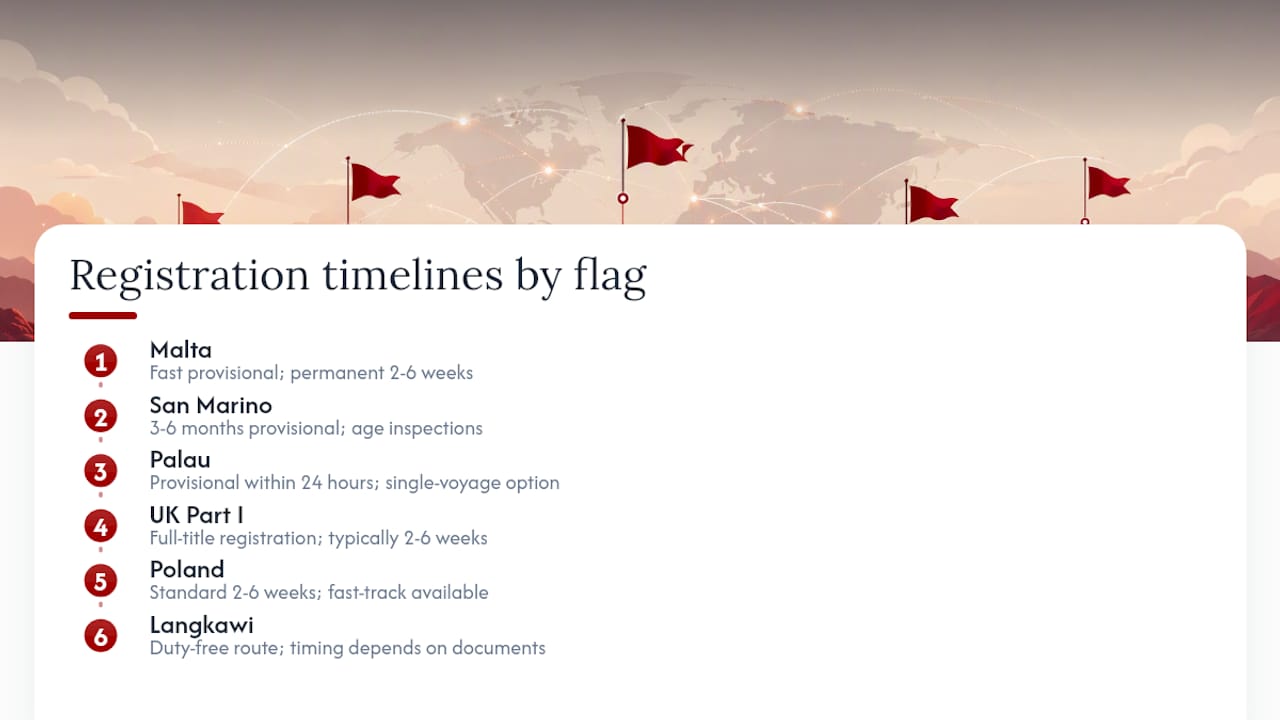
مالطا runs a well-established provisional-to-permanent pipeline. Provisional registration is typically fast once ownership and tonnage documents are confirmed, with permanent registration following within the standard 2 to 6 week window once the vessel’s technical file is complete.
سان مارينو issues provisional certificates for three months, extendable to six, and applies age-based inspection criteria, merchant vessels over 15 years and tankers over 25 years face additional pre-registration scrutiny that can extend the survey stage.
بالاو is one of the fastest fast-track jurisdictions available, with provisional certificates issued within 24 hours when requirements are met, plus flexible single-voyage and laid-up registration options for vessels not yet ready for permanent status.
UK Part I registration suits owners who need full title registration with mortgage recording; it tends to run closer to the standard timeline because of the detail required in the title documentation.
بولندا has become a practical option for European-based owners, generally landing in the standard 2 to 6 week band, with fast-track available when documents and corporate setup (if needed) are ready in advance.
لانكاوي offers a duty-free registration route popular with owners operating in Southeast Asia, with processing speed largely dependent on how quickly ownership and prior-flag documents arrive.
Across all six, expedited processing generally adds a fixed administrative surcharge on top of standard registration fees, plus a possible rush fee if the RO has to prioritize a survey outside its normal queue. Exact figures vary by flag and vessel size, so treat any quoted expedite fee as a starting estimate rather than a fixed number until confirmed for your specific vessel.
How Can You Speed Up Vessel Registration?
Compressing a registration timeline is mostly about sequencing, not luck. Here’s the order that actually saves calendar time:
- Gather the builder’s certificate, bill of sale, and any prior deletion certificate before contacting a registry.
- Confirm your RO statutory certificates are current, or schedule the survey immediately if they aren’t.
- Prepare owner identity and beneficial ownership documents in parallel with the survey, not after it.
- If a corporate structure is needed for ownership, start formation early since this often runs on its own separate clock.
- File mortgage paperwork alongside the registration application rather than waiting for permanent registration to be issued first.
Running surveys, corporate formation, and document legalization at the same time through an agent or RO is the single biggest lever for turning a six-week process into a two-week one.
Watch for these common red flags:
- Incomplete original documents: copies or unsigned pages get bounced back, costing days each round.
- Unresolved mortgages: a lender that hasn’t released a prior lien can stall deletion indefinitely.
- Ownership disputes: any ambiguity in title triggers manual review by the registry.
- Age restrictions: older vessels may need inspection before some flags will accept the application at all.
Expect expedited processing to add an administrative surcharge on top of standard fees, plus a possible RO rush-survey charge if a certificate needs same-week turnaround. Treat these as planning ranges rather than fixed quotes until an agent prices your specific vessel and flag combination.
What Documents Do You Need and What Happens After Registration?
Before you submit anything, assemble this core file:
- Builder’s certificate (or bill of sale for used vessels)
- Deletion certificate from the prior flag, if applicable
- Tonnage certificate or raw measurement data
- Current statutory certificates issued or endorsed by an RO
- Proof of ownership and beneficial owner (UBO) identification
- Proof of payment for registration fees
Vesselflag’s registration checklist walks through each of these in more detail if you want a printable version before you start.
Once your certificate is issued, the work isn’t quite finished. Handle these in order:
- Update MMSI and AIS details tied to the new flag and call sign.
- Confirm insurance and P&I cover reflect the new registration.
- Complete hull marking, carving, and nameplate requirements per the flag’s rules.
- Register any mortgages against the vessel under the new flag.
- Schedule the next periodic survey so certificates don’t lapse.
Tonnage verification and physical marking sometimes require local action, while MMSI updates and insurance confirmation can usually be handled remotely by an agent.
How Vesselflag approaches fast-track processing
Vesselflag runs document pre-checks, RO coordination, and electronic filing in parallel rather than in sequence, which is how fast-track cases avoid the multi-week gaps that come from waiting on one step before starting the next. Supporting flags from Malta to Langkawi alongside MMSI and compliance services means the same team handling your registration can also close out the post-registration tasks. If you’re weighing timelines against your own delivery date, request a timeline estimate before you commit to a flag.
Get Your Vessel Registered Without the Guesswork
You’ve seen how much the timeline depends on document readiness, RO coordination, and which flag you choose, three variables that are hard to manage alone if you’re not doing this regularly. Vesselflag handles all three at once: document pre-checks, RO coordination, mortgage registration, and MMSI/AIS setup run in parallel rather than waiting on each other.
That’s the practical difference between a registration that closes in two weeks and one that drags into month three. If you’re planning a registration under Malta, San Marino, Palau, UK Part I, Poland, or Langkawi, start with a step-by-step registration request and get a timeline specific to your vessel and flag choice before you commit to a filing date.
المصادر
- Shipregistration
- Registration Services | The Palau Ship Registry
- San Marino Maritime Regulation SMMAR – 2025-ADM-005_Rev.01 01 February 2026 San Marino Ship Register SMSR Registration guidelines
الأسئلة الشائعة
How long does yacht registration take under an international flag?
Most registrations close between 24 hours (fast-track jurisdictions like Palau) and 12 weeks for standard cases, with 2 to 6 weeks being typical for permanent registration once documents are in order.
What makes a registration qualify as fast-track?
Fast-track processing usually requires complete owner documentation, current statutory certificates from an RO, and an agent handling parallel filing rather than sequential steps.
Which flag issues provisional certificates the fastest?
Palau can issue a provisional Certificate of Registry within 24 hours when all requirements are met, making it one of the fastest provisional options available.
Does vessel age affect registration timelines?
Yes. Some flags, including San Marino, apply age-based inspection thresholds (15 years for merchant vessels, 25 for tankers) that can add survey time before registration proceeds.
Can Vesselflag help speed up a registration that’s already stalled?
Yes. Vesselflag coordinates RO surveys, document pre-checks, and filing across supported flags like Malta, San Marino, and UK Part I to resolve bottlenecks such as missing deletion certificates or incomplete corporate setup.