
Many vessel owners assume yacht and boat registration are the same process, but this misconception can lead to serious compliance issues and unexpected costs. The truth is that registration requirements differ significantly based on vessel size, purpose, and intended use. Whether you’re a yacht owner navigating international waters or a broker advising clients on flag state options, understanding these distinctions is essential for legal operation and avoiding tax pitfalls. This guide clarifies the key differences between yacht and boat registration, explores how flag state choices impact operations, and provides practical advice for ensuring compliance across jurisdictions.
جدول المحتويات
- Key takeaways
- Defining yachts and boats: legal and practical distinctions
- Legal requirements for yacht versus boat registration
- The impact of flag state choice on registration and operations
- Navigating US state registration and tax considerations for yachts and boats
- Explore Vessel Flag’s expert yacht and boat registration services
- Frequently asked questions
الوجبات الرئيسية
| نقطة | التفاصيل |
|---|---|
| Yacht and boat distinction | Purpose and size determine registration category and the resulting regulatory requirements. |
| Commercial vs private compliance | Commercial yachts require STCW and ISM plus safety and crew standards, whereas private vessels have minimal registration obligations. |
| Flag state impact | Flag state choice affects regulatory obligations, tax treatment, and how the vessel may be operated across jurisdictions. |
| Document primary use | Keeping detailed logs of the vessel’s primary use helps defend registration classification and compliance during inspections. |
Defining yachts and boats: legal and practical distinctions
The maritime industry has no universal yacht size standard, making the distinction between yachts and boats primarily purpose driven rather than strictly dimensional. Generally, yachts are vessels designed for leisure, luxury, or commercial charter operations, while boats serve utility functions like fishing, transportation, or small scale recreation. This classification matters because it directly influences which registration category applies and what compliance obligations follow.
Size often plays a role in practical classification. Vessels exceeding 40 feet in length typically fall into the yacht category, especially when equipped with amenities like cabins, galleys, and sophisticated navigation systems. However, a 35 foot sailing vessel used exclusively for luxury coastal cruising might be considered a yacht, while a 50 foot commercial fishing vessel remains classified as a boat. The intended use determines the legal framework that governs registration.
Key distinctions that affect registration include:
- Operational purpose: leisure versus commercial versus utility
- Onboard accommodations and amenities
- Crew requirements and passenger capacity
- Navigation capabilities and range
- Value and insurance considerations
Understanding these differences helps vessel owners select the appropriate boat registration process from the start. Misclassification can trigger compliance issues, insurance complications, and unexpected tax liabilities down the line. Yacht owners operating vessels for charter must meet commercial standards even if the vessel also serves private use, while purely recreational boat owners face simpler requirements.
Pro Tip: Document your vessel’s primary use with detailed logs and operational records. This evidence becomes critical if authorities question your registration classification or if you need to demonstrate compliance during port inspections.
Legal requirements for yacht versus boat registration
Commercial yachts face stricter rules such as STCW certifications and ISM compliance, while private vessels have minimal requirements. The Standards of Training, Certification, and Watchkeeping for Seafarers (STCW) establishes international qualification standards for crew members on commercial vessels. The International Safety Management (ISM) Code requires documented safety management systems for commercial yacht operations. These frameworks ensure passenger safety and environmental protection but add significant administrative burden.

Private recreational boats typically need only basic registration with their home country or state authority. Owners must prove ownership, pay registration fees, and display registration numbers on the hull. No crew certifications or safety management systems are required unless the vessel carries passengers for hire. This fundamental difference makes private boat registration faster and less expensive than commercial yacht registration.
Compliance requirements that distinguish yacht from boat registration include:
- Crew certification levels and training documentation
- Safety equipment standards and inspection schedules
- Insurance coverage minimums and liability requirements
- Environmental compliance including waste management systems
- Passenger capacity limits and emergency procedures
The classification between private and commercial use carries major tax implications. Commercial yachts may qualify for business expense deductions but face higher registration fees and ongoing compliance costs. Private vessels avoid these operational requirements but cannot claim business related tax benefits. Some owners attempt to register commercial charter yachts as private vessels to reduce costs, but this misclassification creates serious legal exposure.
Flag state authorities conduct periodic inspections to verify compliance with registration classifications. Commercial yachts undergo annual safety inspections covering everything from firefighting equipment to crew qualifications. Private boats rarely face such scrutiny unless involved in an incident. Understanding key yacht compliance requirements helps owners budget accurately for ongoing operational costs beyond initial registration fees.
Pro Tip: If your yacht serves both private and commercial purposes, register it commercially to avoid legal complications. The additional compliance costs are far less expensive than penalties for operating a commercial vessel under private registration.
Maintaining proper documentation becomes essential for yacht registration best practices and avoiding enforcement actions that can ground your vessel indefinitely.
The impact of flag state choice on registration and operations
Selecting where to register your yacht affects far more than paperwork. Flag choice affects insurance rates, port access, and crew nationality, with US flag requiring mostly US crew. Popular yacht registration flags include the Cayman Islands, Malta, Marshall Islands, and British Red Ensign territories, each offering different advantages for owners based on operational needs and tax considerations.
Insurance companies assess risk differently based on flag state regulations and enforcement standards. Vessels registered under flags with strong safety records and rigorous inspection regimes often qualify for lower insurance premiums. Conversely, flags of convenience with minimal oversight may face higher rates or coverage restrictions. Port authorities worldwide also vary in their treatment of different flags, with some nations imposing additional entry requirements or fees on vessels from certain registries.
Crew nationality requirements represent another critical operational factor. US flagged yachts must employ predominantly American crew members, which limits hiring flexibility and typically increases labor costs. Many international flags allow owners to hire crew from any nationality, providing access to a broader talent pool and potentially lower wage structures. However, crew visa requirements vary by flag and can complicate operations in certain regions.
| Flag state | Registration timeline | Crew nationality rules | Tax implications | Insurance impact |
|---|---|---|---|---|
| United States | 4-6 weeks | Primarily US citizens required | US income tax applies | Moderate rates, strong coverage |
| جزر كايمان | 2-3 weeks | No restrictions | No income tax | Competitive rates |
| مالطا | 6-8 weeks | EU preference but flexible | Tonnage tax system | Favorable rates |
| جزر مارشال | 1-2 weeks | No restrictions | No income tax | Variable by insurer |
| British Red Ensign | 3-4 weeks | No restrictions | UK tax may apply | Generally favorable |
Tax obligations tied to flag state registration vary dramatically. Some flags impose annual tonnage taxes based on vessel size, while others levy income taxes on charter revenues or require corporate registration with associated fees. Understanding these financial implications before selecting a flag prevents costly surprises and enables accurate operational budgeting.
Pro Tip: Match your flag choice to your cruising plans. If you’ll spend most of your time in Caribbean waters, a Cayman Islands or British Virgin Islands flag simplifies port clearances and reduces bureaucracy. For Mediterranean cruising, Malta or Cyprus flags offer similar advantages.
إن boat flag selection guide helps owners evaluate options systematically based on operational priorities, budget constraints, and long term cruising plans.
Navigating US state registration and tax considerations for yachts and boats
Documented yachts may still require state registration for tax purposes in states like Florida and California. US Coast Guard documentation provides federal registration for vessels over five net tons used in commercial service or vessels over 26 feet for recreational use. However, this federal documentation does not exempt vessels from state registration requirements in many jurisdictions.
The confusion arises because USCG documentation and state registration serve different purposes. Federal documentation establishes nationality for international waters and provides a clear chain of title for financing purposes. State registration ensures compliance with local tax laws and enables states to track vessels operating in their waters. Some states require both forms of registration simultaneously, while others accept federal documentation alone.
States with the most complex registration requirements include:
- Florida requires documented vessels to obtain a decal even though full state registration is not mandatory, ensuring sales tax compliance.
- California demands state registration for all vessels regardless of federal documentation status, with annual fees based on vessel value.
- New York imposes use tax on vessels kept in state waters more than 90 days per year, requiring careful tracking of time spent in jurisdiction.
- Texas requires title and registration for all motorized vessels, including those with USCG documentation.
- Washington state charges registration fees and requires compliance with local environmental regulations even for federally documented vessels.
To ensure compliance with US state requirements, follow these steps. First, determine your vessel’s primary location and which state claims jurisdiction based on where you keep the vessel and how much time you spend in various waters. Second, research that state’s specific requirements for documented versus undocumented vessels on the state boating authority website. Third, gather required documents including USCG documentation, proof of ownership, and previous registration records. Fourth, calculate applicable taxes including sales tax, use tax, and annual registration fees. Fifth, submit applications and fees before operating in state waters to avoid penalties.
Tax implications extend beyond initial registration. States like Florida aggressively pursue use tax from yacht owners who claim residence elsewhere but keep vessels in Florida waters for extended periods. California’s tax authorities similarly monitor vessel movements to identify tax avoidance. Proper planning and documentation of your vessel’s location and use patterns helps defend against unexpected tax assessments.
Maintaining boat registration compliance globally requires understanding how US state rules interact with international flag state requirements, especially for owners who cruise between domestic and foreign waters.
Explore Vessel Flag’s expert yacht and boat registration services
Navigating the complexities of yacht and boat registration across multiple jurisdictions demands specialized expertise and current knowledge of changing regulations. Vessel Flag simplifies this process by offering comprehensive registration services for international flag states including San Marino, Poland, Malta, Palau, and UK Part 1 registry. Our platform provides transparent timelines, clear cost structures, and expert guidance tailored to your vessel’s specific operational needs.
Whether you need support with initial yacht registration, flag state transfers, or ongoing compliance management, our team handles the details so you can focus on enjoying your vessel. We also provide ancillary services like MMSI licensing, insurance coordination, and corporate registration to create a seamless registration experience. Visit our comprehensive guides on how to register a yacht and learn strategies to ensure yacht registration validity across jurisdictions. For detailed procedural information, explore our boat registration process resources.
Pro Tip: Before committing to a flag state, consult with Vessel Flag’s experts to model the total cost of ownership including registration fees, annual compliance costs, tax implications, and insurance impacts. This analysis often reveals that the cheapest initial registration becomes the most expensive option over time.
Frequently asked questions
What is the main difference between yacht and boat registration?
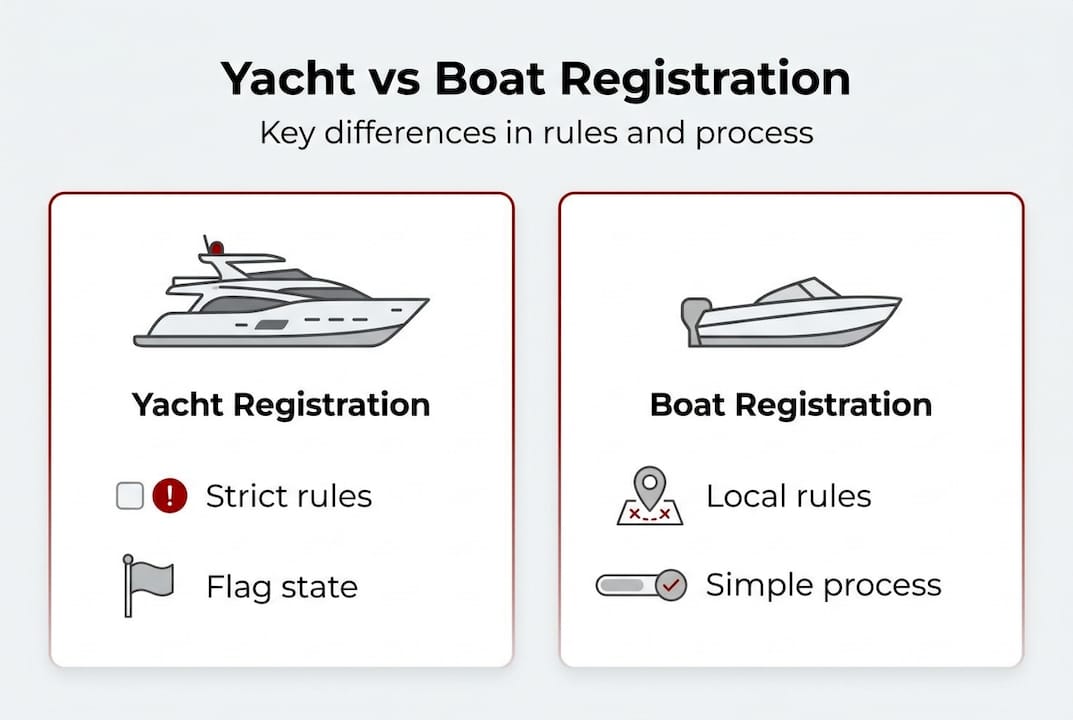
Yacht registration typically involves stricter compliance requirements and international flag state considerations compared to general boat registration. The distinction centers on vessel size, purpose, and whether the vessel operates commercially or privately. Yachts engaged in charter services must meet commercial certification standards, while recreational boats face minimal requirements.
Do all yachts need to be registered under a flag state?
Yes, all yachts must be registered under a flag state for legal operation in international waters. The flag state determines which maritime laws govern the vessel, affects insurance rates and port access rights, and establishes crew nationality requirements. Operating without proper flag state registration exposes owners to legal penalties and port detention.
Can a documented yacht in the US also require state registration?
Yes, some US states require additional registration beyond USCG documentation for tax purposes. States like Florida, California, and New York impose their own registration or decal requirements to ensure sales tax and use tax compliance. Owners should research specific state rules where they plan to operate or store their vessels.
How does commercial use affect yacht registration compared to private use?
Commercial yachts face stricter regulations including STCW crew certifications and ISM safety management compliance. Misclassifying a commercial yacht as private creates serious legal exposure and potential tax penalties. Commercial operations require higher insurance coverage, regular safety inspections, and detailed operational documentation that private recreational vessels avoid.

[…] For owners weighing private-use versus charter registration, the distinction covered in the yacht versus boat registration guide determines which flag jurisdictions and licensing paths actually apply to your entity. If you’re […]