

Securing a yacht registration that balances speed with genuine credibility can feel like a tradeoff for many European yacht owners and brokers. The Malta flag stands out by combining broad eligibility, clear regulatory standards, and genuinely fast processing for both pleasure and commercial vessels. With a framework that welcomes owners of any nationality and delivers international respect, Malta sets itself apart as a trusted solution for those prioritizing operational efficiency and compliance transparency in busy European waters.
جدول المحتويات
- Defining The Malta Flag For Yacht Registration
- Key Benefits: Tax, Reputation, And Flexibility
- Registration Process And Legal Requirements
- Comparing Malta Flag To Other Registries
- Common Pitfalls And Compliance Risks
الوجبات الرئيسية
| نقطة | التفاصيل |
|---|---|
| Malta Offers Flexible Registration | Malta’s yacht registration is accessible and recognized globally, with operational flexibility for both pleasure and commercial vessels. |
| Credibility and Compliance | Malta’s flag complies with International Maritime Organization standards, offering reduced inspections and quicker port clearances. |
| Tax Benefits and Reputation | Registration under the Malta flag provides significant tax advantages and white-listed status, enhancing your vessel’s reputation internationally. |
| Provisional Registration Advantage | The two-week provisional registration allows immediate yacht operation while completing documentation for permanent registration. |
Defining the Malta Flag for Yacht Registration
The Malta flag represents one of Europe’s most accessible and credible options for yacht owners seeking international registration. Unlike some flags that carry operational restrictions or lengthy processing times, Malta offers a straightforward path to register both pleasure and commercial vessels. The registration framework opens doors for yacht owners of any nationality, making it a practical choice for European operators.
Malta’s yacht registration process is recognized worldwide for flexibility and credibility, combining rigorous but straightforward procedures with Malta’s strong maritime tradition. Private yachts over 6 meters can be registered for pleasure use when not carrying passengers for commercial reward. Commercial yachts exceeding 15 meters can carry up to 12 passengers professionally under the Maltese flag.
Who can register under Malta?
- European Union citizens seeking a recognized European flag
- Legally constituted corporate entities of any nationality
- Yacht owners wanting international recognition without complex ownership restrictions
- Operators prioritizing fewer inspections under global Memoranda of Understanding
The eligibility is broad because Malta’s legal framework welcomes international vessel owners. This openness distinguishes Malta from flags requiring local partnerships or restrictive ownership structures.
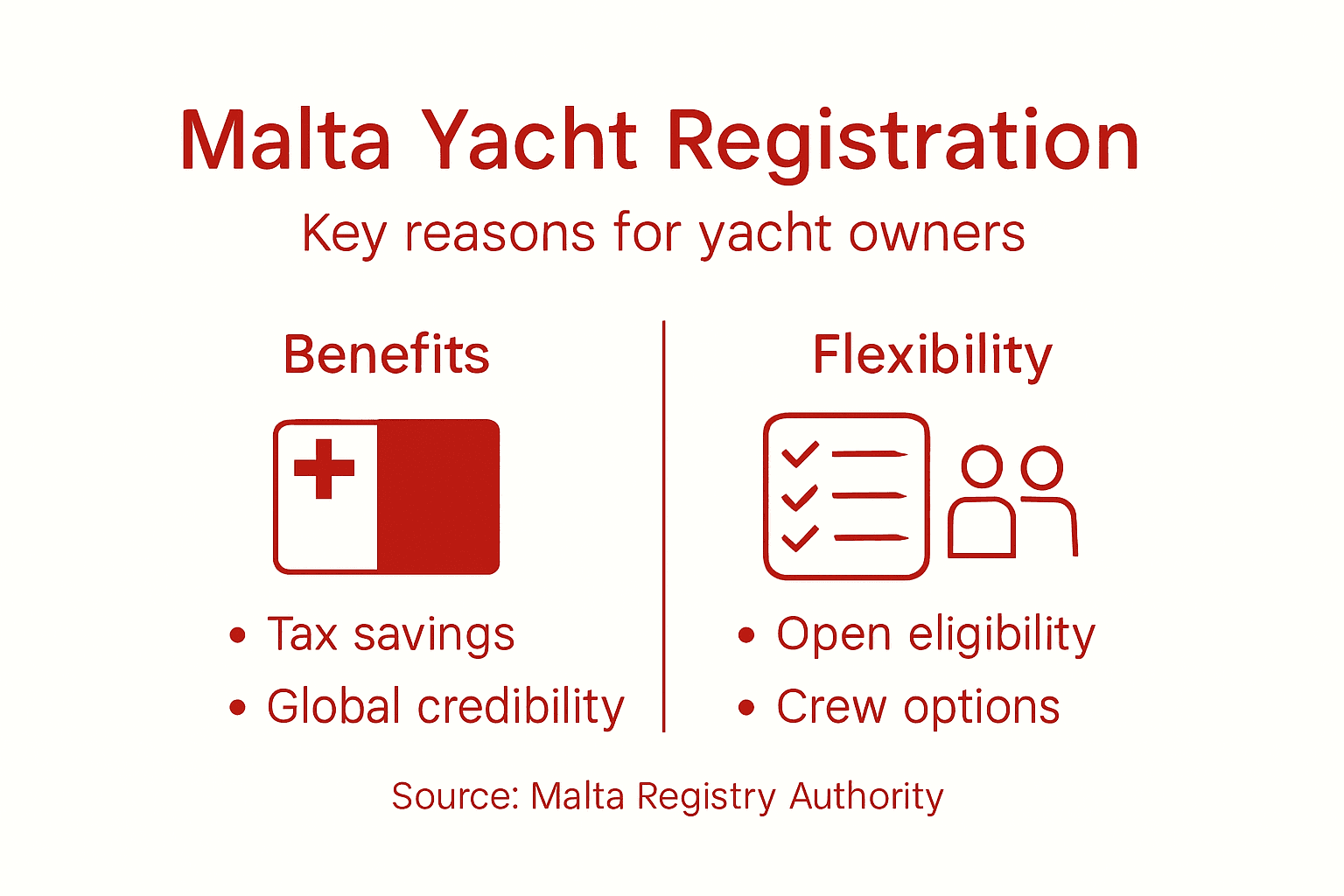
What makes Malta’s registration credible?
Malta participates actively in the International Maritime Organization and maintains strong European Union compliance standards. This dual commitment means your vessel meets standards recognized across international waters. The flag carries less administrative burden compared to registers requiring extensive inspections or documentation reviews.
The registration categories explained
Yacht registration divides into two categories. Pleasure yachts prioritize private enjoyment without commercial income. Commercial registration allows professional passenger operations, charter activities, or crew training under specific guidelines.
The registration process begins with provisional registration lasting six months, with extensions available while you complete required documentation. This structure allows you to operate your vessel immediately while gathering final paperwork.
Malta’s registration combines European credibility with practical flexibility, offering yacht owners a trusted flag that respects operational efficiency.
نصيحة للمحترفين: Determine your registration category before starting—whether pleasure or commercial registration affects your documentation timeline and operational capabilities going forward.
Here’s a comparison of pleasure versus commercial yacht registration in Malta:
| Aspect | Pleasure Registration | التسجيل التجاري |
|---|---|---|
| Primary Purpose | Personal use, no commercial gain | Passenger or charter operations |
| Passenger Limit | Not permitted for hire | Up to 12 paying passengers |
| Crew Requirements | Basic certification | Enhanced qualifications required |
| Regulatory Scrutiny | معتدل | High, with more inspections |
| المزايا الضريبية | Applies to personal use | Commercial incentives, leasing available |
Key Benefits: Tax, Reputation, and Flexibility
Malta’s flag delivers three critical advantages that matter to yacht owners: tax efficiency, global reputation, and operational freedom. These benefits combine to reduce your administrative burden while strengthening your vessel’s standing in international waters. For European operators especially, Malta hits a sweet spot between credibility and practicality.
إن tax incentives under Malta registration are substantial. Tonnage tax systems and leasing structures offer competitive advantages that directly impact your operating costs. This tax efficiency applies whether you operate commercially or maintain your yacht for personal use, making it attractive across different ownership models.
Reputation matters at every port
Malta maintains a white-listed flag status globally, meaning port authorities recognize it as compliant with top international safety standards. This status translates into fewer inspections, faster port clearances, and smoother interactions with coastal states. When your yacht carries a Malta flag, you’re signaling compliance before you even arrive.
- Recognized internationally across all major maritime routes
- Compliant with international maritime conventions and safety standards
- Fewer bureaucratic delays at ports worldwide
- Easier access to insurance and maritime services
Your vessel avoids the scrutiny that flags with questionable standards face. This credibility reduces friction throughout your sailing season.
Operational flexibility sets Malta apart
Unlike restrictive flags, Malta places no restrictions on ownership nationality or crew composition. You can hire crew from any country without complex paperwork. You can sell or transfer your vessel without permission delays.
This flexibility extends to leasing arrangements and commercial partnerships. Whether you operate independently or structure partnerships, Malta’s framework accommodates your business model.
Comparing the financial reality
Registration costs under Malta are competitive. Efficient administration combined with reasonable tonnage tax rates keeps your annual compliance expenses lower than many alternative flags. When you add the tax incentives, your total cost of ownership improves noticeably.
The geographic placement matters too. Malta’s Mediterranean position means shorter transit times for European-based operators and excellent connectivity to major sailing destinations.
Malta’s reputation opens doors that other flags struggle with, while tax efficiency and operational flexibility reduce your costs and administrative workload simultaneously.
نصيحة للمحترفين: Review your specific tax situation with a maritime accountant before registering—Malta’s tonnage tax benefits differ based on your vessel usage and company structure.
Registration Process and Legal Requirements
Malta’s registration pathway follows a clear structure designed to get your yacht operational quickly while ensuring full legal compliance. The process balances speed with rigor, avoiding the bureaucratic delays you might encounter with other flags. Understanding each phase helps you prepare documentation efficiently and avoid surprises.
Registration begins with provisional status valid for six months. During this window, your yacht operates under the Malta flag while you submit required documentation for permanent conversion. This approach means you can start using your vessel immediately rather than waiting months for final approval.
The provisional registration advantage
Provisional registration solves a real problem: you need to operate your vessel while completing paperwork. Malta acknowledges this reality. Your yacht is fully functional under provisional status, with all associated benefits and international recognition. You simply convert to permanent registration once documentation is complete.
Extensions are available if you need additional time gathering paperwork. This flexibility prevents rushed submissions or missed deadlines derailing your registration.
Documentation and compliance requirements
Vessel surveys and safety code compliance form the legal foundation. Your yacht must meet national and international safety standards appropriate to its size and intended use. Crew certification and vessel documentation must align with Maritime Labour Convention requirements and flag state regulations.
Key documentation includes:
- Proof of ownership and legal title
- Vessel survey and condition certification
- Safety and compliance certificates
- Crew qualifications and maritime documentation
- Insurance coverage meeting international standards
- Prior flag state deletion or deregistration proof
Each document serves a purpose in establishing your yacht’s legal status and operational readiness.
Special considerations for older vessels
Yachts older than 15 years require additional inspections before permanent registration approval. These inspections verify structural integrity and continued compliance with safety codes. Plan extra time for survey scheduling and any remedial work identified.
Older vessels often pass inspection without issues, but the extra scrutiny protects both you and Malta’s reputation. The process is straightforward but does add weeks to your timeline.
Timeline expectations
Provisional registration typically processes within two weeks of application. Permanent conversion depends on documentation completeness and survey scheduling. Most straightforward applications convert within the six-month provisional window without extensions.
Malta’s phased registration approach eliminates the all-or-nothing waiting game—your yacht works for you immediately while paperwork processes in the background.
نصيحة للمحترفين: Gather all documentation before applying for provisional registration—the faster you submit, the sooner Malta can process your permanent conversion without extension requests.
Comparing Malta Flag to Other Registries
Malta ranks among the world’s top ten largest ship registries and holds the top position within the European Union. This scale matters because it reflects trust from thousands of vessel owners worldwide. But size alone doesn’t tell the full story—what distinguishes Malta is how it balances operational benefits with genuine regulatory credibility.
Many international flags trade safety standards for speed and affordability. Malta refuses that compromise. Malta maintains white-listed status under the Paris Memorandum of Understanding, placing it among the most respected flags globally. This credibility directly reduces port inspections and administrative friction throughout your sailing season.
How Malta compares on key metrics
Most competing registries force you to choose between flexibility and reputation. Malta delivers both simultaneously. Consider the real-world differences:
- Ownership restrictions: Malta imposes none; many flags require local ownership stakes or residency
- Crew nationality: Unlimited hiring under Malta; restricted flags require home-country crew percentages
- Tax efficiency: Malta’s tonnage tax system favors younger vessels; many registries offer flat rates with no savings
- Port treatment: White-listed status means fewer inspections; lower-tier flags face routine delays
- Registration costs: Competitive for new yachts; older vessels benefit from Malta’s pricing structure
Other European Union registries exist, but none combine Malta’s owner-friendly policies with its international standing.
The convenience flag problem
“Flags of convenience” exist for a reason—they offer rock-bottom costs and minimal oversight. But that reputation follows your vessel everywhere. Port authorities scrutinize these flags heavily, creating the very delays and inspections you hoped to avoid.
Malta avoids this trap entirely. Solid international credibility and streamlined administration mean your yacht receives favorable treatment at every port. Your flag works for you instead of against you.
Realistic cost comparison
Registration and tonnage taxes under Malta remain competitive, particularly for vessels under ten years old. Older registries often charge flat fees regardless of vessel age. Malta’s tiered approach rewards younger vessels while remaining reasonable for established yachts.
Beyond initial registration, consider the hidden costs. More inspections mean survey expenses and operational downtime. Malta’s reputation eliminates most of these friction points, directly offsetting any modest cost differences.
Malta offers the rare combination of owner-friendly policies, genuine international credibility, and European regulatory compliance—advantages that most other registries cannot simultaneously deliver.
نصيحة للمحترفين: Request quotes from competing registries using your specific vessel specifications—you’ll discover that Malta’s total cost of ownership often beats alternatives when you factor in inspection frequency and administrative efficiency.
Common Pitfalls and Compliance Risks
Malta’s registration process is straightforward, but pitfalls exist for yacht owners who rush or misunderstand requirements. Understanding these risks upfront prevents costly delays, penalties, or operational restrictions. Most problems stem from incomplete preparation rather than complex regulations.
The biggest mistake occurs during provisional registration. Yacht owners submit incomplete documentation hoping to complete it later. Malta allows this approach, but incomplete files directly extend your timeline for permanent conversion. The six-month provisional window disappears quickly when documents trickle in.
Documentation mistakes that delay registration
Incomplete submissions waste weeks. Each missing document requires follow-up requests, which adds processing time. Common omissions include outdated survey certificates, missing crew qualifications, or vague ownership documentation.
Safety and survey compliance requirements vary based on vessel category. Pleasure yachts follow one standard; commercial vessels follow stricter codes. Misunderstanding your category leads to incorrect documentation and compliance failures.
Avoid these common errors:
- Submitting surveys older than the required timeframe
- Providing incomplete crew qualification documentation
- Misidentifying your yacht category (pleasure vs. commercial)
- Delaying environmental or pollution prevention certifications
- Failing to provide proof of previous flag deletion
Category confusion creates real problems
The distinction between private and commercial yachts matters legally and operationally. A yacht registered as pleasure cannot carry paying passengers. A commercial yacht requires additional crew certifications and safety measures.
Yacht owners sometimes misclassify to simplify registration. This creates compliance violations discovered during inspections or port control visits. The correction process forces re-registration and operational disruptions.
Crew qualification oversights
Your crew must hold appropriate certifications matching your yacht’s category and size. International maritime regulations mandate specific qualifications for masters and deck officers. Incomplete crew documentation delays registration and prevents legal operation.
Non-compliance consequences
Failing to meet safety standards or missing compliance deadlines triggers serious consequences. Registration delays extend your provisional period or require restarting the process. Some violations result in operational restrictions, preventing legal sailing until resolved.
Port state control inspections identify non-compliance quickly. A vessel flagged under Malta but not meeting Maltese safety standards faces detention, fines, and reputational damage affecting your flag’s standing.
Compliance failures during provisional registration don’t just delay your paperwork—they create cascading problems affecting your operational timeline and potentially your vessel’s legal status.
نصيحة للمحترفين: Have a maritime legal advisor review your documentation before submitting during provisional registration—catching errors upfront prevents weeks of corrections and extension requests.
To help you avoid registration delays, here’s a summary of common documentation pitfalls:
| Mistake Type | Example | Impact |
|---|---|---|
| Outdated Documents | Surveys expired or incomplete | Delays approval, extension needed |
| Category Errors | Wrongly declared as pleasure | Possible legal violations, fines |
| Missing Crew Proof | Unverified certifications | Registration on hold |
| Incomplete Ownership Proof | Title not clear | Application returned or paused |
Seamless Malta Yacht Registration Starts Here
Registering your yacht under the Malta flag offers unmatched credibility, operational flexibility, and tax benefits as detailed above. Yet navigating provisional registration, compliance documentation, and category distinctions can be overwhelming. Avoid costly delays caused by incomplete paperwork or misunderstood regulations by choosing expert guidance from a trusted partner. موقع VesselFlag.com specializes in simplifying the entire process for yacht owners worldwide aiming to capitalize on Malta’s white-listed status and owner-friendly policies.
Our streamlined service covers everything from initial application to final permanent registration, ensuring your vessel meets all safety certifications while benefiting from Malta’s operational advantages. Need assistance with MMSI licensing or insurance setup? We provide comprehensive support adapting to your yacht’s unique category whether pleasure or commercial. Our deep knowledge of Maltese maritime law lets you sail with confidence and save time on bureaucratic hurdles.
Start your hassle-free Malta flag registration journey now with Flag Registration – Vessel Flag.
Don’t let paperwork slow your sailing plans. Visit موقع VesselFlag.com to discover fast, compliant, and transparent Malta yacht registration services today. Secure your vessel’s future with expert support tailored precisely for your needs.
الأسئلة الشائعة
What are the main advantages of registering a yacht under the Malta flag?
Malta offers three key advantages: tax efficiency, global reputation, and operational flexibility. These benefits reduce administrative burdens and enhance your vessel’s standing in international waters.
Who is eligible to register a yacht under the Malta flag?
Eligibility includes European Union citizens, legally constituted corporate entities of any nationality, and yacht owners seeking international recognition without the complexity of ownership restrictions.
How does the registration process for yachts work in Malta?
The registration process starts with provisional registration, allowing you to operate your yacht while you complete required documentation for permanent registration. Provisional status lasts six months, with the option for extensions.
What are the differences between pleasure and commercial yacht registration in Malta?
Pleasure yachts are for personal use without commercial gain, while commercial registration allows for passenger operations, up to 12 paying passengers, with stricter crew and regulatory requirements.
موصى به
- Yacht Registration Services – Vessel Flag
- 2025 Boat Registration Process – Complete Strategic Guide for Yacht Owners – Vessel Flag
- Gibraltar Flag Registration – Vessel Flag
- Yacht Registration Pain Points: Navigate Global Compliance with Confidence – Vessel Flag
- Cruise Home – Croatia Private Transfers & Tours