

TL;DR:
- Yachts are subject to complex international, flag state, and size-dependent regulations. Choosing the right flag affects compliance costs, legal obligations, and operational flexibility. Staying updated on 2026 rule changes and proper registration processes ensures smooth international operations.
Most yacht owners assume that once you’re on the water, the rules are more or less the same everywhere. They’re not. The regulatory framework governing your vessel shifts dramatically based on your flag state, vessel size, intended use, and where you plan to operate. A 45-meter private yacht flying a Cayman flag faces entirely different obligations than a 30-meter charter vessel registered in Malta. This article breaks down the primary international frameworks, walks you through flag state selection, explains the registration process step by step, and covers the most significant 2026 rule changes so you can stay compliant without losing time or money.
جدول المحتويات
- Understanding the regulatory landscape for yachts
- Choosing the right flag state: Comparison and impact
- The yacht registration process: Steps, documents, and timeframes
- Key compliance thresholds and 2026 rule changes
- A practical perspective: The real-world impact of regulatory choices
- Streamline your yacht registration for global compliance
- Frequently asked questions
الوجبات الرئيسية
| نقطة | التفاصيل |
|---|---|
| Flag state matters | Choosing the right flag can lower costs, improve compliance, and expand operational flexibility. |
| Regulations by type and size | Yacht rules change based on use (private vs commercial) and thresholds like 24m or 500 GT. |
| 2026 rule updates | Stay aware of new IMO requirements, including Polar Code extensions to non-SOLAS yachts. |
| Efficient registration process | Prepare essential documents to streamline registration and avoid costly delays. |
| Expert support advantage | Using professional services helps owners avoid hidden pitfalls and assure global compliance. |
Understanding the regulatory landscape for yachts
The first thing to understand is that no single global authority governs all yachts. Instead, a layered system of international treaties, flag state laws, and class society rules creates the actual compliance picture for any given vessel.
At the international level, two frameworks matter most. SOLAS (Safety of Life at Sea) sets minimum safety standards for vessels, covering everything from fire suppression to life-saving equipment. MARPOL (Marine Pollution) governs environmental obligations, including sewage discharge, garbage management, and fuel emissions. Both are administered by the International Maritime Organization (IMO), but how they apply to your yacht depends heavily on your flag and how your vessel is categorized.
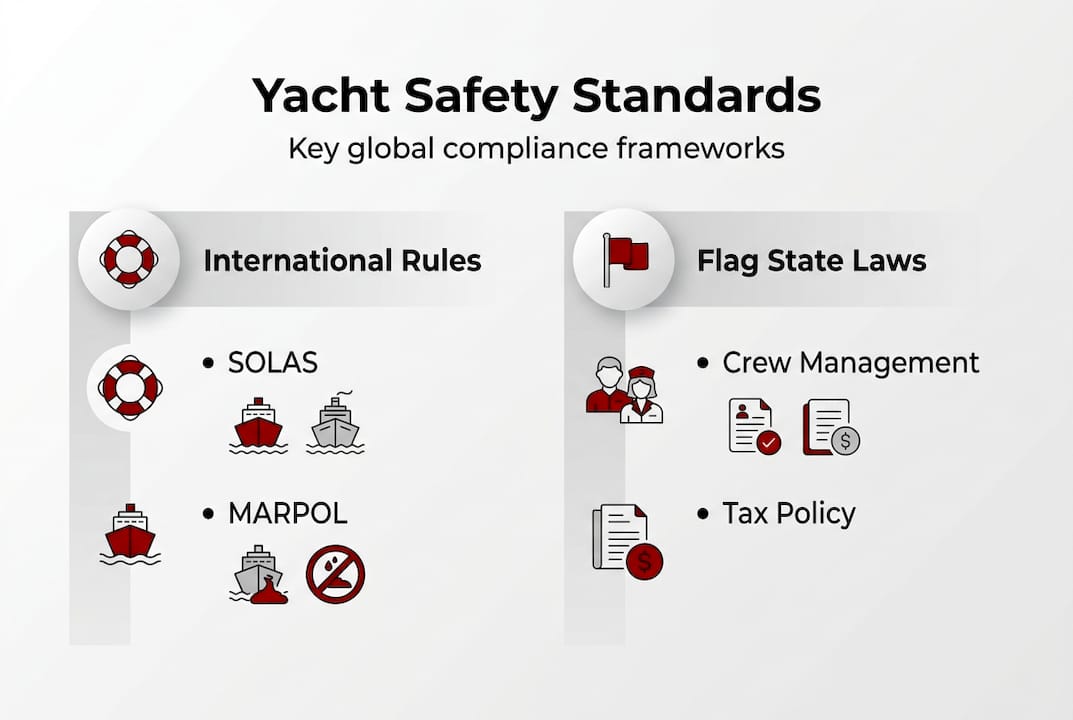
Your flag state is the country where your yacht is registered, and it acts as the primary enforcement authority. Flag states issue your vessel’s certificate, set the specific rules you must follow, and conduct or delegate statutory surveys. This is why flag selection is so consequential. Two yachts of identical size can have radically different compliance burdens depending on which flag they fly.
Yachts generally fall into four categories, each with different regulatory exposure:
- Private pleasure yachts: Used exclusively for personal recreation, not for hire or reward
- Commercial yachts: Operated for profit, including charter, crew training, or paid passenger services
- Superyachts: Typically 24 meters or longer, subject to class society oversight and more rigorous flag state codes
- Small pleasure craft: Under 24 meters, often subject to simplified national rules
The compliance threshold that changes everything is 500 GT. SOLAS applies fully to commercial yachts over 500 GT, while private yachts often comply via equivalence or selected chapters through flag state yacht codes. Below that threshold, most flag states apply their own large yacht codes, which borrow from SOLAS but allow flexibility.
In 2026, the IMO introduced a significant package of new rules. Mandatory amendments now include lost container reporting requirements, safety standards for lifting appliances and anchor winches, oil fuel flashpoint checks, and an extension of the Polar Code to additional vessel categories. These changes affect both private and commercial yachts depending on size and operating area.
As one maritime compliance consultant put it:
“The complexity almost always centers on the intersection of three things: how the vessel is used, its tonnage, and the flag it flies. Change any one of those variables and the entire compliance picture can shift.”
Understanding yacht registration basics before you commit to a flag is essential. Skipping this step is where most owners run into trouble.
Choosing the right flag state: Comparison and impact
With the regulatory landscape defined, your next critical decision is the selection of a flag state, which will determine your specific legal, cost, and operational profile.

Three flags dominate the global superyacht market: Cayman Islands, Marshall Islands, and Malta. Each has a distinct profile. Cayman Islands registration carries prestige and Red Ensign status, with annual costs running roughly $8,000 to $15,000. Marshall Islands offers flexibility and lower costs in the $5,000 to $10,000 range. Malta provides EU membership benefits and is particularly attractive for Mediterranean charter operations, with annual costs between $10,000 and $18,000.
| العلم | Annual cost | Best for | EU access | Charter friendly |
|---|---|---|---|---|
| جزر كايمان | $8,000 to $15,000 | Global ops, prestige | لا يوجد | نعم |
| جزر مارشال | $5,000 to $10,000 | Cost-conscious, flexibility | لا يوجد | نعم |
| مالطا | $10,000 to $18,000 | Med charter, EU ops | نعم | نعم |
Beyond cost, several factors shape the right choice:
- Tax implications: Some flags offer favorable treatment for commercial income; others don’t
- Crew nationality rules: Certain flags require a minimum percentage of nationals on board
- Insurance premiums: Reputable flags on the Paris MOU white list often attract lower premiums
- Charter regulations: EU-flagged vessels have specific VAT and cabotage rules for operating in European waters
- Privacy: Corporate registration structures available under some flags can shield owner identity
Pro Tip: Always verify that your chosen flag appears on the Paris MOU or Tokyo MOU white list. White-listed flags signal to port state control inspectors that your vessel comes from a well-regulated registry, which reduces the frequency and intensity of port inspections globally.
Exploring all flag options for yachts before committing saves you from expensive re-flagging down the road. And if you’re already registered but unsure whether your flag is optimized, reviewing global compliance tips can highlight gaps quickly.
The yacht registration process: Steps, documents, and timeframes
Once you’ve selected the right flag, understanding the exact registration process prevents costly delays and missteps.
The core registration process follows a predictable sequence regardless of flag:
- Confirm vessel eligibility: Verify the vessel meets the flag state’s size, age, and condition requirements
- Gather ownership documentation: Bill of sale, builder’s certificate, or prior registration documents
- Obtain a deletion certificate: If the vessel was previously registered elsewhere, you need proof of cancellation
- Prepare corporate or ownership structure: Many owners register under a holding company for tax and privacy reasons
- Submit technical surveys: Class society certificates or flag-approved survey reports
- Apply for provisional registration: Most flags issue a provisional certificate within days, allowing immediate operation
- Complete full registration: Permanent certificate issued after all documentation is verified
The documents required vary by flag, but the core set is consistent:
| Document | Cayman | جزر مارشال | مالطا |
|---|---|---|---|
| Proof of ownership | Required | Required | Required |
| Deletion certificate | Required | Required | Required |
| Class society certificate | Required (24m+) | Required (24m+) | Required (24m+) |
| Technical survey | Required | Required | Required |
| Corporate structure docs | Optional | Optional | موصى به |
Fast-track provisional registration is available under flags like Marshall Islands, where a provisional certificate can be issued within days once core documents are submitted. This is critical for vessels that need to operate immediately after a sale.
Pro Tip: Registering under a corporate structure, such as a single-purpose holding company, can provide significant tax efficiency and privacy benefits. The flag you choose will determine which jurisdictions are recognized for corporate ownership, so align your legal structure with your flag selection early.
For a detailed breakdown of what each jurisdiction requires, the efficient vessel registration resource covers current 2026 requirements. The global registration process guide walks through each step with jurisdiction-specific notes.
Key compliance thresholds and 2026 rule changes
With registration complete, it’s essential to stay ahead of evolving compliance thresholds, especially as international rules change.
Size and use are the two variables that trigger advanced compliance obligations. Here’s where the key thresholds sit:
- Under 24 meters: Simplified flag state rules; limited SOLAS application; basic safety equipment required
- 24 meters and above: Classification society oversight required for technical rules alongside flag statutory surveys
- 300 GT and above: AIS (Automatic Identification System) and LRIT (Long Range Identification and Tracking) become mandatory
- 500 GT and above: ISM Code (safety management), ISPS Code (security), and MLC (Maritime Labour Convention) apply
- Commercial use at any size: Triggers crew certification, passenger safety, and insurance requirements beyond private yacht standards
The 2026 IMO rule package deserves specific attention. The Polar Code now extends to non-SOLAS pleasure yachts of 300 GT and above, meaning any vessel of that size planning Arctic or Antarctic operations must now meet Polar Code requirements for equipment, training, and voyage planning. This is a significant shift for expedition-style superyachts.
Other 2026 changes include mandatory lost container reporting procedures, updated safety standards for deck machinery including anchor winches and lifting appliances, and revised fuel flashpoint requirements. These aren’t theoretical. Port state control inspectors are actively checking for compliance with these new rules.
Understanding yacht compliance requirements by size category helps you anticipate costs before they become surprises. If you’ve run into compliance issues before, the registration pain points resource addresses the most common problems and how to resolve them.
A practical perspective: The real-world impact of regulatory choices
Here’s something most guides won’t tell you: the flag that looks cheapest on paper often costs the most in practice. A low-cost registry with a poor port state control record can mean your vessel gets detained in a foreign port while competitors sail freely. That detention costs far more than the premium you saved on registration fees.
We’ve also seen owners lose weeks of operational time because of a single missing document, usually the deletion certificate from a prior registry. Registries don’t wait for you to sort out paperwork. They move on, and your vessel sits.
The smarter approach is to treat your flag authority as a long-term partner, not a one-time transaction. Build a direct relationship with your registry contact. Know who handles your file. This matters when you need an emergency certificate extension or a fast turnaround on an amendment.
“Reputable flags reduce insurance premiums and port fees. Cayman and Marshall Islands lead for global operations; Malta is the clear choice for Med and EU charter work.”
The real competitive advantage isn’t just picking the right flag. It’s understanding how your flag, your vessel’s size, and your operating profile interact, and then building a compliance structure that holds up under scrutiny. Review registration best practices to see how experienced operators structure this.
Streamline your yacht registration for global compliance
Navigating international maritime regulations requires more than reading the rules. It requires knowing which rules apply to your specific vessel, flag, and operating profile, and having the right support to execute registration without errors or delays.
موقع VesselFlag.com provides expert-led registration services across multiple flag states, including Malta, Marshall Islands, Cayman, and more. Whether you need a complete yacht registration guide or want to understand the difference in yacht vs boat registration, the platform gives you clear, jurisdiction-specific guidance. For ongoing peace of mind, the registration validity compliance resource helps you stay current as rules evolve through 2026 and beyond.
Frequently asked questions
Which maritime regulations apply to private yachts versus commercial yachts?
Commercial yachts over 500 GT follow SOLAS fully, while private yachts typically comply through flag-specific equivalents or selected SOLAS chapters as defined by their flag state’s large yacht code.
How do I select the best flag state for my yacht?
Evaluate cost, operational area, tax structure, crew requirements, and charter plans. Cayman, Marshall Islands, and Malta are the top three choices, each suited to different operational profiles.
What are the main documents needed to register a yacht?
You’ll typically need proof of ownership, a deletion certificate from the prior registry, a class society certificate for vessels 24 meters and above, and completed technical surveys.
What changed for yacht regulations in 2026?
The IMO introduced mandatory lost container reporting and extended the Polar Code to pleasure yachts over 300 GT, alongside new safety standards for deck machinery and fuel requirements.
موصى به
- Essential yacht compliance tips: global registration guide
- Yacht compliance explained: safe, legal, efficient ops
- Top Challenges in Yacht Registration and Compliance: Navigate Global Regulations with Confidence – Vessel Flag
- Transparent Compliance: The Anchor of Safe, Efficient Yacht Ownership – Vessel Flag