

Securing the right documentation and flag jurisdiction is often the difference between swift yacht registration and months of costly delays. For luxury yacht owners and brokers, every regulatory requirement and international compliance detail matters. This practical guide breaks down each step, from gathering essential documents to verifying full compliance, so you can confidently register your vessel under any preferred flag with minimal hassle and maximum legal security. Proper vessel documentation and registry selection are key foundations for global yachting freedom.
جدول المحتويات
- Step 1: Gather Essential Vessel Documents
- Step 2: Choose The Optimal Flag Jurisdiction
- Step 3: Submit Your Yacht Registration Application
- Step 4: Obtain Mmsi, Ais, And Insurance Certificates
- Step 5: Verify Registration Approval And Compliance
Quick Summary
| Key Point | Explanation |
|---|---|
| 1. Gather all essential documents | Collect key paperwork like the Bill of Sale, HIN, and insurance certificates to ensure smooth yacht registration. |
| 2. Choose the right flag jurisdiction | Select a flag that aligns with your tax needs, regulatory standards, and operational flexibility to maximize benefits. |
| 3. Submit a complete application | Ensure your yacht registration application includes all necessary documents and is accurately completed to avoid delays. |
| 4. Obtain MMSI, AIS, and insurance | Securing your MMSI and AIS documentation and essential marine insurance is critical for regulatory compliance and safety. |
| 5. Verify registration and compliance | Regularly check your registration status and documentation to maintain compliance and avoid legal complications with maritime authorities. |
Step 1: Gather essential vessel documents
Registering your yacht requires collecting a comprehensive set of critical paperwork that establishes your vessel’s legal identity and ownership status. This step is fundamental to ensuring a smooth registration process with maritime authorities.
Your primary documentation package will typically include several key documents that prove your vessel’s legitimacy. International maritime regulations mandate specific proof of ownership and vessel details. Here are the essential documents you’ll need to compile:
- Bill of Sale: The original transfer document showing how you acquired the vessel
- Manufacturer’s Statement of Origin: Factory documentation establishing the yacht’s initial production details
- رقم تعريف بدن السفينة (HIN): Your vessel’s unique identification code
- Proof of Vessel Dimensions: Detailed specifications including length, beam, and tonnage
- Current Insurance Certificates: Verification of marine insurance coverage
When gathering these documents, pay close attention to ensuring all paperwork is current, legible, and matches the physical vessel precisely. Registration requirements can vary by jurisdiction, so verify specific local regulations.
Incomplete or inconsistent documentation can significantly delay your yacht registration process, potentially costing weeks or even months of processing time.
Pro Tip: Create digital and physical backup copies of all essential documents, storing them in separate secure locations to prevent potential loss or damage.
Step 2: Choose the optimal flag jurisdiction
Selecting the right flag jurisdiction is a critical decision that will impact your yacht’s legal status, operational flexibility, and financial considerations. Your choice determines the regulatory environment, tax implications, and international compliance standards that will govern your vessel.
International maritime regulations recognize different registry types, which broadly fall into two categories: closed and open registries. Understanding these options is crucial for making an informed decision:
- Closed Registries: Restrict registration to vessels with direct national ownership or crewing connections
- Open Registries: Allow foreign-owned vessels to register, often providing more operational flexibility
- Flags of Convenience: Jurisdictions with less stringent regulatory requirements
- Traditional Maritime Registries: Countries with established maritime legal frameworks
When evaluating potential flag jurisdictions, consider these key factors:
- Regulatory Standards: Assess the jurisdiction’s commitment to maritime safety
- Tax Implications: Compare tax structures and potential financial benefits
- الاعتراف الدولي: Ensure the flag has widespread maritime credibility
- Administrative Efficiency: Evaluate registration processing speed and complexity
The choice of flag state directly influences your vessel’s legal compliance, operational freedom, and potential financial advantages.
Careful research into maritime law considerations will help you navigate this complex decision, balancing regulatory requirements with your specific operational needs.

Here’s how different flag jurisdictions impact yacht registration:
| Jurisdiction Type | Main Advantage | Common Drawback | الأفضل لـ |
|---|---|---|---|
| Closed Registry | Strong legal protection | Limited flexibility | National vessels |
| Open Registry | Lower operational costs | Less regulatory oversight | International yachts |
| Flag of Convenience | Easy, fast registration | Potential for increased scrutiny | Charter or large fleets |
| Traditional Registry | Established reputation | Stricter requirements | Owners seeking credibility |
Pro Tip: Consult with a maritime legal expert who specializes in international vessel registration to gain personalized insights into the most advantageous flag jurisdiction for your specific yacht and intended use.
Step 3: Submit your yacht registration application
Submitting your yacht registration application is the critical moment that transforms your vessel’s legal status from unregistered to officially recognized. This step requires precision, comprehensive documentation, and careful attention to detail to ensure a smooth processing experience.
Boat registration processes typically involve completing a standardized application form with multiple required components. You’ll need to compile and organize the following key documents:
- Completed Registration Form: Accurately filled out with all vessel details
- Proof of Ownership: Original bill of sale or Manufacturer’s Statement of Origin
- رقم تعريف بدن السفينة (HIN): Official vessel identification documentation
- Vessel Measurements: Precise length, beam, and tonnage specifications
- Ownership Identification: Valid government-issued personal identification
When preparing your application, follow these critical submission steps:
- Review Documentation: Double-check all paperwork for accuracy
- Select Submission Method: Choose online, mail, or in-person submission
- Prepare Payment: Calculate and ready registration fees
- Make Copies: Retain duplicates of all submitted documents
Incomplete or incorrect applications can significantly delay your yacht’s registration, potentially extending processing times by weeks or even months.
Multi-owner registration requirements demand additional attention, especially when multiple individuals share vessel ownership. Ensure all owners sign necessary documentation to prevent potential legal complications.
Pro Tip: Create a digital backup of your entire registration packet, including scanned copies of all original documents, to protect against potential loss or administrative complications.
Step 4: Obtain MMSI, AIS, and insurance certificates
Obtaining your Maritime Mobile Service Identity (MMSI), Automatic Identification System (AIS) documentation, and comprehensive marine insurance are critical steps in establishing your yacht’s legal and safety credentials. These documents not only ensure regulatory compliance but also provide essential protection and communication capabilities for your vessel.
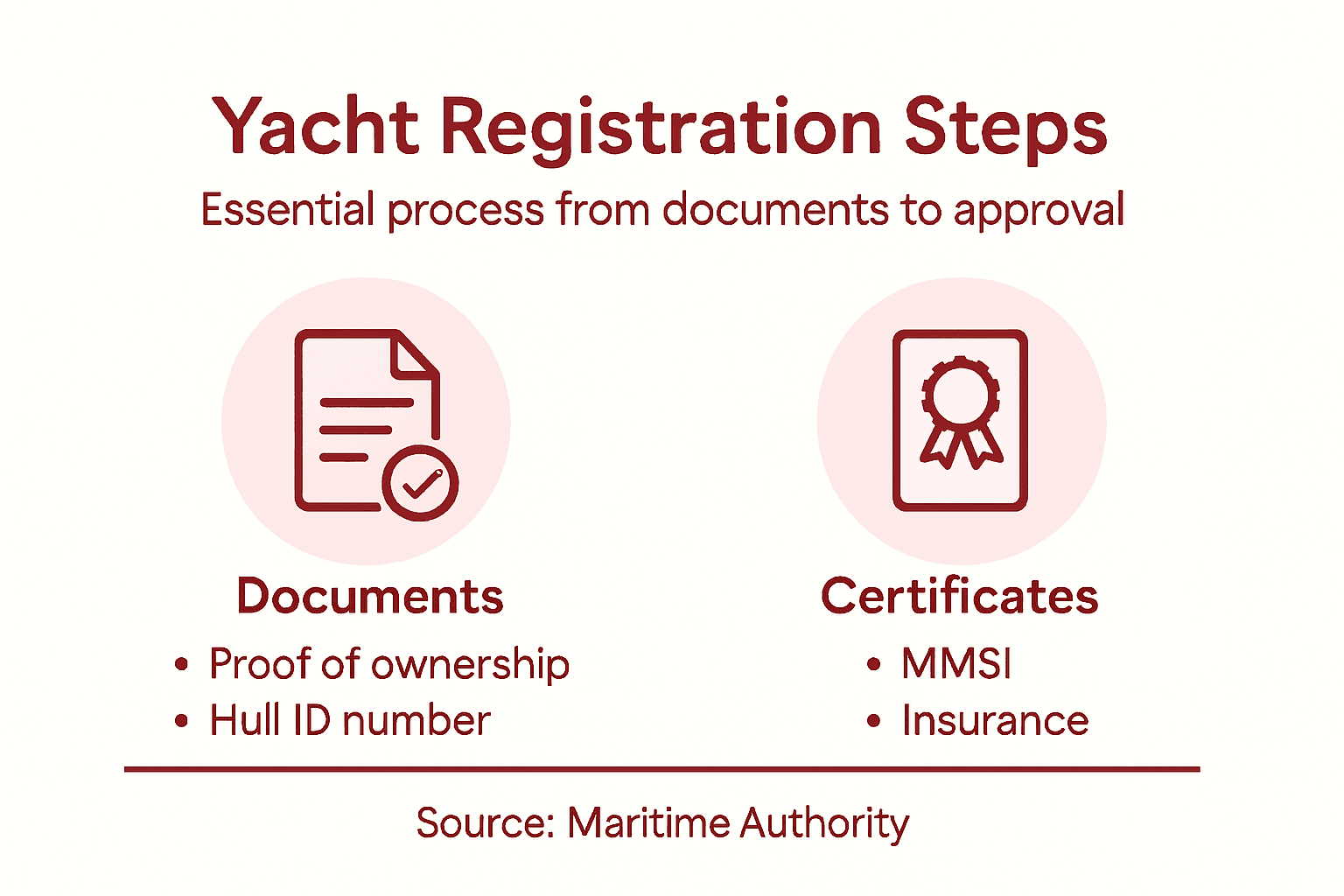
MMSI registration requirements involve obtaining a unique nine-digit number that will be programmed into your vessel’s communication equipment. This identifier is crucial for safety systems, enabling automated distress calls and vessel identification within international maritime networks.
Here are the key documents you’ll need to secure:
- رقم MMSI: Unique nine-digit maritime identification code
- AIS Transponder Certificate: Verification of vessel tracking system
- Marine Insurance Certificate: Comprehensive liability and damage coverage
- Safety Compliance Certificates: Verification of international maritime standards
Follow these systematic steps to complete your documentation:
- Contact FCC: Apply for your MMSI number through official channels
- Install Communication Equipment: Program MMSI into VHF radio and AIS transponder
- Select Marine Insurance Provider: Choose a comprehensive coverage plan
- Schedule Vessel Surveys: Obtain necessary safety certifications
Your MMSI and AIS documentation are not just bureaucratic requirements, but essential safety tools that can save lives in maritime emergencies.
International maritime regulations mandate maintaining up-to-date certificates that demonstrate your vessel’s compliance with global safety and operational standards.
Pro Tip: Keep digital and physical copies of all maritime certificates in multiple secure locations, ensuring quick access during inspections or emergencies.
Step 5: Verify registration approval and compliance
Verifying your yacht’s registration approval and ongoing compliance is the final critical step that ensures your vessel meets all legal and regulatory requirements. This process involves carefully reviewing all documentation and confirming your yacht’s status with the appropriate maritime authorities.
International registration standards mandate a comprehensive verification process that goes beyond simple paperwork submission. Your goal is to establish a genuine link between your vessel and its flag state while demonstrating full compliance with maritime regulations.
Here are the key elements to verify during your compliance review:
- Registration Status: Confirm official approval and documentation
- Flag State Compliance: Validate adherence to international maritime standards
- Safety Certification: Ensure all required safety documents are current
- Insurance Coverage: Verify active and comprehensive marine insurance
- Equipment Certifications: Check all communication and safety equipment credentials
Follow these systematic verification steps:
- Request Official Confirmation: Contact the flag state registry
- Review Documentation: Carefully examine all issued certificates
- Conduct Internal Audit: Cross-reference your documents
- Address Any Discrepancies: Resolve potential compliance issues
A thorough compliance verification protects you from potential legal complications and ensures your yacht remains fully operational under international maritime regulations.
Compliance tracking platforms can help streamline the verification process, providing real-time updates and comprehensive document management.
This table summarizes key compliance verification checkpoints:
| Compliance Checkpoint | What to Review | Risk if Missed |
|---|---|---|
| Registration Status | Flag approval documents | Vessel may be impounded |
| Safety Certifications | Valid expiration dates | Fines or denied entry |
| Insurance Coverage | Active policy confirmation | No financial protection |
| Equipment Certificates | Current system credentials | Communication failures |
Pro Tip: Schedule an annual compliance review with a maritime legal expert to proactively identify and address potential regulatory changes or documentation requirements.
Simplify Your Yacht Registration Journey with Expert Support
Registering your yacht involves navigating complex requirements like flag jurisdiction choice, MMSI and AIS certification, and strict compliance verification. These challenges can be overwhelming and cause costly delays if handled without precise expertise. If you want to avoid paperwork frustrations and ensure fast, reliable registration, you need a partner who truly understands every step of the process.
Explore streamlined solutions on our Flag Registration – Vessel Flag page where we guide you through selecting the right international flag and ensuring your documents meet all legal standards. At موقع VesselFlag.com, we specialize in fast, transparent yacht registration services worldwide—from securing MMSI licenses to comprehensive insurance and compliance assurance. Act now to protect your investment, gain full legal recognition for your yacht, and sail with confidence. Start your hassle-free registration today and experience maritime expertise you can trust.
Discover all our services including corporate registration and vessel insurance in our Uncategorized – Vessel Flag section.
الأسئلة الشائعة
What documents do I need to register my yacht?
You need several key documents including the Bill of Sale, Manufacturer’s Statement of Origin, and Hull Identification Number (HIN). Gather these documents to ensure a smooth registration process.
How do I choose the right flag jurisdiction for my yacht?
Consider factors like regulatory standards, tax implications, and international recognition when selecting a flag jurisdiction. Research options thoroughly to select the most beneficial flag state for your operational needs.
What is the process for submitting my yacht registration application?
Start by completing the standard registration form and assembling essential documents like proof of ownership and vessel measurements. Submit your application methodically and ensure all fees are paid to avoid delays.
How can I obtain an MMSI and AIS documentation for my yacht?
Apply for a unique Maritime Mobile Service Identity (MMSI) number through the appropriate channels and ensure its installation in your communication equipment. Follow this by obtaining the necessary AIS transponder certificate for tracking your vessel.
What steps should I follow to verify my yacht’s registration approval?
Confirm your registration status with the relevant maritime authorities and review all documentation for accuracy. Conduct an internal audit to check for compliance and promptly address any discrepancies to maintain legal status.
How often should I review my yacht’s compliance documentation?
Schedule an annual compliance review to ensure all documentation remains current and meets international maritime standards. This proactive approach can help you identify and resolve any regulatory changes before they become issues.
موصى به
- Yacht Registration Pain Points: Navigate Global Compliance with Confidence – Vessel Flag
- Top Challenges in Yacht Registration and Compliance—and How to Navigate Them with Confidence – Vessel Flag
- ما هي ضريبة تسجيل اليخوت - التكاليف والقواعد العالمية - علم السفينة
- Top Challenges in Yacht Registration and Compliance: Navigate Global Regulations with Confidence – Vessel Flag