

Registering a yacht under the San Marino flag is genuinely inexpensive compared to most flag states, but the registry fee is the smallest line item in your first-year budget. The real cost picture includes a resident agent, a survey, certified translations, insurance, and strict advance-payment rules, which can trigger deregistration if missed. Most owners land somewhere between a few hundred and a few thousand euros total, depending on vessel length and how clean their paperwork is.
TL;DR:
- Resident agent, survey, translation, insurance, and delivery costs can significantly increase the first-year budget, often totaling several thousand euros depending on vessel size and paperwork accuracy.
- Fees scale with vessel length, with yachts under 10 meters paying notably less than larger vessels, but external costs like translations and survey fees vary independently of the official registry fee.
- Missing or incomplete documentation, especially in the required languages or lacking notarizations, can cause delays of a week or more, adding to costs and extending registration timelines.
- Annual renewal invoices must be paid promptly to avoid deregistration, with ongoing costs including insurance, system upkeep, and corporate maintenance, which owners should budget for over time.
- Registering through a third-party service can streamline the process, reducing surprises and ensuring compliance with all translation, document, and payment requirements.
جدول المحتويات
- How Much Is San Marino Yacht Registration by Length?
- What Other Upfront Costs Should You Budget For?
- What Are the Ongoing Annual Costs After Registration?
- How Do You Estimate Your Total First-Year Cost?
- How Long Does Registration Take and What Causes Delays?
- Is Renting a Yacht Cheaper Than Registering One?
- Are There VAT or Import Duty Costs Tied to San Marino Registration?
- What Legal Rules Could Add Unexpected Costs Later?
- A Publisher’s Perspective on San Marino’s Real Costs
- Get Your San Marino Registration Handled Without the Guesswork
- Where to Verify Official San Marino Registration Fees
- Sources
- الأسئلة الشائعة
How Much Is San Marino Yacht Registration by Length?
The San Marino Ship Register (SMSR) publishes an official private yacht price list, and it’s the only source you should trust for exact numbers. Fees scale with vessel length, with separate brackets for yachts under 10 meters, under 24 meters, and larger vessels. That structure means a 9-meter day cruiser and a 22-meter motor yacht pay very different registration fees even though both fly the same flag.
What the published price list does not include matters just as much as what it does:
- Resident agent fees, which SMSR requires as a separate, third-party cost
- Surveyor or inspection fees, when the vessel’s documentation needs verification
- Certified translation costs for any paperwork not already in English or Italian
- Notarization and courier costs tied to submitting original documents
SMSR also runs a strict proforma invoice system: you get an invoice before any work starts, and the registry doesn’t move forward until it’s paid. That advance-payment habit shows up again later at renewal time, so it’s worth getting used to now.
What Other Upfront Costs Should You Budget For?
The registry fee is just the anchor. Around it sits a cluster of third-party costs that vary by vessel and by how organized your paperwork already is.
- Resident agent fees: San Marino requires a resident agent for registration, and this cost is billed separately from the registry itself.
- Survey or inspection fees: not every yacht needs one, but older vessels or those with unclear documentation history often do.
- Certified translations: any ownership document, bill of sale, or builder’s certificate not already in English or Italian needs a certified translation, and sometimes notarization on top of that.
- Insurance premiums: your first-year policy is due before or shortly after registration, not after you’ve had time to shop around.
- Transport and delivery: if the yacht needs to be moved to a new home port, factor in delivery costs separately from registration.
- Corporate setup fees: owners registering through a company structure, such as a UK LTD or USA LLC, pay separate formation costs on top of the flag registration itself.
Pro Tip: Get your translation quotes before you submit anything. Translators who specialize in maritime bills of sale and builder’s certificates work faster and make fewer errors than a general translation service, and that difference alone can save you a week of back-and-forth with the registry.
What Are the Ongoing Annual Costs After Registration?
Registration isn’t a one-time event you pay for and forget. SMSR invoices annual fees on your registration anniversary, and it issues that invoice the same way it handled your original registration: a proforma invoice, paid in advance, no exceptions.
Miss that payment window and the consequences aren’t just a late fee. SMSR’s own registration guidelines state that unpaid invoices can lead to deregistration initiated by the registry itself, known as ex officio deregistration. That’s a serious outcome for something as avoidable as a missed invoice.
Beyond the annual registry fee, plan for these recurring costs every year:
- Insurance policy renewal, typically re-quoted annually based on vessel value and usage
- MMSI and AIS system upkeep, especially if hardware needs periodic recalibration
- Periodic surveys, required more frequently for older or commercially used vessels
- Company accounting and maintenance fees if ownership runs through a corporate structure
How Do You Estimate Your Total First-Year Cost?
Building a realistic number takes about thirty minutes if you gather the right inputs first. Here’s the sequence that avoids the biggest surprises.
- Pull your exact registry fee from the SMSR price list based on your yacht’s length bracket. Don’t estimate this one. It’s published.
- Get a resident agent quote. Prices vary, so ask for a fixed quote rather than an hourly estimate.
- Request a survey estimate if your vessel is older or your documentation history has gaps. Ask the surveyor directly whether your vessel likely needs one.
- Get a translation quote for every document not already in English or Italian. Do this before you submit anything to the registry.
- Request an insurance premium estimate from a marine insurer familiar with San Marino flagged vessels. This is one figure you should never guess at.
- Add transport and provisioning costs if the yacht is being delivered to a new location.
- Add corporate setup fees only if you’re registering through a company vehicle.
Two items consistently blindside first-time owners: translation costs that balloon because nobody checked which documents needed certification, and annual fees that go unpaid simply because nobody set a calendar reminder.
How Long Does Registration Take and What Causes Delays?
Processing can move quickly when your paperwork is complete and correctly translated on the first submission. The registry’s own application procedure is explicit on this point: incomplete applications simply don’t get processed. There’s no partial review or provisional queue for missing documents.
The most common causes of delay and added cost:
- Documents submitted in a language other than English or Italian without certified translation
- Missing notarizations on ownership transfer documents
- Incomplete bills of sale, especially on older or previously flagged vessels
- Corporate paperwork gaps when registering through a company structure
Pro Tip: Before you submit anything, lay every document out against SMSR’s checklist and cross off each item one by one. A single missing notarization can add a week or more to your timeline, and that week often costs more in delayed insurance or delivery scheduling than the notarization itself.
Is Renting a Yacht Cheaper Than Registering One?
For occasional use, chartering almost always wins on cost. A week-long charter typically bundles the daily or weekly rate, broker commission, and an advance provisioning allowance (APA) into one predictable number, with no registry fees, no annual invoices, and no compliance calendar to track.
Ownership costs work differently, and they front-load hard. You’re paying registration, resident agent fees, survey costs, translations, and a first insurance premium before the yacht ever leaves the dock, and then repeating a smaller version of that cycle every year after.
- Charter usually wins if you’re on the water fewer than a handful of weeks per year and don’t need a specific vessel customized to your preferences.
- Ownership usually pays off with heavy annual use, a strong preference for a specific layout or refit, or tax and residency planning objectives that only ownership satisfies.
- Commercial charter changes the math entirely: a San Marino flagged yacht used for paid charter operations falls under different registration and compliance categories than a private pleasure yacht, with its own fee structure and inspection requirements.
Are There VAT or Import Duty Costs Tied to San Marino Registration?
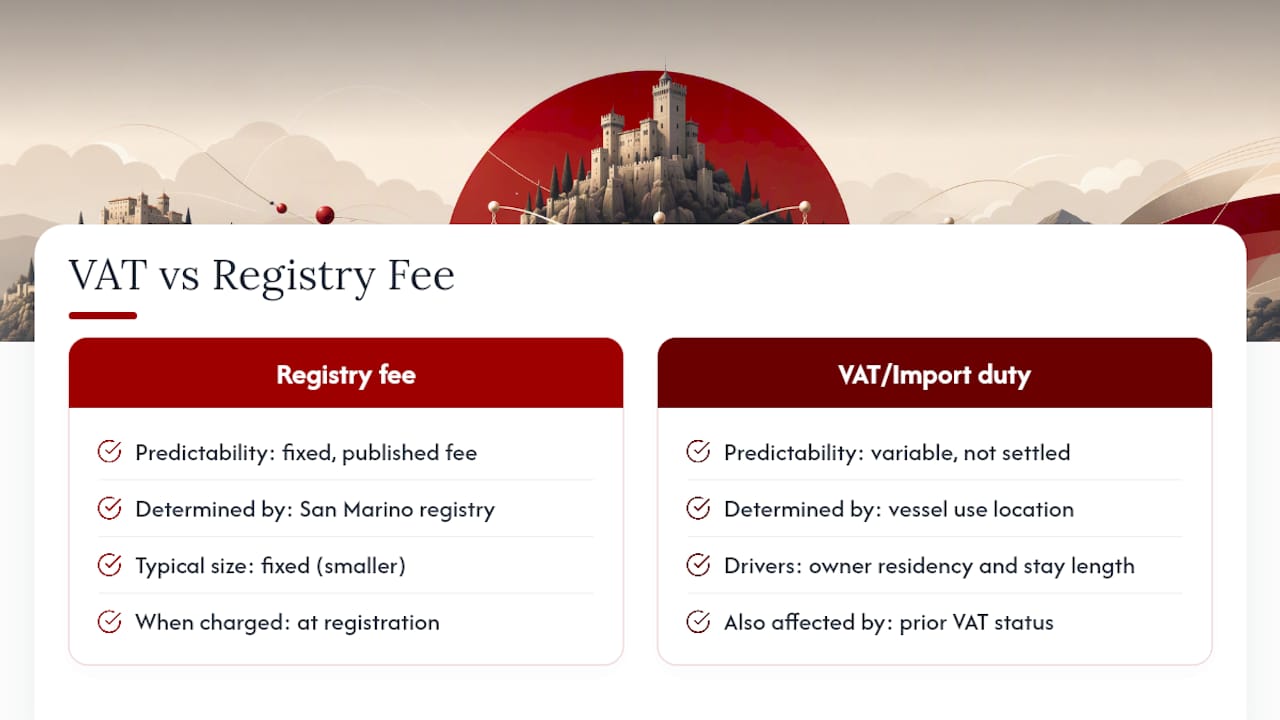
San Marino sits outside the European Union’s VAT area, which changes how tax exposure works compared to flagging a yacht in an EU member state. Registering under the San Marino flag does not, by itself, settle your VAT position within EU waters. If you plan to keep the yacht in EU territory for extended periods, VAT liability is typically determined by where the vessel is used and by the owner’s residency and import history, not by the flag state alone.
This is one area where generic guidance genuinely isn’t good enough. Tax exposure depends heavily on your personal residency, how long the vessel stays in EU waters, whether it was previously VAT-paid under a different flag, and whether ownership runs through a corporate structure. A company-owned vessel can carry different tax treatment than one owned personally, and San Marino’s own business license fee schedule shows that corporate structures carry their own separate charges on top of any VAT question.
The practical takeaway: budget time and money for a session with a tax advisor who specializes in yacht VAT and import duty before you finalize registration, not after. The registry fee is fixed and published. Your VAT exposure is not, and it’s usually the larger number if it goes wrong.
What Legal Rules Could Add Unexpected Costs Later?
San Marino’s registry accepts private yachts, commercial yachts, and vessels under construction, but it explicitly does not register fishing vessels, so confirm your vessel’s category matches what the registry actually processes before you start. Getting this wrong late in the process means restarting under a different classification, which costs both time and money.
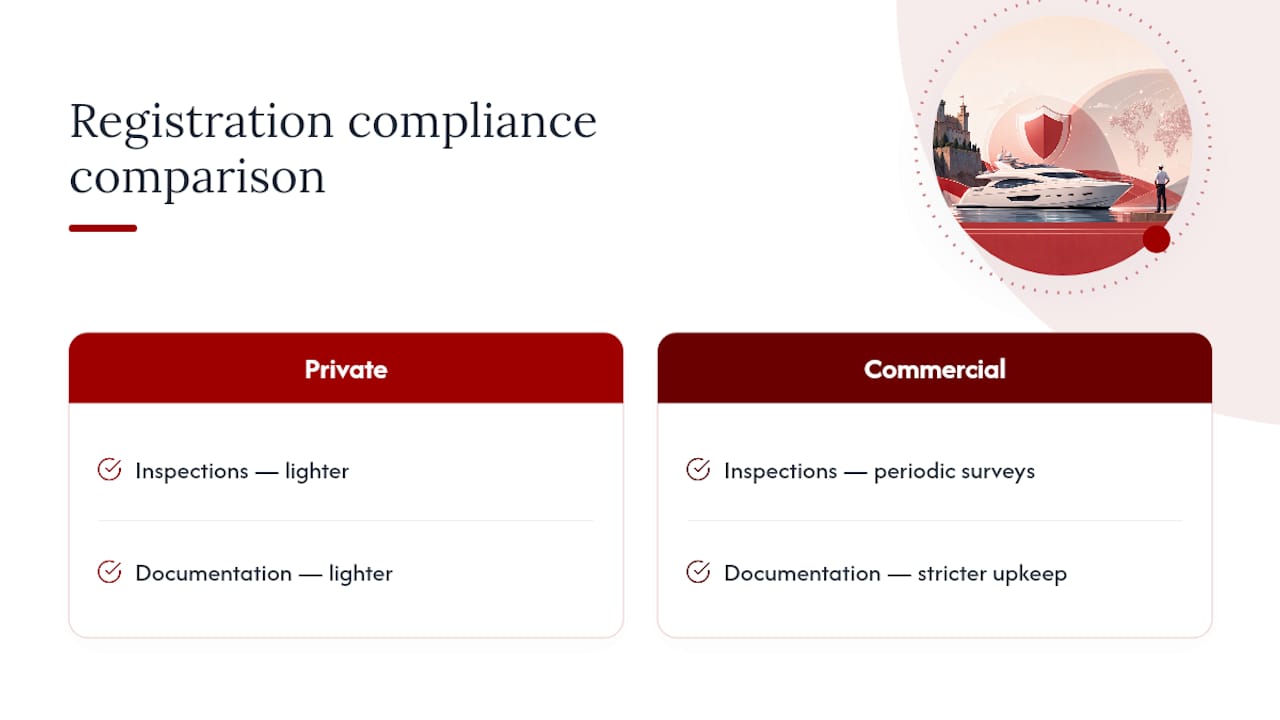
Compliance obligations scale with how the vessel is used. A private pleasure yacht faces lighter ongoing inspection requirements than a vessel registered for commercial charter, which typically needs periodic safety surveys and stricter documentation upkeep. If you’re on the fence about future charter use, it’s worth registering under the correct category from day one rather than converting later.
Ownership structure carries its own legal weight too. Registering through a UK LTD or USA LLC adds a layer of corporate compliance, including company maintenance and accounting obligations in whichever jurisdiction the company is formed. That’s a separate legal and cost track from the yacht’s flag registration itself, and skipping proper company upkeep can create complications for the vessel’s ownership documentation down the line.
Equipment compliance is the other quiet cost driver. MMSI and AIS systems need to stay properly licensed and functioning, and a lapsed or improperly configured system can create problems during a survey or an inspection tied to insurance renewal.
A Publisher’s Perspective on San Marino’s Real Costs
San Marino’s fees are competitive, and processing moves fast when the paperwork arrives complete on the first try. Where owners underestimate cost is almost never the registry fee itself. It’s the translations, the resident agent, and the unforgiving advance-payment schedule that catches people off guard. A single point of contact can handle the paperwork, MMSI setup, and corporate formation pieces so those gaps don’t turn into delays.
— VesselFlag
Get Your San Marino Registration Handled Without the Guesswork
A practical alternative to piecing this together yourself across multiple agents, translators, and registry contacts is a service where one point of contact manages your resident agent appointment, MMSI and AIS setup, certified translations, and direct liaison with SMSR on your proforma invoice, so you’re not chasing five separate vendors while a submission deadline slips.
Here’s what happens after you reach out: you get a written quote based on your yacht’s length and documentation status, a realistic timeline estimate, and a document checklist built specifically for your vessel type so nothing gets flagged as incomplete on submission. For owners considering a corporate structure, Vesselflag also handles UK LTD and USA LLC formation as part of the same process. If your vessel needs coverage during the transition, the insurance checklist is worth reviewing before your first premium quote lands. Visit the San Marino Yacht Registration page to request your quote and get a document checklist started today.
Where to Verify Official San Marino Registration Fees
Every figure in this article traces back to SMSR’s own published materials, and you should check them directly before finalizing any budget. The private yacht price list is the authoritative source for registration fees by vessel length. The registration guidelines document covers invoicing rules, payment timing, and deregistration policy in full. The application procedure page lays out documentation and translation requirements step by step. These three pages are where the registry’s own rules live, and they should be your final check before you submit anything or wire a payment.
الأسئلة الشائعة
How much does it cost to register a yacht in San Marino?
San Marino registry fees for private yachts range roughly from $290 to $2990, depending on vessel length, plus separate costs for a resident agent, translations, and any required survey.
Does San Marino require an annual renewal fee?
Yes. SMSR issues a proforma invoice for the annual fee on your registration anniversary, and unpaid invoices can lead to deregistration initiated by the registry.
Do I need a certified translation for my yacht documents?
Yes, if any ownership document, bill of sale, or builder’s certificate isn’t already in English or Italian, SMSR requires a certified translation before the application can be processed.
Is San Marino registration cheaper than renting a yacht?
For occasional use, chartering is usually cheaper since it avoids registration fees, annual invoices, and insurance premiums entirely. Ownership tends to pay off only with frequent annual use.
Does San Marino charge VAT on yacht registration?
San Marino sits outside the EU VAT area, and registering there doesn’t automatically resolve VAT exposure for time spent in EU waters. Speak with a tax advisor familiar with yacht VAT rules before finalizing your plans.