

TL;DR:
- Several U.S. vessel registration providers offer comprehensive services beyond basic charters, including federal documentation and compliance monitoring. Vesselflag stands out by handling international registrations, MMSI and AIS setup, vessel insurance, and ongoing regulatory oversight from a single platform. Proper selection depends on jurisdiction coverage, processing speed, support quality, and transparency to ensure continuous compliance and operational security.
What are the top alternatives to unicoyachting.com for U.S. vessel registration?
If you’re searching for unicoyachting.com alternatives that go beyond basic charter listings and actually handle federal documentation, compliance tracking, and ancillary maritime services, the U.S. market has several capable options. The strongest providers cover U.S. Coast Guard (USCG) federal documentation, state-level registration, MMSI/AIS setup, and ongoing regulatory monitoring.
Here are the leading alternatives worth your attention:
- علم السفينة — Comprehensive international and U.S. flag registration, MMSI/AIS setup, vessel insurance, and compliance consultancy across multiple jurisdictions including San Marino, Malta, UK Part 1, and Palau.
- U.S. Coast Guard National Vessel Documentation Center (NVDC) — The federal authority for initial vessel documentation, handling certificates, renewals, and endorsement changes directly.
- Delaware Business Incorporators — Offers USCG documentation services including initial certificates, renewals, transfers, SSL-secured online ordering, expedited processing, and lifetime client support with a BBB A+ rating.
- American Nautical Services (Amnautical) — Provides flag state compliance support with regulatory updates, inspections, compliance checklists, and e-Navigation software aligned with international maritime standards.
- Virtual Pursers — Shore-based superyacht support covering port clearance documentation, cruising permit applications, and customs coordination across global jurisdictions.
- Yacht Compliance Management LLC — Specializes in superyacht compliance under ISM, ISPS, and MLC 2006 codes, including safety management system audits and security protocol management.
- State-level DMV/boating agencies — Handle registration for vessels under the federal documentation threshold, required in most states regardless of USCG documentation status.
جدول المحتويات
- How do you choose the right yacht registration and compliance service?
- What U.S. vessel registration and compliance actually requires
- How do these alternatives compare on the features that matter most?
- Vesselflag covers what most registration services leave out
- الوجبات الرئيسية
- الأسئلة الشائعة
How do you choose the right yacht registration and compliance service?
The registration step is straightforward. The compliance layer that follows is where most owners get caught short.
When evaluating any service, prioritize these factors:
- Jurisdictional coverage: Does the provider handle both USCG federal documentation and your flag state’s requirements? If you operate internationally, can they register under foreign flags?
- Processing speed and transparency: Delayed processing and opaque fees create real compliance risk. Ask for published timelines and itemized pricing before committing.
- Compliance monitoring: One-time registration is not enough. Look for providers that track regulatory updates, flag state requirements, and renewal deadlines on your behalf.
- Ancillary services: MMSI licensing, AIS setup, vessel insurance partnerships, and corporate registration support are worth having under one roof. Coordinating these separately multiplies administrative burden.
- Customer support quality: Maritime compliance questions rarely arise during business hours. Evaluate whether the provider offers responsive, knowledgeable support, not just a ticketing system.
- Digital platform usability: A well-designed portal for document management, status tracking, and renewal reminders reduces the chance of a lapsed certificate catching you off guard.
Pro Tip: Mixing personal and vessel operational funds is one of the fastest ways to create audit exposure. Maintaining separate, defensible financial records from day one is critical to protecting yourself during tax audits and liability reviews.

What U.S. vessel registration and compliance actually requires
Federal documentation through the USCG is mandatory for vessels at least 5 net tons (typically 26 feet or longer) engaged in coastwise trade or fisheries, and is optional but often pursued voluntarily by recreational vessels over 26 feet. Documentation does not replace state registration in most cases — both may apply simultaneously.
The USCG’s National Vessel Documentation Center issues Certificates of Documentation (form CG-1270) with endorsements for registry, coastwise, fishery, or recreational use. The endorsement type determines what trade the vessel may legally engage in, and the actual use of the vessel governs which endorsement applies at any given time.
Beyond initial documentation, compliance obligations expand significantly for commercial and superyacht operators:
- كود ISM — Safety Management System audits and certification for vessels in international trade.
- ISPS Code — Security protocols and ship security plans.
- MLC 2006 — Maritime Labour Convention compliance covering crew conditions, contracts, and welfare.
- Flag state requirements — Ongoing regulatory monitoring, inspection coordination, and real-time navigation updates tied to your vessel’s flag.
Many owners underestimate this layer entirely. Registration gets the vessel legal; ongoing compliance management keeps it that way. For a full breakdown of the registration process step by step, the requirements differ meaningfully by vessel type and intended use.
How do these alternatives compare on the features that matter most?
The table below maps the key service dimensions across provider types. Generic labels reflect the market segment rather than specific competitor names.
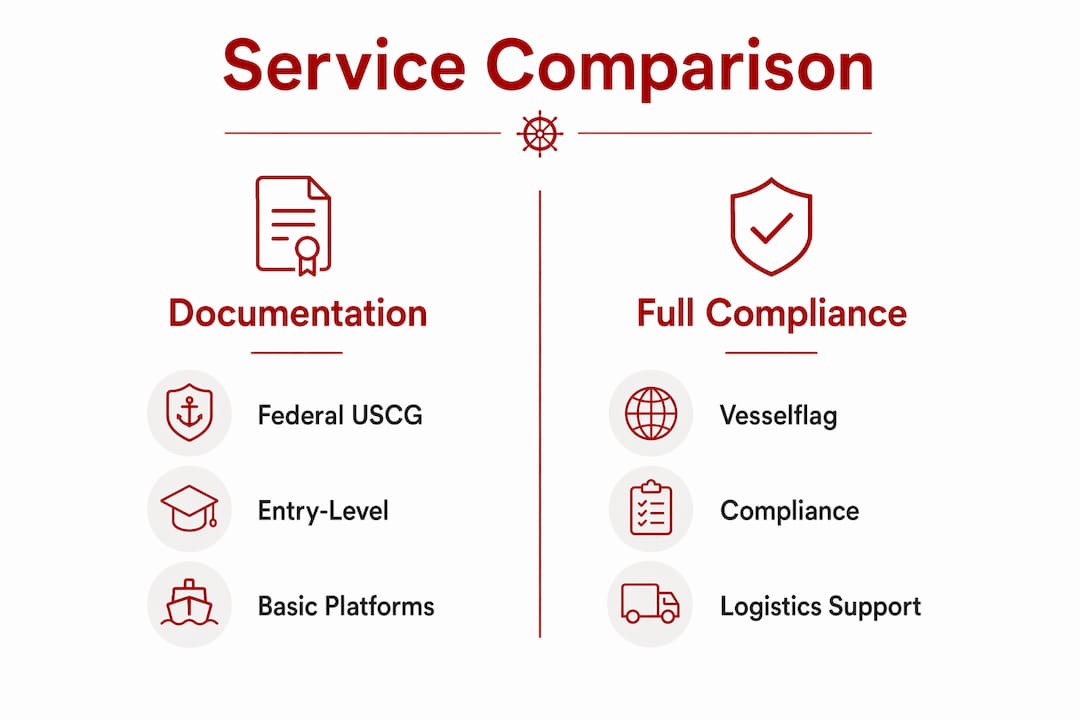
| Feature | NVDC (Direct Federal) | Entry-Level Doc Services | Full-Service Compliance Platforms | علم السفينة |
|---|---|---|---|---|
| Service coverage & jurisdictions | U.S. federal only | U.S. federal only | U.S. + limited international | U.S. + multiple international flags |
| Registration processing speed | Standard government timelines | Expedited options available | Varies by provider | Fast-track options with published timelines |
| Compliance support services | None | الحد الأدنى | معتدل | Comprehensive, ongoing monitoring |
| MMSI/AIS setup | Not included | Not included | Sometimes included | Included |
| Insurance partnerships | None | None | Rarely included | Included |
| Pricing transparency | Fee schedule published | متفاوتة | Often opaque | Itemized, upfront |
| Digital platform usability | Basic eStorefront | متفاوتة | معتدل | Full portal with document management |
| Customer support | Government contact center | BBB-rated support | متفاوتة | Dedicated maritime consultants |
The practical gap between a documentation-only service and a full-service platform shows up most clearly when a vessel moves between jurisdictions or when a renewal deadline approaches without a reminder system in place. For owners managing international compliance, the difference between a provider that tracks flag state updates and one that simply files paperwork is the difference between staying operational and facing a port detention.
Ocean freight and logistics operators dealing with vessel documentation alongside cargo management may also find value in purpose-built tools like FreightSuite’s ocean freight capabilities, which handle the transportation compliance layer separately from vessel registration.
Vesselflag covers what most registration services leave out
Most yacht registration services stop at the certificate. Vesselflag handles what comes after: compliance monitoring, MMSI and AIS setup, vessel insurance, and registration across more than a dozen international flag states, all from a single platform built specifically for yacht owners and maritime professionals.
If you’ve been relying on a charter-focused platform or a single-jurisdiction documentation service, Vesselflag fills the gaps that create compliance exposure. The platform covers flags including San Marino, Malta, UK Part 1, Palau, Langkawi, and Poland, with published timelines and itemized pricing at every step. No hidden fees, no chasing separate vendors for MMSI licensing or insurance.
For owners ready to move from basic documentation to full registration compliance, start with Vesselflag’s step-by-step yacht registration guide or check the flag registration options to find the right jurisdiction for your vessel’s use case.
الوجبات الرئيسية
Vesselflag stands out among unicoyachting.com alternatives by combining U.S. and international flag registration, compliance monitoring, MMSI/AIS setup, and vessel insurance under one platform with transparent pricing.
| نقطة | التفاصيل |
|---|---|
| Federal documentation threshold | USCG documentation is mandatory for vessels at least 5 net tons (typically 26 feet or longer) engaged in coastwise trade or fisheries; optional but beneficial for recreational vessels over 26 feet. |
| State registration still applies | Federal documentation does not replace state registration requirements in most cases. |
| Compliance goes beyond registration | ISM, ISPS, and MLC 2006 codes create ongoing obligations for commercial and superyacht operators. |
| Transparency reduces risk | Opaque fees and delayed processing create compliance risk; prioritize providers with published timelines. |
| Vesselflag’s advantage | Covers multiple international flags, MMSI/AIS setup, insurance, and compliance monitoring from one platform. |
الأسئلة الشائعة
What is the minimum vessel size for USCG federal documentation?
Federal documentation is mandatory for vessels of at least 5 net tons (typically 26 feet or longer) engaged in coastwise trade or fisheries. Recreational vessels at least 5 net tons may also document voluntarily.
Does federal documentation replace state registration?
No. USCG documentation and state registration are separate requirements, and most states require state registration regardless of federal documentation status.
What compliance codes apply to superyachts beyond basic registration?
Superyachts in international trade must comply with the ISM Code for safety management, the ISPS Code for security, and MLC 2006 for labor conditions. These are ongoing obligations, not one-time filings.
How does Vesselflag differ from a standard documentation service?
Vesselflag covers registration across multiple international flag states and includes MMSI/AIS setup, vessel insurance, and ongoing compliance monitoring, while most documentation services handle only the initial USCG certificate.
Why does pricing transparency matter when choosing a registration service?
Opaque fees and unclear timelines create compliance risk and owner frustration. Providers with itemized, upfront pricing allow owners to plan accurately and avoid unexpected delays that could affect vessel operations.