

باختصار:
- Registration agents serve as official intermediaries responsible for vessel registration compliance, legal documentation, and ongoing due diligence. They actively manage sanctions screening, ownership declarations, and regulatory communications to ensure vessels remain legally compliant across international waters.
A registration agent is the official intermediary who manages vessel registration compliance, legal documentation, and ongoing due diligence on behalf of shipowners or businesses. The role of registration agents goes far beyond paperwork. These professionals serve as the compliance backbone between foreign vessel owners and flag state registries, handling everything from sanctions screening to annual ownership declarations. Malta’s 2026 resident-agent Code of Standards is the clearest modern example of how this function has been formalized into a structured, enforceable framework. Understanding what registration agents do, and why their duties matter, is the first step toward maintaining a vessel that stays legally compliant across international waters.

What is the role of registration agents in maritime compliance?
Registration agents, formally called resident agents in maritime contexts, are licensed professionals who act as the official point of contact between a shipowner and a flag state registry. Their core job is to receive, manage, and forward legal and compliance documents on behalf of vessel owners who may be based in another country entirely.
The functions of registration agents cover several distinct areas:
- Document receipt and forwarding: Accepting official correspondence from the registry and delivering it to the shipowner without delay.
- Service of process: Receiving legal notices, court documents, and government communications on behalf of the registered entity.
- Sanctions screening: Checking vessel owners, operators, and beneficial owners against international sanctions lists.
- Due diligence collection: Gathering Know Your Customer (KYC) documentation from shipowners, particularly those outside the EU or UK owning vessels over 24 meters.
- Ownership change reporting: Notifying the registry when ownership or beneficial ownership changes occur.
- Regulatory communication: Responding to registry queries within specified timeframes and cooperating with enhanced due diligence requests.
Registered agents act as critical points of contact ensuring businesses and vessel owners can be reached promptly for legal proceedings, government notices, and compliance alerts. Their presence preserves due process rights by guaranteeing service of process is never missed.
نصيحة من الخبراء: When evaluating a registration agent, ask specifically about their sanctions screening process and how quickly they respond to registry information requests. Speed and accuracy in these areas directly affect your vessel’s compliance standing.
How do registration agents operate under Malta’s 2026 Code of Standards?
Malta’s 2026 resident-agent Code of Standards is the most detailed public framework defining what registration agents must do in a maritime context. Malta’s 2026 Code requires agents to act as the compliance link between foreign shipowners and the Malta Registry, managing vessel matters and assisting with registration. The Code’s purpose is to strengthen oversight and standardize due diligence to protect Malta’s reputation as a leading flag state.
Under the Code, a resident agent’s operational workflow follows a clear sequence:
- Onboarding and KYC collection: The agent collects due diligence documentation from the shipowner before registration proceeds.
- Sanctions screening at entry: Every owner, operator, and beneficial owner is screened against international sanctions lists before the vessel is registered.
- Annual directors’ declarations: The agent obtains annual declarations disclosing any changes in ownership or beneficial ownership and reports them to the Registry.
- Ongoing record updates: Client data is kept current, and any flags for non-compliance are reported to competent authorities immediately.
- Enhanced due diligence response: When the Ship Registry requests additional information, the agent cooperates within the specified timeframe.
- Contractual clarity with owners: The agent establishes written terms with the shipowner covering communication expectations and compliance obligations.
| Compliance task | Frequency | Reporting destination |
|---|---|---|
| Sanctions screening | At onboarding and ongoing | Competent authorities |
| KYC documentation collection | At registration and on change | Malta Ship Registry |
| Annual directors’ declarations | Yearly | Malta Ship Registry |
| Enhanced due diligence response | On registry request | Malta Ship Registry |
| Ownership change notification | Immediately on change | Malta Ship Registry |
Resident agents must collect due diligence documentation from international shipowners, especially those outside the EU and UK owning vessels over 24 meters. The Ship Registry may request enhanced due diligence at any time, requiring the agent’s cooperation within specified timeframes.
نصيحة من الخبراء: Ask your Malta resident agent to show you their compliance calendar. A professional agent tracks annual declaration deadlines and screening refresh cycles proactively, not reactively.
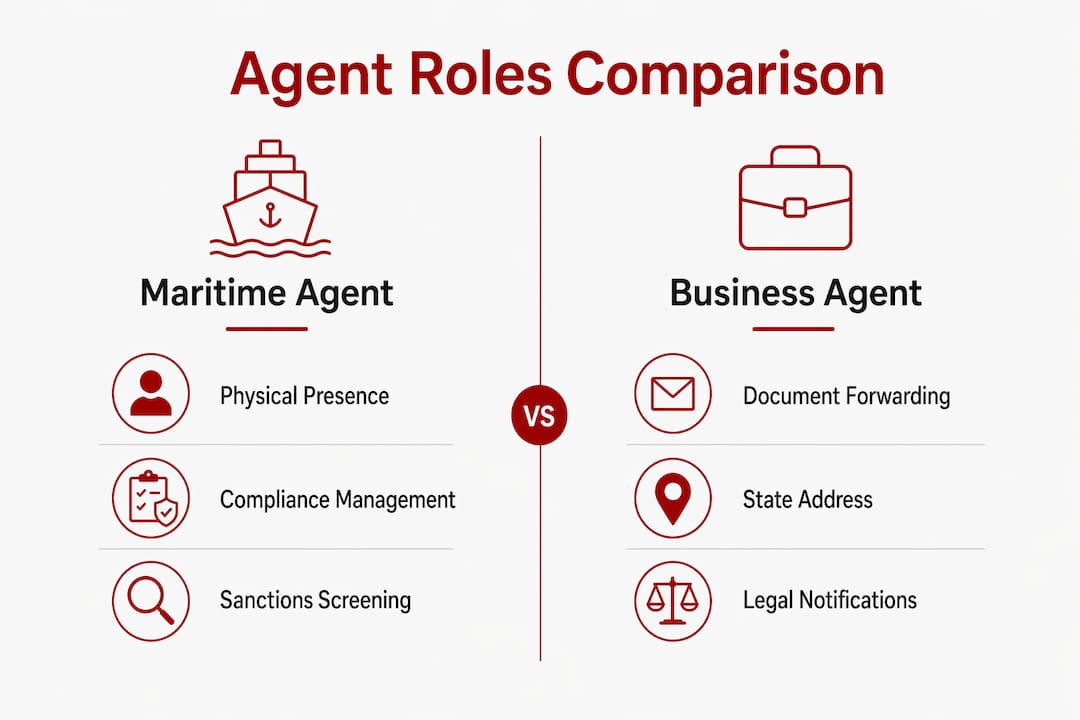
Maritime resident agents vs. general business registered agents
The duties of registration agents in maritime and general business contexts share a common foundation but diverge significantly in scope and complexity.
In U.S. business compliance, a registered agent must have a physical address in the state of registration and be available during business hours to receive legal documents and government correspondence. Their job includes accepting service of process and forwarding it to the business entity. This is a well-defined, largely administrative function.
Maritime resident agents carry all of those responsibilities and then add a layer of active compliance management. They do not simply receive and forward documents. They screen for sanctions, collect KYC records, report ownership changes, and maintain readiness to respond to regulatory queries on short notice.
| Feature | Maritime resident agent | General business registered agent |
|---|---|---|
| Physical presence required | Yes, in flag state jurisdiction | Yes, in state of incorporation |
| Documents handled | Vessel registration, flag registry, maritime compliance | Legal notices, tax correspondence, state filings |
| Sanctions screening | Required under frameworks like Malta’s 2026 Code | Not typically required |
| KYC obligations | Ongoing, with annual declarations | Not standard |
| Compliance reporting | Active reporting to flag registry | Passive forwarding to business |
| Regulatory exposure | High, tied to international maritime law | Moderate, tied to state business law |
In U.S. law, registered agents ensure service of process and state communication accessibility. These same principles underpin maritime resident agent requirements, but the maritime version adds compliance risk management as a core function, not just an administrative one.
What are the benefits of using professional registration agents?
The importance of registration agents becomes clearest when something goes wrong. A missed legal notice, an expired sanctions screening, or a late ownership declaration can trigger registry suspension or worse. Professional registration agents prevent exactly these failures.
The practical benefits of working with a qualified agent include:
- No missed deadlines: Agents track annual declaration dates, screening refresh cycles, and registry communication windows so owners do not have to.
- Reduced legal exposure: Timely receipt and forwarding of legal documents preserves the owner’s right to respond within required timeframes.
- Regulatory expertise: Agents who specialize in maritime compliance understand how flag state requirements change and advise owners accordingly.
- Audit readiness: A professional agent maintains organized records that can be produced quickly during a registry audit or enhanced due diligence review.
- Smoother renewals: Vessels with clean compliance records and up-to-date documentation face fewer delays during registration renewals.
A reliable registered agent’s qualities include expertise, reliability, professionalism, and strong communication. These qualities directly protect the vessel owner by ensuring prompt handling of every legal and compliance document.
For owners registering under flags like Malta, where the flag state compliance role is actively enforced, the agent’s quality is not a minor detail. It is a direct factor in whether the vessel maintains good standing.
نصيحة من الخبراء: Before signing with any registration agent, request a sample of their compliance documentation package. A well-prepared agent will have a clear template for KYC collection, sanctions screening records, and annual declaration tracking.
How do registration agents support ongoing compliance after registration?
Registration is not a one-time event. Maritime resident agents must maintain continuous KYC and compliance updates, embedding them in ongoing vessel regulatory oversight rather than treating registration as a completed task.
The ongoing compliance workflow of a professional registration agent includes:
- Continuous KYC maintenance: Updating ownership records whenever a change occurs and verifying that all parties remain off sanctions lists.
- Annual declaration management: Collecting directors’ declarations each year and submitting them to the registry on schedule.
- Readiness pack maintenance: Agents maintain a readiness pack including ownership evidence, sanctions screening data, and corporate documents so they can respond immediately to registry requests.
- Sanctions match reporting: When a screening returns a potential match, the agent reports it to competent authorities without delay.
- Registry communication management: All incoming registry correspondence is logged, forwarded, and tracked to confirm the owner has received and acknowledged it.
This ongoing role protects the flag state’s reputation as much as it protects the individual vessel owner. Malta’s 2026 Code operationalizes compliance tasks like sanctions screening and annual declarations so the registry can efficiently rely on local agents for oversight. Agents who perform this function well become genuine compliance partners, not just administrative contacts.
نصيحة من الخبراء: Treat your registration agent relationship like a retainer, not a transaction. The agents who deliver real compliance value are the ones you communicate with regularly, not just at renewal time.
الوجبات الرئيسية
Professional registration agents are the compliance infrastructure that keeps vessels legally registered, audit-ready, and protected from sanctions exposure across every flag state jurisdiction.
| نقطة | التفاصيل |
|---|---|
| Core function | Agents receive, manage, and forward legal and compliance documents on behalf of vessel owners. |
| Malta’s 2026 Code | Sets the clearest standard for maritime agents, requiring sanctions screening, KYC collection, and annual declarations. |
| Maritime vs. business agents | Maritime agents carry active compliance obligations; general business agents perform largely administrative forwarding. |
| Ongoing compliance | Registration agents maintain continuous KYC records and readiness packs, not just initial documentation. |
| Selecting an agent | Verify sanctions screening protocols, communication standards, and record retention practices before signing. |
The compliance function that most vessel owners underestimate
At Vesselflag, we have seen the same pattern repeat across hundreds of vessel registrations. Owners treat the registration agent appointment as a formality. They pick whoever is cheapest or most convenient, sign the paperwork, and move on. Then, six months later, the registry sends an enhanced due diligence request, and the agent either cannot respond in time or does not have the records to respond at all.
The misconception is that registration agents handle administration. The reality, especially under frameworks like Malta’s 2026 Code, is that they handle compliance risk. Those are fundamentally different jobs. An administrative agent files documents. A compliance agent actively monitors ownership changes, screens for sanctions, and keeps a readiness pack that can satisfy a registry audit on short notice.
What we have found actually works is treating the agent selection process the way you would treat hiring a compliance officer. Ask about their screening frequency. Ask how they handle a sanctions match. Ask to see their annual declaration tracking system. The agents who answer those questions confidently are the ones worth hiring.
The future of registration agent responsibilities will only move in one direction. Flag states are tightening oversight, not loosening it. Agents who cannot demonstrate active compliance management will lose their authorization. Vessel owners who chose those agents will face registration suspensions. The time to verify your agent’s capabilities is before a registry request arrives, not after.
— Vesselflag
Vesselflag’s registration services for compliant vessel owners
Vessel owners who want to register under a reputable flag without managing the compliance complexity alone have a clear option with Vesselflag.
Vesselflag specializes in yacht and vessel registration across multiple international flags, including Malta, San Marino, Poland, UK Part 1, and Palau. Every registration includes support for the documentation and compliance steps that registration agents are responsible for managing. Owners who are unsure whether their current setup meets 2026 compliance standards can review the full vessel registration process on the Vesselflag platform. The goal is a registration that holds up under scrutiny, not just one that gets approved on day one.
الأسئلة الشائعة
What does a registration agent do for a vessel owner?
A registration agent acts as the official intermediary between a vessel owner and the flag state registry, managing legal documents, sanctions screening, KYC collection, and compliance reporting on the owner’s behalf.
How do registration agents work under Malta’s 2026 Code?
Under Malta’s 2026 resident-agent Code of Standards, agents must conduct sanctions screenings, collect due diligence documentation, obtain annual directors’ declarations, and respond to enhanced due diligence requests within specified timeframes.
What is the difference between a maritime resident agent and a business registered agent?
A business registered agent primarily receives and forwards legal documents in a U.S. state context. A maritime resident agent carries additional active compliance duties including KYC maintenance, sanctions screening, and ownership change reporting to the flag registry.
Why does the importance of registration agents matter for vessel compliance?
A professional registration agent prevents missed deadlines, ensures audit readiness, and maintains the continuous compliance records that flag state registries require. Without one, vessel owners risk registration suspension or legal exposure.
How do I choose a reliable registration agent for my vessel?
Verify that the agent follows documented protocols for sanctions screening, record retention, and communication standards. Selecting a resident agent requires confirming they align with responsible flag state risk management requirements, not just administrative availability.

[…] means recognizing what a Transport Malta reviewer will flag before it costs you a resubmission. A registration agent can verify certificate wording, coordinate directly with your broker or insurer, and make sure […]