باختصار:
- The yacht name reservation process is a formal application to maritime authorities to secure a unique vessel name before registration. It requires preparing specific documents, verifying name availability through official databases, and submitting a fee within a set validity period to prevent delays or rejection. Properly handling this early step ensures a smooth registration, avoids costly rework, and secures the desired vessel name legally on official documents.
The yacht name reservation process is the formal procedure through which yacht owners secure an official, unique vessel name before completing registration. Skipping this step or rushing through it creates real problems: rejected applications, name conflicts with existing vessels, and costly administrative rework. Registries like the Virgin Islands Shipping Registry (VISR), the U.S. Coast Guard (USCG), and flag state authorities worldwide each maintain their own name databases and rules. Understanding how the process works across these registries, what documents you need, and what mistakes to avoid is the difference between a smooth registration and weeks of delays.
What does the yacht name reservation process require?
The yacht name reservation process is a distinct step within the broader yacht registration process. It is not simply picking a name you like. It is a formal application to a maritime authority confirming that your chosen name is unique, compliant, and officially held for your vessel during the registration period.

Most registries hold a reserved name for a fixed period. The VISR, for example, reserves a name for six months upon approval. That window gives you time to complete the full registration without losing your chosen name to another applicant. The full registration timeline runs 4–8 weeks depending on the flag state, so starting the name reservation early is not optional. It is the first real deadline in the process.
The name you reserve also becomes the legally displayed name on your vessel’s transom and in all official documentation. Changing it later means re-submitting applications, updating insurance records, and paying additional fees. Getting it right the first time is the only practical approach.
What documents do you need before reserving a yacht name?
Gathering your documents before you submit anything saves significant time. Registries will not process incomplete applications, and missing a single item can push your timeline back by weeks.
The standard documents required across most flag registries include:
- Proof of ownership: A bill of sale, builder’s certificate, or previous registration certificate confirming you own the vessel.
- Owner identification: A valid government-issued ID or passport for individual owners. Corporate owners typically need articles of incorporation and a certificate of good standing.
- Vessel details: Hull Identification Number (HIN), vessel dimensions, gross tonnage, and construction material.
- Completed application form: For VISR, this is Form SR101-01, which covers both name reservation and initial registration data.
- Fee payment: The VISR charges a $50 non-refundable reservation fee. Other registries vary.
Some flag states add requirements beyond this baseline. Malta and the UK Part 1 registry may require a tonnage survey certificate. Palau and Langkawi registries have their own documentation checklists. Checking the specific requirements for your chosen flag state before you start prevents surprises.
| Document | Purpose | Notes |
|---|---|---|
| Bill of sale or builder’s certificate | Proves ownership | Required by all major registries |
| Owner ID or corporate documents | Confirms applicant identity | Passport for individuals; incorporation docs for companies |
| Hull Identification Number | Identifies the specific vessel | Found on the transom or hull plate |
| Tonnage survey certificate | Confirms vessel measurements | Required by some flag states (Malta, UK Part 1) |
| Completed application form | Initiates the reservation | VISR uses Form SR101-01 |
نصيحة من الخبراء: Prepare a digital folder with scanned copies of every document before you start any application. Registries often request additional copies mid-process, and having everything organized cuts response time from days to hours.
How do you check yacht name availability and follow naming guidelines?
Name availability is not something you verify with a trademark search. Maritime registries are the authoritative source for name conflicts, not the U.S. Patent and Trademark Office or any commercial database. A name can be fully trademarked and still be rejected by a registry because another vessel already holds it.
The USCG maintains a national vessel documentation database searchable online. VISR, Malta, and other flag registries maintain their own separate databases. You need to check the specific registry you are applying to, not just one central source.
Maritime authorities reject names that are phonetically similar to existing vessel names, even when the spelling is completely different. This rule exists to prevent confusion during radio communications and emergency situations. A vessel named “Sea Breeze” and one named “See Brees” create real operational risk on VHF Channel 16. Registries take this seriously.
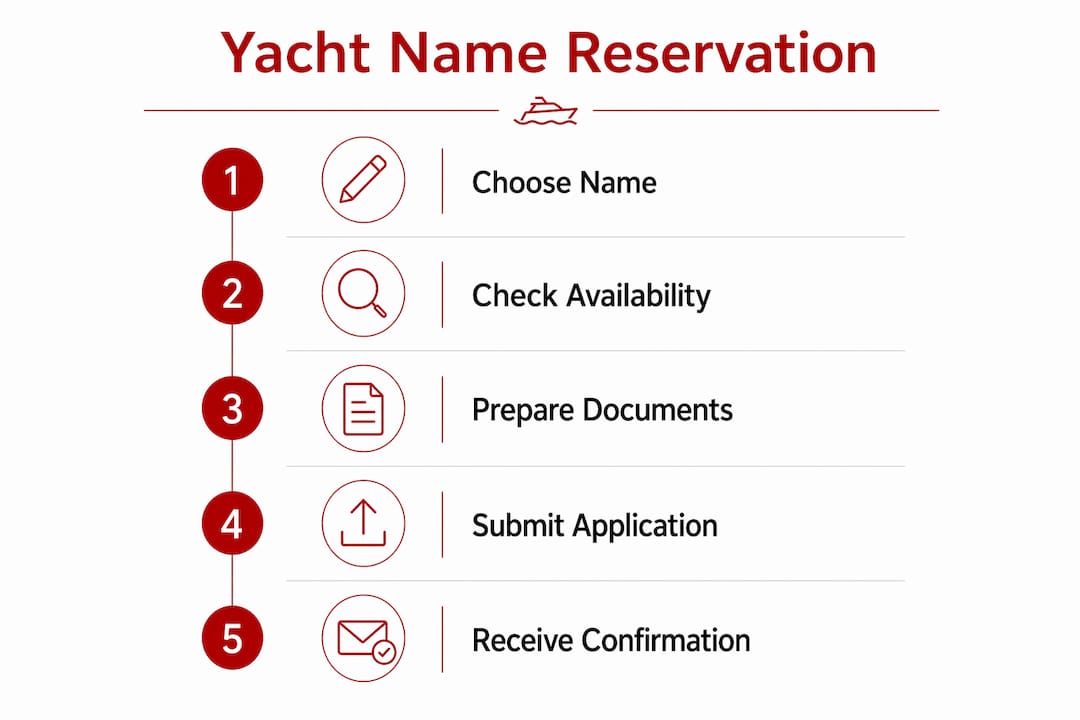
Follow this sequence when selecting and verifying a name:
- Generate three to five name candidates. Having backups ready before you search prevents starting over if your first choice is taken.
- Search the target registry’s database for exact matches on each candidate.
- Run a phonetic check by saying each name aloud and listing words that sound similar. Search those variants too.
- Review naming guidelines for the specific registry. Most prohibit offensive language, names that imply government or military affiliation, and names longer than a practical display length.
- Confirm transom space before finalizing a long name. A 40-foot yacht with a narrow transom may not accommodate a 25-character name at the required display size.
- Select your primary name and one backup. Submit both in your reservation application if the registry allows it.
نصيحة من الخبراء: Say your top name choice over a VHF radio to a friend and ask them to write down what they heard. If they spell it differently or mishear it entirely, a registry may reject it on phonetic grounds. This test takes two minutes and can save weeks of resubmission.
How do you submit the yacht name reservation application?
The submission process follows a clear sequence. Deviating from it, or skipping steps, results in rejection or processing delays.
- Complete the official application form for your chosen registry. For VISR, this is Form SR101-01. Download it directly from the registry’s official website to confirm you have the current version.
- Attach all required supporting documents. Incomplete submissions are returned without processing.
- Pay the reservation fee. The VISR charges $50 as a non-refundable fee. Most registries accept wire transfer or credit card. Confirm accepted payment methods before submitting.
- Submit via the registry’s preferred channel. Some registries accept email submissions with scanned documents. Others require physical mail or an online portal. VISR accepts submissions through authorized agents.
- Record your submission date and confirmation number. You will need this if you follow up on processing status.
“Submitting the name reservation early, ideally right after the purchase agreement is signed, can help ensure registration is complete before yacht delivery.” — Yacht Flag Registration Guide
Processing time runs 4–8 weeks depending on the flag state. VISR and similar registries in smaller jurisdictions often process faster than large national registries. Plan your delivery timeline around the longer end of that range.
| Registry | Reservation Fee | Validity Period | Processing Time |
|---|---|---|---|
| Virgin Islands Shipping Registry (VISR) | $50 (non-refundable) | 6 months | 2–4 weeks |
| USCG National Vessel Documentation | Varies by service | 1 year | 4–8 weeks |
| Malta Maritime Authority | متفاوتة | 3–6 months | 3–6 weeks |
If your application is rejected, the registry will specify the reason. A phonetic conflict requires you to select a new name and resubmit from step one. A documentation error typically allows you to correct and resubmit without losing your place in the queue.
نصيحة من الخبراء: If your reservation is approaching its expiration and full registration is not yet complete, contact the registry before the deadline to request an extension. Most registries allow at least one renewal, but they will not remind you automatically.
Selecting a hailing port is part of the reservation and registration process. The hailing port affects stern markings but does not restrict where you operate or dock the vessel. Choose a port that reflects your home base or ownership structure, not one you think sounds prestigious.
What are the most common mistakes in the name reservation process?
Most errors in the yacht name reservation process are avoidable. They fall into a small number of recurring categories.
- Assuming trademark ownership equals name availability. A registered trademark gives you no priority in a maritime registry. Check maritime databases directly, not trademark records.
- Ordering graphics before confirmation. Sign shops and marina painters require lead time. Ordering transom lettering before your name is officially confirmed means paying to redo the work if the name is rejected.
- Ignoring phonetic similarity. Owners focus on spelling and aesthetics. Registries focus on how names sound over radio. A name that passes a visual check can still fail a phonetic review.
- Changing the name after registration. Changing a registered vessel name requires formal re-submission, insurance updates, and additional fees. The administrative burden is significant. Treat the name you reserve as final.
- Not reserving a backup name. If your primary name is rejected, you need a ready alternative. Reserve a backup name in writing with your sign shop and marina before ordering any graphics.
- Missing the reservation expiration date. A six-month reservation window sounds long. Combined with construction delays, financing timelines, and survey scheduling, it passes quickly.
نصيحة من الخبراء: Coordinate with your marina and sign shop before you submit your reservation. Tell them your primary and backup name choices. Ask them to hold your slot and confirm the transom dimensions can accommodate both options. This prevents a last-minute scramble if your first choice is rejected.
Key takeaways
The yacht name reservation process requires early action, correct documentation, and phonetic name verification across official maritime databases, not trademark records.
| نقطة | التفاصيل |
|---|---|
| Start early after purchase | Submit your name reservation right after signing the purchase agreement to stay ahead of delivery timelines. |
| Use maritime databases | Check USCG, VISR, and flag state registries directly. Trademark databases do not reflect vessel name conflicts. |
| Verify phonetics, not just spelling | Registries reject names that sound like existing vessels, even when spelled differently. |
| Prepare backup names | Have at least one alternate name ready before submitting to avoid restarting the process after a rejection. |
| Treat the reserved name as final | Changing a registered name triggers re-submission, insurance updates, and fees. Get it right before you submit. |
What we have learned from handling hundreds of name reservations
The single most consistent mistake we see is owners treating name reservation as an afterthought. They finalize their purchase, arrange financing, schedule surveys, and then, two weeks before delivery, they start thinking about the name. By that point, the registration timeline is already compressed, and any rejection creates a real problem.
The second pattern we see constantly is over-reliance on trademark searches. Owners spend time and money confirming a name is trademarked in their favor, then discover the same name is already registered to a vessel in the USCG database or a foreign flag registry. Maritime name rights and intellectual property rights are completely separate systems. Checking one tells you nothing about the other.
Our honest recommendation: treat name selection as part of your purchase negotiation, not your delivery preparation. The moment you have a signed purchase agreement, start your name availability check and reservation application. Six months of validity sounds like plenty of time. When you factor in survey delays, flag state selection, and documentation gathering, it is exactly enough time if you start immediately.
We also recommend consulting a maritime registration agent or attorney if you are registering under a foreign flag for the first time. The documentation requirements, fee structures, and processing timelines vary significantly between jurisdictions. Getting that guidance upfront costs less than correcting errors after submission.
— Vesselflag
How Vesselflag simplifies your registration from day one
Vesselflag handles yacht name reservation and full registration across multiple international flag states, including VISR, Malta, UK Part 1, Palau, and others. The platform provides flag-specific documentation checklists, fee breakdowns, and direct submission support so you are not navigating registry requirements alone.
Whether you are registering your first yacht or switching flag states on an existing vessel, Vesselflag’s team manages the paperwork, tracks your reservation status, and coordinates with registries on your behalf. Explore the complete yacht registration guide to see exactly what the process looks like from name reservation through final certificate issuance. For owners comparing flag options, the flag registration overview covers timelines, costs, and jurisdiction-specific requirements in one place.
الأسئلة الشائعة
What is the yacht name reservation process?
The yacht name reservation process is the formal procedure of applying to a maritime registry to secure a unique vessel name before completing full registration. It typically involves submitting an application form, paying a non-refundable fee, and receiving confirmation that the name is held for a defined period.
How long does a yacht name reservation stay valid?
Validity periods vary by registry. The Virgin Islands Shipping Registry holds a reserved name for six months. Other registries, including the USCG, may offer up to one year. Contact your specific registry to confirm the validity window and renewal options.
Can i use a trademarked name for my yacht?
A trademark does not guarantee name availability in a maritime registry. Maritime registries are the authoritative source for vessel name conflicts. You must search the relevant registry database directly, regardless of trademark status.
Why would a registry reject my yacht name?
Registries reject names that duplicate or are phonetically similar to existing vessel names, names containing offensive language, and names that imply government or military affiliation. Phonetic similarity is the most common reason for rejection.
What happens if i change my yacht’s name after registration?
Changing a registered vessel name requires a formal re-submission to the registry, updates to all insurance documents, and payment of additional fees. The process adds weeks to your timeline and costs more than getting the name right before initial registration.