

TL;DR:
- Registration documents establish a vessel’s legal identity, ownership, and regulatory authority required for port access and financing. Proper management and proactive renewal are essential to avoid delays, penalties, and operational disruptions. Treat registration records as a strategic asset, maintaining organized files and scheduled audits to ensure ongoing compliance.
Most vessel owners think registration is just paperwork you file once and forget. It isn’t. The role of registration documents goes far deeper than bureaucratic formality. These records define who legally owns your vessel, which flag state has jurisdiction over it, whether your financing is valid, and whether a port authority will let you dock or detain you. Get them right and your operations run without friction. Miss a detail, and you could face fines, seized cargo, or an unenforceable ownership claim. This article breaks down what these documents actually do, what types you need, and how to manage them without letting compliance drift sneak up on you.
جدول المحتويات
- الوجبات الرئيسية
- The role of registration documents in maritime and business law
- Types of registration documents you need to know
- Compliance challenges and what happens when documentation fails
- How to use and manage registration documents effectively
- What I’ve learned about treating registration as an asset
- Get expert help with vessel registration
- الأسئلة الشائعة
الوجبات الرئيسية
| نقطة | التفاصيل |
|---|---|
| Legal identity depends on documents | Registration documents create the official record that proves ownership and grants your vessel legal standing in any jurisdiction. |
| Document types vary by purpose | From certificates of registry to corporate formation papers, each document serves a distinct legal or operational function. |
| Missing documents cause real delays | A single outdated or incomplete document can hold up your registration by weeks or result in outright rejection. |
| Digital files don’t replace originals | Hybrid systems still require physical notarized originals for certain filings, making a hard-copy master set non-negotiable. |
| Proactive management prevents penalties | Scheduling renewals and updates ahead of deadlines keeps you compliant and avoids regulatory sanctions. |
The role of registration documents in maritime and business law
Registration documents do more than prove you paid for something. They create a legally recognized identity for a vessel or business entity within a specific jurisdiction. That distinction matters enormously. Legal ownership recognition requires registration in virtually every regulated jurisdiction before a transaction is enforceable, and the same logic applies to vessels.
Here is what registration documents actually accomplish:
- Establish legal identity and ownership. A vessel without a valid certificate of registry has no provable nationality. It exists in a legal gray zone where no flag state claims jurisdiction and no court can cleanly adjudicate a dispute.
- Enable regulatory oversight. Registration ties your vessel to a flag state, which then has the authority and obligation to enforce safety standards, crew regulations, and environmental rules on board.
- Prevent fraud and establish chain of title. A documented ownership history makes it significantly harder for fraudulent sales or duplicate financing to go undetected. Notarized signatures and registration create a verifiable safety net against forgery.
- Support financial transactions. Banks and insurers require valid registration documents before issuing marine mortgages or hull insurance. No certificate, no financing.
- Create a public record of accountability. Registration puts ownership on record with a government authority, which matters when disputes go to court or when a vessel changes hands.
Registration also connects to something broader. Research on civil registration shows that without complete documentation, entities remain invisible to institutions. For vessels, that invisibility can mean denial of port services, inability to obtain an MMSI number, or exclusion from commercial trade routes entirely.
Pro Tip: Think of your registration certificate as your vessel’s passport. A passport doesn’t just identify you; it grants you rights, access, and legal standing in foreign territories. Your certificate of registry works the same way at every port of call.
Types of registration documents you need to know
إن types of registration documents required depend on whether you are registering a vessel, incorporating a corporate owner entity, or both. Most serious maritime operators deal with both layers simultaneously.
Corporate formation documents
When a vessel is owned by a company rather than an individual, the registration authority needs proof that the company itself is legitimate. That means submitting a Memorandum of Association, Articles of Association, shareholder resolutions authorizing the purchase, and proof of beneficial ownership. In the UAE, for example, beneficial owner updates must be filed within 15 days of any change, with non-compliance triggering fines up to AED 100,000. That kind of deadline applies across many flag state jurisdictions in similar forms.

Vessel-specific documents
These are the papers tied directly to the hull and its operations. The table below gives you a quick reference.
| Document | Purpose | Notarization Required? |
|---|---|---|
| Certificate of Registry | Establishes nationality and flag state | Yes, often apostilled |
| Bill of Sale | Proves transfer of ownership | نعم |
| Title Document | Evidences legal title to the vessel | نعم |
| Radio License (MMSI) | Authorizes VHF and AIS operation | No, but registration required |
| Marine Mortgage | Records financial encumbrance on vessel | نعم |
| Tonnage Certificate | Confirms vessel measurements for regulatory use | لا يوجد |
Identity and address verification
Most flag states require proof of identity and address for the vessel owner, whether individual or corporate. REAL ID-compliant documents or passport-grade identification are now standard requirements, reflecting broader government efforts to tighten identity verification across all registration types.
Notarization deserves its own emphasis here. Defective or missing notarization can make a deed or transfer document unrecordable, wiping out the legal recognition you were trying to establish. This isn’t a technicality you want to discover after a sale closes.
Compliance challenges and what happens when documentation fails
The most common compliance failures aren’t dramatic. They are small. A name that doesn’t match between the bill of sale and the registry application. An address proof that expired two months ago. A corporate resolution that was signed by the wrong officer. Even minor compliance drift like mismatched names or expired proofs can cause weeks of delay or outright rejection.
The consequences cascade quickly:
- Application rejection. Registrars will not accept a file with missing or inconsistent documents. You restart the process from the point of failure, not from where you submitted.
- Fines and sanctions. Regulatory bodies in many jurisdictions impose direct financial penalties for late or incorrect filings. The UAE example above is not an outlier.
- Operational disruption. A vessel operating on an expired or invalid certificate of registry can be detained at port. Charter operators face cancellations and liability claims when this happens.
- Financial complications. Lenders will freeze disbursements or call a marine mortgage if registration lapses. Title insurers can void coverage retroactively if documentation was deficient at the time of closing.
- Ownership disputes. The legal distinction between registration and title means that registration creates evidentiary public record but doesn’t itself perfect ownership. Courts and title standards do that. Incomplete records weaken your position significantly in any dispute.
Pro Tip: Build a compliance calendar with 60-day and 30-day advance alerts for every document that has an expiration date. Certificate renewals, radio licenses, insurance policies, and corporate filings all run on different clocks. A calendar view catches the conflicts before they become crises.
The role of registration in compliance goes beyond checkbox filing. It is an ongoing process that requires someone in your organization to own it actively, not just handle it reactively.
How to use and manage registration documents effectively
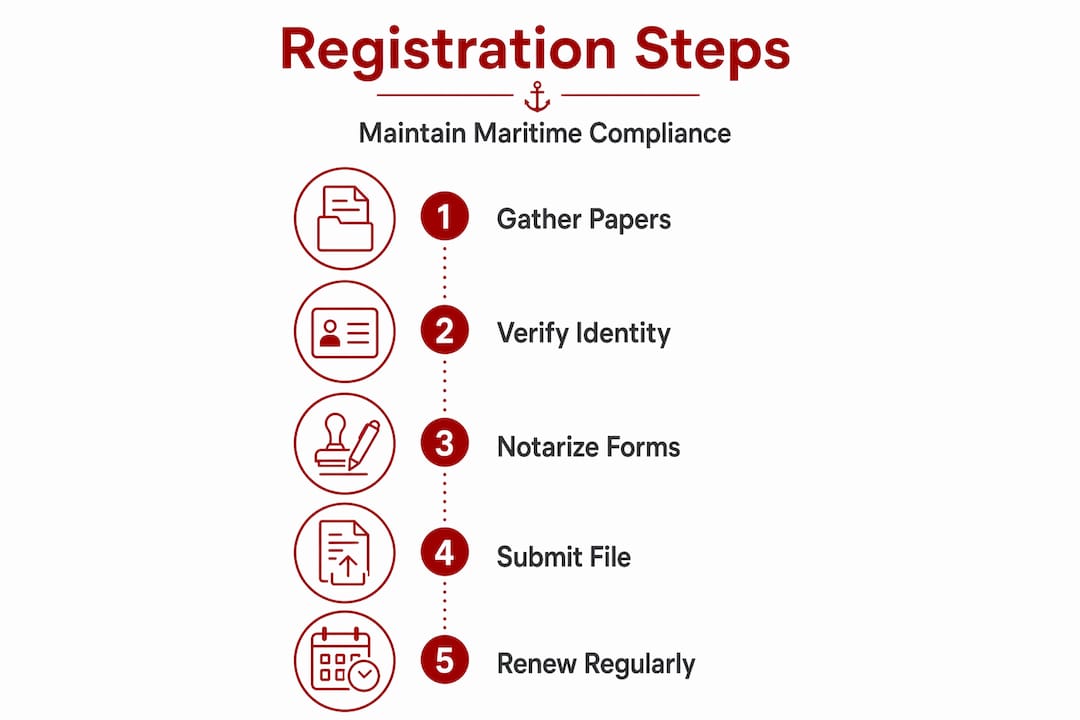
Effective document management means your files are always ready for an audit, a sale, a financing request, or a flag state inspection without scrambling. Here is how to build that system:
- Create a compliance master file. Organize every document by category: corporate formation papers, vessel-specific certificates, financial encumbrances, and crew-related records. Physical originals and certified copies go into separate clearly labeled folders.
- Maintain a hard-copy master set. Digital and physical systems coexist in today’s registration environments. Practitioners who keep verified originals on hand move through audits and transactions significantly faster than those who rely solely on digital scans.
- Schedule renewals proactively. Map every document’s expiration date into your compliance calendar the day you receive it. This includes your vessel registration checklist items, radio licenses, and any jurisdiction-specific annual filings.
- Leverage documents for financing and sales. When approaching lenders or buyers, a clean, organized document file signals professionalism and reduces due diligence time. It often directly affects the terms you get.
- Work with specialists for international filings. Different flag states have very different registration document requirements. Malta, San Marino, and Palau each operate under distinct rules for what needs apostilling, what corporate evidence is required, and how long processing takes. A global compliance guide specific to your chosen flag state is worth consulting before you submit anything.
- Audit your file annually. Even documents that don’t expire can become stale. Corporate officer changes, ownership restructuring, or address updates must flow through to every relevant filing immediately.
The benefits of registered documents compound over time. A vessel with a clean, uninterrupted registration history commands buyer confidence, cleaner title insurance, and smoother flag state inspections at every port.
What I’ve learned about treating registration as an asset
In my experience working with yacht owners and commercial vessel operators across dozens of jurisdictions, the single biggest mistake I see is treating registration documents as a cost center rather than a strategic asset. Owners spend heavily on the vessel itself and then treat the paperwork as an afterthought. That order of priority gets reversed painfully when something goes wrong.
I’ve seen a vessel detained in a Mediterranean port because the certificate of registry had lapsed by 11 days. The owner had no idea the renewal window had opened. The detention cost more in lost charter revenue and legal fees than five years of diligent compliance management would have cost in total.
What I find genuinely underestimated is how much the importance of registration documents has grown as maritime authorities coordinate more closely across borders. Flag state inspections, port state control checks, and financial institution due diligence now cross-reference records in ways that simply weren’t possible a decade ago. A gap that used to slip through unnoticed now triggers automated flags.
The emerging potential of blockchain for immutable document records is worth watching, too. Several flag states are piloting digital registry systems that create tamper-proof chains of title. But we are still years from widespread adoption, and in the meantime the hybrid reality of digital-plus-physical documentation demands discipline, not shortcuts.
My honest advice: treat your registration file the way a ship’s captain treats a passage plan. Check it before every voyage, update it when conditions change, and never assume it’s still accurate just because it was correct the last time you looked.
— VesselFlag
Get expert help with vessel registration
The role of registration documents is complex, and the stakes for getting it wrong are real. Vesselflag exists specifically to take that complexity off your plate.

Whether you are registering a yacht for the first time, switching flag states, or bringing a corporate-owned commercial vessel into compliance, Vesselflag’s team handles the full documentation process across jurisdictions including Malta, San Marino, Poland, UK Part 1, and more. Explore the complete yacht registration guide to understand exactly what your flag state requires, or use the global registration process guide to map out your timeline and document checklist before you submit a single form. Compliance doesn’t have to be stressful. It just has to be handled correctly.
الأسئلة الشائعة
What is the main role of registration documents for vessels?
Registration documents establish a vessel’s legal nationality, prove ownership, and authorize it to operate under a specific flag state’s jurisdiction. Without them, a vessel cannot legally access most commercial ports or secure marine financing.
What types of registration documents does a vessel owner typically need?
Most vessels require a certificate of registry, a bill of sale, proof of identity for the owner, and a radio license for MMSI operation. Corporate-owned vessels additionally need formation documents like Articles of Association and beneficial ownership declarations.
What happens if vessel registration documents are incomplete or expired?
Incomplete or expired documents can result in port detentions, application rejections, lapsed insurance coverage, and in some jurisdictions, direct financial penalties. Even a name mismatch between documents can delay registration by weeks.
How do you manage registration documents for ongoing compliance?
Maintain a physical master file of all originals, schedule renewals at least 60 days before expiration, and audit the full file annually to catch any corporate or ownership changes that need to flow through to registered records.
Do digital copies replace physical registration documents?
Not entirely. Many registration systems still require notarized physical originals for key filings. Practitioners who keep a verified hard-copy master set alongside digital records process audits and transactions faster than those relying on digital files alone.