

Preparing your paperwork? Use our full yacht registration documents checklist – Vessel Flag prepares all documents for you.
Securing the right yacht registration documents is not just a formality for today’s international yacht owners and brokers, but a critical step in protecting your vessel’s legal status and operational freedom across borders. Every certificate and proof of ownership forms the backbone of compliance with international maritime regulations, ensuring your yacht’s nationality, flag state protection, and seamless access to global waters. This guide explains how the proper documents anchor legitimacy, liability coverage, and smooth transfer under any jurisdiction you choose.
جدول المحتويات
- Defining Yacht Registration Documents And Core Purpose
- Essential Certificates And Proof Of Ownership
- Flag State Documents And Variations Explained
- Legal And Compliance Requirements Worldwide
- Financial Risks And Common Registration Mistakes
الوجبات الرئيسية
| نقطة | التفاصيل |
|---|---|
| Importance of Registration | Yacht registration documents ensure legal ownership and operational rights under international maritime law. |
| Ownership Proof | Essential documents like the Certificate of Ownership and Bill of Sale validate your legal claim to the vessel. |
| Compliance Necessity | Valid registration and certificates are critical for legal operation and to avoid fines or detention. |
| Avoiding Registration Mistakes | Maintaining accurate and updated ownership records prevents legal risks and ensures seamless maritime operations. |
Defining Yacht Registration Documents and Core Purpose
Yacht registration documents serve as the legal foundation for vessel ownership and operation on international waters. These documents establish your yacht’s nationality, grant it the right to operate under a specific flag state’s jurisdiction, and create the legal framework that protects your vessel and enforces maritime regulations.
At their core, registration documents accomplish several critical functions:
- Establish legal nationality by linking your vessel to a flag state
- Grant operational authority to navigate international waters under that state’s laws
- Enable maritime safety and security compliance across all jurisdictions
- Create liability and insurance frameworks that protect all parties involved
- Facilitate international commerce by providing proof of ownership and legitimacy
The purpose of these documents goes beyond simple record-keeping. Registration of ships establishes nationality and allows your vessel to operate under particular state laws, linking it to your chosen flag state and granting essential legal protection. Without proper registration, your yacht cannot legally engage in commercial operations, obtain insurance, or receive flag state protection.
Why Registration Documents Matter
Think of registration documents as your yacht’s passport and birth certificate combined. They prove ownership, establish where your vessel “belongs” legally, and determine which rules apply to your operations.
International maritime law requires that every vessel flying a flag demonstrates a genuine link between ship and flag state to ensure effective jurisdiction and control. This genuine link prevents vessels from evading regulations by simply changing flags at will.
When you register your yacht, you’re accessing specific legal frameworks that provide:
- Navigation rights across international waters under your flag state’s protection
- Regulatory compliance aligned with your chosen jurisdiction’s maritime standards
- Liability protections established by your flag state’s maritime law
- Insurance eligibility through recognized underwriting standards
- Commercial legitimacy for charter, sale, or business operations
Different flag states offer varying approaches to registration. Some maintain open registries accepting vessel ownership from any nationality, while others operate closed registries restricting ownership to nationals of that state.
Proper registration documents transform your yacht from an unrecognized vessel into a legally protected maritime asset with clearly defined rights, obligations, and protections under international law.
Your registration documents create accountability. They link your vessel to documented owners, responsible management, and verifiable contact information. This accountability ensures that your yacht cannot become a tool for piracy, smuggling, or environmental violations.
نصيحة للمحترفين: Before selecting a flag state, verify that your chosen registry’s registration documents meet the specific insurance and financing requirements of your lenders or charter operators.
Essential Certificates and Proof of Ownership
Yacht registration requires concrete proof that you own the vessel. This proof takes the form of specific certificates and documents that validate your legal ownership and your yacht’s right to operate internationally.
The foundation of ownership proof centers on several key documents:
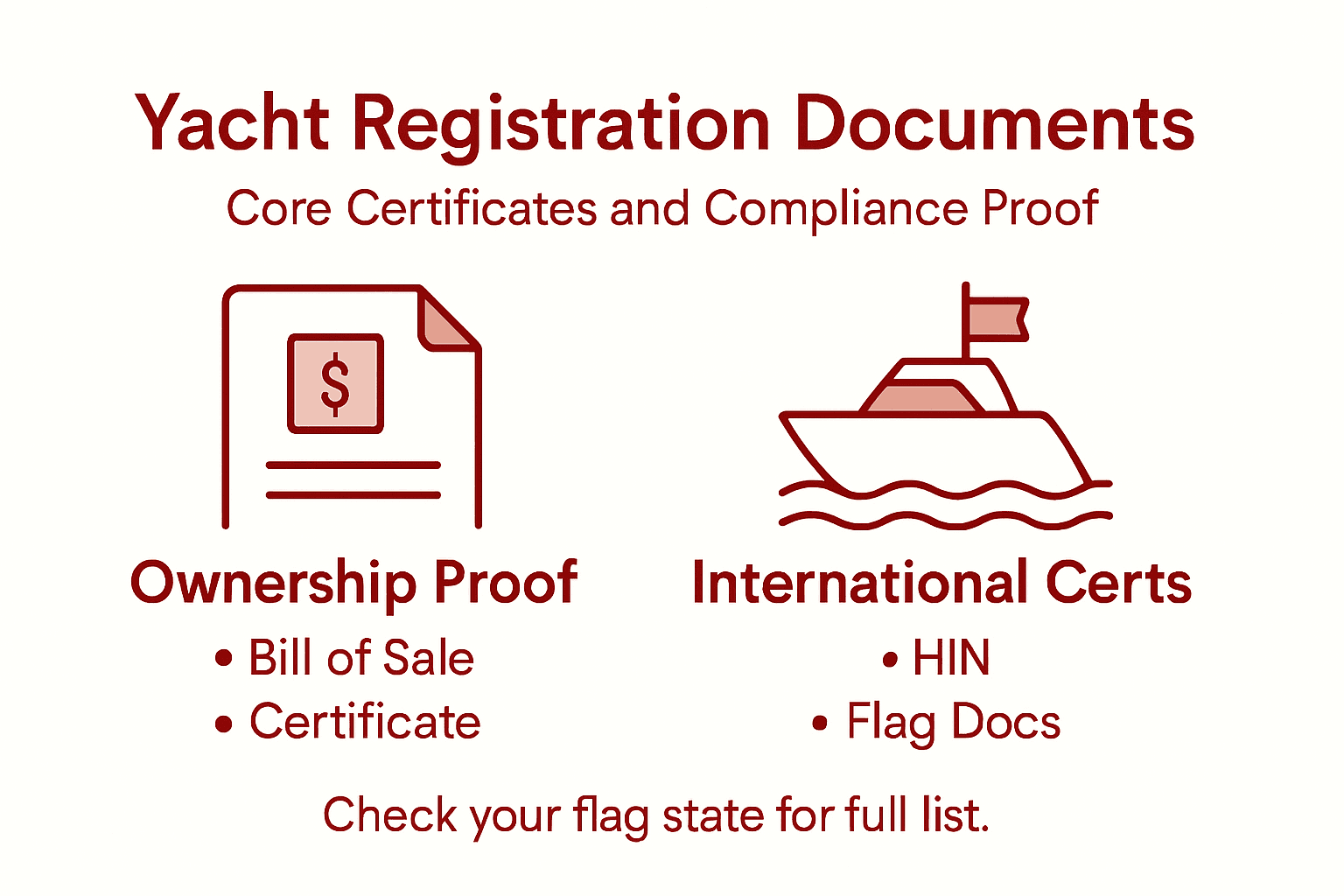
- Certificate of Ownership – Establishes your legal claim to the vessel
- رقم تعريف بدن السفينة (HIN) – Uniquely identifies your yacht like a fingerprint
- Bill of Sale – Documents the transfer of ownership from seller to buyer
- Manufacturer’s Statement of Origin – Provides the vessel’s original ownership trail
- Transfer Documents – Proves the chain of ownership if the yacht changed hands previously
These documents work together to create an unbreakable record of who legally owns the yacht. Vessel registration requires proof of ownership such as manufacturer statements, bills of sale, or signed transfer documents that establish legal recognition and safe operation.
Required International Certificates
Beyond ownership proof, your yacht must carry essential certificates and documents onboard.pdf) that validate compliance with maritime regulations worldwide. These certificates prove your vessel meets international safety and operational standards.
Common certificates your yacht must maintain include:
- Registration Certificate – Your flag state’s official recognition of ownership
- Certificate of Seaworthiness – Confirms the vessel meets safety standards
- International Safety Management Certificate – Documents operational procedures
- Pollution Prevention Certificate – Proves environmental compliance capability
- Crew Certification Documents – Validates that crew members meet qualification standards
Each certificate serves a specific enforcement purpose. Your registration certificate is the primary proof of nationality and ownership, while safety certificates demonstrate compliance with maritime conventions.
Without valid certificates and ownership documentation, your yacht cannot legally operate internationally, obtain insurance coverage, or be legally bought or sold.
إن Hull Identification Number deserves special attention. This unique identifier appears on your yacht’s hull and appears on all ownership and registration documents, preventing fraud and ensuring consistent identification across all authorities.
Your ownership documents must match precisely across all records. Discrepancies in vessel names, HIN numbers, or registered owner information can delay registration approval and create complications during international operations.
نصيحة للمحترفين: Maintain certified copies of all ownership and registration documents in a secure location separate from originals, and keep digital backups accessible to your legal representatives.
Flag State Documents and Variations Explained
Your choice of flag state determines which documents you’ll need and what those documents will require. Different countries maintain vastly different registration systems, and understanding these variations is crucial for efficient compliance.

A flag state is the country where a ship is registered and whose laws it follows. Flag state documents vary significantly based on whether the registry operates as open or closed. This distinction shapes everything from required paperwork to ownership restrictions.
The two main registry types serve different purposes:
- Open Registries – Allow foreign ownership with minimal restrictions, attracting vessels through streamlined processes
- Closed Registries – Restrict registration to vessels with stronger ties to that state, often requiring national ownership or management
Understanding Open vs. Closed Registries
Open registries like Panama, Liberia, and Malta dominate international yacht registration because they offer speed and flexibility. Your documents for an open registry typically require less proof of connection to that state and focus primarily on vessel compliance and safety standards.
Closed registries such as the United Kingdom, Germany, and Norway demand more extensive documentation proving your connection to their jurisdiction. This might include proof of national ownership, local management requirements, or employment of nationals in crew positions.
Here’s a comparison of key differences between open and closed yacht registries:
| Registry Type | Ownership Restrictions | Processing Speed | Common Users |
|---|---|---|---|
| Open Registry | Allows foreign ownership | Fast (days) | Charter or commercial yachts |
| Closed Registry | Requires national ownership | Slower (weeks) | Private or nationally owned yachts |
Flag state documents always include:
- Certificate of Registry – Official proof your vessel flies that state’s flag
- Ownership Documentation – Establishing who legally owns the vessel
- Management Records – Showing responsible parties and operational oversight
- Compliance Certificates – Proving adherence to maritime safety standards
- Crewing Documentation – When the flag state requires specific crew qualifications
The United Nations Convention emphasizes flag state responsibilities in authorizing vessel operation and ensuring management accountability. Each flag state interprets these international standards differently, creating variations in their document requirements.
Your flag state’s specific documents depend on their national maritime laws, ownership policies, and crewing requirements—not all flag states demand identical paperwork.
Some flag states impose minimal crewing requirements while others demand that percentages of your crew hold certifications from their country. Some require local managing agents while others allow entirely remote management.
Processing timelines vary dramatically too. Open registries often issue registration documents within days, while closed registries may require weeks for background verification and documentation review.
نصيحة للمحترفين: Before committing to a flag state, obtain their specific document checklist directly from their maritime authority to avoid delays caused by missing or incorrectly formatted submissions.
Legal and Compliance Requirements Worldwide
Compliance isn’t optional—it’s the foundation of legal yacht operation globally. Your registration documents must satisfy multiple legal frameworks simultaneously, from international maritime conventions to individual flag state requirements.
International maritime law sets a global legal framework for ship registration and compliance through UNCLOS and IMO conventions. Flag states must exercise jurisdiction and control over registered vessels, ensuring adherence to safety, environmental, and operational regulations worldwide.
Your yacht must comply with three overlapping legal layers:
- International Conventions – SOLAS, MARPOL, and Load Line standards apply universally
- Flag State Laws – Your chosen registry’s specific requirements and enforcement standards
- Port State Controls – Inspections and compliance checks in every port you visit
Core Compliance Standards
Most yachts fall under maritime safety regulations designed for larger commercial vessels. The Red Ensign Group Yacht Code prescribes safety standards applicable to yachts internationally, harmonizing compliance with SOLAS and Load Line regulations while recognizing variations based on yacht size and use.
Your registration documents must demonstrate compliance with:
- Safety Standards – Hull construction, stability, lifesaving equipment requirements
- Pollution Prevention – MARPOL regulations on fuel, waste, and ballast water management
- Environmental Protection – Emissions controls and marine pollution prevention systems
- Documentation Standards – Crew certifications, vessel records, and operational logs
- Insurance Requirements – Third-party liability and crew coverage verification
Port state control officers will board your yacht and verify that your registration documents match reality. They check that your certificates aren’t expired, your crew holds required certifications, and your vessel meets safety standards.
Non-compliance discovered during port state inspections can result in detentions, fines, or forced repairs that delay operations and damage your vessel’s record.
Different jurisdictions interpret compliance differently. What satisfies Malta’s requirements might not satisfy the United Kingdom’s. Your documents must specifically address your chosen flag state’s interpretation of international standards.
Compliance isn’t static either. Maritime regulations evolve constantly. Your registration documents must remain current as new conventions take effect and existing standards are updated.
نصيحة للمحترفين: Subscribe to your flag state’s maritime authority bulletins or work with a registration service that tracks regulatory changes, ensuring your yacht’s documentation stays compliant with evolving international standards.
Financial Risks and Common Registration Mistakes
One mistake during yacht registration can cost you thousands in fines, loss of insurance coverage, or even the inability to legally operate your vessel. Understanding these pitfalls protects your investment and keeps your operations compliant.
Improper yacht registration exposes owners to legal and financial risks including liability for accidents, loss of vessel protection under international law, and penalties for non-compliance. Fraudulent registrations may also lead to increased scrutiny and financial loss.
The most common and costly mistakes include:
- Outdated ownership documentation – Failing to update records after vessel sale or transfer
- Expired certificates – Operating with lapsed safety or compliance certifications
- Incomplete paperwork – Missing required documentation during initial registration
- Incorrect vessel information – Hull number, dimensions, or name discrepancies
- Neglected flag state requirements – Not meeting your chosen registry’s specific obligations
High-Impact Financial Consequences
Common registration mistakes include failure to maintain valid registration and improper documentation, leading to fines, loss of insurance coverage, and inability to legally operate or sell the vessel. These aren’t minor administrative issues—they threaten your entire operation.
When your registration lapses, several immediate problems occur:
- Insurance voids automatically – Your coverage terminates, exposing you to catastrophic liability
- Port access gets denied – Authorities may prevent departure or boarding
- Financing complications arise – Lenders lose security interest in your vessel
- Sale becomes impossible – Buyers can’t register transfers without valid documentation
- Commercial penalties apply – Operating without registration triggers escalating fines
Documentation errors compound quickly. A typo in your hull identification number might seem minor until a port state inspector flags it as a discrepancy, potentially leading to vessel detention.
One overlooked registration requirement can cascade into operational shutdown, financial penalties, and years of bureaucratic remediation.
Changes in ownership or flag state without updating records create legal nightmares. If you sell your yacht but don’t transfer ownership documents properly, you remain legally responsible for the vessel’s actions and debts.
This table summarizes major financial risks linked to faulty yacht registration:
| Mistake Type | Immediate Consequence | Long-Term Impact |
|---|---|---|
| Expired registration | Insurance canceled | Fines, port restrictions |
| Incorrect documentation | Vessel detention | Legal disputes, costly corrections |
| Unreported ownership change | Owner still liable for vessel | Personal liability for accidents |
Understanding boat registration cost factors helps you budget appropriately and recognize when expenses indicate quality service rather than hidden fees.
Many owners attempt to save money by handling registration themselves, then discover they’ve missed critical details that require expensive corrections. This false economy costs far more than professional assistance would have.
نصيحة للمحترفين: Document every change to your yacht’s ownership, management, or operational status immediately, and maintain a timeline of all registration updates to prevent discrepancies that port state inspections could flag.
Secure Your Yacht’s Legal Standing with Expert Registration Support
Navigating the complex world of yacht registration documents and ensuring full legal compliance can be overwhelming. This article highlights key challenges such as maintaining up-to-date certificates, proving ownership with flawless documentation, and meeting diverse flag state requirements. Owners face the risk of financial penalties, insurance voids, and operational interruptions when registration errors occur. Don’t let registration mistakes put your valuable asset at risk.
Flag Registration – Vessel Flag offers a streamlined approach to yacht registration that takes the stress out of this critical process.
Take control of your vessel’s legal compliance today by partnering with موقع VesselFlag.com. With deep expertise in international maritime law, fast processing across multiple jurisdictions, and comprehensive services including MMSI setup and insurance, we ensure your yacht’s registration documents meet all regulatory standards. Visit https://vesselflag.com now to secure your yacht’s future and avoid costly delays or penalties.
الأسئلة الشائعة
What are yacht registration documents?
Yacht registration documents are legal papers that establish ownership and operational rights for your vessel under a specific flag state’s jurisdiction. They are essential for navigating international waters legally.
Why is it important to have proper registration documents for a yacht?
Proper registration documents provide legal protection, establish the yacht’s nationality, ensure compliance with maritime regulations, and enable insurance coverage and commercial operations.
What essential certificates do I need for yacht registration?
Key certificates required for yacht registration include the Certificate of Ownership, Bill of Sale, Hull Identification Number (HIN), Manufacturer’s Statement of Origin, and various compliance certificates related to safety and operational standards.
How do open and closed yacht registries differ in terms of documentation requirements?
Open registries typically have fewer ownership restrictions and faster processing times, requiring basic compliance documents, while closed registries demand more extensive proof of national ties and thorough documentation, resulting in longer processing times.
موصى به
- تكلفة تسجيل القارب: العوامل الرئيسية للمالكين
- Top Challenges in Yacht Registration and Compliance: Navigate Global Regulations with Confidence – Vessel Flag
- How to Register a Yacht: Complete Guide for Owners
- أهم التحديات في مجال تسجيل اليخوت والامتثال للوائح — وكيفية التغلب عليها بثقة – Vessel Flag
- Contractor Compliance – Ensuring Safety and Legal Integrity

[…] Key Yacht Registration Documents: Ensuring Legal Compliance […]